Melanotan 1 vs Melanotan 2: Safety, Side Effects, and What the Community Actually Uses (2026)
If you only care which is safer, Melanotan 1 has the narrower, cleaner side-effect profile, because it acts mainly on one receptor (MC1R) and skips the libido, appetite, and priapism effects that come with Melanotan 2. But "safer of two unapproved tanning shortcuts" is a low bar: Melanotan 2 is what most people actually use because it is stronger and cheaper, and the honest answer for a purely cosmetic tan is that neither is a good idea. This page settles the comparison the way it actually matters for a search like this, by side effect and risk first, then by what our community does once they have tried one or both.
Most "Melanotan 1 vs Melanotan 2" pages lead with which gives a deeper tan. We lead with the risk profile, because that is the real decision, then add the signal no competitor has: among ProtocolPlus users who logged these two, which direction people switch and why. Both also feature in our wider guide to the best peptides for skin and anti-aging. For the full pharmacology and the complete adverse-effect list, we link up to each compound's own guide so this page stays a focused decision hub.
Head-to-head
Edge: Melanotan 2 — by a modest margin
Head-to-head safety-first comparison of Melanotan 1 (afamelanotide) and Melanotan 2 for skin pigmentation. Leads with the side-effect-profile angle: MT-2 is the more potent, broader melanocortin agonist (extra libido and appetite effects but documented priapism, nausea, blood-pressure and changing-mole risk), while MT-1 is MC1R-selective and the only one with an approved medicine (Scenesse, EPP only, not cosmetic tanning). The moat panel quotes illustrative ProtocolPlus community data: MT-2 dominates adoption (~75%) yet the net switch leans slightly toward MT-1 as users move away from MT-2's sexual and darkening side effects. The fit-score radar is the secondary editorial 'why' across six dimensions.
Overall fit score
By dimension
Side by side
| Melanotan 1 | Melanotan 2 | |
|---|---|---|
| Compound / brand | Melanotan 1 (afamelanotide; brand Scenesse) | Melanotan 2 (no approved brand) |
| Regulatory status | Afamelanotide approved as Scenesse for EPP only (FDA 2019, EMA 2014); not approved for cosmetic tanning | Unlicensed everywhere; FDA, EMA, MHRA and TGA warn against use |
| Receptor action | MC1R-selective (pigment pathway) | Broad melanocortin agonist (MC1R plus MC3R, MC4R, MC5R) |
| Primary effects | Tanning / photoprotection only | Tanning plus libido / spontaneous erections and appetite suppression |
| Key safety flag | Darkening of existing moles; mole surveillance still required | Priapism (medical emergency), nausea / flushing, blood-pressure effects, new or changing moles (melanoma-surveillance concern), case reports of rhabdomyolysis |
| Route | Subcutaneous implant (Scenesse, every ~2 months); grey-market vials injected | Subcutaneous injection (grey-market vials) |
| Community cost / dose | Not enough community pricing data | ~$1.62 per dose (vial ~$20-45, ~20 doses) |
| Community adoption (illustrative) | ~25% (272 of 1,104) | ~75% (832 of 1,104) |
Educational. These are research compounds, not FDA-approved, with limited or no human trial data; this is not medical advice and not a claim that either is effective or safe. Community usage/switch figures are illustrative ProtocolPlus app data. Verify everything with a clinician.
Key Takeaways
- Safer side-effect profile: Melanotan 1. It is MC1R-selective, so it darkens skin without Melanotan 2's libido, spontaneous-erection, and appetite-suppression effects. Melanotan 2 is a broad melanocortin agonist (MC1R plus MC3R, MC4R, MC5R), which is exactly why it does more and risks more.
- Most documented harms are reported with Melanotan 2: nausea and flushing, blood-pressure changes, priapism (a urological emergency), and case reports of rhabdomyolysis. Both compounds are linked to new and changing moles, which is the shared melanoma-surveillance worry.
- Neither is approved for tanning. Afamelanotide (Melanotan 1) is approved as Scenesse, but only for erythropoietic protoporphyria (FDA 2019, EMA 2014). Melanotan 2 is unlicensed everywhere, and the FDA, EMA, UK MHRA, and Australian TGA have all warned against it.
- What our community does: among ProtocolPlus users tracking these two, the split is roughly 75% Melanotan 2, 25% Melanotan 1 (Melanotan 2 wins on potency and price), yet the net switch leans slightly toward Melanotan 1, as people move off Melanotan 2 to escape its sexual and darkening side effects. A usage signal, not proof either is safe.
- The honest verdict: if the goal is purely a cosmetic tan, the safest choice is neither, use a topical self-tanner. If you are weighing the two anyway, Melanotan 1 is the lower-side-effect option, and dermatologist mole checks are mandatory either way.
Melanotan 1 vs Melanotan 2 at a glance
Here is the side-by-side before we go deep. Melanotan 2 is stronger and cheaper; Melanotan 1 is narrower and carries fewer documented systemic risks. Everything below this table explains the why, with the safety rows doing the heavy lifting.
| Dimension | Melanotan 1 | Melanotan 2 |
|---|---|---|
| Compound / brand | Afamelanotide (Scenesse) | No approved brand |
| Regulatory status | Approved as Scenesse for EPP only (FDA 2019) | Unlicensed; FDA, EMA, MHRA, TGA warn against it |
| Receptor action | MC1R-selective | Broad: MC1R + MC3R + MC4R + MC5R |
| Primary effects | Tanning / photoprotection only | Tanning plus libido, erections, appetite suppression |
| Key safety flag | Darkening of existing moles | Priapism, nausea / flushing, BP effects, changing moles, rhabdomyolysis (case reports) |
| Route | Subcutaneous implant (Scenesse); grey-market vials injected | Subcutaneous injection (grey-market vials) |
| Community cost / dose | Not enough data | ~$1.62 (vial ~$20-45) |
| Community adoption | ~25% | ~75% |
The two rows that decide this for most people are receptor action and key safety flag. Melanotan 2's extra effects are the whole reason it is popular and the whole reason it is riskier, the same fork shows up in every section below.
Which is safer, and how the side effects actually differ
The one-sentence answer: Melanotan 1 is the safer of the two because it is MC1R-selective and does not trigger the sexual and systemic effects that drive Melanotan 2's worst case reports. Both still darken moles, so neither removes the need for dermatologist skin checks. The difference is in everything beyond pigment.
Melanotan 2 hits multiple melanocortin receptors, so its effects spill well past tanning. The most common are nausea, facial flushing, and spontaneous yawning or stretching after a dose; the most serious documented in case reports are priapism (a prolonged, painful erection that can cause permanent damage and needs emergency care), rhabdomyolysis with kidney injury, and blood-pressure changes. Melanotan 1, acting mainly on MC1R, is generally limited to milder, pigment-linked effects, transient nausea and flushing, with the sexual effects largely absent. That is the cleaner profile, but "cleaner" is relative: it is still an injectable peptide that darkens moles.
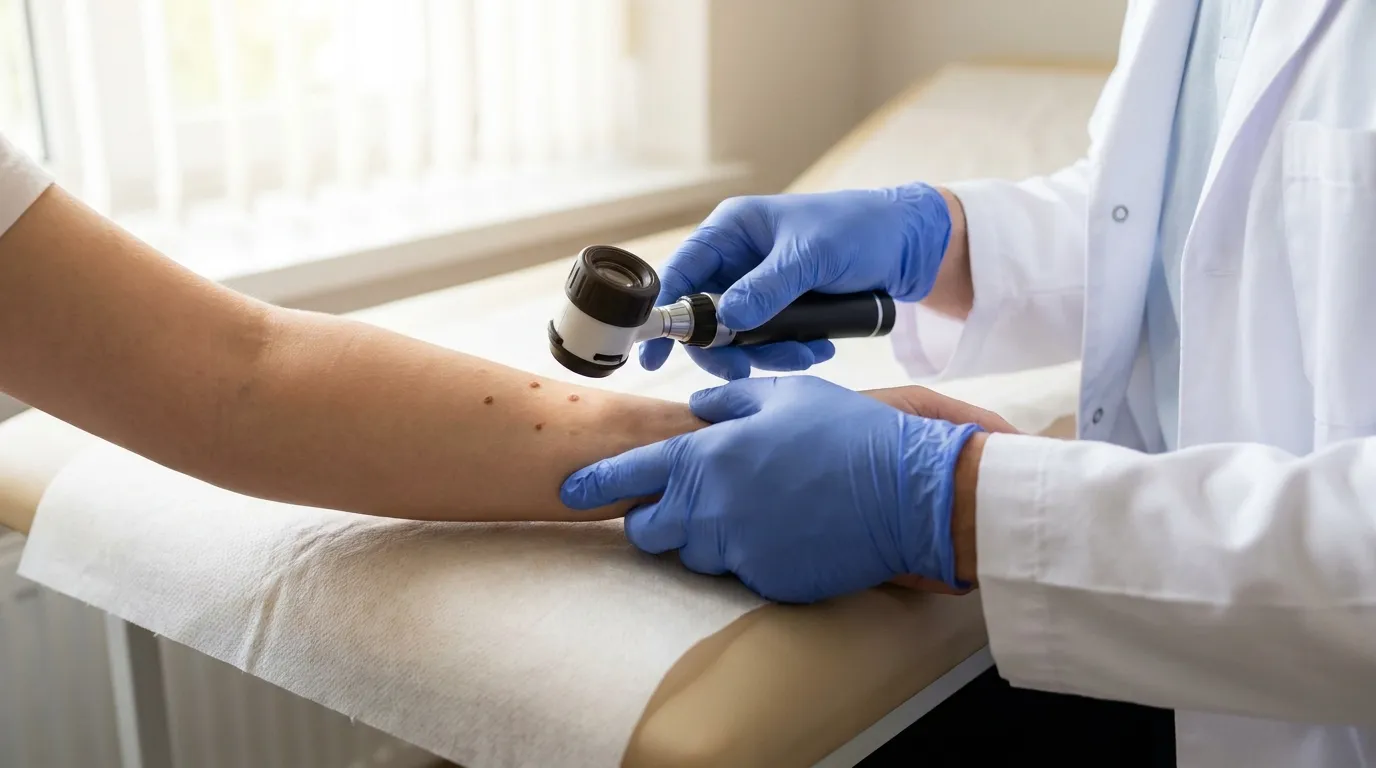
The shared red flag is moles. Published case reports describe new and rapidly changing nevi, and in several cases melanoma, in people using Melanotan 2, often alongside sunbeds or sun exposure. The mechanism plausibility (these peptides stimulate melanocytes) plus the case reports is enough that dermatologists treat any melanotan use as a reason for closer mole surveillance, not less. This is the single most important takeaway on the page, and it applies to both compounds.
It is worth being precise about what the mole evidence does and does not prove. These are case reports and small case series, not controlled trials, so they establish a plausible association and a clear warning, not a measured risk percentage. No one can tell you "X% of users develop melanoma," because the studies to produce that number do not exist for unlicensed melanotan use. What the literature does support is that pre-existing moles can darken, enlarge, or change in appearance, that new pigmented lesions can appear, and that distinguishing a benign change from an early melanoma by eye is exactly the judgment a dermatologist is trained for. The practical rule is the same for both compounds: photograph your moles before you start, get a baseline skin check, and have anything that changes looked at promptly rather than waiting.
A second point experienced users raise is that Melanotan 2's faster, more intense pigment response can itself make mole monitoring harder, because everything darkens at once and a genuinely changing lesion is easier to miss against a rapidly tanning background. That is a subtle argument in Melanotan 1's favor on the mole question specifically, separate from its broader side-effect advantage: a slower, more selective pigment effect is easier to watch. Neither compound makes mole surveillance optional.
For the complete tolerability breakdown and the full red-flag list, read melanotan 2 side effects. This page does not duplicate it.
When to seek urgent care. An erection lasting more than ~4 hours is priapism, a medical emergency, go to an emergency department immediately. Also seek prompt care for severe muscle pain with dark urine (possible rhabdomyolysis), chest pain, fainting, or a severe allergic reaction. And book a dermatologist if any mole changes in size, shape, color, or border, or a new one appears, this matters for both compounds.
What the ProtocolPlus community actually does between the two
This is the part no case series and no competitor page gives you: among users who logged both, which way do people move? The published literature tells you what can go wrong; it cannot tell you what real users decide once they have felt the side effects. That is the gap our first-party data fills. The short version has a twist: Melanotan 2 dominates by headcount, but the net switch traffic actually leans the other way, toward Melanotan 1, because people leave Melanotan 2 to get away from its sexual and darkening effects.
Three numbers carry the story, all from ProtocolPlus app data among the roughly 1,104 users tracking one of these two:
- Adoption split: ~75% Melanotan 2 (832 users), ~25% Melanotan 1 (272 users). Melanotan 2 is the clear majority, the usual reasons being stronger pigmentation at lower doses, lower price, and the bonus libido and appetite effects.
- Co-tracking: ~9% (about 99 users) log both. A smaller overlap than the GLP-1 pairs, consistent with people trying one, reacting to the side effects, and moving rather than running them in parallel.
- Net switch leans toward Melanotan 1. About 28% of Melanotan 1 users (roughly 76) later moved to or added Melanotan 2, while about 12% of Melanotan 2 users (roughly 100) moved to or added Melanotan 1. In raw users the reverse flow is slightly larger, a net of about 24 toward Melanotan 1, a ratio near 0.76. It is a small, noisy signal, but it points the opposite way from the adoption split.
That contradiction is the whole story of this matchup. Melanotan 2 wins the popularity contest on potency and price, but when individual users move, a meaningful share are moving away from it, and the reason in user reports is consistent: the sexual side effects (priapism risk, unwanted erections), the speed and intensity of mole darkening, and nausea. People reach for Melanotan 2 first because it works harder, then some retreat to Melanotan 1 because it bothers them less. Neither direction is an endorsement, it is what the community does, not what is safe.
The timing of the typical switch is informative too. The move from Melanotan 2 to Melanotan 1 is rarely a first-week reaction; it tends to follow a few cycles, once a user has felt the nausea on dosing days, dealt with an unwanted erection at an inconvenient time, or noticed a mole starting to change. The move in the other direction, Melanotan 1 to Melanotan 2, is usually about results: someone wants a deeper tan faster than the selective compound delivers and trades up to the stronger one, often without fully weighing the side-effect cost. Reading the two flows together, the population is sorting itself by tolerance for risk: people who prioritize a fast, deep tan drift toward Melanotan 2, and people who get unsettled by its broader effects drift back. Because the co-tracking overlap is small (about 9%), most users are not running both at once; they are picking one, reacting, and sometimes moving, which is why a noisy net signal like this is still worth reporting honestly.
How they work: MC1R selectivity vs broad melanocortin action
The one-sentence answer: both are analogs of the body's own alpha-MSH hormone, but Melanotan 1 is selective for the MC1R pigment receptor while Melanotan 2 also hits MC3R, MC4R, and MC5R, which is why Melanotan 2 does more than tan. The receptor map is the cleanest predictor of how the two differ in effects and risks.
MC1R is the switch on melanocytes that ramps up eumelanin, the pigment that darkens skin, independent of how much UV you get. Melanotan 1 (afamelanotide) is a linear peptide that targets MC1R fairly selectively, so its action stays close to pigmentation. Melanotan 2 is a smaller, cyclic peptide and a broader agonist: by activating MC3R and MC4R it influences sexual arousal and appetite, and through the wider melanocortin system it touches blood pressure and other autonomic functions. That extra reach is the entire difference. The libido effects that some users seek and the priapism that sends others to the emergency room come from the same MC4R activity that Melanotan 1 mostly leaves alone. For the full pharmacology of each, see the Melanotan 1 guide and the Melanotan 2 guide.
One practical consequence: because Melanotan 2 is more potent at the pigment receptor too, users report visible tanning at lower cumulative doses than Melanotan 1, which is part of why it dominates the community despite its worse profile. More potent and broader is the appeal and the hazard in one sentence.
Regulatory status: approved for one narrow disease, banned for tanning
The one-sentence answer: neither is a legitimate tanning product, but their legal footing is very different. Afamelanotide, the active ingredient in Melanotan 1, is an approved prescription medicine, Scenesse, but only for a rare light-sensitivity disease, while Melanotan 2 is unlicensed everywhere and regulators have issued direct warnings against it.
Scenesse (afamelanotide) was approved by the FDA in October 2019 and earlier by the EMA in 2014, in both cases for the prevention of phototoxicity in adults with erythropoietic protoporphyria (EPP), a rare inherited disorder in which sunlight causes severe pain. It is delivered as a subcutaneous implant placed by a trained clinician roughly every two months, nothing like the self-injected vials sold online. Crucially, it is not approved for cosmetic tanning, and several competitor pages get this wrong by implying Melanotan 1 is an approved tanning drug. It is not. The grey-market "Melanotan 1" sold for tanning is the same unapproved-use territory as Melanotan 2, just with a narrower side-effect profile.
Melanotan 2 has no approval anywhere. The U.S. FDA, the EMA, the UK's MHRA, and Australia's TGA have all issued explicit warnings against melanotan products, citing the lack of testing, the unregulated supply, and the documented adverse events. Buying either online means buying an unlicensed product of unknown purity, which is a risk layered on top of the pharmacology.
The editorial scorecard (the "why," not a recommendation)
The fit-score radar below rates each compound 1 to 5 on six dimensions. With equal weighting Melanotan 2 edges ahead overall (57 vs 50 in the engine's index), because it scores higher on raw effectiveness, speed, and cost. Melanotan 1 wins on evidence and on safety. Read this as a map of trade-offs, not a thumbs-up: a higher overall score here reflects potency and price, not that an unlicensed tanning peptide is a good idea. The safety and regulatory sections above, not this radar, carry the real weight.
Choose Melanotan 1 if... / Choose Melanotan 2 if...
The honest framing first: for a purely cosmetic tan, the safest answer is neither, a topical self-tanner gives color with none of this risk. If you are weighing the two anyway, these cards cover the usual reasoning.
Lean Melanotan 1 if:
- You want pigment only and want to avoid Melanotan 2's libido, erection, and appetite effects.
- You have erythropoietic protoporphyria and a specialist is treating you with Scenesse (the only approved use).
- You are unusually sensitive to nausea, flushing, or blood-pressure swings and want the narrower MC1R-selective profile.
- You value an FDA- and EMA-reviewed active ingredient over raw potency or low price.
Lean Melanotan 2 if:
- You accept that it is unlicensed and the higher-risk option, and you still want the faster, deeper tan at lower cost that makes it the community majority.
- You specifically want its appetite or libido effects (off-label, unstudied, and carrying priapism risk, weigh this carefully).
- You will commit to dermatologist mole surveillance and know the priapism emergency plan before you start.
Either way, the non-negotiables are the same: mole checks, a clinician in the loop, and a clear-eyed view that neither is an approved tanning product.
The honest verdict
If the question is strictly "which is safer," Melanotan 1 wins on the side-effect profile: MC1R selectivity spares it the sexual, appetite, and most systemic effects that fill Melanotan 2's case reports. If the question is "which do people use," Melanotan 2 wins on headcount, three to one, because it is stronger and cheaper. And in the twist our data captures, when individual users switch, a slightly larger raw flow goes the other way, back to Melanotan 1, to escape exactly the effects that make Melanotan 2 popular. None of that makes either one a sound cosmetic choice. The genuinely safe answer for a tan is a sunless self-tanner plus sun protection; if you are going to use one of these regardless, Melanotan 1 is the lower-side-effect option and dermatologist mole surveillance is mandatory with both.
To make it concrete, here is how the decision usually lands by situation:
- Lowest side-effect profile of the two: Melanotan 1 (MC1R-selective, no sexual or appetite effects).
- Most documented serious harms (priapism, rhabdomyolysis, BP effects): Melanotan 2, the reason people switch away.
- Have erythropoietic protoporphyria: afamelanotide as Scenesse, specialist-prescribed only, not a DIY option.
- Want a cosmetic tan with the least risk: neither, use a topical self-tanner.
- Already using either: book regular dermatologist mole checks and learn the priapism emergency plan.
For the deeper science and full safety lists, see the Melanotan 1 guide, the Melanotan 2 guide, and Melanotan 2 side effects.
Frequently Asked Questions
Sources
- U.S. Food & Drug Administration. "SCENESSE (afamelanotide) implant, for subcutaneous use - Prescribing Information" and FDA approval (Oct 8, 2019) for erythropoietic protoporphyria. Retrieved 2026-06-18. https://www.accessdata.fda.gov/drugsatfda_docs/label/2019/210797s000lbl.pdf
- European Medicines Agency. "Scenesse (afamelanotide)" marketing authorisation (2014), prevention of phototoxicity in adults with erythropoietic protoporphyria. Retrieved 2026-06-18. https://www.ema.europa.eu/en/medicines/human/EPAR/scenesse
- Hjuler KF, Lorentzen HF. "Melanoma Associated with the Use of Melanotan-II." Dermatology, 2014. Retrieved 2026-06-18. https://pubmed.ncbi.nlm.nih.gov/24356145/
- Cousen P, Colver G, Helbling I. "Eruptive melanocytic naevi following melanotan injection." British Journal of Dermatology, 2009. Retrieved 2026-06-18. https://pubmed.ncbi.nlm.nih.gov/19663876/
- Nelson ME, Bryant SM, Aks SE. "Melanotan II injection resulting in systemic toxicity and rhabdomyolysis." Clinical Toxicology, 2012. Retrieved 2026-06-18. https://pubmed.ncbi.nlm.nih.gov/22455355/
- Case report: "Melanotan Tanning Injection: A Rare Cause of Priapism." 2021. Acute ischemic priapism after subcutaneous melanotan II. Retrieved 2026-06-18. https://pubmed.ncbi.nlm.nih.gov/33532966/
- U.S. National Library of Medicine, LiverTox. "Afamelanotide" (mechanism, MC1R agonist, EPP indication). Retrieved 2026-06-18. https://www.ncbi.nlm.nih.gov/books/NBK602608/
- UK Medicines and Healthcare products Regulatory Agency (MHRA). Warnings against unlicensed melanotan ("Melanotan I and II") tanning products. Retrieved 2026-06-18. https://www.gov.uk/government/news/dont-use-melanotan-products
- ProtocolPlus. "Community head-to-head data: Melanotan 1 vs Melanotan 2" (head-to-head/melanotan-1__melanotan-2.json). First-party app data, 2026. n ~ 1,104 users tracking one of the two. Usage and switching signal, not a clinical safety or efficacy verdict.