MOTS-c vs 5-Amino-1MQ: Injectable Mitochondrial Peptide vs Oral NNMT Inhibitor (2026)
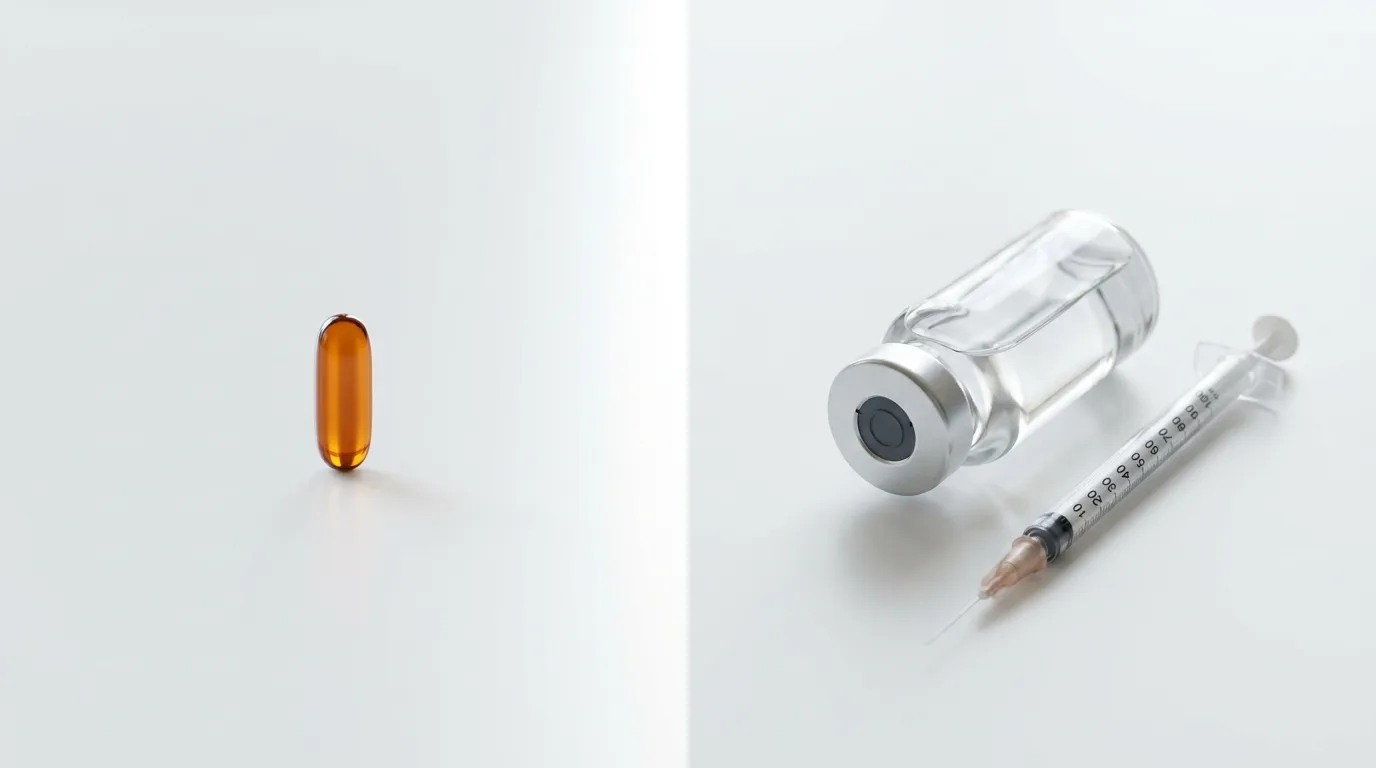
These two get compared because both are sold as "metabolic, energy, and fat-loss" research compounds, but they are barely in the same conversation as molecules: MOTS-c is an injectable mitochondrial-derived peptide that switches on AMPK to mimic exercise, while 5-Amino-1MQ is an oral small-molecule that blocks the NNMT enzyme. The single most important difference is not which is "stronger" but the evidence floor: MOTS-c has a decade of animal work plus early mechanistic human interest, whereas 5-Amino-1MQ rests on essentially mouse data with no human efficacy. So the honest one-line answer is that MOTS-c is the more established pick and 5-Amino-1MQ is the easier-to-take gamble.
Most "MOTS-c vs 5-Amino-1MQ" pages stop at a mechanism blurb and a vendor link. We add three things no competitor has: a clear side-by-side of route and mechanism, an honest evidence-tier map that says out loud where the human data ends, and first-party ProtocolPlus data on which one our community actually uses and switches toward. Both also feature in our roundup of the best peptides for longevity. For the full science on either molecule, we link up to its dedicated guide so this page stays a clean decision hub.
Head-to-head
Edge: MOTS-c — by a clear margin
Two metabolic research compounds with very different molecules, routes, and evidence floors: MOTS-c is an injectable mitochondrial-derived peptide that activates AMPK (exercise-mimetic, animal and early mechanistic human-interest data), while 5-Amino-1MQ is an oral small-molecule NNMT inhibitor with essentially mouse data only and no human efficacy. Among ProtocolPlus users tracking both, MOTS-c is the larger camp (~65%) and the net switch drifts toward it. The fit-score radar is the secondary editorial 'why': MOTS-c leads on evidence, effectiveness, safety, and speed; the two tie on accessibility and cost.
Overall fit score
By dimension
Side by side
| 5-Amino-1MQ | MOTS-c | |
|---|---|---|
| Molecule type | Small molecule (NNMT enzyme inhibitor) | Mitochondrial-derived peptide (16 amino acids) |
| Route | Oral (capsule) | Subcutaneous injection |
| Primary mechanism | Inhibits NNMT, sparing NAD+ and curbing fat storage | Activates AMPK, the cellular energy sensor (exercise-mimetic) |
| Evidence floor | Mouse data only (diet-induced obesity); no human efficacy | Animal + early mechanistic human-interest data; no human efficacy trial |
| Key cited research | Neelakantan et al. 2018 (mouse weight loss via NNMT inhibition) | Lee et al. 2015, Cell Metab (AMPK, metabolic homeostasis) |
| FDA status | Research compound, not FDA-approved | Research compound, not FDA-approved |
| Community adoption (illustrative) | ~35% of the pair (288 users) | ~65% of the pair (544 users) |
| Community cost / dose (illustrative) | Not reported in our data | ~$14 per dose ($45-$95 per vial) |
Educational. These are research compounds, not FDA-approved, with limited or no human trial data; this is not medical advice and not a claim that either is effective or safe. Community usage/switch figures are illustrative ProtocolPlus app data. Verify everything with a clinician.
Key Takeaways
- The molecules are nothing alike. MOTS-c is a 16-amino-acid mitochondrial-derived peptide given by subcutaneous injection; 5-Amino-1MQ is an oral small-molecule NNMT inhibitor. Same marketing bucket, very different biology and route.
- Different mechanisms. MOTS-c activates AMPK, the cell's energy sensor, mimicking some effects of exercise (Lee et al., Cell Metabolism, 2015). 5-Amino-1MQ inhibits NNMT, which spares NAD+ and curbs fat storage in mice (Neelakantan et al., 2018).
- The evidence floor is the real story. Neither has a completed human efficacy trial. MOTS-c has animal plus early mechanistic human-interest data; 5-Amino-1MQ has essentially diet-induced-obesity mouse data only. Community use is what people do, not proof either works.
- What our community does: among ProtocolPlus users tracking these two, the split is roughly 65% MOTS-c, 35% 5-Amino-1MQ, and the net switch drifts toward MOTS-c (about 20% of 5-Amino-1MQ users later moved to or added MOTS-c, vs about 10% the other way). A usage signal, not proof one is better for you.
- Both are research-only, not FDA-approved. Nothing here is a dose recommendation. Cited doses describe what was used or studied, not what you should take.
MOTS-c vs 5-Amino-1MQ at a glance
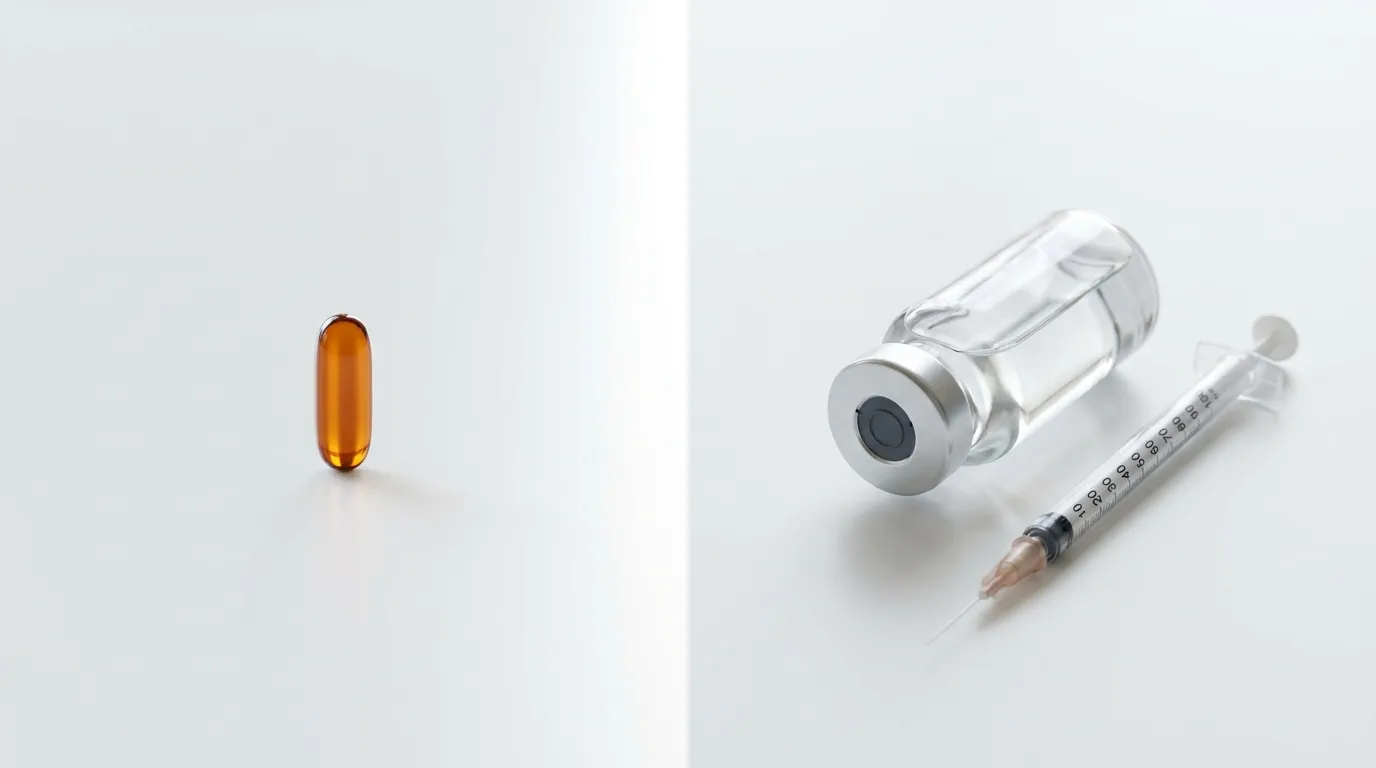
Here is the side-by-side before we go deep. The two genuinely diverge on every structural line: molecule type, route, mechanism, and how much evidence stands behind each claim. Everything below this table explains the why.
| Dimension | 5-Amino-1MQ | MOTS-c |
|---|---|---|
| Molecule type | Small molecule (NNMT inhibitor) | Mitochondrial-derived peptide (16 amino acids) |
| Route | Oral (capsule) | Subcutaneous injection |
| Primary mechanism | Inhibits NNMT, spares NAD+, curbs fat storage | Activates AMPK (exercise-mimetic), aids insulin sensitivity |
| Evidence floor | Mouse data only; no human efficacy | Animal + early mechanistic human interest; no human efficacy trial |
| Key cited research | Neelakantan et al., 2018 (mouse) | Lee et al., 2015, Cell Metabolism |
| FDA status | Research compound, not approved | Research compound, not approved |
| Community adoption | ~35% (288 users) | ~65% (544 users) |
| Community cost / dose | Not reported in our data | ~$14 per dose |
The table is the headline. The two places the decision genuinely turns are route (pill vs needle) and evidence floor (mouse-only vs animal-plus-mechanistic), so most of the real choice comes down to which of those you weight more.
The part that actually matters: mechanism, route, and the evidence floor
The one-sentence answer: these compounds reach "better metabolism" by completely different roads, and one of those roads has been mapped much further than the other. Reading the mechanism is the only way to understand why the community leans the way it does.

MOTS-c is encoded inside mitochondrial DNA and acts like a stress signal that activates AMPK, the master sensor cells use to switch from storing energy to burning it. In animal work it improved insulin sensitivity, boosted fat oxidation, and increased exercise capacity, which is why it gets called an "exercise mimetic" (Lee et al., Cell Metabolism, 2015). 5-Amino-1MQ comes at the same goal from the opposite direction: it blocks NNMT, an enzyme that, when overactive in fat tissue, drains NAD+ and promotes fat storage. Inhibit NNMT and, in mice, you spare NAD+ and reduce fat mass (Neelakantan et al., 2018).
That mechanism split maps cleanly onto the evidence floor, and this is where honesty matters more than hype. MOTS-c has a decade of peer-reviewed animal data plus genuine mechanistic human interest (it is a naturally occurring human peptide, and its biology has been studied in human cells and cohorts). 5-Amino-1MQ has essentially one strand of preclinical rodent data and no human efficacy trial at all. Neither has proven it makes a person leaner or healthier in a controlled study. The difference is in how much surrounding science exists: one is early but reasonably mapped, the other is a single promising mouse result that has not been carried forward in humans.
The route difference is the other half of the practical decision, and it is bigger than it looks. 5-Amino-1MQ is an oral capsule, which is exactly why people reach for it: no needles, no cold chain, no reconstitution. MOTS-c is a subcutaneous injection that needs refrigeration and a little technique. For some people that friction is decisive in 5-Amino-1MQ's favor; for others, the injectable peptide's deeper track record outweighs the convenience of a pill. There is no universal winner here, only a trade-off you weight yourself. For the full pharmacology of each, see the MOTS-c guide and the 5-Amino-1MQ guide.
Insulin sensitivity, NAD+, and where the two overlap
It is worth pulling apart the one place these compounds seem to converge, because the marketing blurs it. Both get sold as "metabolic" partly because both touch how cells handle energy currency, but they touch it from different ends. MOTS-c works on the demand side: by activating AMPK it pushes cells toward burning fuel and improving insulin sensitivity, and in the original animal work it measurably reduced insulin resistance in high-fat-diet mice (Lee et al., Cell Metabolism, 2015). 5-Amino-1MQ works on the supply side of NAD+: NNMT consumes methyl groups and, when overactive, is associated with insulin resistance in human adipose tissue (Kannt et al., Diabetologia, 2015), so inhibiting it is meant to preserve NAD+ and ease metabolic load. The shared theme is "better cellular energy handling," but one is an exercise-style signal and the other is an enzyme brake.
That overlap is exactly why people ask whether the two are redundant or complementary, and the honest answer is that nobody knows in humans. The mechanisms are not the same pathway, so on paper they are not obviously redundant, but there is no human study of either alone, let alone together, that would tell you whether stacking them adds anything. Treat any "they synergize" claim as a hypothesis built on two separate mouse stories, not a finding. If your single goal is insulin sensitivity specifically, MOTS-c has the more direct animal evidence for that endpoint; if your interest is NAD+ preservation as a longevity angle, that is the lane 5-Amino-1MQ is marketed into, again on rodent and association data only.
Why MOTS-c is called the "more established" pick
"More established" is a phrase that needs unpacking, because it does not mean "approved" or "proven." MOTS-c earns the label for three concrete reasons. First, it is a naturally occurring human peptide encoded in mitochondrial DNA, so its biology has been studied as part of normal human physiology, not only as a designer compound. Second, its literature spans multiple independent labs and endpoints, from metabolic homeostasis to exercise capacity and age-related decline (Reynolds et al., Nature Communications, 2021), which is a broader base than a single obesity result. Third, it has a longer continuous research history, roughly a decade, giving reviewers more to scrutinize. None of that makes it effective in you. It simply means that when something goes wrong or right, there is more published context to interpret it against, which is also why our community treats it as the safer default of the two.
What does the ProtocolPlus community actually do between the two?
This is the part no preclinical paper and no competitor page can give you: among users who log these compounds, which one do people land on, and which way do they move? Mouse data tells you what might happen in a cell; it cannot tell you what real people pick once they weigh route, cost, and the thinness of the evidence. That is the gap our first-party data fills. The short version is that MOTS-c is the larger and more "default" camp, and the small net drift runs toward it, but a meaningful minority go the other way for the simplicity of an oral option.
Three numbers carry the story, all from ProtocolPlus app data among the 832 users tracking one of these two:
- Adoption split: ~65% MOTS-c (544 users), ~35% 5-Amino-1MQ (288 users). MOTS-c is the clear larger camp, but 5-Amino-1MQ holds a solid third, which is notable for a compound with so much weaker data, the oral route is doing real work.
- Co-tracking: ~12% (about 100 users) log both. These are people comparing, layering, or testing one against the other rather than committing to a single tool.
- Net switch drifts toward MOTS-c. About 20% of 5-Amino-1MQ users (roughly 58) later moved to or added MOTS-c, versus about 10% of MOTS-c users (roughly 54) who moved the other way. The net flow is small, only about 4 users, a ratio near 1.07 to 1, so call it a gentle lean, not a stampede.
Adoption: who the community is on
Which way people switch (and why it is close)
The reverse flow is almost as large as the forward one, and that tells you who 5-Amino-1MQ is still right for: people who simply will not inject, people who want to layer a pill onto an existing routine, and people who tried the peptide and decided the needle was not worth it. Switching is not a verdict that one compound works better. With no human efficacy data on either, it mostly reflects route preference and curiosity, people sampling both and settling on the one that fits their life. The honest read of the moat is "MOTS-c is the more established default, by a little," not "MOTS-c won."
A note on the data gaps, because honesty is the point of this section. Our head-to-head file has no side-effect comparison for this pair (we do not yet have a tolerability profile for 5-Amino-1MQ), and no cost figure for 5-Amino-1MQ either. We are not going to fabricate either one. So the moat here is adoption, switch direction, and co-tracking, and we flag the missing tolerability and oral-cost data rather than guessing at it.
Cost and practicality: what we can and cannot say
The one-sentence answer: we only have community cost data for MOTS-c, so we will not pretend to compare price head-to-head. What we can say is concrete on one side and honestly blank on the other.
In ProtocolPlus data, MOTS-c runs about a median $14 per dose, with vials in roughly the $45 to $95 range across the community. We do not have a reliable per-dose cost for 5-Amino-1MQ in our dataset, so any "X is cheaper" claim would be invented, and we will not make it. On practicality, the directions are clear even without a price match: 5-Amino-1MQ wins on convenience (oral capsule, room-temperature handling, no syringe), while MOTS-c carries the usual injectable peptide overhead of reconstitution, refrigeration, and subcutaneous dosing. If avoiding all of that is what you are optimizing for, that is a real point in 5-Amino-1MQ's column, separate from any question of which one works.
Speed, onset, and expectations
The one-sentence answer: neither has human onset data, so any "works in X days" claim is extrapolation, and you should treat both as slow, uncertain experiments rather than quick fixes. What little we can say comes from mechanism and animal work, not from people.
MOTS-c is dosed in pulsed subcutaneous cycles in community practice, and its AMPK-driven effects in animals build over weeks of dosing rather than appearing overnight. 5-Amino-1MQ is taken as a simple daily oral dose, and its NNMT-inhibition effect in mice also accrues over time. Neither produces a dramatic same-week change in any controlled human study, because no such study exists. The realistic expectation for either is "we do not actually know in humans," paired with the practical truth that people who want a low-effort daily routine gravitate to the pill, and people chasing the deeper metabolic mechanism gravitate to the peptide. Anyone promising you a timeline is reading the mouse, not the human.
The editorial scorecard (the "why," not the verdict)
The fit-score radar below rates each compound 1 to 5 on six dimensions, weighted equally. MOTS-c comes out ahead on the composite (50 vs 37): it leads on evidence, effectiveness, safety, and speed, and the two tie on accessibility and cost. That gap reflects how much more surrounding science MOTS-c has, not a claim that it is proven to work. The community usage data above, not this radar, is the headline signal, and your own priorities, especially route, decide which dimension matters most.
Choose 5-Amino-1MQ if... / Choose MOTS-c if...
The decision rarely needs a coin flip. These two cards cover the great majority of cases.
Choose 5-Amino-1MQ if:
- A needle is a hard no. It is an oral capsule with no injection, reconstitution, or cold storage.
- You are already training and dieting and want a simple daily pill layered on top.
- You accept that you are acting on mouse data with no human efficacy proof.
- You want the lowest-friction option and convenience outweighs the thinner evidence for you.
Choose MOTS-c if:
- You want the more established metabolic pick. It has the deeper mechanistic story and a decade of animal data.
- Insulin sensitivity, mitochondrial function, or an exercise-mimetic effect is your goal.
- You are comfortable with subcutaneous injection and refrigerated storage.
- You want the compound the community more often lands on and gently switches toward.
The honest verdict
For most people weighing these two, MOTS-c is the more defensible choice on the science: it has the deeper mechanism, the longer animal track record, early human mechanistic interest, and the community's modest lean. But "more established" is not "proven," and that caveat is the whole point, neither compound has shown in a human efficacy trial that it does anything for body composition or metabolism. 5-Amino-1MQ earns its real third of the community almost entirely on route: a pill is easier to live with than a peptide injection, and for some people that decides it. If you want the better-supported mechanism and will inject, choose MOTS-c. If convenience is non-negotiable and you accept the thinner evidence, 5-Amino-1MQ is the oral gamble. Either way, these are research compounds, not a decision to make from a comparison page alone.
To make it concrete, here is how the decision usually lands by situation:
- Want the better-supported mechanism and metabolic track record: MOTS-c.
- Will not inject, want a daily pill: 5-Amino-1MQ.
- Goal is insulin sensitivity or an exercise-mimetic effect: MOTS-c.
- Want the lowest-friction, room-temperature option: 5-Amino-1MQ.
- Want what the community most often defaults to: MOTS-c (about two-thirds of the pair).
- Cannot tolerate cold-chain storage or reconstitution: 5-Amino-1MQ.
For the full science and tolerability on each, see the MOTS-c guide, the 5-Amino-1MQ guide, and MOTS-c side effects. To see where both rank against every option people use, see best peptides for weight loss.
Frequently Asked Questions
Sources
- Lee C, Zeng J, Drew BG, et al. "The mitochondrial-derived peptide MOTS-c promotes metabolic homeostasis and reduces obesity and insulin resistance." Cell Metabolism, 2015;21(3):443-454. DOI 10.1016/j.cmet.2015.02.009. Retrieved 2026-06-18. https://www.cell.com/cell-metabolism/fulltext/S1550-4131(15)00079-1
- Neelakantan H, Vance V, Wetzel MD, et al. "Selective and membrane-permeable small molecule inhibitors of nicotinamide N-methyltransferase reverse high fat diet-induced obesity in mice." Biochemical Pharmacology, 2018;147:141-152. DOI 10.1016/j.bcp.2017.11.007. Retrieved 2026-06-18. https://pubmed.ncbi.nlm.nih.gov/29155147/
- Reynolds JC, Lai RW, Woodhead JST, et al. "MOTS-c is an exercise-induced mitochondrial-encoded regulator of age-dependent physical decline and muscle homeostasis." Nature Communications, 2021;12:470. DOI 10.1038/s41467-020-20790-0. Retrieved 2026-06-18. https://www.nature.com/articles/s41467-020-20790-0
- Kannt A, Pfenninger A, Teichert L, et al. "Association of nicotinamide-N-methyltransferase mRNA expression in human adipose tissue and the plasma concentration of its product, 1-methylnicotinamide, with insulin resistance." Diabetologia, 2015;58(4):799-808. DOI 10.1007/s00125-014-3490-7. Retrieved 2026-06-18. https://pubmed.ncbi.nlm.nih.gov/25596852/
- ProtocolPlus. "Community head-to-head data: 5-Amino-1MQ vs MOTS-c" (head-to-head/5-amino-1mq__mots-c.json). First-party app data, 2026. n = 832 users tracking one of the two. Usage and switching signal, not a clinical efficacy verdict. Side-effect and 5-Amino-1MQ cost fields are not populated for this pair and are not estimated.