GHK-Cu vs BPC-157: Different Jobs, Not a Winner, and What the Community Actually Picks (2026)
This is the comparison where the honest answer is not "which one wins" but "which problem are you solving." GHK-Cu and BPC-157 are not really rivals: they solve different problems and live in different parts of the body. GHK-Cu is the copper peptide for skin, hair, and anti-aging, and it carries the most real human evidence of any research peptide, mostly from topical cosmetic use. BPC-157 is the systemic-healing compound people reach for with gut, tendon, ligament, and joint problems, and its evidence is animal data only. Both sit in our best peptides for recovery hub. So the right question is not "which is better" but "what am I trying to fix": for skin and aesthetics it points to GHK-Cu, for internal and joint healing it points to BPC-157.
Most "GHK-Cu vs BPC-157" pages line up two columns and force a winner, which misreads the matchup. We do two things no competitor page does. First, we route you by goal, because these compounds barely overlap. Second, we add the first-party signal: among ProtocolPlus users who track either, how the camps split, which direction the few switchers move, and how often people simply run both as a skin-plus-internal pairing. For the full science on either molecule, we link up to its dedicated guide so this page stays a clean decision hub and never re-teaches each peptide from scratch.
Head-to-head
Edge: TIE — effectively a tie
These two are not really rivals: GHK-Cu is the skin, hair, and cosmetic copper peptide with real topical human data, while BPC-157 is the systemic gut, tendon, and joint healing compound with animal data only. Pick by goal, not by a winner. The headline signal is the community usage moat: among ProtocolPlus users tracking either, BPC-157 is the slightly larger camp (52% vs 48%), switching between them is essentially flat (about 0.9 to 1), and roughly 18% co-track both as a skin-plus-internal stack. The fit-score radar is the secondary editorial 'why', and it ties (63 to 63), because each peptide leads on different dimensions.
Overall fit score
By dimension
Side by side
| BPC-157 | GHK-Cu | |
|---|---|---|
| Class / origin | Body Protection Compound, a 15-amino-acid gastric-juice peptide | Copper tripeptide GHK bound to copper (a naturally occurring matrix peptide) |
| Primary use | Systemic healing: gut/GI lining, tendon, ligament, joint | Skin, hair, anti-aging and cosmetic; topical wound healing, collagen |
| Evidence floor | Animal + mechanistic data and anecdote; no human efficacy trials | Real human topical/cosmetic data (collagen, skin quality) + in-vitro; injectable use is off-label |
| FDA status | Not FDA-approved; research-grade for injection | Not FDA-approved as an injectable drug, but used in FDA-regulated approved cosmetic topicals |
| Route | Subcutaneous injection (oral forms used for gut) | Topical (serums/creams) and subcutaneous injection |
| Community cost / dose | ~$2.60 (~25 doses/vial) | ~$1.60 (~50 doses/vial) |
| Headline reported effect | Nausea (~6%) | Nausea (~4%) |
| Sport status | WADA-prohibited (S0) | Not specifically WADA-listed (copper peptide); verify before competition |
Educational. These are research compounds, not FDA-approved, with limited or no human trial data; this is not medical advice and not a claim that either is effective or safe. Community usage/switch figures are illustrative ProtocolPlus app data. Verify everything with a clinician.
Key Takeaways
- They solve different problems, so pick by goal. Skin, hair, anti-aging, or cosmetic points to GHK-Cu; gut, tendon, ligament, or joint healing points to BPC-157. There is no overall winner because they barely compete.
- GHK-Cu has the strongest human evidence of the two, but it is topical and cosmetic: copper-peptide studies show collagen and skin-quality effects from creams and serums. Injecting it for systemic goals is off-label and not validated.
- BPC-157 has no human efficacy trials, only animal and mechanistic data (Sikiric's angiogenesis and tendon work) plus anecdote. Treat mechanism as the reason people use it, not proof it works.
- What our community does: among ProtocolPlus users tracking either, the split is roughly 52% BPC-157, 48% GHK-Cu, switching between them is essentially flat (~0.9 to 1), and about 18% (roughly 403 users) co-track both as a skin-plus-internal stack. A usage signal, not proof one is better.
- Cost is close and both are cheap per dose (GHK-Cu ~$1.60 vs BPC-157 ~$2.60 in our data). Tolerability is mild and similar; neither decides the choice.
- Different regulatory footing: GHK-Cu is used in approved cosmetic topicals, while injectable GHK-Cu and all BPC-157 are research-grade and not FDA-approved. BPC-157 is WADA-prohibited (S0).
The goal router: which problem are you solving?
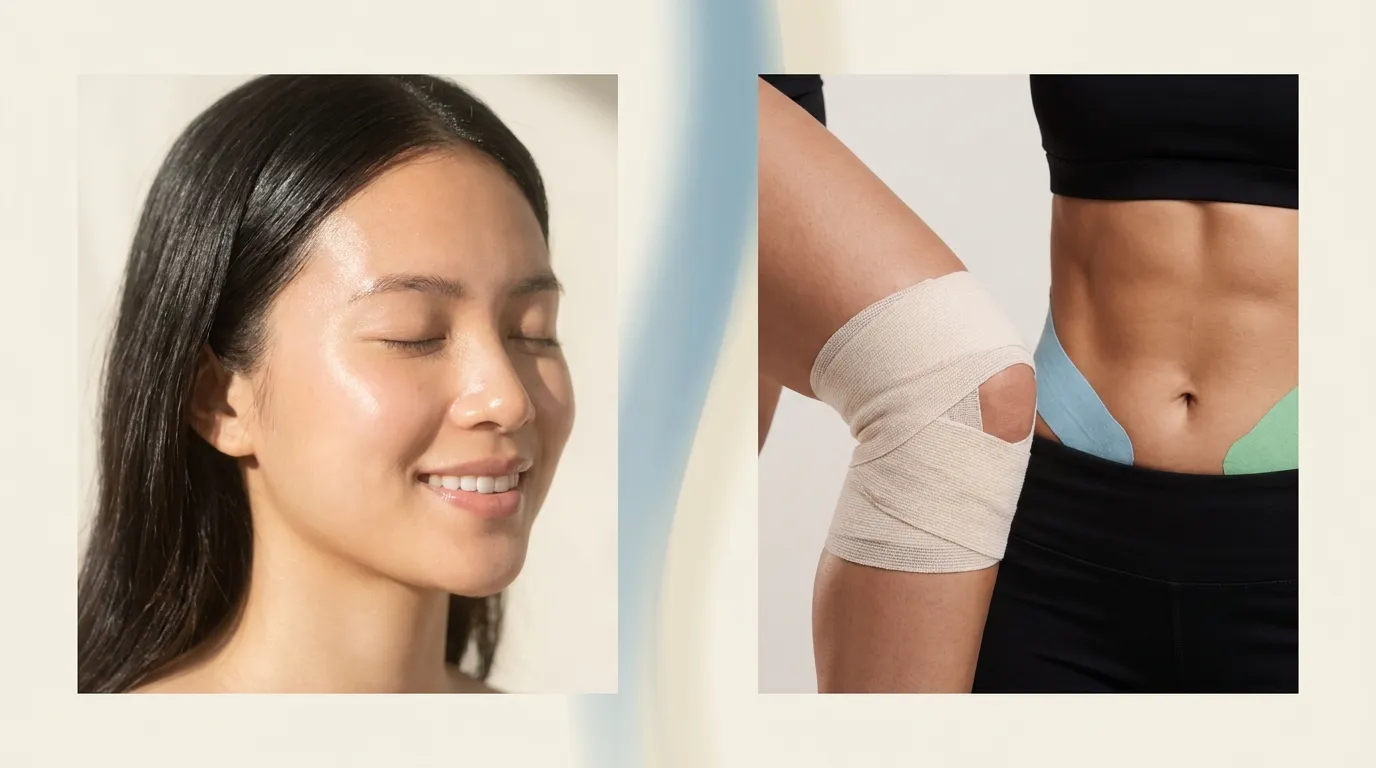
Before any data, internalize the one idea that makes this whole comparison simple: these two peptides sit at opposite ends of a single axis, from surface and cosmetic on one side to deep and structural on the other. GHK-Cu lives on the skin-and-aesthetics end; BPC-157 lives on the internal-and-joint end. The map below is the lead visual because it answers the real question people arrive with, which is not "which is stronger" but "which one for my goal." Find your goal on the line, and the peptide is the one nearest it.
GHK-Cu vs BPC-157 at a glance
Here is the side-by-side before we go deep. The single most useful thing to notice is that almost every row points in a different direction, because the two answer different questions: GHK-Cu owns skin, the human-evidence story, and a needle-free route, while BPC-157 owns internal and joint healing. Everything below this table explains the why.
| Dimension | GHK-Cu | BPC-157 |
|---|---|---|
| Class / origin | Copper tripeptide (GHK bound to copper), naturally occurring | 15-amino-acid peptide from a gastric-juice protein |
| Primary use | Skin, hair, anti-aging, cosmetic; topical wound healing | Systemic: gut/GI lining, tendon, ligament, joint |
| Evidence floor | Human topical/cosmetic data (collagen, skin quality) + in-vitro | Animal + mechanistic data only; no human efficacy trials |
| Mechanism | Copper-dependent collagen and matrix remodeling, antioxidant signaling | Angiogenesis (VEGFR2, nitric oxide), tendon and gut repair |
| Route | Topical (serums/creams) and subcutaneous | Subcutaneous (oral forms used for gut) |
| FDA / regulatory | Used in approved cosmetic topicals; injectable is research-grade | Not approved; research-grade for injection |
| Sport (WADA) | Not specifically listed (verify before competition) | Prohibited (S0) |
| Community cost / dose | ~$1.60 (~50 doses/vial) | ~$2.60 (~25 doses/vial) |
| Headline reported effect | Nausea (~4%) | Nausea (~6%) |
The table reads like a list of differences, and that is the point. The two genuinely flip on target (surface vs internal) and on evidence type (real but topical for GHK-Cu, animal-only for BPC-157). Cost and tolerability are close enough that they rarely decide anything.
What our community actually does between the two
This is the part no study and no competitor column can give you: among users who have logged either compound, how do the camps split, and do people move between them? Because the two solve different problems, the prediction is that switching should be low and co-tracking should be modest, driven by people who want both a skin result and an internal one. That is exactly what the data shows. The short version: it is close to an even split, almost nobody abandons one for the other, and a meaningful minority run both as a deliberate skin-plus-internal pairing.
Three numbers carry the story, all from ProtocolPlus app data among the roughly 2,240 users tracking one of these two compounds:
- Adoption split: ~52% BPC-157, ~48% GHK-Cu. It is nearly even (1,168 vs 1,072 users). BPC-157 is the slightly larger camp, consistent with the broad popularity of systemic healing peptides, but GHK-Cu holds almost half the field on the strength of its skin and anti-aging following.
- Switching is essentially flat (~0.9 to 1). About 8% of BPC-157 users (93) later moved to or added GHK-Cu, and about 10% of GHK-Cu users (107) moved the other way. The net is around 14 users toward BPC-157, statistically a wash. Almost nobody trades one for the other, because they are not substitutes.
- Co-tracking: ~18% (about 403 users) run both. These are people pairing a skin or anti-aging goal with an internal-healing one, GHK-Cu for the surface and BPC-157 for the depths. It is the second-most-telling number on the page after the flat switch: people who want both effects use both compounds, not one in place of the other.
Why the switch is flat (and what it tells you)
The balanced, tiny flow is the tell. In a real head-to-head rivalry you see a lopsided exodus toward the stronger option. Here the traffic is small in both directions because the typical "switch" is not abandonment, it is a person who started with one goal (say, skin) later picking up the other (an injury or gut issue) and adding the matching peptide. The slight edge toward BPC-157 most likely reflects how often a skin-focused user later develops a recovery need, rather than any sense that BPC-157 "beat" GHK-Cu. Read the flatness as confirmation that these are different jobs, and your choice should follow your goal rather than a popularity contest.
How they work: surface matrix vs deep repair
The one-sentence answer: GHK-Cu remodels the skin's collagen matrix using copper as its cofactor, while BPC-157 drives blood-vessel growth and tissue repair where it is injected, so they act on entirely different biology in different places. That single difference explains every downstream choice in this comparison, including why almost nobody swaps one for the other.
GHK-Cu is the copper tripeptide GHK (glycyl-L-histidyl-L-lysine) bound to a copper ion. It occurs naturally in the body and declines with age. In human and in-vitro research, much of it summarized in Pickart and Margolina's 2018 review, GHK-Cu is described as stimulating collagen and the skin's extracellular matrix, supporting wound repair, acting as an antioxidant, and improving measures of skin quality. Crucially, this is the peptide with the most real human data of any in the research-peptide world, but that data is overwhelmingly topical and cosmetic, from creams, serums, and dermatological studies. Its reputation for skin firmness, fine lines, and hair support comes directly from that body of work.
BPC-157 (Body Protection Compound) is a stable 15-amino-acid peptide derived from a protein found in gastric juice. In animal and mechanistic studies, much of it associated with the laboratory of Sikiric and colleagues, its standout effects are angiogenesis (described as upregulating the VEGFR2 receptor and engaging the nitric oxide system to grow new blood vessels) and direct effects on the gut lining, tendon fibroblasts, and ligaments. That is why its reputation is concentrated on internal and joint healing. The honesty check that competitors soft-pedal: there are no published human efficacy trials for BPC-157. What exists is mechanism, animal data, and anecdote. For the deeper molecular detail on each, see the GHK-Cu guide and the BPC-157 guide.
The evidence asymmetry you should not gloss over
The one-sentence answer: GHK-Cu and BPC-157 are not on equal evidentiary footing, GHK-Cu has real human topical data while BPC-157 has none in humans, so "more studied" means something different for each. This is the most important honesty point on the page, and it is the one most comparison articles blur by calling both "well-researched."
For GHK-Cu, the human evidence is genuine but bounded: it is largely topical and cosmetic, measuring skin and collagen outcomes from products applied to the skin. That tells you a lot about creams and serums and very little about injecting GHK-Cu for systemic healing, which is an off-label use with thin human exposure data. For BPC-157, the picture is starker: the entire efficacy case rests on animal models and mechanism, with no human trials showing a clinical result. Neither asymmetry makes the choice for you, but it should calibrate expectations. If you want evidence behind a result, GHK-Cu's topical skin data is the most solid thing in this matchup; if you want internal healing, you are relying on mechanism and anecdote with BPC-157, and you should weigh that honestly. The takeaway is not "GHK-Cu wins," it is "know which kind of evidence you are leaning on for your specific goal."
Which compound for which goal, in detail
The one-sentence answer: match the compound to the goal's location, surface and cosmetic to GHK-Cu, internal and structural to BPC-157, and use both when you have a goal at each end. This is where the goal-router map at the top turns into practical reasoning.
For skin quality, fine lines, and anti-aging, GHK-Cu is the clear community lean, and it is the use it is most associated with: the human cosmetic and collagen research is the heart of its profile, and topical serums exist precisely for this purpose. BPC-157 has no skin reputation to speak of. For hair support, GHK-Cu again leads, drawing on copper-peptide work cited by Pickart on hair follicles. Flip to gut and GI issues, and BPC-157 is the lean, thanks to its animal literature on gut-lining protection and the gut-brain axis, with oral forms made for it; GHK-Cu has no comparable gut use. For tendon, ligament, and joint healing, BPC-157's angiogenesis and tendon-fibroblast mechanisms are why people reach for it, with GHK-Cu essentially absent from this goal. The one genuine overlap is general or topical wound healing, where both have a rationale (GHK-Cu from human topical data, BPC-157 from animal models), and where some people use them together. The honest caveat on all of this: outside GHK-Cu's topical skin data, these are mechanism-driven usage tendencies and anecdote, not head-to-head human evidence.
This is exactly why "which compound" so often resolves to "both, for different goals." Someone managing a tendon injury who also wants better skin runs BPC-157 for the joint and GHK-Cu (often topical) for the face. That is not a stack in the synergy sense; it is two separate tools for two separate problems, which is precisely what the 18% co-tracking number captures.
Tolerability: mild, close, and not the deciding factor
The one-sentence answer: in our community reports both are generally described as well tolerated, with low and similar side-effect frequencies, so tolerability rarely decides this matchup. These are self-reported community frequencies, not trial incidence and not proof of cause, but the pattern is consistent.
In ProtocolPlus reports the most common effects are low for both: nausea (BPC-157 6% vs GHK-Cu 4%), headache (6% vs 5%), and lightheadedness (5% vs 5%). The two are within a point or two on every row, with GHK-Cu marginally more tolerable on nausea and headache and a tie on lightheadedness. The differences are small enough that tolerability is better read as reassurance than as a tiebreaker. Two compound-specific caveats matter more than these mild effects: injectable GHK-Cu can sting or cause local irritation because of its copper content and is often preferred topically for that reason, and the bigger unknown for both is the absence of long-term human safety data plus the variability of unregulated research-grade material.
For the complete tolerability breakdown and red-flag list, read GHK-Cu side effects and BPC-157 side effects. This page does not duplicate them.
Cost and access: close on price, different on route
The one-sentence answer: per dose the two are similarly cheap (GHK-Cu about $1.60, BPC-157 about $2.60 in our data), so cost is a minor factor, and the bigger practical difference is route: GHK-Cu has a needle-free topical option that BPC-157 does not. Access, not price, is where the two diverge.
In ProtocolPlus cost figures, GHK-Cu runs about a median $1.60 per dose, with a typical vial in the $50 to $110 range yielding roughly 50 doses, while BPC-157 runs about $2.60 per dose, with a $40 to $90 vial yielding roughly 25 doses. Both are inexpensive per dose, and the gap is small enough that price rarely tips the decision. The more meaningful access difference is that GHK-Cu can be used topically in serums and creams, including ingredients found in FDA-regulated approved cosmetic products, so a skin goal does not require injecting at all. BPC-157 is injectable (with some oral use for the gut) and is entirely research-grade. The usual caveat applies: these are unregulated research-grade materials whose price and quality vary by source, we do not name vendors, and the per-dose figures are a directional signal, not a quote.
A note on legality and sport
GHK-Cu and BPC-157 sit on different regulatory footing, which is worth flagging because it affects who can use each and how. GHK-Cu appears in approved cosmetic topical products and is widely sold as a skincare ingredient, while injectable GHK-Cu for systemic goals is an off-label, research-grade use. BPC-157 is research-grade across the board, not FDA-approved, and is prohibited in competitive sport under WADA's S0 category (unapproved substances). GHK-Cu as a copper peptide is not specifically named on the prohibited list, but tested athletes should verify their exact product and route before competition rather than assume it is cleared. This is a compliance and logistics point, not a deep legal guide, and it does not change the goal-router comparison above.
The editorial scorecard (the "why," not a verdict)
The fit-score radar below rates each compound 1 to 5 on six dimensions. With equal weighting the two tie, 63 to 63: GHK-Cu scores higher on evidence (real human topical data) and accessibility (topical route), BPC-157 scores higher on effectiveness (broad systemic applicability) and speed, and they tie on safety and cost. That tie is the honest editorial summary, and it reinforces the whole premise: there is no winner because they are built for different jobs. The community usage and goal-router above, not this radar, are the headline signals.
Choose GHK-Cu if... / Choose BPC-157 if...
Because these solve different problems, read these as "which fits your goal," not as a ranking.
Choose GHK-Cu if:
- Your goal is skin quality, fine lines, or anti-aging: this is its signature use and the one with real human data.
- You want hair support, where copper-peptide research is most cited.
- You prefer a needle-free topical route (serums and creams), which BPC-157 does not offer.
- You want the compound with the strongest human evidence in this matchup, accepting that it is mostly topical, and the slightly cheaper per dose (~$1.60).
Choose BPC-157 if:
- Your goal is internal: gut or GI issues, where it is the most-associated peptide.
- You have a tendon, ligament, or joint injury and want systemic healing support.
- You want a versatile injectable for deeper-tissue recovery rather than skin or cosmetics.
- You accept animal-only evidence and WADA-prohibited status (S0) in exchange for that systemic profile.
The honest verdict
For most people the real answer to "GHK-Cu vs BPC-157" is that it is the wrong framing: they are different jobs, not rival products, and the community confirms it, splitting almost evenly, switching at a near-flat rate, and co-tracking both about 18% of the time when goals span both ends. If your goal is skin, hair, or anti-aging, GHK-Cu is the pick, and it is also the only compound here with real human evidence, even if that evidence is topical. If your goal is internal, tendon, or joint healing, BPC-157 is the pick, with the honest asterisk that its case is animal data and mechanism, not human trials. The biggest caveat outranks all of it: neither is an FDA-approved injectable, GHK-Cu's human data does not transfer to injection, BPC-157 has no human efficacy trials and is WADA-prohibited, and everything here is mechanism plus usage data inside a clinician-supervised plan, not a result you should expect or a protocol to run alone.
To make it concrete, here is how the decision usually lands by goal:
- Skin, fine lines, or anti-aging: GHK-Cu, the one with real human (topical) data.
- Hair support: GHK-Cu.
- Gut or GI repair: BPC-157, its most-associated use.
- Tendon, ligament, or joint healing: BPC-157.
- Both a skin goal and an internal one: run both, GHK-Cu (often topical) for the surface and BPC-157 for the depths. This is the ~18% who co-track.
- Want the most human evidence behind the result: GHK-Cu, with the caveat that it is topical, not injectable.
- Tested athlete: BPC-157 is WADA-prohibited (S0); confirm your exact GHK-Cu product before competing.
For an adjacent comparison, see BPC-157 vs TB-500. For the full science on each molecule, see the GHK-Cu guide and the BPC-157 guide, and for tolerability detail see GHK-Cu side effects and BPC-157 side effects.
Frequently Asked Questions
Sources
- Pickart L, Margolina A. "Regenerative and Protective Actions of the GHK-Cu Peptide in the Light of the New Gene Data." International Journal of Molecular Sciences, 2018;19(7):1987. Retrieved 2026-06-18. https://pubmed.ncbi.nlm.nih.gov/29986520/
- Pickart L, Vasquez-Soltero JM, Margolina A. "GHK Peptide as a Natural Modulator of Multiple Cellular Pathways in Skin Regeneration." BioMed Research International, 2015;2015:648108. Retrieved 2026-06-18. https://pubmed.ncbi.nlm.nih.gov/26236730/
- Sikiric P, Rucman R, Turkovic B, et al. "Stomach Pentadecapeptide BPC 157 and Related Vascular and Endothelial Healing Factors: VEGF, Nitric Oxide and Angiogenesis." Current Pharmaceutical Design, 2018;24(18):1990-2001. Retrieved 2026-06-18. https://pubmed.ncbi.nlm.nih.gov/29879882/
- Chang CH, Tsai WC, Hsu YH, Pang JHS. "Pentadecapeptide BPC 157 enhances the growth hormone receptor expression in tendon fibroblasts." Molecules, 2014;19(11):19066-19077. Retrieved 2026-06-18. https://pubmed.ncbi.nlm.nih.gov/25415472/
- World Anti-Doping Agency. "The Prohibited List" (BPC-157 under S0 Unapproved Substances). 2024. Retrieved 2026-06-18. https://www.wada-ama.org/en/prohibited-list
- U.S. Food & Drug Administration. "Certain Bulk Drug Substances for Use in Compounding (peptide review; BPC-157 is not an FDA-approved drug)." Retrieved 2026-06-18. https://www.fda.gov/drugs/human-drug-compounding/bulk-drug-substances-nominated-use-compounding-under-section-503a-federal-food-drug-and-cosmetic-act
- ProtocolPlus. "Community head-to-head data: GHK-Cu vs BPC-157" (head-to-head/bpc-157__ghk-cu.json). First-party app data, 2026. n ~ 2,240 users tracking one of the two. Usage and switching signal, not a clinical efficacy verdict.