PT-141 (Bremelanotide) Side Effects: What 500 Users Report vs the Vyleesi Label (2026)
Most PT-141 (bremelanotide) side effects are short-lived and mild-to-moderate — nausea is by far the most common and is often the dose-limiting one — but the effect you actually need to respect is the transient blood-pressure rise after each dose, which makes the drug off-limits for anyone with uncontrolled hypertension or cardiovascular disease. This page answers the real tolerability question two ways at once: what 500 ProtocolPlus users report from real use, placed honestly next to the FDA Vyleesi label rates that validate them.
Most "PT-141 side effects" pages pick a lane — either the off-label male "libido peptide" framing, where it ranks among the best peptides for libido, or a dry restatement of the drug label. We do both, honestly, and we lead with first-party community data: what 500 ProtocolPlus users who tracked bremelanotide tolerability actually report, kept beside the FDA Vyleesi label rates as the validated benchmark. For the molecule itself (how the melanocortin pathway works, the approved use, dosing), this page links up to the PT-141 complete guide so it stays a clean safety-and-tolerability hub.
Key Takeaways
- The honest top line (what our users report, N=500): the most common by far is nausea (40%, 200 users), then flushing (20%, 100), injection-site reactions (13%, 65), headache (11%, 55), and a transient blood-pressure rise (10%, 50). Most are short-lived and cluster in the hours after a dose.
- Bremelanotide is FDA-approved as Vyleesi for HSDD in premenopausal women (2019), so unlike most peptides it has a real label adverse-event table — and our community numbers track it closely. The widely-used male / "PT-141 for ED" route is off-label, but the same cautions apply.
- Nausea is the dose-limiter. At ~40% on the label it is the single biggest reason people cut back or stop; on the Vyleesi label about 13% of patients took an anti-nausea medicine for it.
- The one safety signal to respect: Vyleesi transiently raises blood pressure and lowers heart rate after each dose and is contraindicated in uncontrolled hypertension or known cardiovascular disease. A severe hypertensive response is the red flag — rare (0.5%, 2 users in our data), but it is the line where this stops being a tolerability issue.
- Skin and gum darkening (hyperpigmentation) is the melanocortin-class effect (8%, 40 users): it builds with repeated dosing and, per the label, may not fully resolve after stopping. Self-report ≠ label incidence ≠ causation.
What are the most common PT-141 side effects?
Across 500 ProtocolPlus users who tracked bremelanotide tolerability, the most-reported effects are nausea (40%), flushing (20%), injection-site reactions (13%), headache (11%), and a transient blood-pressure rise (10%) — mostly short-lived and concentrated in the hours after a dose. This is a community-report ranking from our own app data, not a validated incidence table — but because bremelanotide is FDA-approved, we can hold it up against the real Vyleesi label rates, and the match is close.
The pattern is exactly what bremelanotide's mechanism predicts. As a non-selective melanocortin-receptor agonist it acts centrally (which is why it works through desire rather than blood flow), and that same broad receptor activity spills into the autonomic and GI systems — hence nausea, flushing, and a brief cardiovascular response. After the top cluster, reports tail off into milder, less specific effects: skin or gum hyperpigmentation (8%, 40 users), spontaneous erections in male users (8%, 40), dizziness (6%, 30), vomiting (5%, 25), and decreased appetite (5%, 25).
These shares come only from our community-reported dataset and describe what people experience and log, not trial-grade incidence and not causation. The receptor-level mechanism lives on the hub; for the molecule itself see the PT-141 complete guide.
Citation capsule. Among 500 ProtocolPlus users who tracked bremelanotide (PT-141) tolerability, the most-reported effects were nausea (40%, 200 users), flushing (20%, 100), injection-site reactions (13%, 65), headache (11%, 55), and a transient blood-pressure rise (10%, 50). This is first-party data reflecting what the community reports — self-reported, not validated trial incidence, and not proof of causation. Source: ProtocolPlus app data (side-effects/pt-141.json), 2026.
When should you seek urgent care on PT-141?
Go to urgent care or the ER if you get a severe blood-pressure spike — a pounding headache, chest pain or pressure, blurred vision, shortness of breath, or one-sided weakness in the hours after a dose — especially if you have high blood pressure or any heart condition. This is rare (0.5%, 2 users in our data), but it is the one effect that turns a manageable side effect into an emergency, so it comes before everything else.
The reason it leads the safety section is mechanism, not frequency. Vyleesi transiently increases blood pressure and reduces heart rate after each dose — on the FDA label the average rise is small (about 6 mmHg systolic and 3 mmHg diastolic, peaking 2–4 hours after dosing, with heart rate down about 5 beats per minute, usually back to baseline within 12 hours). For most healthy users that small, brief bump passes unnoticed. The problem is the person whose baseline is already high or whose heart can't absorb the change — which is exactly why Vyleesi is contraindicated in uncontrolled hypertension or known cardiovascular disease and not recommended for anyone at high cardiovascular risk. The off-label male "PT-141 for ED" route does not change that physiology; the same caution applies.
Severe hypertensive response
Warning sign: a sudden, severe pounding headache, chest pain or pressure, blurred or double vision, shortness of breath, or one-sided weakness in the hours after a dose.
Action: seek emergency care now. Highest risk with uncontrolled hypertension or heart disease — for whom the drug is contraindicated.
Persistent vomiting + dehydration
Warning sign: vomiting you can't stop, inability to keep down fluids, lightheadedness on standing.
Action: don't push through — rehydrate and call a clinician; severe cases need care.
Prolonged / painful erection
Warning sign: an erection lasting more than ~4 hours or that becomes painful (priapism).
Action: seek urgent care — untreated priapism can damage tissue.
Note the label limits that exist to contain these: no more than one dose in 24 hours, and no more than 8 doses per month. Those caps are there partly to keep the per-dose BP response and the repeat-dose hyperpigmentation in check.
Citation capsule. Per the FDA Vyleesi (bremelanotide) label, the drug transiently increases blood pressure (about 6 mmHg systolic / 3 mmHg diastolic, peaking 2–4 hours post-dose) and reduces heart rate (about 5 bpm), usually returning to baseline within 12 hours; it is contraindicated in uncontrolled hypertension or known cardiovascular disease and not recommended at high CV risk. Dosing is capped at one dose per 24 hours and no more than 8 doses per month. Source: FDA Vyleesi Prescribing Information (Initial U.S. Approval 2019), via DailyMed.
What do the common PT-141 side effects feel like, and how do people manage them?
The common effects are short-lived and tied to the hours right after a dose — nausea leads and is the main reason people stop, flushing and headache are usually brief, and the blood-pressure change is something to monitor rather than feel. Below is each frequent effect: what it feels like, why it happens, its time-course, and how our community manages it. These are descriptions of common practice, not a prescription — dosing belongs with your clinician (see the PT-141 complete guide for how the approved dose is structured).
Nausea (40%, 200 users) — the dose-limiter
The dominant effect, and the one that most often decides whether someone keeps using PT-141. On the Vyleesi label nausea affected about 40% of patients, was worst with the first injection, and was enough that roughly 13% of patients took an anti-nausea medicine for it. It usually starts within an hour or two of a dose and settles over the next several hours rather than lingering for days. Community practice leans on dosing on a light or empty-ish stomach, having an anti-nausea option discussed with a clinician on hand, timing the dose when a few hours of feeling "off" won't matter, and — for people who find the full dose too rough — discussing a lower starting amount. Because it is so front-loaded onto the first dose, many people find it eases on later doses.
Flushing (20%, 100 users)
A warm, red sensation in the face, neck, or chest, again from the broad melanocortin and vascular activity. It is typically mild, comes on within the first hour, and fades on its own within a few hours. Most people simply ride it out; cooling down and hydration are the usual comfort measures.
Injection-site reactions (13%, 65 users)
Redness, a small bump, or tenderness where the subcutaneous injection goes in. Usually minor and self-resolving. Community practice is the standard subcutaneous routine: rotate the site, let alcohol dry before injecting, and use a fresh needle each time.
Transient blood-pressure rise (10%, 50 users)
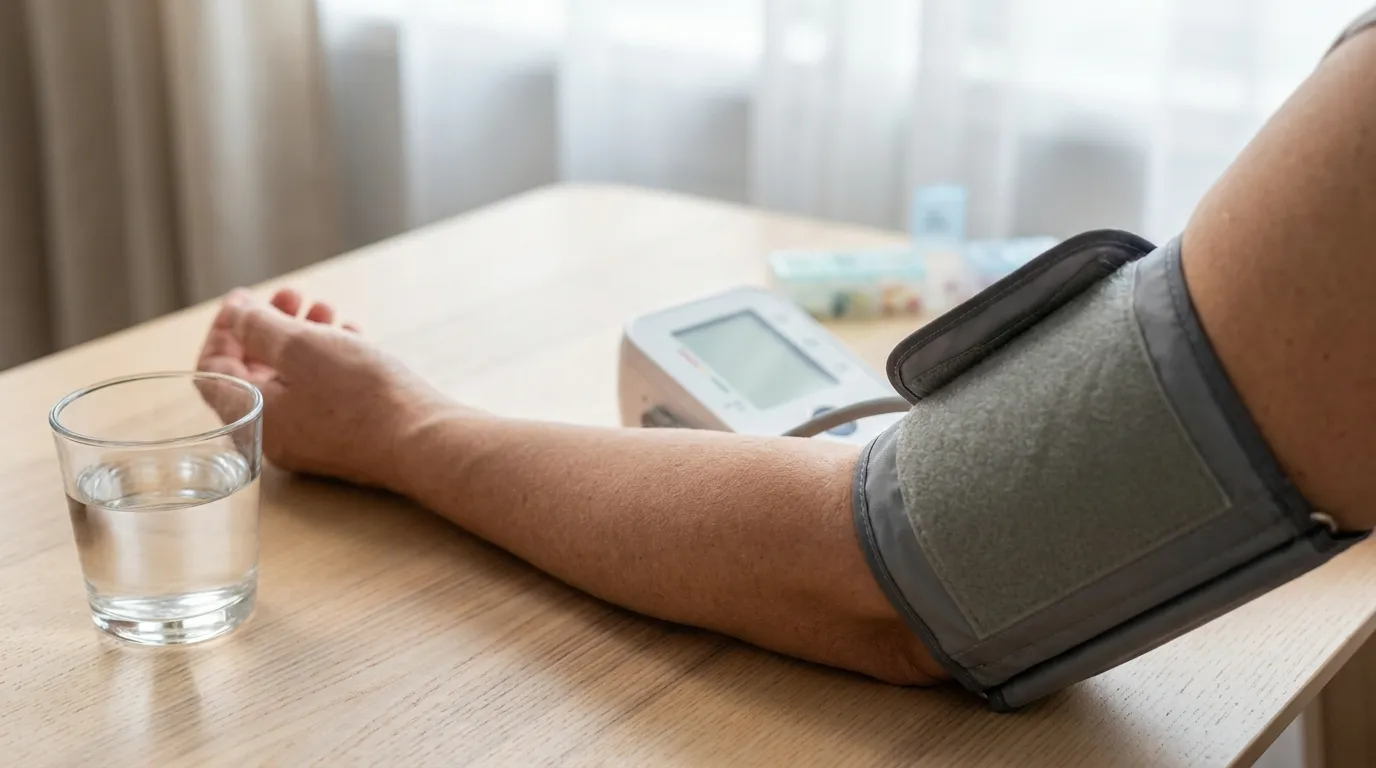
This is the one to measure rather than feel. For most users the small label-described rise (about 6 mmHg systolic) is asymptomatic — they only see it if they check. The practical community habit, especially for anyone borderline on blood pressure, is to take a baseline reading and a post-dose reading a couple of hours later to confirm the response stays small and brief. If you have any hypertension or heart history, this is the effect that belongs in a conversation with a clinician before the first dose, not after.
Skin and gum hyperpigmentation (8%, 40 users)
The melanocortin-class signature: because the drug activates melanocortin-1 receptors (the same family that drives pigmentation), repeated dosing can produce darkening of the skin — and notably the gums, face, and breasts. On the Vyleesi label this focal hyperpigmentation was reported in about 1% of patients over up to 8 doses a month, was more likely with darker skin and with more frequent dosing, and — importantly — resolution was not confirmed in all patients, meaning it may not fully fade after stopping. This is the effect most off-label male-use pages gloss over, and the reason the monthly-dose cap matters: the more cumulative dosing, the higher the risk.
The milder tail (headache, dizziness, vomiting, decreased appetite, spontaneous erections)
Headache (11%, 55 users) is usually brief and dose-window-related. Dizziness (6%) and the smaller GI tail — vomiting (5%) and decreased appetite (5%) — track with the nausea response and tend to pass within the same dosing window. Spontaneous erections (8%, 40 users) in male off-label users are an on-target pharmacology effect rather than a true adverse one — worth flagging only because a prolonged or painful erection (priapism) is a red flag (see above).
Our take: Two habits cover most of PT-141's tolerability. First, treat nausea as a first-dose problem you front-load for — dose when you have a few hours of slack, and discuss an anti-nausea plan rather than gritting through it. Second, if you have any blood-pressure or heart history, the BP rise is not a "wait and see" effect — it's a "clear it with a clinician and measure it" effect. Comfort and a baseline reading beat improvising.
How does our community report compare to the Vyleesi label rates?
Our community-reported frequencies line up closely with the FDA Vyleesi label: our nausea (40%) sits right on the label's ~40%, flushing (20%) matches the label's 20.3%, and injection-site reactions (13%) match its 13.2% — but our numbers are self-reported and un-adjudicated, so read the match as reassuring, not as proof of equivalence. This is the honest framing that matters: community self-report, the controlled-trial-derived label incidence, and any one person's real experience are three different things, and none of them establishes that PT-141 caused a given effect.
Two honesty points sit on top of the comparison. First, the label data come from the approved 1.75 mg subcutaneous Vyleesi dose in premenopausal women (the RECONNECT Phase-3 program, ~1,247 women in the safety set, with nausea, flushing, and headache each appearing in 10% or more of patients). Most ProtocolPlus reporters are using PT-141 off-label, often at different doses and including men — so a clean one-to-one mapping isn't guaranteed even when the numbers happen to align. Second, rare-but-serious ≠ never: our 0.5% severe-hypertensive-response rate is small, but the cardiovascular caution is the whole reason the label carries a contraindication, so it should be read as a hard line, not a footnote.
The table below places our community report next to the Vyleesi label rates for the effects where the comparison is clean.
| Effect | ProtocolPlus community (N=500) | Vyleesi FDA label | Read it as |
|---|---|---|---|
| Nausea | 40% (200) | ~40% (worst on first dose; ~13% used an antiemetic) | Close match — reassuring, not proof |
| Flushing | 20% (100) | 20.3% | Close match |
| Injection-site reaction | 13% (65) | 13.2% | Close match |
| Headache | 11% (55) | 11.3% | Close match |
| Vomiting | 5% (25) | 4.8% | Close match |
| Hyperpigmentation | 8% (40) | ~1% (focal; may not resolve) | Community higher — off-label/repeat dosing |
| Severe hypertensive response | 0.5% (2) | (warning/contraindication, no single rate) | Rare; the safety red flag |
Why does PT-141 cause these side effects?
Almost every PT-141 side effect traces back to one fact: bremelanotide is a non-selective melanocortin-receptor agonist, so it activates several melanocortin receptors at once — and each effect on this page maps to one of them. That single mechanism explains why the side-effect set looks the way it does, and why it differs so much from blood-flow drugs like sildenafil. The deep receptor science lives on the hub; this is the short version that explains the pattern above.
The mapping is unusually clean. The nausea, flushing, and the transient blood-pressure/heart-rate change come from central and autonomic melanocortin activity — the same broad receptor activation that produces the desired effect on sexual desire also nudges the gut and cardiovascular system. The skin and gum hyperpigmentation comes specifically from melanocortin-1 receptor (MC1R) activation — the receptor that controls pigment-producing cells — which is why it builds with repeated dosing and can be slow to fade. And the erectile / desire effects route through central MC4R signaling, which is why PT-141 works through the brain rather than directly on penile blood vessels. For the full receptor-level science and the approved indication, see the PT-141 complete guide.
Citation capsule. Bremelanotide (PT-141) is a non-selective melanocortin-receptor agonist; its central and autonomic melanocortin activity accounts for the dose-window nausea, flushing, and transient blood-pressure rise, while MC1R activation drives the focal skin and gum hyperpigmentation seen with repeated dosing. Source: FDA Vyleesi Prescribing Information (2019) and NCBI LiverTox (Bremelanotide), 2020–2026.
Who should be cautious, and who should avoid PT-141?
Bremelanotide is contraindicated for anyone with uncontrolled hypertension or known cardiovascular disease, and is not recommended for anyone at high cardiovascular risk; it is approved only for premenopausal women (HSDD), so all male and other use is off-label. Those are the hard lines; everything else is a conversation with a clinician about your specific history and blood pressure.
A few practical cautions follow from the side-effect profile. Anyone with borderline or treated high blood pressure should treat the per-dose BP rise as a real consideration and measure it, not assume it. People who dose more frequently — or use higher off-label amounts — raise their cumulative exposure to the hyperpigmentation risk, which is partly why the label caps dosing at 8 times a month and once per 24 hours. Vyleesi is not used in pregnancy. And because the "research-use-only" PT-141 sold for off-label use is unregulated, it adds purity and dosing uncertainty on top of the drug's own profile; for how to think about that, see how to vet peptide quality. None of this page replaces that clinician conversation — and for PT-141, the blood-pressure question is the one to settle before the first dose.
Frequently Asked Questions
The bottom line
If you came here worried about PT-141 side effects, the honest answer is layered. The effects you will most likely feel are short-lived and tied to the hours after a dose — nausea leads by a wide margin and is the main reason people cut back, followed by flushing, injection-site reactions, and headache — and they mostly pass within the same dosing window. Our community's frequencies (nausea 40%, flushing 20%, injection-site 13%, headache 11%) line up almost exactly with the FDA Vyleesi label, which is reassuring even though self-report is not validated incidence.
The effects you actually need to respect are two: the transient blood-pressure rise — small and brief for most, but the reason PT-141 is off-limits with uncontrolled hypertension or heart disease, and the source of the rare severe hypertensive red flag — and the skin/gum hyperpigmentation, which builds with repeated dosing and may not fully fade. Settle the blood-pressure question with a clinician before the first dose. From here, the natural next reads are the PT-141 complete guide for the molecule, the approved use, and dosing, and how to vet peptide quality if you are sourcing the off-label research version.
Sources
- U.S. Food & Drug Administration / NIH DailyMed. "Vyleesi (bremelanotide injection) — Prescribing Information" (Adverse Reactions, Table 1; Warnings & Precautions §5.1 cardiovascular effects, §5.2 focal hyperpigmentation; Contraindications; Dosage & Administration). Initial U.S. Approval 2019. Retrieved 2026-06-18. https://dailymed.nlm.nih.gov/dailymed/drugInfo.cfm?setid=8c9607a2-5b57-4a59-b159-cf196deebdd9
- Kingsberg SA, Clayton AH, Portman D, et al. "Bremelanotide for the Treatment of Hypoactive Sexual Desire Disorder: Two Randomized Phase 3 Trials" (RECONNECT). Obstetrics & Gynecology, 2019;134(5):899-908. PubMed 31599840. Retrieved 2026-06-18. https://pubmed.ncbi.nlm.nih.gov/31599840/
- National Institute of Diabetes and Digestive and Kidney Diseases. "Bremelanotide." LiverTox: Clinical and Research Information on Drug-Induced Liver Injury (NCBI Bookshelf, NBK573221). 2020 (updated). Retrieved 2026-06-18. https://www.ncbi.nlm.nih.gov/books/NBK573221/
- American Society of Health-System Pharmacists / MedlinePlus. "Bremelanotide Injection." MedlinePlus Drug Information (a619054). Retrieved 2026-06-18. https://medlineplus.gov/druginfo/meds/a619054.html
- Cleveland Clinic. "Bremelanotide Injection." Cleveland Clinic Drug Information (Elsevier). Retrieved 2026-06-18. https://my.clevelandclinic.org/health/drugs/21312-bremelanotide-injection
- ProtocolPlus. "Community-reported tolerability data: PT-141 (bremelanotide)" (side-effects/pt-141.json). First-party app data, 2026. N = 500 users who tracked bremelanotide tolerability. Self-reported community frequency, not validated incidence and not proof of causation.