How to Vet Peptide Quality: Reading a COA, Purity, and Lab Testing
Vetting peptide quality comes down to one habit: never trust a label, always verify the chemistry. In an unregulated market, the only objective evidence you have is a batch-specific, independent lab test, a Certificate of Analysis (COA), that proves the powder in your vial is the right molecule, at the purity claimed, without dangerous contamination.
If you are newer to the topic, our beginner's guide to what peptides are covers the fundamentals this builds on. If you have shopped for research peptides, you have seen "99% purity" printed everywhere. That number means almost nothing on its own. It can be copy-pasted, faked, or measured by the seller's own lab on a different batch entirely. This guide shows you how to read a real COA line by line, what HPLC and mass spectrometry actually tell you, why an injectable peptide needs an endotoxin test that purity alone will never reveal, and the concrete red flags that separate a genuine analysis from marketing theater.
Key Takeaways
- A COA is the document that proves quality. A useful one shows HPLC purity, mass-spectrometry identity, and the batch (lot) number, ideally from an independent third-party lab.
- Two tests answer two different questions. HPLC answers "how pure?" and mass spectrometry answers "is it actually the right peptide?" You need both; one without the other is half an answer.
- Purity is not the whole story. HPLC purity usually counts only peptide-related impurities, not water, salt, bacteria, or endotoxin. For anything injectable, an endotoxin (LAL) test matters as much as the purity number.
- Practical benchmark: the peptide community commonly treats ≥98% HPLC purity as a reasonable research-grade bar, with the lot number matching your vial; this is a common-use convention, not a regulatory standard.
- The market really does fail testing. A 2024 peer-reviewed study of no-prescription online semaglutide found measured purity of just 7.7% to 14.37% versus the 99% claimed, with bacterial endotoxin in every sample (JMIR, 2024).
- Biggest red flags: no COA, a generic COA that doesn't name your batch, a seller's in-house test with no independent lab, a purity number with no chromatogram image, and refusal to share documentation.
What is a Certificate of Analysis (COA) for a peptide?
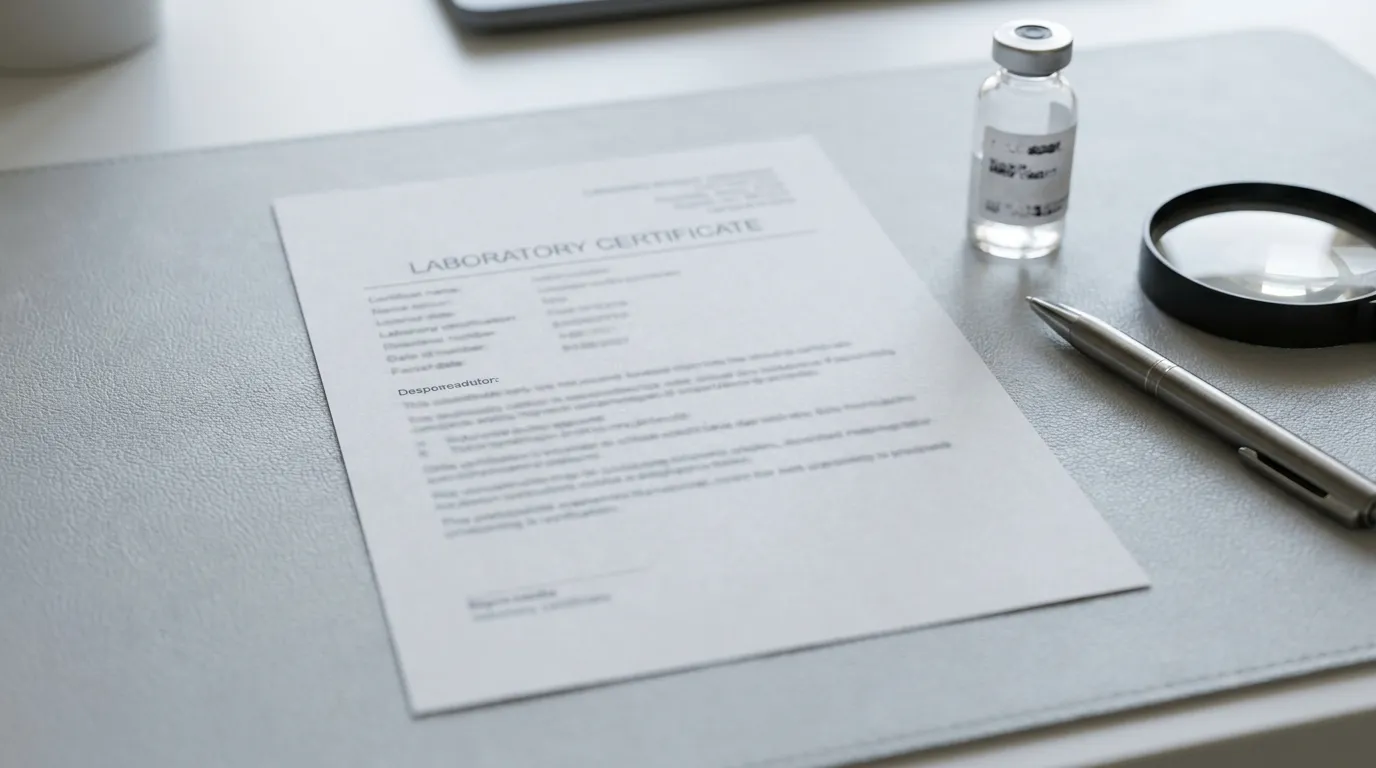
A Certificate of Analysis is a lab report that documents the test results for a specific batch of a peptide: its purity, its identity, and its contamination checks. Think of it as the chemical "nutrition label," except it only matters if it is real, recent, and tied to the exact batch in your hand.
A genuine COA names the product, a unique lot or batch number, the test date, and the laboratory that ran the analysis. Below that, it reports the actual results: a purity percentage from HPLC, an identity confirmation from mass spectrometry, and, on a complete certificate, additional checks such as endotoxin level, water content, and counter-ion (acetate or TFA) content. Industry guides converge on the same core set: purity, identity, peptide content, and contaminant testing (PeptideDeck, "How to Read a Peptide COA," 2026, retrieved 2026-06-15).
The single most important concept is batch specificity. A COA is only evidence for the batch it was generated from. If the lot number on the certificate does not match the lot number printed on your vial, the document tells you nothing about what you actually have (Peptidepedia, "Peptide Certificates of Analysis," 2026, retrieved 2026-06-15). A beautiful COA for last year's batch is just a piece of paper.
Citation capsule. A peptide Certificate of Analysis (COA) is a batch-specific laboratory report documenting a sample's purity (by HPLC), identity (by mass spectrometry), and contaminant testing for a single named lot. It is evidence only for the exact batch number it references; a COA whose lot number does not match the product vial provides no assurance about that vial. Source: PeptideDeck and Peptidepedia COA guides, 2026.
Why does peptide quality matter so much?
Peptide quality matters because the research-peptide market has no mandatory oversight, so a vial can contain the wrong molecule, far less drug than claimed, or bacterial contamination, and you would have no way to know without testing. Unlike an approved pharmacy medicine, a "research use only" peptide is not checked by any regulator before it reaches you.
The risk is not hypothetical. In 2024, researchers led by Ashraf published a peer-reviewed analysis in the Journal of Medical Internet Research of semaglutide products bought from online sellers without a prescription. The measured peptide purity ranged from just 7.7% to 14.37%, against the 99% claimed on the labels, and bacterial endotoxin was detected in every sample tested, at 2.16 to 8.95 EU/mg (JMIR, "Multifactor Quality and Safety Analysis of Semaglutide Products," 2024, retrieved 2026-06-15). All purchased vials were judged probable substandard or falsified products.
Regulators are acting on the same problem. The U.S. FDA has issued warning letters to peptide sellers who hide behind "research use only" disclaimers. In a December 2024 letter to one vendor, the agency concluded that despite such labeling, evidence from the company's own marketing showed the products were "intended for use in the cure, mitigation, treatment, or prevention of disease" in humans, making them unapproved new drugs (U.S. FDA, "Summit Research Peptides Warning Letter," 2024, retrieved 2026-06-15). The takeaway for a buyer is blunt: nobody is checking these products for you, so the COA is the only quality gate that exists.
For the broader legal picture of "research use only" status, see guide to peptide legality and research-chemical status.
What does HPLC purity actually measure?
HPLC measures purity by separating your sample into its components and reporting what fraction is the target peptide versus peptide-related impurities, expressed as a percentage. It answers the question "how clean is this?", but it has an important blind spot you need to understand.
HPLC, or high-performance liquid chromatography, pushes the dissolved sample through a column that separates molecules by how strongly they stick to it. Each component shows up as a peak on a chromatogram; the area under the target peak, divided by the total area of all peaks, gives the purity percentage. The impurities it catches are the by-products of synthesis: truncated chains, deletion sequences (where an amino acid was skipped), and other closely related fragments (CertaPeptides, "Peptide Purity Testing," 2026, retrieved 2026-06-15). Reverse-phase HPLC (RP-HPLC) is the standard mode for this, and it is the same analytical backbone used in pharmacopeial peptide quality control (USP, "Reference Standards to Support Quality of Synthetic Peptide Therapeutics," 2023, retrieved 2026-06-15).
Here is the blind spot: a typical HPLC purity figure counts only the peptide-related material it can see. It does not measure water, residual salt, the counter-ion, or biological contaminants like bacteria or endotoxin. So a vial can read "99% pure" by HPLC and still be mostly water by weight, or carry a dangerous endotoxin load, because those things never appear on that particular chart (HonestPeptide, "How to Read a Peptide COA," 2026, retrieved 2026-06-15). Purity is necessary, but it is not sufficient.
How to read an HPLC chromatogram, not just the number
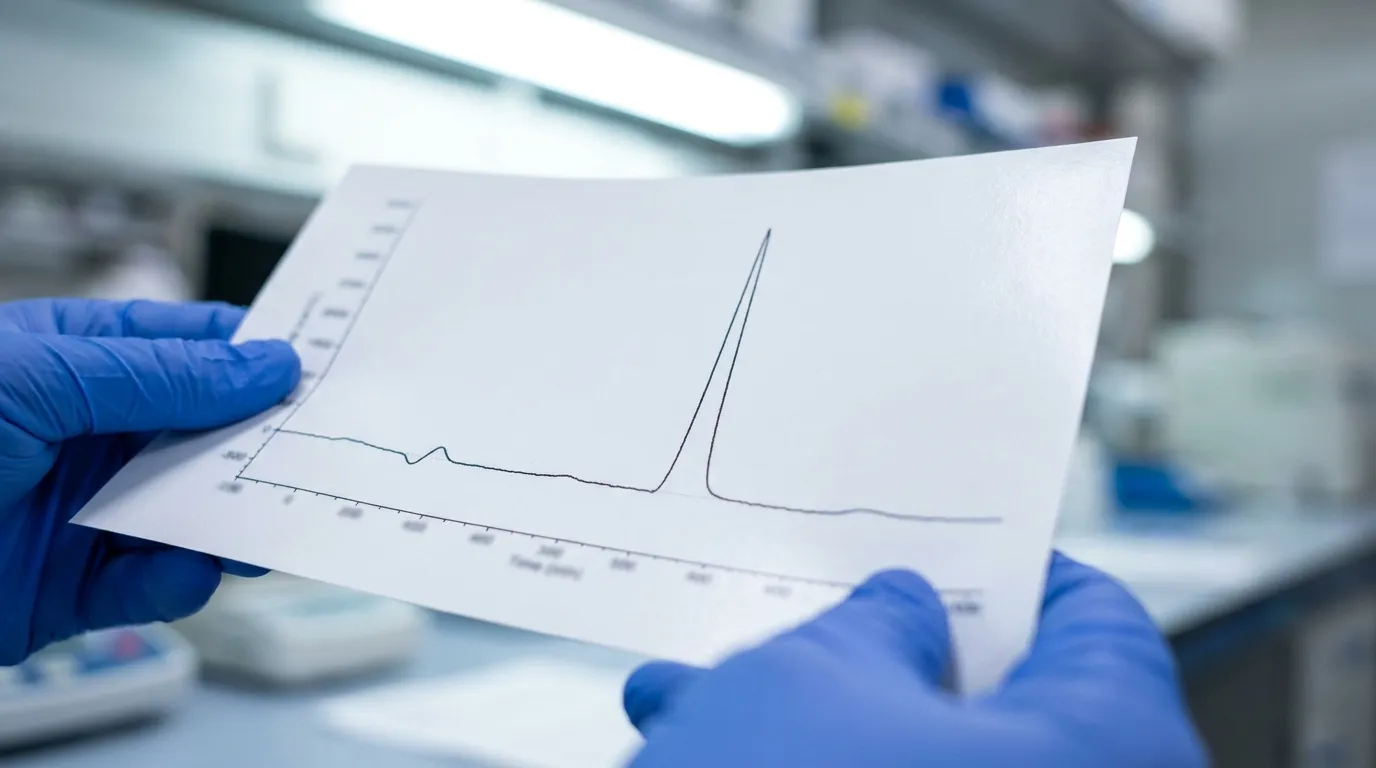
Always look at the chromatogram image, not only the headline purity percentage. The number is a summary; the chart is the evidence, and a clean chart and a clean number should agree.
On a trustworthy chromatogram you want to see one dominant, sharp, symmetrical peak (your peptide) and a flat, quiet baseline. Warning signs include several sizable secondary peaks, a "noisy" or drifting baseline, broad or tailing peaks, or co-eluting shoulders that hint the software lumped an impurity in with the main peak (Chameleon Peptides, "How to Verify Peptide Purity," 2026, retrieved 2026-06-15). If a COA gives you a purity number but no chromatogram at all, you are being asked to trust a claim with the proof removed.
How does mass spectrometry confirm the peptide is real?
Mass spectrometry confirms identity: it measures the molecular weight of what is in the vial and checks that it matches the exact peptide you ordered. If HPLC asks "how pure?", mass spec asks the more fundamental question, "is this even the right molecule?"
Every peptide has a precise, calculable molecular mass set by its amino acid sequence. A mass-spectrometry (MS) reading should show a clear ion peak at that expected mass. If the measured mass is off, you may have a different peptide, a wrong sequence, or a degraded product, regardless of how pure the HPLC said it was (CertaPeptides, "Peptide Purity Testing," 2026, retrieved 2026-06-15). This is why purity without identity is a half-test: a sample can be 99% pure and still be 99% of the wrong compound.
The two methods are partners. Pharmacopeial and analytical guidance treats HPLC (purity/quantity) and MS (identity) as complementary, often alongside amino acid analysis or sequencing for full confirmation (USP, "Reference Standards to Support Quality of Synthetic Peptide Therapeutics," 2023, retrieved 2026-06-15). A complete COA shows both, with the measured mass next to the theoretical mass so you can check the match yourself.
What is endotoxin testing, and why does it matter for injectables?
Endotoxin testing checks for fragments of bacterial cell walls that can trigger fever, shock, and severe immune reactions, and it is critical for any peptide meant to be injected, because purity testing will not catch it. Endotoxins are not peptides, so they are invisible on a peptide HPLC chart.
Endotoxins (also called lipopolysaccharides) come from Gram-negative bacteria and survive even after the bacteria themselves are killed by filtration or heat. The standard detection method is the LAL assay, the Limulus Amebocyte Lysate test, codified in pharmacopeial standards for bacterial endotoxins; results are reported numerically in endotoxin units per milligram (EU/mg) rather than a simple pass/fail (USP, General Chapter <85> "Bacterial Endotoxins Test", retrieved 2026-06-15). For injectable drugs, pharmacopeial endotoxin limits are tightly controlled precisely because even tiny amounts are dangerous in the bloodstream.
This is exactly where unregulated product fails. In the 2024 JMIR semaglutide study, endotoxin was found in 100% of the no-prescription samples (JMIR, 2024, retrieved 2026-06-15). A high-purity peptide can still be a contaminated injectable, which is why a complete COA for anything you would inject should include an endotoxin result, not just a purity number.
A peptide COA, field by field
Read a COA top to bottom, confirming each field rather than skipping to the purity number. The header proves the document belongs to your batch; the results prove the chemistry. Here is what each line should tell you.
| COA field | What it should say | Why it matters |
|---|---|---|
| Product name & sequence | The exact peptide name (and ideally amino-acid sequence) | Confirms the document is for the compound you bought |
| Lot / batch number | A unique code that matches your vial | A COA is only valid for the batch it names |
| Test date | A recent, specific date | Stale or undated COAs may not reflect your batch |
| Testing laboratory | A named, ideally independent third-party lab | An in-house-only result has a built-in conflict of interest |
| HPLC purity | A percentage with the chromatogram image | The chart is the proof behind the number |
| Mass spectrometry | Measured mass next to theoretical mass | Confirms it is the correct molecule, not just pure |
| Net peptide content | The fraction that is actual peptide (vs water/salt) | Often well below the HPLC purity figure |
| Endotoxin (LAL) | A numeric EU/mg result (for injectables) | Catches contamination purity testing misses |
| Counter-ion / water content | Acetate or TFA, and Karl Fischer water | Explains "missing mass" and residual chemistry |
Pro tip: start with the lot number. If it does not match your vial, stop reading; the rest of the certificate is irrelevant to what you are holding.
Third-party testing vs. an in-house COA
An independent third-party COA is far stronger evidence than a seller's in-house test, because the seller has an obvious incentive to report a good result. Both can appear on official-looking letterhead, but only one removes the conflict of interest.
An in-house COA is generated by the same company selling the product. It may be perfectly honest, but you cannot tell, and it is the easiest kind to fabricate or cherry-pick. A third-party COA is produced by an independent analytical laboratory that has no stake in the sale; independent peptide-testing labs (such as Janoshik Analytical, frequently referenced in the community) let buyers confirm results directly (PeptideNerds, "Peptide Purity Testing Methods," 2026, retrieved 2026-06-15).
The strongest signal of all is independent verifiability. The best labs give each report a unique ID you can look up on the lab's own portal, so you confirm the result at the source instead of trusting a PDF the seller emailed you (HonestPeptide, "How to Read a Peptide COA," 2026, retrieved 2026-06-15). Accreditation adds another layer: a lab carrying ISO/IEC 17025 accreditation has been independently assessed for testing competence, which you can confirm through the accreditation body rather than the lab's own marketing (Peptidepedia, "Peptide Certificates of Analysis," 2026, retrieved 2026-06-15).
What purity level is "good enough"?
For most research uses, the community treats ≥98% HPLC purity as a solid benchmark, with ≥95% sometimes acceptable and pharmaceutical-grade work demanding more; but the right number depends on the application. There is no single legal threshold for "research use only" peptides, so these are conventions, not rules.
As a practical orientation, higher purity reduces the chance that an impurity skews a result or causes an unexpected reaction, which is why 98%+ is a common community floor for injectable research compounds. Crucially, purity and net peptide content are different numbers. A vial can be 99% pure by HPLC yet contain noticeably less actual peptide by weight once water, salt, and counter-ion are subtracted, which is the "missing mass" honest COAs disclose (HonestPeptide, "How to Read a Peptide COA," 2026, retrieved 2026-06-15). The figures below are illustrative community conventions, not validated or regulatory standards.
| Purity tier | Often described as | Typical context (community convention) |
|---|---|---|
| < 95% | Below research bar | Treated as low quality; secondary peaks likely |
| 95-97.9% | Acceptable / research grade | Sometimes used; scrutinize the chromatogram |
| ≥ 98% | Research grade (common floor) | Common community benchmark for injectables |
| ≥ 99% + full identity + endotoxin | High / pharma-aligned | Closest to pharmaceutical-grade documentation |
Remember the limits of any number: research-grade documentation is not the same as a regulated pharmaceutical product, and a high purity figure says nothing about sterility, legality, or whether a compound is safe to use (HonestPeptide, "How to Read a Peptide COA," 2026, retrieved 2026-06-15).
Red flags: how to spot a fake or low-quality product
The clearest warning signs are missing, generic, or unverifiable documentation, plus visual problems in the vial itself. Most low-quality product reveals itself before any lab is involved, if you know what to look for.
Watch for these documentation red flags:
- No COA at all, or a seller who is reluctant or slow to provide one (Peptidepedia, 2026, retrieved 2026-06-15).
- A COA with no batch number, or a batch number that does not match your vial.
- A purity percentage with no chromatogram image to back it up.
- Only an in-house test, with no named independent third-party lab.
- Identical-looking COAs across different products (same layout, fonts, and values), a sign of mass-produced, non-batch-specific paperwork (PeptideDeck, 2026, retrieved 2026-06-15).
- A report you cannot verify on the testing lab's own portal or with the lab directly.
And these physical red flags once the vial arrives:
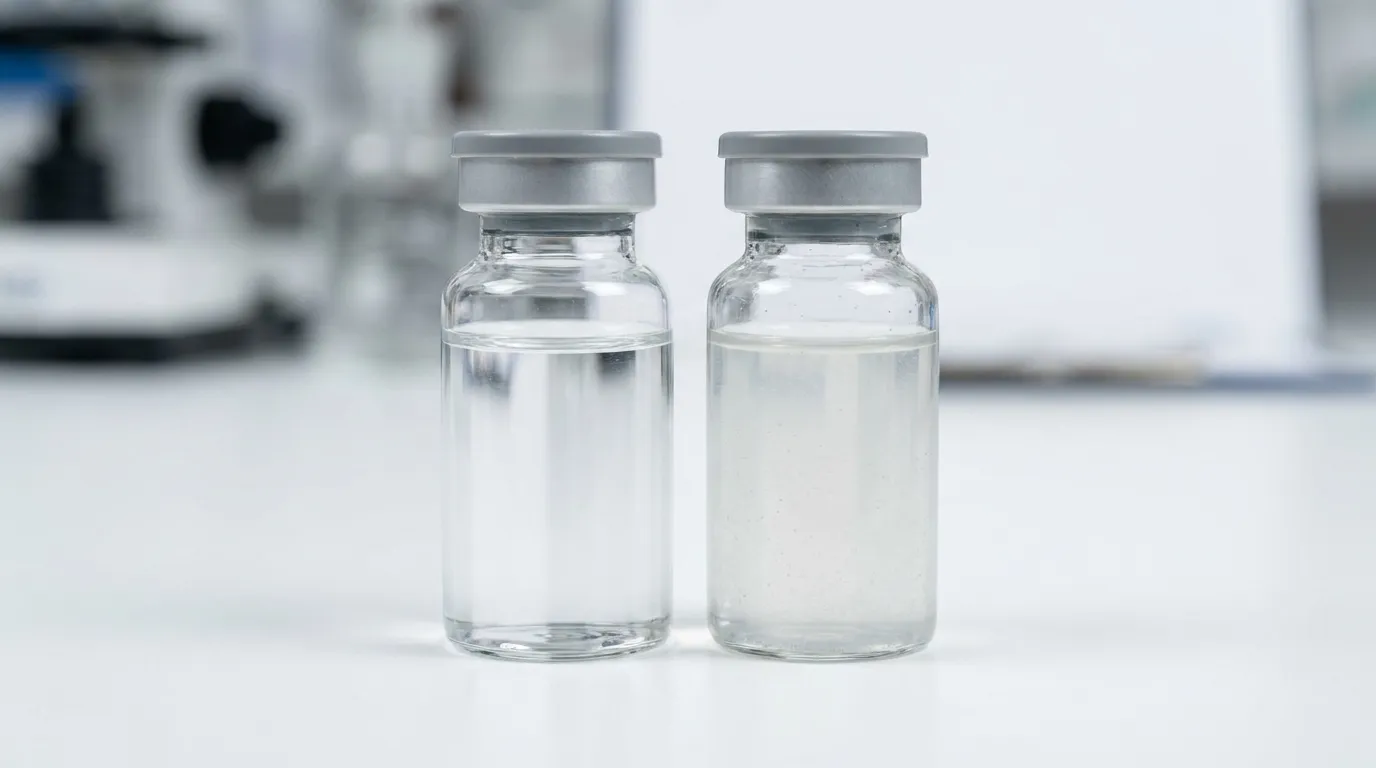
- Cloudiness, haze, or floating particles in a solution that should be clear and colorless.
- A color change (a yellow or brown tint) in a peptide that should be colorless.
- Powder that looks melted, clumped, wet, or discolored, which can indicate poor handling or moisture exposure.
When the documentation looks wrong, the conservative response is to not use the product and to consider independent testing. For what a degraded but genuine product looks like, and how storage causes it, see guide to peptide storage and degradation signs.
Can I send my own peptide for independent testing?
Yes, independent labs will test a sample you send, and for an injectable compound it can be the only way to truly confirm purity and rule out endotoxin. This is the highest-confidence option, because the result comes from a lab with no stake in the sale.
The basic process is straightforward, though the details vary by lab:
- Choose an independent lab. Look for one that publishes verifiable reports and, ideally, holds recognized accreditation. Confirm what tests they offer (HPLC purity, MS identity, endotoxin).
- Confirm the test menu and cost. Decide whether you need purity alone or also identity and endotoxin; injectables warrant the endotoxin add-on.
- Prepare and label the sample. Follow the lab's instructions for how much material to send and how to package it so it stays stable and uncontaminated in transit.
- Ship per the lab's guidance, keeping a record of your batch number so the result maps back to a specific vial.
- Read the returned COA against this guide, and verify the report ID on the lab's portal.
Two honest caveats: testing consumes part of your sample, and a COA on a chemical's quality still does not make using an unapproved peptide safe or legal. Independent testing answers "what is in the vial?", not "should I use it?", which is a conversation for a qualified clinician. For the broader getting-started context, see beginner roadmap for researching peptides responsibly.
Where quality vetting fits in the bigger picture
Vetting quality is one link in a chain that also includes legality, the underlying science, and safe handling, and most of the community's tracked compounds are exactly the injectable type where this vetting matters most. Quality is necessary, but it never stands alone.
Across the ProtocolPlus community's tracking data, the overwhelming majority of tracked compounds are injectable, lyophilized peptides, the category where a COA, endotoxin testing, and reconstitution-clarity checks carry the most weight. The chart below shows that mix; the practical implication is that COA literacy is not a niche skill but a baseline one for most peptide research.
The adjacent skills each have their own home: the legal and research-chemical status, the underlying mechanisms of how peptides work, and safe injection and reconstitution technique. This guide stays focused on the one question of quality: is the chemistry what the label claims?
Frequently Asked Questions
The bottom line
Vetting peptide quality is really one disciplined habit applied every time: get the batch-specific COA, confirm the lot matches your vial, read the HPLC purity alongside its chromatogram, check the mass-spectrometry identity, and, for anything injectable, demand an endotoxin result, ideally all from an independent lab whose report you can verify yourself. The number printed on the label is a marketing claim; the matched, verifiable COA is the only evidence.
The market makes this non-optional. When peer-reviewed testing finds no-prescription products at a fraction of their claimed purity and contaminated with endotoxin in every sample, "trust the label" is not a strategy. And remember the boundary of what a COA can do: it tells you what is in the vial, not whether you should use it. A clean certificate is a quality check, never a safety guarantee, and the use of any unapproved peptide is a decision to make with a qualified healthcare professional.
Sources
- Ashraf AR, et al. "Multifactor Quality and Safety Analysis of Semaglutide Products Sold by Online Sellers Without a Prescription: Market Surveillance, Content Analysis, and Product Purchase Evaluation Study." Journal of Medical Internet Research, 2024. Retrieved 2026-06-15. https://pmc.ncbi.nlm.nih.gov/articles/PMC11582493/
- U.S. Food & Drug Administration. "Warning Letters" (Summit Research Peptides, December 2024; research-peptide vendors marketing "research use only" products for human use). Retrieved 2026-06-15. https://www.fda.gov/inspections-compliance-enforcement-and-criminal-investigations/warning-letters
- United States Pharmacopeia. General Chapter <85>, "Bacterial Endotoxins Test." Retrieved 2026-06-15. http://www.uspbpep.com/usp29/v29240/usp29nf24s0_c85.html
- United States Pharmacopeia. "Reference Standards to Support Quality of Synthetic Peptide Therapeutics." Pharmaceutical Research, 2023. Retrieved 2026-06-15. https://www.usp.org/
- PeptideDeck. "How to Read a Peptide COA (Certificate of Analysis): Complete Guide." 2026. Retrieved 2026-06-15. https://www.peptidedeck.com/blog/how-to-read-peptide-coa-certificate-of-analysis
- Peptidepedia. "Peptide Certificates of Analysis: How to Read and Verify a COA (2026 Guide)." 2026. Retrieved 2026-06-15. https://peptidepedia.org/guides/peptide-certificates-of-analysis
- HonestPeptide. "How to Read a Peptide COA (Real vs Fake)." 2026. Retrieved 2026-06-15. https://honestpeptide.com/research/how-to-read-a-peptide-coa
- Chameleon Peptides. "How to Verify Peptide Purity: HPLC, Mass Spectrometry, and COA Interpretation." 2026. Retrieved 2026-06-15. https://chameleonpeptides.com/2026/04/25/how-to-verify-peptide-purity-hplc-mass-spectrometry-and-coa-interpretation/
- CertaPeptides. "Peptide Purity Testing: HPLC and Mass Spectrometry Explained." 2026. Retrieved 2026-06-15. https://medium.com/@certapeptides/peptide-purity-testing-hplc-and-mass-spectrometry-explained-certapeptides-12a0f6007b6e
- PeptideNerds. "Peptide Purity Testing: HPLC, Mass Spec & Endotoxin." 2026. Retrieved 2026-06-15. https://peptidenerds.com/blog/peptide-purity-testing-methods