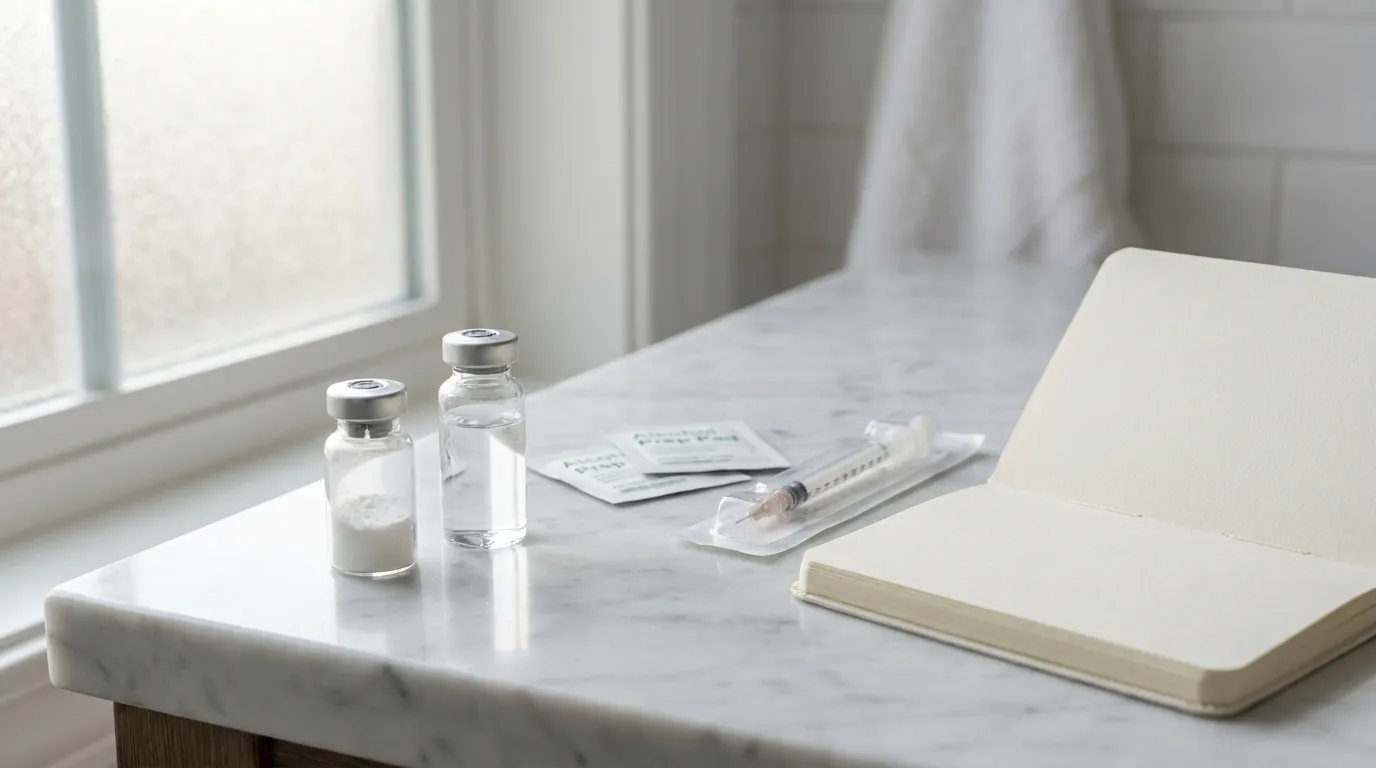
Getting Started With Peptides: A Practical Beginner's Roadmap
If you have landed here, you have probably already heard the hype, seen the before-and-after photos, and noticed how many people online talk about peptides like they are simple. Getting started is less about a magic compound and more about a calm, careful process: deciding whether this is even right for you, understanding what you are buying, gathering the right supplies, and building a few safety habits before anything goes anywhere near your body.
This guide is the practical roadmap, not the science textbook. We will keep the deep mechanism, the full injection walkthrough, the legal fine print, and the lab-testing detail short on purpose and point you to dedicated guides for each. The goal here is to walk a complete beginner from "I'm curious" to "I understand the steps and the risks," responsibly, without pretending the unknowns away.
Key Takeaways
- Start with the decision, not the needle. The honest first step is talking to a qualified clinician, getting baseline bloodwork, and being clear on why you want to use a specific compound, because many research peptides have limited human safety data.
- One peptide at a time. Beginners are widely advised to run a single compound first so that any effect, good or bad, can be traced to one source. Stacking comes much later, if ever.
- The starter supply list is short: the peptide itself, bacteriostatic water, insulin syringes, alcohol swabs, an FDA-cleared sharps container, and a way to log doses. See the supplies table below.
- Sourcing is the real risk. The market is largely unregulated, so what is on the label is not guaranteed. Demand a recent third-party certificate of analysis (COA) before you buy. full COA and purity vetting guide
- "Start low, go slow." Beginner protocols generally begin at the low end of any published range and change one variable at a time, while keeping a written log.
- Legal status varies by compound and country, and in the US the regulatory picture for compounded peptides shifted again in 2026. current legal and research-chemical status
Should you even start with peptides?
Before any supplies or sourcing, the first real step is honestly deciding whether peptides are right for you, and that decision belongs with a qualified clinician. This sounds anticlimactic, but it is the part that separates a responsible start from a reckless one. Many of the peptides people get curious about are not approved for human use and have very little long-term human safety data.
Major academic medical centers are blunt about this. Columbia University clinicians note that synthetic peptide use in humans for wellness "is still in its infancy, and there's extremely limited research to support their safety and efficacy," and they advise anyone interested to "consult a licensed physician first" (ColumbiaDoctors, "What to Know About Peptides," 2024, retrieved 2026-06-15). That is the baseline reality to carry into every later step.
Getting started well means answering three questions honestly before you spend a dollar:
- Why this, and why now? Be specific about the goal (recovery, body composition, metabolic health, skin) and whether a peptide is actually the best-evidenced tool for it, or just the most hyped one.
- What does the evidence say for the specific compound? Not "peptides" in general. Human clinical trials beat animal studies, which beat anecdotes and influencer testimonials.
- What is your medical context? Existing conditions, current medications, pregnancy, and family history all matter, and only a clinician can weigh interactions and contraindications for you.
Our take: The most common beginner mistake is treating "peptides" as one decision. Insulin and an unapproved research powder are both technically peptides, yet they sit worlds apart in evidence and risk. Decide about the specific compound in front of you, never the category. For the chemistry behind that distinction, see what peptides are, in plain English.
How do peptides actually work? (the 60-second version)
Most peptides act as chemical messengers: short chains of amino acids that bind to receptors and switch a specific biological process on or off. Because they are so targeted, a tiny amount can produce a precise effect, which is exactly why people find them interesting and why dosing them carelessly is risky.
That is genuinely all you need for the getting-started stage. A peptide is a short string of amino acids (the same building blocks as protein), and the body already uses thousands of them as signals, including hormones like insulin. Lab-made peptides copy or tweak those natural signals.
We are keeping this deliberately shallow because the receptor-and-signaling detail is its own topic and does not change your first practical steps. If you want the mechanism in full, that lives in a dedicated guide. mechanisms: receptors, signaling, half-life And for the pure definition and the peptide-versus-protein distinction, see beginner's guide to what peptides are.
What supplies do you actually need to get started?
A beginner's peptide kit is short and inexpensive: the peptide, bacteriostatic water to mix it, small insulin syringes, alcohol swabs, a sharps container, and a way to log doses. Most peptides arrive as a freeze-dried (lyophilized) powder that has to be reconstituted into liquid before use, so several of these items exist just to do that mixing safely.
Here is the realistic starter list, with what each item is for. This is a supplies reference, not an instruction to administer anything.
| Supply | What it is for | Beginner notes |
|---|---|---|
| The peptide (lyophilized powder) | The compound itself, freeze-dried for shipping stability | Comes in a sealed vial; stays a powder until you mix it |
| Bacteriostatic water | The diluent you mix the powder with; contains 0.9% benzyl alcohol as a preservative | Suited to multi-dose vials you draw from repeatedly; sterile water (no preservative) is single-use only |
| Insulin syringes (e.g. 29-31G, 0.3-1 mL) | Drawing and measuring small subcutaneous doses | Fine, short needles; units on the barrel make small doses readable |
| Alcohol prep pads | Wiping the vial stopper and the skin to reduce contamination | Cheap, single-use; a core sterile-technique habit |
| FDA-cleared sharps container | Safe disposal of used needles | The FDA advises placing sharps in a proper container immediately after use (FDA, "Best Way to Get Rid of Used Needles," 2024, retrieved 2026-06-15) |
| A dose log (notebook or app) | Tracking dose, date, site, and any effects or side effects | This is how you connect cause and effect; do not skip it |
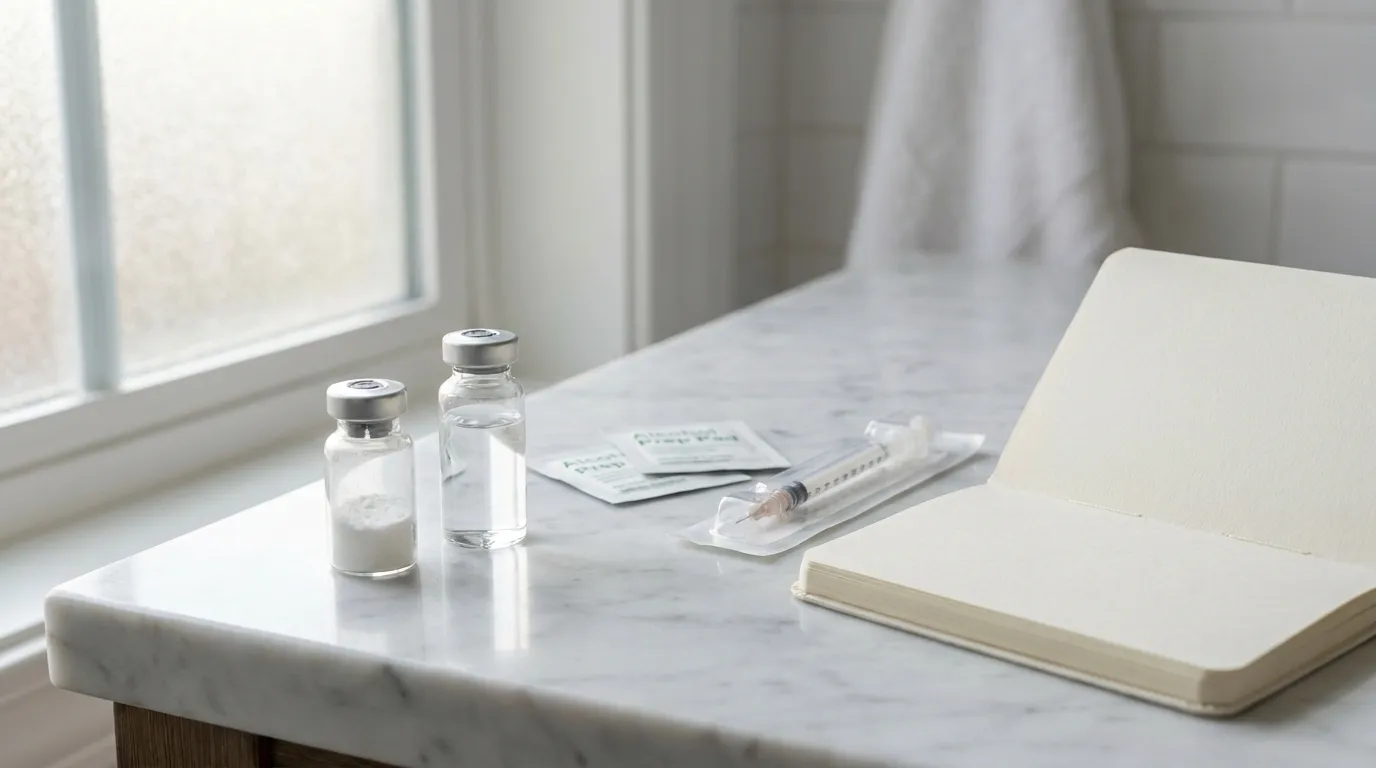
A couple of supplies generate the most beginner questions. Bacteriostatic versus sterile water trips people up constantly: bacteriostatic water contains a preservative (0.9% benzyl alcohol) that protects a vial you puncture repeatedly, while plain sterile water has none and is really single-use. Syringe size is the other one: peptide doses are usually tiny, so small insulin syringes marked in units make a small dose readable instead of a guess. The full reconstitution math and injection technique are their own walkthrough. reconstitution, syringe units, and injection technique
Why are most peptides injected?
Most peptides are injected because if you swallow them, your digestive system breaks them down before they can work, the same way it digests the protein in food. That single fact explains why the supply list above centers on syringes rather than pills.
Your gut treats a peptide like any other protein: enzymes chop the amino-acid chain into fragments, destroying the signal before it reaches your bloodstream. To get around that, peptides are most often given by subcutaneous injection (a small shot into the fat just under the skin). Some are delivered as nasal sprays or topical creams, and a few newer drugs are engineered to survive as pills, but those are exceptions (ColumbiaDoctors, "What to Know About Peptides," 2024, retrieved 2026-06-15).
This is borne out in what the ProtocolPlus community actually tracks: the overwhelming majority of tracked compounds are injectable, with only a small slice oral or topical (see the chart below). For a true needle-averse beginner, that matters: the handful of non-injectable options is small, so "getting started" for most people does involve learning basic injection technique. We keep that technique to a mini-section here and link the full guide. step-by-step injection technique and sites
How do you choose a first peptide responsibly?
Choosing a first peptide is less about picking the "best" compound and more about matching one well-studied compound to one clear goal, then verifying you can source it safely and legally. There is no universal "best beginner peptide," and any source that gives you one without knowing your health context is overselling.
A responsible selection process looks like this, in order:
- Define one goal. Recovery, metabolic health, body composition, skin, sleep, cognition. Pick one, not five.
- Map goals to the evidence, not the marketing. Some categories (like GLP-1 metabolic drugs) have large approved-drug evidence bases; many "wellness" peptides do not. Be honest about which bucket your candidate falls into.
- Check the regulatory status of that specific compound before you fall in love with it, since some are prescription-only, some are cosmetic-only, and many are "research use only." legal status by compound and country
- Confirm you can verify quality. If you cannot get a recent third-party COA for it, that is a reason to stop, not a detail to skip. reading a certificate of analysis
- Bring the shortlist to a clinician. They can flag interactions, contraindications, and whether a non-peptide option is simply better-evidenced for you.
It helps to see where the community actually concentrates. Across the ProtocolPlus userbase, tracking clusters heavily around a small number of well-known compounds rather than spreading evenly across all 41 we track, which tells you most beginners are reaching for the same handful of "talked-about" names.
A word of caution about that chart: popular is not the same as proven, or safe, or right for you. The metabolic / GLP-1 names dominate community attention largely because of the weight-loss wave, but several are prescription medicines, and many other tracked compounds are research-only with thin human data. Use the chart to understand the landscape, not as a shopping list.
How do you source peptides without getting burned?
Sourcing is the riskiest part of getting started, because the research-peptide market is largely unregulated, so the label is a claim, not a guarantee. Independent testing has repeatedly found products that are underdosed, impure, or simply not what the label says. The single best protective habit is to demand a recent, batch-specific third-party certificate of analysis (COA) before you buy.
A COA from an independent lab should report identity and purity (often via HPLC and mass spectrometry) for the specific batch you are buying. No COA, an old COA, or a COA that does not match the batch number are all reasons to walk away. We keep the deep how-to-read-a-COA detail in its own guide, because it is the make-or-break skill. how to read a COA, HPLC, mass spec, and red flags
A few baseline sourcing habits worth internalizing now:
- Require a batch-matched, recent third-party COA. Treat "we test our products" with no document as a no.
- Be wary of impossible claims (miracle results, "pharmaceutical grade" with no evidence, prices far below everyone else).
- Understand what "research use only" means for the legality and recourse you actually have. what "research use only" really means
- Prefer a clinical route where one exists. For compounds available through a licensed clinician or pharmacy, that path comes with oversight a website does not.
This connects directly to the law, which changed recently in the US. In 2023, the FDA moved more than a dozen popular peptides into "Category 2" of its interim 503A bulk drug substances list, a designation for substances that "may present significant safety risks" and that effectively barred their use in compounding (FDA, "Certain Bulk Drug Substances for Use in Compounding That May Present Significant Safety Risks," 2024, retrieved 2026-06-15). In April 2026, the FDA announced it would remove 12 peptides from Category 2 because their nominations were withdrawn, and scheduled Pharmacy Compounding Advisory Committee meetings to evaluate peptides for the bulks list, a change that did not mean unrestricted approval (Orrick, "FDA Announces Removal of 12 Peptides from Category 2," 2026, retrieved 2026-06-15). The takeaway for a beginner: the legal status of a specific compound can move, so check it fresh rather than trusting a years-old forum post. current US and international legal status
What does a first protocol look like? (the beginner mindset)
A sound first protocol is deliberately boring: one compound, the low end of any published range, one variable changed at a time, and everything written down. The mindset matters more than any specific number, and the numbers themselves should come from real published trial ranges and a clinician, never from a guess or an influencer.
Three principles do most of the work:
- One peptide at a time. Running two new compounds at once makes it impossible to know which one caused any effect, good or bad. Start solo so cause and effect stay legible; stacking is an advanced step, if ever.
- Start low, go slow. Beginner convention is to begin at the bottom of any published range and adjust gradually, watching how your body responds before changing anything. (This is widely used community and clinic practice, not a validated universal dose, and it is not a recommendation to use any compound.)
- Change one variable at a time, and log it. Dose, timing, and injection site are separate variables. If you change all three at once, your log tells you nothing. A simple notebook with date, dose, site, and notes is the entire system.
A note on dosing numbers. We deliberately do not print "starter doses" for specific research compounds in this beginner overview. Real dose ranges should come from published clinical trials for that exact compound and from a clinician who knows your history, framed as "studied in trials," not as a prescription. Anchoring a number to your body is a clinical decision, not a blog decision.
This is also where baseline measurement pays off. Many clinicians recommend baseline bloodwork before starting, both to catch a reason not to proceed and to give you a real "before" to compare against later. It is the difference between tracking progress and guessing at it.
What baseline safety habits matter most?
The highest-value beginner safety habits are simple: sterile technique, single-compound starts, conservative dosing, honest tracking, and proper sharps disposal. None of these require expertise, and together they prevent the most common avoidable problems, infection, untraceable reactions, and needle-stick injury.
The realistic side-effect picture, even for compounds people consider "mild," is not nothing. Documented side effects of peptide supplements include injection-site reactions, headaches, fatigue, and nausea, and the long-term effects of many are simply unknown (ColumbiaDoctors, "What to Know About Peptides," 2024, retrieved 2026-06-15). That uncertainty is the reason for caution, not a reason to assume the worst, but it does argue for going slow.
A baseline habit checklist that fits any beginner:
- Sterile technique every time. Wipe the vial stopper and skin with alcohol; never reuse needles; do not touch the needle.
- One new compound at a time so any reaction is traceable.
- Conservative, clinician-informed dosing anchored to published ranges, started low.
- A written log of dose, date, site, and effects, so you can spot a pattern (or a problem) early.
- Know your stop conditions. Persistent or severe reactions, signs of infection at an injection site, or anything alarming means stop and seek medical advice.
- Dispose of sharps safely. The FDA recommends placing used needles in an FDA-cleared sharps container immediately, keeping it out of reach of children and pets, and disposing of it per your community's rules when it is about three-quarters full (FDA, "Best Way to Get Rid of Used Needles and Other Sharps," 2024, retrieved 2026-06-15).
To make the priorities concrete, here is how those baseline habits stack up by how much avoidable risk each one removes for a typical beginner. This is an orientation, not a measured ranking, but it captures the order of operations most clinicians and experienced users emphasize.
One more habit worth naming: know that many peptides are banned in sport. Nearly all national and international sport governing bodies treat peptides as performance-enhancing substances (ColumbiaDoctors, "What to Know About Peptides," 2024, retrieved 2026-06-15). If you compete at any tested level, "getting started" might mean "do not start," and that is worth knowing before, not after.
Your first 7 steps, in order
If you distill everything above into a sequence, getting started with peptides is a seven-step process that front-loads the thinking and back-loads the needle. Use this as the checklist, and remember it is orientation, not instructions to use any compound.
- Talk to a qualified clinician about your goal, your health context, and whether a peptide is even the right tool.
- Get baseline bloodwork so you have a real "before" and a chance to catch a reason not to proceed.
- Pick one specific compound matched to one clear goal, and confirm its current legal status. legal status by compound
- Verify quality before buying: require a recent, batch-matched third-party COA. reading a COA
- Gather the short supply list (peptide, bacteriostatic water, insulin syringes, alcohol swabs, sharps container, log).
- Learn proper reconstitution and injection technique before the first dose. reconstitution and injection
- Start low, go slow, log everything, and know your stop conditions.
That order is the whole point: the decision, the evidence, and the safety habits come first; the injection comes last and only after the rest is in place.
Frequently Asked Questions
The bottom line
Getting started with peptides is mostly a thinking exercise that ends with a needle, not the other way around. The beginners who do this well front-load the unglamorous parts: they decide whether a specific compound is even right for them, they talk to a clinician and get baseline bloodwork, they verify quality with a real COA, they check the current legal status, and only then do they gather a short supply list and learn proper technique. Start with one compound, start low, log everything, and know your stop conditions.
If you remember one principle, make it this: reason about the specific compound, never "peptides" as a category, and let evidence beat hype every time. From here, the natural next steps are understanding what peptides actually are, how they work in the body, the legal and research-chemical status, and how to vet quality before anything else. When you are ready for the hands-on part, the injections guide covers reconstitution and technique. And for anything you might consider using, talk to a qualified healthcare professional first.
Sources
- ColumbiaDoctors (Columbia University Department of Surgery). "What to Know About Peptides: Benefits & Safety Concerns." 2024. Retrieved 2026-06-15. https://www.columbiadoctors.org/news/what-know-about-peptides-benefits-safety-concerns
- U.S. Food & Drug Administration. "Best Way to Get Rid of Used Needles and Other Sharps." 2024. Retrieved 2026-06-15. https://www.fda.gov/medical-devices/safely-using-sharps-needles-and-syringes-home-work-and-travel/best-way-get-rid-used-needles-and-other-sharps
- U.S. Food & Drug Administration. "Certain Bulk Drug Substances for Use in Compounding That May Present Significant Safety Risks." 2024. Retrieved 2026-06-15. https://www.fda.gov/drugs/human-drug-compounding/certain-bulk-drug-substances-use-compounding-may-present-significant-safety-risks
- Orrick. "FDA Announces Removal of 12 Peptides from Category 2 and Schedules PCAC Meetings to Consider Adding Peptides to 503A Bulk Drug Substances List." 2026. Retrieved 2026-06-15. https://www.orrick.com/en/Insights/2026/04/FDA-Announces-Removal-of-12-Peptides-from-Category-2-and-Schedules-PCAC-Meetings
- Wang L, Wang N, Zhang W, et al. "Therapeutic peptides: current applications and future directions." Signal Transduction and Targeted Therapy (Nature), 2022. Retrieved 2026-06-15. https://www.nature.com/articles/s41392-022-00904-4
- Baptist Health. "What Are Peptides? Benefits, Risks and What to Know." 2024. Retrieved 2026-06-15. https://www.baptisthealth.com/blog/primary-care/what-are-peptides-and-whats-all-the-buzz-about