What Are Peptides? A Beginner's Guide to the Basics
Peptides are short chains of amino acids, the same building blocks that make up the protein in your body and your food. Think of an amino acid as a single bead and a peptide as a short string of those beads, usually a few up to a few dozen, joined by chemical links called peptide bonds. Your body already makes thousands of them, and some are also made in labs as medicines or research compounds.
If you have heard the word "peptides" attached to skincare, weight-loss injections, gym recovery, or anti-aging, that is because peptides do an enormous range of jobs. The same basic chemistry that describes insulin also describes a collagen fragment in a face cream. This guide keeps things simple and definitional: what a peptide actually is, how it differs from a protein and from a single amino acid, the main types with real examples, how peptides are made, why people use them, and the high-level safety and legal facts to understand before you go any deeper.
As your starting point, this overview links out to the rest of the basics: a look at the way peptides actually act inside cells, a plain-language glossary of peptide terms, the rules around peptide legality, and a practical beginner roadmap for getting started. Two compounds you will hear about constantly are the weight-loss drug semaglutide and the research peptide BPC-157.
Key Takeaways
- A peptide is a short chain of amino acids linked by peptide bonds, typically up to around 50 amino acids; longer chains that fold into a 3D shape are usually called proteins.
- Peptides are not one thing. They range from FDA-approved medicines (insulin, GLP-1 drugs) to cosmetic ingredients to research-only compounds with little human safety data.
- The body uses peptides as messengers, including many hormones, so a small molecule can have a large, specific effect.
- Most peptides are broken down if swallowed, which is why many are injected; the science of how they actually work has its own guide on how peptides work.
- Legal status varies by compound and country. Some are prescription drugs; many "research" peptides are not approved for human use. See our guide to peptide legality.
- Quality is not guaranteed in the unregulated market, which is why third-party testing matters. See how to vet peptide quality.
What is a peptide, in plain English?
A peptide is a short chain of amino acids, the small molecules that link together to build everything from your muscles to your hormones. Picture amino acids as alphabet letters: string a few together and you get a short word (a peptide); string hundreds together and you get a long paragraph that folds up into a shape (a protein).
There are 20 standard amino acids that the human body uses, and the order they appear in gives each peptide its identity and its job. When two amino acids join, they form a single peptide bond and release a molecule of water, a reaction that repeats down the chain. A chain of two amino acids is a dipeptide, three is a tripeptide, and a chain of fewer than twenty amino acids is called an oligopeptide (Wikipedia, "Peptide", retrieved 2026-06-15).
Peptides are everywhere in normal biology. Your body makes them constantly to send signals, regulate processes, and defend against microbes. The peptides people buy or are prescribed are simply versions of this same chemistry, either copied from something the body makes or designed in a lab to act in a specific way.
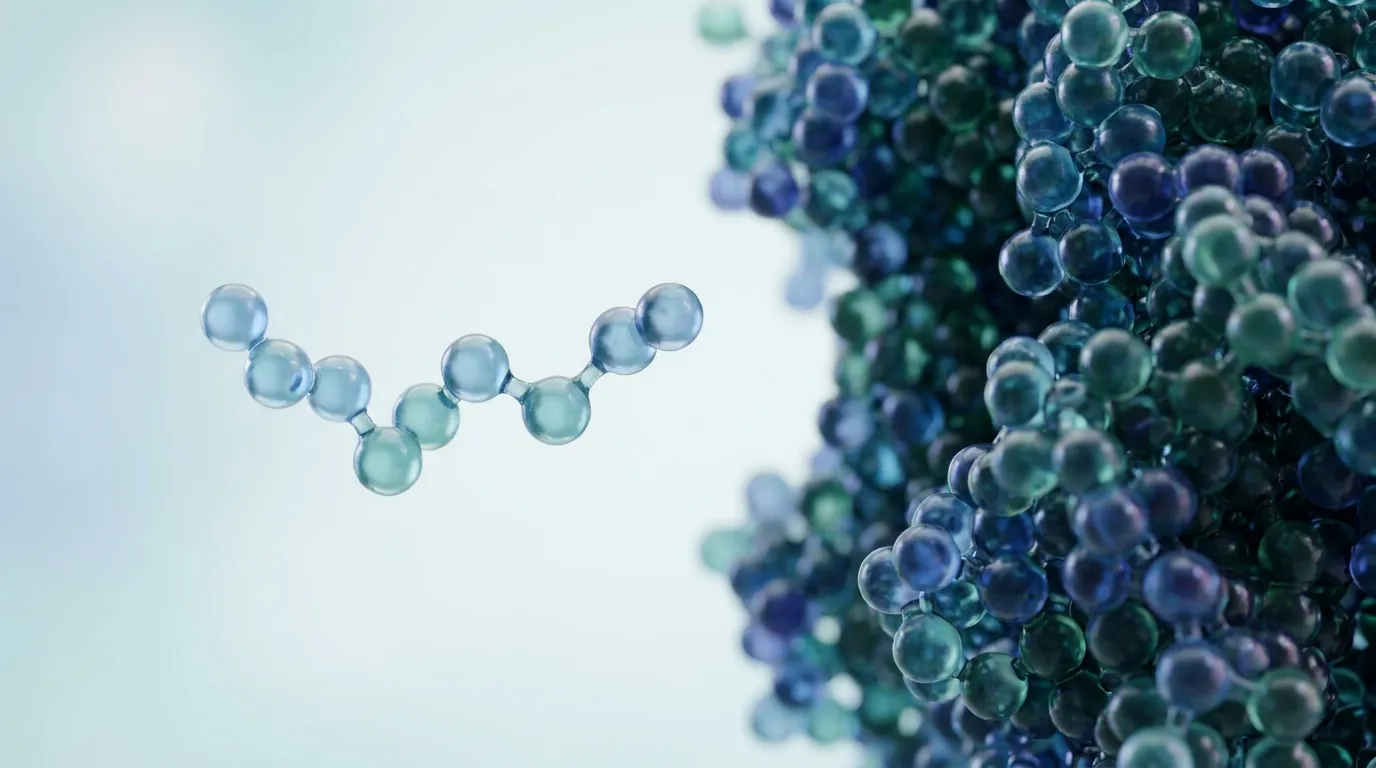
Citation capsule. A peptide is a short chain of amino acids joined by peptide bonds, typically up to roughly 50 amino acids. It is the same chemistry as a protein, only shorter; chains of fewer than 20 amino acids are called oligopeptides, and chains with a molecular mass of about 10,000 daltons or more are usually called proteins. Source: Wikipedia, "Peptide," 2026.
How are peptides different from proteins?
The difference is mostly size: peptides are short amino acid chains, while proteins are long ones that fold into a complex 3D structure. There is no single hard line, but a common convention treats chains of up to about 50 amino acids as peptides and longer chains as proteins.
Beyond raw length, the practical difference is folding and function. A protein like an antibody or an enzyme folds into an intricate shape that does its job. A peptide is usually too short to fold into that kind of stable structure, so it tends to act more like a key or a signal than a machine. Some references draw the line by molecular weight instead, classifying chains with a molecular mass of roughly 10,000 daltons or more as proteins (Wikipedia, "Peptide", retrieved 2026-06-15).
It helps to see all three sizes on one scale: a single amino acid, a short peptide, and a folded protein.
One more distinction worth knowing: amino acids, peptides, and proteins are a continuum, not separate worlds. A peptide is just the in-between size. For the deeper question of how these molecules actually create effects in the body, see our dedicated guide on how peptides work.
How do peptides differ from amino acids?
An amino acid is a single building block; a peptide is two or more of those blocks joined together. If a peptide is a short word, an amino acid is a single letter. You cannot make a peptide without amino acids, and you cannot make a protein without peptides as the intermediate stage.
This matters because supplement labels blur the terms. "Amino acid" supplements (like BCAAs) provide individual building blocks. "Collagen peptides" provide short pre-joined chains. "Protein powder" provides whole proteins your gut then breaks back down into peptides and amino acids. All three are the same family of chemistry at different chain lengths.
How are peptides made and where do they come from?
Peptides come from two places: your own body makes them naturally, and labs make them synthetically to copy or redesign those natural signals. Understanding both explains why an identical-sounding molecule can be a hormone in your blood and a product in a vial.
In the body, peptides are built in two main ways. Most are ribosomal peptides, assembled by the cell's ribosome by reading a gene, which is how hormones and many signaling peptides are produced. A smaller group are nonribosomal peptides, stitched together directly by specialized enzymes rather than from a gene (Wikipedia, "Peptide", retrieved 2026-06-15). Either way, the body is constantly making and breaking these chains as part of normal metabolism.
In the lab, the dominant method is solid-phase peptide synthesis (SPPS), where chemists add amino acids one at a time onto a tiny solid bead to grow a chain in a precise, repeatable order; larger peptides and proteins can also be produced by recombinant methods using engineered cells (Wikipedia, "Peptide", retrieved 2026-06-15). After synthesis, peptides are typically purified and freeze-dried into a powder (a process called lyophilization) so they stay stable in shipping and storage. The practical side of that powder, mixing it with bacteriostatic water and storing it correctly, is its own topic; see getting started with peptides and how to vet peptide quality.
What are the main types of peptides?
Peptides are grouped both by their chemistry (how long or how they are shaped) and by what they do in the body. For a beginner, the "what they do" grouping is the most useful, because it maps onto the peptides you will actually hear about.
By structure, the common labels are simple counts and shapes: oligopeptides (fewer than twenty amino acids), polypeptides (many), and cyclic peptides (chains joined into a ring, which can make them more stable) (Wikipedia, "Peptide", retrieved 2026-06-15).
By function, here are the categories most people encounter, with real examples:
| Category | What it does | Familiar examples |
|---|---|---|
| Hormone / metabolic | Regulate blood sugar, appetite, and metabolism | Insulin; GLP-1 drugs (semaglutide, tirzepatide) |
| Growth-hormone related | Signal the body's own growth-hormone system | Sermorelin, ipamorelin, CJC-1295 |
| Repair / recovery | Studied for tissue and injury repair | BPC-157, TB-500 (research peptides) |
| Cosmetic / skin | Used in topicals for skin and collagen | Copper peptides (GHK-Cu), "signal" peptides in creams |
| Antimicrobial / immune | Part of the body's natural defenses | Defensins (natural); thymosin alpha-1 |
| Neuropeptides | Act as signals in the brain and nervous system | Oxytocin, endorphins (natural) |
A key takeaway from this table: the word "peptide" covers everything from a century-old approved medicine to an ingredient in a face cream to a compound only sold for laboratory research. They are not interchangeable in safety, evidence, or legality.
What do peptides do in the body?
Most natural peptides act as messengers: small molecules that tell cells what to do, like raise or lower blood sugar, signal hunger, or kick off repair. Because they are so specific, a tiny amount can produce a precise, powerful effect.
The classic example is insulin, a peptide of 51 amino acids that tells your cells to take up glucose from the blood. Insulin was the first therapeutic peptide, synthesized in 1921, and it remains one of the most consequential discoveries in medicine (Nature, Signal Transduction and Targeted Therapy, "Therapeutic peptides: current applications and future directions", 2022, retrieved 2026-06-15). Other natural signaling peptides include glucagon (raises blood sugar), oxytocin (involved in bonding and labor), and the endorphins (pain and mood).
This "messenger" role is exactly why lab-made peptides are interesting: if you can copy or tweak a natural signal, you can potentially turn a specific process up or down. We keep the mechanism light here on purpose. The receptor-and-signaling detail lives in our how peptides work guide, so this page stays a clean overview.
A short history: how peptides went from insulin to GLP-1
Peptides have been medicines for over a century, but the current consumer wave is recent, driven by GLP-1 weight-loss drugs. Knowing the timeline helps separate proven, decades-old peptide medicine from today's fast-moving and largely unproven wellness market.
A few anchor points put the field in context:
- 1921: Insulin is synthesized as the first therapeutic peptide, launching the entire class (Nature, 2022, retrieved 2026-06-15).
- Decades since: Peptide medicines steadily expand into diabetes, cancer, and bone disease, reaching more than 80 approved peptide drugs worldwide (Nature, 2022, retrieved 2026-06-15).
- 2023: The FDA approves five new peptide drugs in a single year, including trofinetide (Daybue), the first-ever treatment for Rett syndrome (Journal of Peptide Science / PMC, "2023 FDA TIDES Harvest", 2024, retrieved 2026-06-15).
- Now: GLP-1 drugs like semaglutide and tirzepatide make "peptide" a household word, and a large unregulated "research peptide" market grows alongside the approved medicines.
That split, between a mature pharmaceutical history and a brand-new and largely untested consumer scene, is the backdrop for everything else on this page.
Why do people use peptides?
People use peptides for two very different reasons: as established, approved medicines and as experimental wellness or performance compounds. The first group has decades of evidence; the second is far less proven and far less regulated.
On the medicine side, peptides are a major and growing drug class. More than 80 peptide drugs have reached the market worldwide for conditions including diabetes, cancer, and osteoporosis (Nature, Signal Transduction and Targeted Therapy, "Therapeutic peptides: current applications and future directions", 2022, retrieved 2026-06-15). In 2023 alone, the FDA approved five new peptide drugs, including the first-ever treatment for Rett syndrome (Journal of Peptide Science / PMC, "2023 FDA TIDES (Peptides and Oligonucleotides) Harvest", 2024, retrieved 2026-06-15). The category is large enough that market analysts valued the global peptide therapeutics market at about 42.5 billion US dollars in 2023, projecting it to reach roughly 101.7 billion by 2033 at a 9.1 percent annual growth rate (Market.us, "Peptide Therapeutics Market", 2024, retrieved 2026-06-15).
On the wellness and performance side, people turn to peptides hoping for benefits like fat loss, muscle recovery, better skin, sleep, or anti-aging effects. Major medical centers are clear that many of these "trendy" peptides have not been tested enough to confirm they are safe or that they work, and most are not FDA-approved for those uses (Baptist Health, "What Are Peptides?", 2024, retrieved 2026-06-15). That honest gap, between hope and proof, is the single most important thing to carry into any peptide research.
Are there peptides in food?
Yes. Some peptides come from your diet, and "collagen peptides" are the most common example sold as a supplement. These are food-grade peptides, eaten and digested, and they sit in a completely different world from injectable research compounds.
When you eat protein, your gut breaks it down into peptides and amino acids during digestion, and some short food-derived peptides (called bioactive peptides) are studied for mild effects on blood pressure or other functions. Collagen peptides are simply collagen protein broken into shorter chains so it dissolves easily; people add them to drinks hoping for skin or joint benefits. The key beginner point: a peptide you swallow as food is regulated, sold, and used very differently from a peptide drawn into a syringe, even though both are "peptides" by chemistry.
How are peptides taken?
Many peptides are injected, because if you swallow them your digestive system breaks them down before they can work. That single fact explains most of what beginners find confusing about peptide use.
Your gut is built to digest protein, so it treats a peptide the same way: enzymes chop the amino acid chain into pieces, which destroys the signal before it reaches the bloodstream. To get around this, peptide medicines and research compounds are commonly given by subcutaneous injection (a small shot under the skin). Some are delivered as nasal sprays or topical creams (common for skin peptides), some come as ingestible powders, and a few newer drugs have been engineered to survive as pills, which is a notable exception rather than the rule (ColumbiaDoctors, "What to Know About Peptides", 2024, retrieved 2026-06-15).
This guide stays at the overview level on administration. The full practical walkthrough, including reconstitution and injection technique, lives in our peptide injections guide, and a beginner roadmap is in getting started with peptides.
Are peptides safe and legal?
It depends entirely on the specific peptide. Some are approved, prescription-only medicines; many sold online are unapproved "research" compounds with little human safety data and uncertain legal status. There is no single answer that covers "peptides" as a category, and anyone who gives you one is oversimplifying.
On safety, the honest picture from major medical centers is mixed. Approved peptide medicines like insulin and GLP-1 drugs have extensive safety data from clinical trials. By contrast, synthetic peptide use in humans for wellness is still new, with very limited research, and most available evidence comes from laboratory and animal studies. Documented side effects of peptide supplements can include injection-site reactions, headaches, fatigue, and nausea, with longer-term effects often simply unknown (ColumbiaDoctors, "What to Know About Peptides", 2024, retrieved 2026-06-15). No responsible source calls research peptides "safe" in a blanket way.
On legality, status varies by compound and country. A peptide can be an approved prescription drug, an ingredient permitted in cosmetics, or a substance sold only "for research use, not for human consumption." Many are also treated as performance-enhancing substances and banned by national and international sports bodies (ColumbiaDoctors, "What to Know About Peptides", 2024, retrieved 2026-06-15). Because the unregulated market also has real quality and contamination risks, two of the most important beginner skills are understanding the rules and checking what you are actually buying. We cover those in depth in are peptides legal? and how to vet peptide quality.
Our take: The most common beginner mistake is treating "peptides" as one thing. Insulin and an unapproved research powder are both technically peptides, but they could not be further apart in evidence, oversight, and risk. Always ask about the specific compound, never the category.
Key peptide terms, in one place
A handful of words come up constantly once you start reading about peptides; here is a plain-language quick reference. None of these are instructions to use anything; they just let you read accurately.
| Term | Plain meaning |
|---|---|
| Amino acid | A single building block; 20 standard ones make up human peptides and proteins. |
| Peptide bond | The chemical link joining two amino acids, formed by releasing a water molecule. |
| Sequence | The specific order of amino acids, which gives a peptide its identity and job. |
| Oligopeptide | A short chain, fewer than about 20 amino acids. |
| Polypeptide | A longer chain of many amino acids, on the way to a protein. |
| Cyclic peptide | A chain joined into a ring, often more stable than a straight chain. |
| Lyophilized | Freeze-dried into a powder for stability; "reconstituting" means mixing it back into liquid. |
| Research peptide | A peptide sold "for research use only," not approved for human use. |
For a fuller list, see our peptide terminology and glossary.
A quick orientation checklist for beginners
Before going deeper than this overview, get clear on a few basics for whatever specific peptide you are researching. This is orientation, not instructions to use anything.
- Identify the exact compound. Get its full name and, ideally, its sequence or molecular identity, not just a marketing label.
- Find its regulatory status. Is it FDA-approved for a use, sold as a cosmetic ingredient, or "research use only"? See are peptides legal?.
- Look for real evidence. Human clinical trials beat animal studies, which beat anecdotes. Separate hope from proof.
- Understand the quality question. Unregulated products vary widely, so learn what a certificate of analysis is in how to vet peptide quality.
- Talk to a clinician. A qualified healthcare professional can weigh your specific situation, interactions, and contraindications.
Frequently Asked Questions
The bottom line
A peptide is simply a short chain of amino acids, the same building blocks as protein, just shorter. That one idea makes sense of the whole topic: insulin, a GLP-1 weight-loss drug, a copper peptide in a serum, and an unapproved research powder are all peptides, yet they sit worlds apart in evidence, oversight, and risk. The chemistry is shared; the safety and legality are not.
If you remember one thing, make it this: never reason about "peptides" as a category. Reason about the specific compound in front of you, its approval status, and the actual evidence behind it. From here, the natural next steps are understanding how peptides work, the legal and research-chemical status, and how to vet peptide quality before anything else. And for anything you might consider using, talk to a qualified healthcare professional first.
Sources
- Wang L, Wang N, Zhang W, et al. "Therapeutic peptides: current applications and future directions." Signal Transduction and Targeted Therapy (Nature), 2022. Retrieved 2026-06-15. https://www.nature.com/articles/s41392-022-00904-4
- Al Musaimi O, et al. "2023 FDA TIDES (Peptides and Oligonucleotides) Harvest." Pharmaceuticals / PMC, 2024. Retrieved 2026-06-15. https://pmc.ncbi.nlm.nih.gov/articles/PMC10893093/
- Market.us. "Peptide Therapeutics Market Size, Share | CAGR of 9.1%." 2024. Retrieved 2026-06-15. https://market.us/report/peptide-therapeutics-market/
- Wikipedia. "Peptide." Retrieved 2026-06-15. https://en.wikipedia.org/wiki/Peptide
- Baptist Health. "What Are Peptides? Benefits, Risks and What to Know." 2024. Retrieved 2026-06-15. https://www.baptisthealth.com/blog/primary-care/what-are-peptides-and-whats-all-the-buzz-about
- ColumbiaDoctors (Columbia University Department of Surgery). "What to Know About Peptides: Benefits & Safety Concerns." 2024. Retrieved 2026-06-15. https://www.columbiadoctors.org/news/what-know-about-peptides-benefits-safety-concerns
- Medical News Today. "Peptides: What are they, uses, and side effects." Retrieved 2026-06-15. https://www.medicalnewstoday.com/articles/326701
- WebMD. "What Are Peptides?" Retrieved 2026-06-15. https://www.webmd.com/a-to-z-guides/what-are-peptides