
Peptide Glossary: Key Terms and Definitions for Beginners
Start reading about peptides and you hit a wall of jargon fast: BAC water, reconstitution, lyophilized, subQ, half-life, agonist, secretagogue, COA. None of it is hard once someone defines it plainly, but most sources assume you already know. This glossary fixes that. It collects the terms a beginner actually meets, in one scannable place, each defined in plain English and sourced where a real definition exists.
This is a reference page, not a how-to. It pairs naturally with our overview of what peptides are and the deeper explainer on how peptides work, which give the concepts these terms label. The goal is simple: after reading it, you should be able to follow a peptide forum thread, a product page, or a research summary without getting lost. Each entry links out to the deeper guide where the topic has one, so you can go further when you want to. Nothing here is an instruction to use anything.
Key Takeaways
- A peptide is a short chain of amino acids joined by peptide bonds, typically up to around 50 amino acids; longer folded chains are usually called proteins (Wikipedia, "Peptide").
- The terms split into four families: chemistry (amino acid, peptide bond, sequence, oligopeptide vs polypeptide), practical handling (lyophilized, reconstitution, BAC water, subQ, IM, intranasal), pharmacology (agonist, secretagogue, half-life, bioavailability, Cmax/Tmax), and quality (COA, HPLC, mass spectrometry, purity).
- "Lyophilized" and "reconstitution" matter most in practice because the vast majority of peptides people track arrive as a freeze-dried powder that must be mixed with liquid before use.
- "Agonist" and "secretagogue" describe how a peptide acts: an agonist switches a receptor on directly; a secretagogue nudges your body to release more of its own hormone.
- Chain length sets the names: an oligopeptide is short (roughly 2 to 20 amino acids), a polypeptide is longer (roughly 20+), and once a long chain folds into a stable 3D shape it is usually called a protein (Wikipedia, "Peptide").
- A COA (Certificate of Analysis) is a lab test report for a specific batch; learning to read one is a core skill in an unregulated market. See how to vet peptide quality.
- A peptide is not a SARM and not a steroid. A SARM is a non-peptide small molecule that binds the androgen receptor; the chemistry, legality, and risks are different. See are peptides legal.
- This page only defines terms. It is not medical advice and does not endorse self-use of any compound.
How to use this glossary
Use it as a lookup, not a read-through: skim to the term you hit, get the plain-English meaning, then follow the link if you want depth. The entries below are grouped first by the four families most beginners run into, then the full list is repeated in a single alphabetical cheat-sheet table at the end so you can scan A-to-Z.
A few conventions used throughout this page:
- Plain meaning first. Each entry leads with a one-sentence definition you can act on, then adds context only if it helps.
- Sourced where a real definition exists. Chemistry and pharmacology terms cite an authority (NIH-indexed references, peer-reviewed sources, standard pharmacology). Community-handling terms (the way a word is used in practice) are labeled as community/convention, because that is what they are.
- Links go to the owning guide. Where a term has its own deep article, the entry links there rather than duplicating it, so this page stays a clean glossary.
Citation capsule. A peptide glossary for beginners covers four families of terms: chemistry (amino acid, peptide bond, sequence, oligopeptide vs polypeptide, cyclic peptide, analog, peptidomimetic), practical handling (lyophilized, reconstitution, bacteriostatic water, diluent, subcutaneous, intramuscular, intranasal), pharmacology (agonist, antagonist, secretagogue, half-life, bioavailability, Cmax, Tmax, melanocortin and GLP-1 receptor classes), and quality assurance (Certificate of Analysis, HPLC, mass spectrometry, purity, research-use-only labeling). The most practically important pair for newcomers is "lyophilized" and "reconstitution," because most research peptides ship as a freeze-dried powder. Source: ProtocolPlus, "Peptide Glossary," 2026.
Core chemistry terms
These terms describe what a peptide physically is: the building blocks, the bonds, and the way length changes the name. Get these four and the rest of the science reads much more easily.
A peptide is a short chain of amino acids linked by peptide bonds, typically up to roughly 50 amino acids; chains that grow longer and fold into a 3D shape are usually called proteins (Wikipedia, "Peptide", retrieved 2026-06-15). For the full beginner explainer, see what are peptides.
| Term | Plain-English definition |
|---|---|
| Amino acid | A single building block of peptides and proteins. There are 20 standard ones the human body uses; their order defines a peptide's identity (Wikipedia, "Peptide"). |
| Peptide bond | The chemical link that joins two amino acids, formed when they bond and release a molecule of water (Wikipedia, "Peptide"). |
| Sequence | The specific order of amino acids in a chain. The sequence is the peptide's "spelling" and determines what it does. |
| Residue | The technical word for one amino acid unit inside a chain; a "12-residue peptide" has 12 amino acids. |
| Carrier peptide | A peptide attached to another molecule mainly to ferry it or extend how long it lasts in the body. |
| N-terminus / C-terminus | The two ends of a peptide chain: the N-terminus has a free amino group, the C-terminus a free carboxyl group. Sequences are written N-to-C by convention. |
| Peptide vs protein | A matter of size and folding. Short chains are peptides; long chains that fold into a stable 3D structure are proteins. The ~50-amino-acid line is a convention, not a hard rule (Wikipedia, "Peptide"). |
| Oligopeptide | A short peptide defined by chain length: usually about 2 to 20 amino acids ("oligo" means "few"). Many signaling peptides and the popular research peptides sit in this range (Wikipedia, "Peptide"). |
| Polypeptide | A longer single chain, defined by chain length: roughly 20 or more amino acids ("poly" means "many"), on the way to being called a protein once it folds into a stable shape (Wikipedia, "Peptide"). The oligopeptide/polypeptide line is a convention of length, not a hard chemical rule. |
| Cyclic peptide | A peptide whose chain is joined into a ring rather than a straight line, which can make it more stable and resistant to enzymes (Wikipedia, "Cyclic peptide", retrieved 2026-06-15). |
| Analog | A peptide deliberately modified from a natural one to change its stability, potency, or duration. Many drugs are analogs of a natural hormone (for example, a longer-lasting GLP-1 analog). |
| Peptidomimetic | A molecule designed to copy a peptide's shape and action but built so it resists breakdown and can sometimes survive being swallowed. It mimics a peptide without being a normal peptide chain (Wikipedia, "Peptidomimetic", retrieved 2026-06-15). |
| PEGylation | Attaching a polyethylene glycol (PEG) chain to a peptide to slow its clearance and extend its half-life. It is a common way to turn a short-acting peptide into a longer-lasting drug. |
| Fusion peptide / conjugate | A peptide joined to another molecule (such as a carrier protein or a second peptide) to change how long it lasts or what it targets. |
| Endogenous vs exogenous | Endogenous means made inside your body; exogenous means introduced from outside (a dose). Insulin is endogenous when your pancreas makes it and exogenous when injected. |
| Peptide vs SARM | A peptide is an amino acid chain; a SARM (selective androgen receptor modulator) is a non-peptide small molecule that targets the androgen receptor. They are different chemistry with different legal status and risks, and are often grouped together only because both are sold in the same "research compound" market. See are peptides legal. |
For the deeper "how a peptide creates an effect" science, see how peptides work.
Practical handling terms (the ones you hit first)
These are the words that appear the moment you look at an actual product: what the powder is, what you mix it with, and how it is given. They are mostly handling conventions rather than formal science, so we label them honestly as common community/clinical usage.
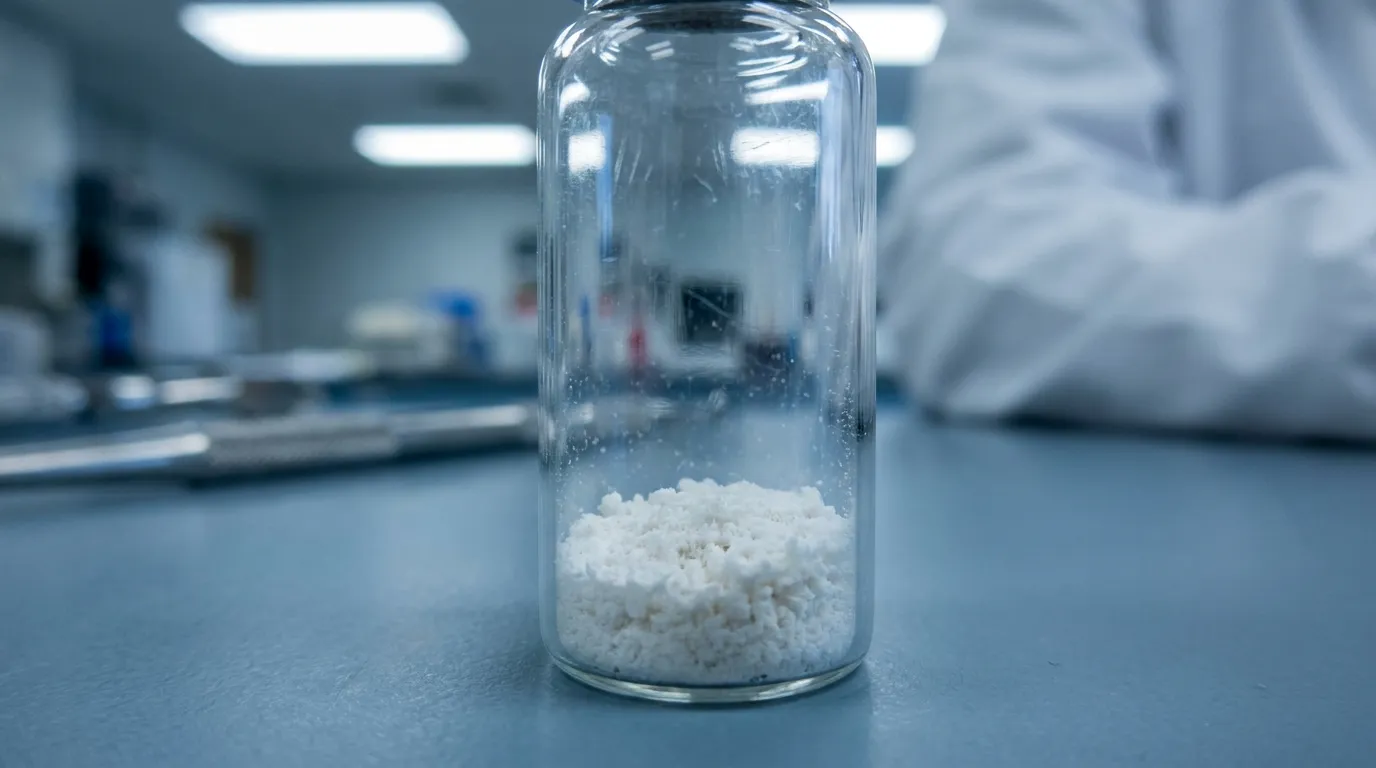
Most research peptides arrive as a lyophilized (freeze-dried) powder, which has to be reconstituted (mixed back into liquid) before it can be drawn into a syringe. That single fact is why the next few terms come up constantly.
| Term | Plain-English definition |
|---|---|
| Lyophilized | Freeze-dried into a dry powder. Lyophilization removes water by freezing then sublimation, which protects fragile molecules and extends shelf life, leaving a porous "cake" that rehydrates quickly (Wikipedia, "Freeze-drying", retrieved 2026-06-15). |
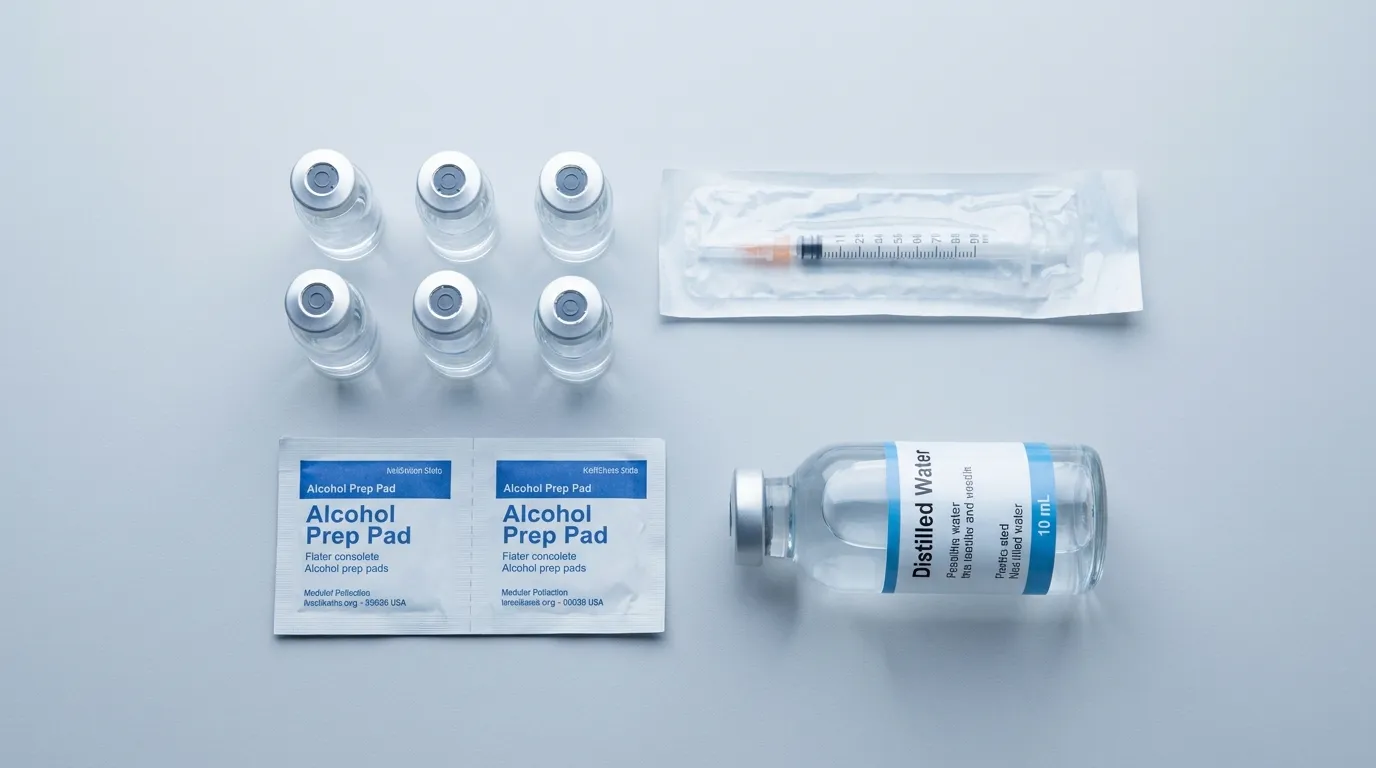
| Reconstitution | Mixing a lyophilized powder with a sterile liquid to make a solution. How much liquid you add sets the concentration (more liquid = more dilute). Community/clinical term. |
| Bacteriostatic (BAC) water | Sterile water that contains 0.9% benzyl alcohol as a preservative, which inhibits bacterial growth and allows a vial to be used over multiple doses (Wikipedia, "Bacteriostatic water", retrieved 2026-06-15). |
| Sterile water (SWFI) | Plain sterile water for injection with no preservative. It is single-use because it cannot resist bacterial growth once opened. Community/clinical term. |
| Diluent | The general word for whatever liquid you add to a powder to dissolve it. For peptides the diluent is usually bacteriostatic or sterile water. Community/clinical term. |
| Subcutaneous (subQ / SC) | An injection into the fatty tissue layer just under the skin. Absorption is slower than intramuscular but steadier (Wikipedia, "Subcutaneous injection", retrieved 2026-06-15). |
| Intramuscular (IM) | An injection into a muscle, which generally absorbs faster than subcutaneous (Wikipedia, "Subcutaneous injection"). |
| Intravenous (IV) | An injection directly into a vein, which reaches the bloodstream immediately. It is a clinical route and is generally not a casual at-home one. Clinical term. |
| Intranasal | Delivery as a spray into the nose rather than by needle. Some peptides are studied or used as nasal sprays; bioavailability by this route varies and is usually lower than injection. Community/clinical term. |
| Oral | Taken by mouth. Most peptides survive digestion poorly, so oral forms are the exception and usually need special engineering (see peptidomimetic). |
| Insulin syringe / units (IU) | A small syringe marked in "units" (100 units = 1 mL on a U-100 syringe). People often measure peptide doses in these units; a unit is a volume mark, not a dose of the drug itself. Community convention. |
| mcg vs mg | Units of weight for a dose. 1 mg = 1,000 mcg (micrograms). Many research peptides are dosed in mcg, which is why a tiny number can still be a full dose. |
| Titration | Starting low and increasing a dose gradually over time. In trials, GLP-1 drugs are titrated up to reduce side effects. Described in trials; not a personal instruction. |
| Stack / blend | Using more than one peptide together (a "stack"), or buying them pre-mixed in one vial (a "blend"). Community term. |
| Depot | A reservoir of slowly released drug. A "depot effect" describes a dose that absorbs gradually from the injection site rather than all at once, stretching out its action. |
The full hands-on walkthrough (mixing math, syringe technique, sites) lives in the peptide injections guide and the beginner roadmap in getting started with peptides. This page only defines the words.
Pharmacology terms (how a peptide acts)
These words describe the mechanism: whether a peptide turns a receptor on, blocks it, nudges your body to release its own hormone, and how long it lasts. They are the terms that separate one peptide's "personality" from another's.
The two you will see most are agonist and secretagogue, and people mix them up. An agonist binds a receptor and activates it directly; a secretagogue does not act at the target receptor itself but signals your body to secrete more of its own hormone.
| Term | Plain-English definition |
|---|---|
| Receptor | A protein on or in a cell that, when activated, makes the cell change what it is doing (Wikipedia, "Agonist", retrieved 2026-06-15). |
| Agonist | A molecule that activates a receptor to produce a biological response (Wikipedia, "Agonist"). GLP-1 drugs are GLP-1 receptor agonists. |
| Partial agonist | A molecule that activates a receptor but only partially, producing a weaker maximum effect than a full agonist (Wikipedia, "Agonist"). |
| Antagonist | A molecule that binds a receptor and blocks it, preventing the response without producing one itself (Wikipedia, "Agonist"). |
| Dual / triple agonist | A single molecule that activates two or three receptors at once. Tirzepatide is a GLP-1/GIP dual agonist; retatrutide is a GLP-1/GIP/glucagon triple agonist. |
| Secretagogue | A compound that stimulates your body's own secretion of a hormone rather than supplying it directly. Growth-hormone secretagogues (for example ipamorelin, MK-677) prompt the body to release its own growth hormone (ScienceDirect, "Growth Hormone-Releasing Peptides and Their Analogs", retrieved 2026-06-15). |
| GHRH analog | A peptide built to mimic growth-hormone-releasing hormone (for example sermorelin, tesamorelin, CJC-1295), telling the pituitary to release growth hormone. |
| GHRP | Growth-hormone-releasing peptides (for example GHRP-2, GHRP-6, ipamorelin, hexarelin): a separate family that releases growth hormone through a different receptor than GHRH (ScienceDirect). |
| GLP-1 | Glucagon-like peptide-1, a natural gut hormone that lowers blood sugar and reduces appetite. "GLP-1 receptor agonist" drugs (semaglutide, liraglutide) copy its action (Wikipedia, "Glucagon-like peptide-1", retrieved 2026-06-15). |
| GIP | Glucose-dependent insulinotropic polypeptide, a second incretin gut hormone. Some drugs (tirzepatide) hit both GLP-1 and GIP receptors. |
| Incretin | The umbrella term for gut hormones (GLP-1 and GIP) that boost insulin release after eating. "Incretin drugs" is the broad name for the GLP-1 and GLP-1/GIP class. |
| Glucagon | A hormone that raises blood sugar, the counterpart to insulin. A "triple agonist" like retatrutide adds the glucagon receptor to GLP-1 and GIP. |
| Melanocortin | A receptor family (MC1R through MC5R) involved in skin pigmentation, appetite, and sexual function. Melanocortin agonists are the class behind tanning and libido-focused peptides (for example melanotan, PT-141) (Wikipedia, "Melanocortin receptor", retrieved 2026-06-15). |
| Half-life | The time it takes for the amount of a substance in the blood to fall to half its peak. A longer half-life generally means less frequent dosing (Wikipedia, "Biological half-life", retrieved 2026-06-15). |
| Pharmacokinetics (PK) | What the body does to a drug over time: absorption, distribution, metabolism, and elimination. |
| Bioavailability | The fraction of a dose that actually reaches the bloodstream intact. It is why most peptides are injected: swallowed, very little survives digestion. |
| Cmax | The peak (maximum) concentration a dose reaches in the bloodstream. A core pharmacokinetic measure, "the maximum (or peak) serum concentration that a drug achieves" after dosing (Wikipedia, "Cmax (pharmacology)", retrieved 2026-06-15). |
| Tmax | The time it takes after a dose to reach Cmax, the peak concentration. A short Tmax means a fast-acting compound; a long Tmax means a slower, more gradual one (Wikipedia, "Tmax (pharmacology)", retrieved 2026-06-15). |
We keep mechanism light here on purpose; the receptor-and-signaling detail has its own home in how peptides work.
Quality and testing terms
These terms are about trust: how you tell whether what is in the vial matches the label, in a market with little oversight. In an unregulated space, reading a test report is one of the most valuable beginner skills.
The anchor term is the COA, a Certificate of Analysis: a lab report for a specific batch that states what was tested and what was found. The deep skill of actually reading one, including its limits, lives in how to vet peptide quality.
- COA (Certificate of Analysis): A batch-specific lab report documenting a product's identity and purity. A COA is only as good as the lab and the batch it covers; a generic or undated one tells you little. (Community/industry term.)
- Purity: The percentage of the sample that is the intended peptide rather than impurities. Often reported from an HPLC test (for example, "98% by HPLC").
- HPLC (high-performance liquid chromatography): A standard lab technique that separates a sample's components to measure how much is the target peptide versus impurities (BioLongevity Labs, "Peptide Glossary", retrieved 2026-06-15).
- Mass spectrometry (MS): A technique that measures molecular weight to confirm the peptide's identity (that it is the right molecule) (BioLongevity Labs, "Peptide Glossary").
- Third-party testing: Testing done by an independent lab rather than the seller, which carries more weight than a vendor's own claim.
- Research use only (RUO): A label meaning a product is sold for laboratory research and is not approved or intended for human consumption. It is a regulatory/legal status, not a safety rating. See are peptides legal.
- "Not for human consumption": A near-identical disclaimer to RUO that appears on many research peptides. It is a legal-status label, not a comment on the actual contents, and it is part of why this market sits in a gray zone. See are peptides legal.
- Net peptide content: The fraction of the powder's weight that is actually peptide, the rest being water, salts, or counter-ions left from manufacturing. It is why "5 mg in the vial" is not always 5 mg of peptide.
- Acetate / TFA salt: Peptides are often supplied as a salt (acetate or trifluoroacetate) left over from purification. The salt form is normal; it is one of the things that makes net peptide content lower than the labeled milligrams.
- Endotoxin: A bacterial contaminant a quality lab may test for. Low endotoxin is one marker a serious manufacturer can document on a COA.
- Reconstitution stability / shelf life: How long a peptide stays intact, which differs before mixing (as a dry powder) versus after (in solution). Storage temperature drives this.
Our take: If you only learn to read one document in this whole field, make it the COA. In a market with no gatekeeper, a real, recent, batch-matched test report from an independent lab is the closest thing to a quality guarantee you will get, and knowing what it cannot tell you matters just as much.
How much of this vocabulary you actually need
Most beginners need maybe a dozen of these terms day to day; the rest are for reading deeper. The practical-handling family does the heavy lifting because almost everything in the community arrives as a freeze-dried injectable, while the chemistry and quality families come up when you want to understand or vet a compound.
Inside the ProtocolPlus app, the breadth of what people track shows why: across 41 distinct compounds, the same handful of words (lyophilized, reconstitution, BAC water, subQ, agonist, secretagogue) recur again and again because they describe how those compounds are handled and how they act.
A quick way to decode any new peptide term
When you meet a term this glossary missed, sort it into one of the four families and you can usually figure out what it is asking. Most peptide vocabulary falls into chemistry, handling, pharmacology, or quality, and the family tells you what kind of answer to look for.
- Is it describing what the molecule is? That is a chemistry term (amino acid, sequence, cyclic). Look it up in a biochemistry reference.
- Is it about preparing or giving it? That is a handling term (lyophilized, reconstitution, subQ). Treat it as community/clinical convention and check a practical guide.
- Is it about how it acts or how long it lasts? That is pharmacology (agonist, half-life, bioavailability). Standard pharmacology definitions apply.
- Is it about proving what is in the vial? That is a quality term (COA, HPLC, purity). Read it skeptically and look for independent testing.
- Still unsure, or is it a specific compound name? Identify the exact compound, then check its regulatory status and the real evidence before anything else.
The full glossary, A to Z
Here is every term above in one alphabetical cheat-sheet for fast lookup. Family tags (Chem / Handle / Pharm / Quality) tell you which kind of term it is.
| Term | Family | Plain meaning |
|---|---|---|
| Acetate / TFA salt | Quality | Salt form a peptide is supplied in; lowers net peptide content. |
| Agonist | Pharm | Activates a receptor to produce a response. |
| Amino acid | Chem | A single building block of peptides; 20 standard ones. |
| Analog | Chem | A modified version of a natural peptide. |
| Antagonist | Pharm | Blocks a receptor instead of activating it. |
| Bacteriostatic (BAC) water | Handle | Sterile water with 0.9% benzyl alcohol; supports multi-dose use. |
| Bioavailability | Pharm | Fraction of a dose that reaches the blood intact. |
| C-terminus | Chem | The carboxyl end of a peptide chain. |
| Carrier peptide | Chem | A peptide attached to another molecule to ferry it or extend duration. |
| Cmax | Pharm | The peak (maximum) blood concentration a dose reaches. |
| COA (Certificate of Analysis) | Quality | Batch-specific lab report of identity and purity. |
| Cyclic peptide | Chem | A chain joined into a ring; often more stable. |
| Depot | Handle | A slow-release reservoir of drug at the injection site. |
| Diluent | Handle | The liquid added to a powder to dissolve it (usually BAC or sterile water). |
| Dual / triple agonist | Pharm | One molecule that activates 2 or 3 receptors at once. |
| Endogenous / exogenous | Chem | Made inside the body / introduced from outside. |
| Endotoxin | Quality | Bacterial contaminant a quality lab may test for. |
| Fusion peptide / conjugate | Chem | A peptide joined to another molecule to change targeting or duration. |
| GHRH analog | Pharm | Mimics growth-hormone-releasing hormone. |
| GHRP | Pharm | Growth-hormone-releasing peptide (separate receptor). |
| GIP | Pharm | Glucose-dependent insulinotropic polypeptide; a second incretin hormone. |
| GLP-1 | Pharm | Glucagon-like peptide-1; gut hormone behind the "GLP-1 agonist" drug class. |
| Glucagon | Pharm | Hormone that raises blood sugar; a target of triple agonists. |
| Half-life | Pharm | Time for a blood level to fall by half. |
| HPLC | Quality | Lab method to measure purity. |
| Incretin | Pharm | Gut-hormone class (GLP-1, GIP) that boosts insulin after eating. |
| Insulin syringe / units (IU) | Handle | Small syringe marked in volume "units" (U-100: 100 = 1 mL). |
| Intramuscular (IM) | Handle | Injection into muscle; absorbs faster than subQ. |
| Intranasal | Handle | Delivery as a nasal spray rather than by needle. |
| Intravenous (IV) | Handle | Injection directly into a vein; reaches blood immediately. |
| Lyophilized | Handle | Freeze-dried into a dry powder. |
| Mass spectrometry (MS) | Quality | Confirms a peptide's identity by molecular weight. |
| mcg vs mg | Handle | Weight units; 1 mg = 1,000 mcg. |
| Melanocortin | Pharm | Receptor family (MC1R-MC5R) behind tanning and libido peptides. |
| N-terminus | Chem | The amino end of a peptide chain. |
| Net peptide content | Quality | Share of vial weight that is actually peptide, not salts or water. |
| "Not for human consumption" | Quality | Legal disclaimer like RUO; not a comment on contents. |
| Oligopeptide | Chem | A short peptide, about 2 to 20 amino acids. |
| Oral | Handle | Taken by mouth; uncommon for peptides because digestion destroys them. |
| Partial agonist | Pharm | Activates a receptor only partway. |
| Peptide | Chem | A short chain of amino acids (up to ~50). |
| Peptide bond | Chem | The link joining two amino acids. |
| Peptide vs SARM | Chem | Peptide = amino acid chain; SARM = non-peptide androgen-receptor molecule. |
| Peptidomimetic | Chem | A non-peptide molecule that copies a peptide's shape and action. |
| PEGylation | Chem | Adding a PEG chain to extend a peptide's half-life. |
| Pharmacokinetics (PK) | Pharm | What the body does to a drug over time. |
| Polypeptide | Chem | A longer single chain, roughly 20+ amino acids. |
| Purity | Quality | Percent of sample that is the intended peptide. |
| Receptor | Pharm | A cell protein that changes cell activity when activated. |
| Reconstitution | Handle | Mixing lyophilized powder back into liquid. |
| Residue | Chem | A single amino acid unit within a peptide chain. |
| Research use only (RUO) | Quality | Sold for lab research, not human use; legal status, not safety. |
| Secretagogue | Pharm | Prompts the body to release its own hormone. |
| Sequence | Chem | The order of amino acids in a peptide. |
| Stack / blend | Handle | Multiple peptides used together / pre-mixed in one vial. |
| Sterile water (SWFI) | Handle | Preservative-free sterile water; single-use. |
| Subcutaneous (subQ / SC) | Handle | Injection into fat under the skin; steady absorption. |
| Third-party testing | Quality | Independent-lab testing, not the seller's own. |
| Titration | Handle | Increasing a dose gradually over time. |
| Tmax | Pharm | Time after a dose to reach the peak blood level (Cmax). |
Frequently Asked Questions
The bottom line
A peptide glossary is really just a translation guide. The field is full of jargon, but almost every term sorts into one of four buckets: what the molecule is (chemistry), how you prepare and give it (handling), how it acts and how long it lasts (pharmacology), and how you prove what is in the vial (quality). Once you can place a word in its bucket, you can read almost anything without getting lost.
If you remember one thing, make it this: definitions are not endorsements. Knowing what "reconstitution" or "agonist" means tells you how to read about a compound, not whether to use it. For that, identify the specific compound, check its legal status in are peptides legal, learn to read a test report in how to vet peptide quality, and talk to a qualified healthcare professional before anything else. Start with what are peptides if any of the chemistry above was new.
Sources
- Wikipedia. "Peptide." Retrieved 2026-06-15. https://en.wikipedia.org/wiki/Peptide
- Wikipedia. "Cyclic peptide." Retrieved 2026-06-15. https://en.wikipedia.org/wiki/Cyclic_peptide
- Wikipedia. "Peptidomimetic." Retrieved 2026-06-15. https://en.wikipedia.org/wiki/Peptidomimetic
- Wikipedia. "Melanocortin receptor." Retrieved 2026-06-15. https://en.wikipedia.org/wiki/Melanocortin_receptor
- Wikipedia. "Glucagon-like peptide-1." Retrieved 2026-06-15. https://en.wikipedia.org/wiki/Glucagon-like_peptide-1
- Wikipedia. "Cmax (pharmacology)." Retrieved 2026-06-15. https://en.wikipedia.org/wiki/Cmax_(pharmacology)
- Wikipedia. "Tmax (pharmacology)." Retrieved 2026-06-15. https://en.wikipedia.org/wiki/Tmax_(pharmacology)
- Wikipedia. "Freeze-drying." Retrieved 2026-06-15. https://en.wikipedia.org/wiki/Freeze-drying
- Wikipedia. "Bacteriostatic water." Retrieved 2026-06-15. https://en.wikipedia.org/wiki/Bacteriostatic_water
- Wikipedia. "Subcutaneous injection." Retrieved 2026-06-15. https://en.wikipedia.org/wiki/Subcutaneous_injection
- Wikipedia. "Agonist." Retrieved 2026-06-15. https://en.wikipedia.org/wiki/Agonist
- Wikipedia. "Biological half-life." Retrieved 2026-06-15. https://en.wikipedia.org/wiki/Biological_half-life
- Bowers CY, et al. "Growth Hormone-Releasing Peptides and Their Analogs." Frontiers in Neuroendocrinology (ScienceDirect), 1997. Retrieved 2026-06-15. https://www.sciencedirect.com/science/article/abs/pii/S0091302297901588
- BioLongevity Labs. "Peptide Glossary: Essential Definitions and Terminology." Retrieved 2026-06-15. https://biolongevitylabs.com/research/peptide-glossary/
- Creative Peptides. "Peptide Glossary | Key Terms and Definitions." Retrieved 2026-06-15. https://www.creative-peptides.com/resource/peptide-glossary.html