
Epitalon: The "Longevity Peptide" and the Science Behind the Telomere Hype
Epitalon is a synthetic four-amino-acid peptide that the biohacking world calls the "longevity peptide," and it routinely tops community shortlists of the best peptides for longevity, because a series of studies reported it could switch on telomerase, the enzyme that maintains the protective caps on our chromosomes. That is a genuinely striking claim. The honest catch is that almost all of the headline evidence comes from one research group in Russia, the studies are small and old, and none of it has been reproduced in the kind of large, controlled human trials that would let anyone call Epitalon a proven anti-aging therapy.
This page is the high-level map of the whole compound, written to separate the real science from the hype. We cover what Epitalon actually is, where it came from, the telomerase and telomere story, what the animal and human studies genuinely showed (and did not show), the doses people report, the safety picture, and its research-only legal status. Each section is a clear overview; the deep-dive topics point to dedicated guides so this page stays a clean hub.
Key Takeaways
- Epitalon (Epithalon) is a synthetic tetrapeptide with the sequence Ala-Glu-Asp-Gly (AEDG), a lab-made analog of a compound from the pineal-gland extract epithalamin, developed in Russia by Vladimir Khavinson (Wikipedia, "Epitalon", retrieved 2026-06-15; PubChem CID 219042, retrieved 2026-06-15).
- It is not FDA-approved for any use. The U.S. NIH NCATS drug database states Epitalon "has not been approved for any therapeutic and/or prophylactic use by any government health authority," and it is sold only as a research chemical (NIH NCATS Inxight Drugs, "Epitalon", retrieved 2026-06-15).
- The famous telomerase claim comes from a 2003 in-vitro study in which the peptide induced telomerase activity and telomere elongation in cultured human cells, a finding from Khavinson's group that has not been independently replicated (Bulletin of Experimental Biology and Medicine, 2003, PMID 12937682, retrieved 2026-06-15).
- Human "lifespan" data are small and Russian. A 2003 cohort and a 2011 fifteen-year follow-up reported lower mortality in elderly patients given the pineal peptide, but these were small, single-group studies, not large randomized trials (Neuro Endocrinology Letters, 2003, PMID 14523363; Bulletin of Experimental Biology and Medicine, 2011, PMID 22451889, retrieved 2026-06-15).
- In mice, the effect was on maximum lifespan, not average. A 2003 study found Epitalon raised maximum lifespan by about 12 percent and cut leukemia incidence, but did not change mean lifespan (Biogerontology, 2003, PMID 14501183, retrieved 2026-06-15).
- Reported doses cluster around a few milligrams per subcutaneous injection in short cycles (often roughly 10-20 days, a few times a year). These are community/clinic conventions, not validated dosing, and no proper human dose-finding trial exists (International Journal of Molecular Sciences, 2025, PMC11943447, retrieved 2026-06-15).
What is Epitalon?
Epitalon is a synthetic peptide made of just four amino acids, designed in Russia as a simplified, active copy of a substance found in an extract of the pineal gland. Its sequence is Ala-Glu-Asp-Gly, which is why it is often written as the "AEDG peptide," and it is also spelled Epithalon or Epithalone. It is studied, and used in the longevity community, for anti-aging and the maintenance of telomeres.
Chemically, Epitalon is a short chain with the sequence alanine-glutamate-aspartate-glycine and the molecular formula C14H22N4O9, catalogued as PubChem CID 219042 and CAS 307297-39-8 (PubChem CID 219042, retrieved 2026-06-15). It was created by Vladimir Khavinson at the St. Petersburg Institute of Bioregulation and Gerontology as the proposed active fragment of epithalamin, a peptide preparation made from the pineal glands of animals (Wikipedia, "Epitalon", retrieved 2026-06-15). In other words, researchers started with a crude pineal extract that seemed to do interesting things in aging animals, then distilled it down to this tiny four-amino-acid sequence. If injectable peptides are new to you, start with our how peptides work guide.
The single most important fact about Epitalon is its status: it is not approved by the FDA or any other drug regulator for any use. It exists in a modest body of mostly-Russian research and, separately, in a large unapproved "research chemical" market aimed at longevity enthusiasts. Everything else on this page should be read through that lens.
Citation capsule. Epitalon (Epithalon, Epithalone, AEDG peptide) is a synthetic tetrapeptide with the sequence Ala-Glu-Asp-Gly and formula C14H22N4O9. It is a lab-made analog of the active component of the pineal extract epithalamin, developed by Vladimir Khavinson in St. Petersburg, and is not approved by any regulator for human use. Source: Wikipedia, "Epitalon," 2026; PubChem CID 219042; CAS 307297-39-8; NIH NCATS UNII O65P17785G.

How is Epitalon supposed to work?
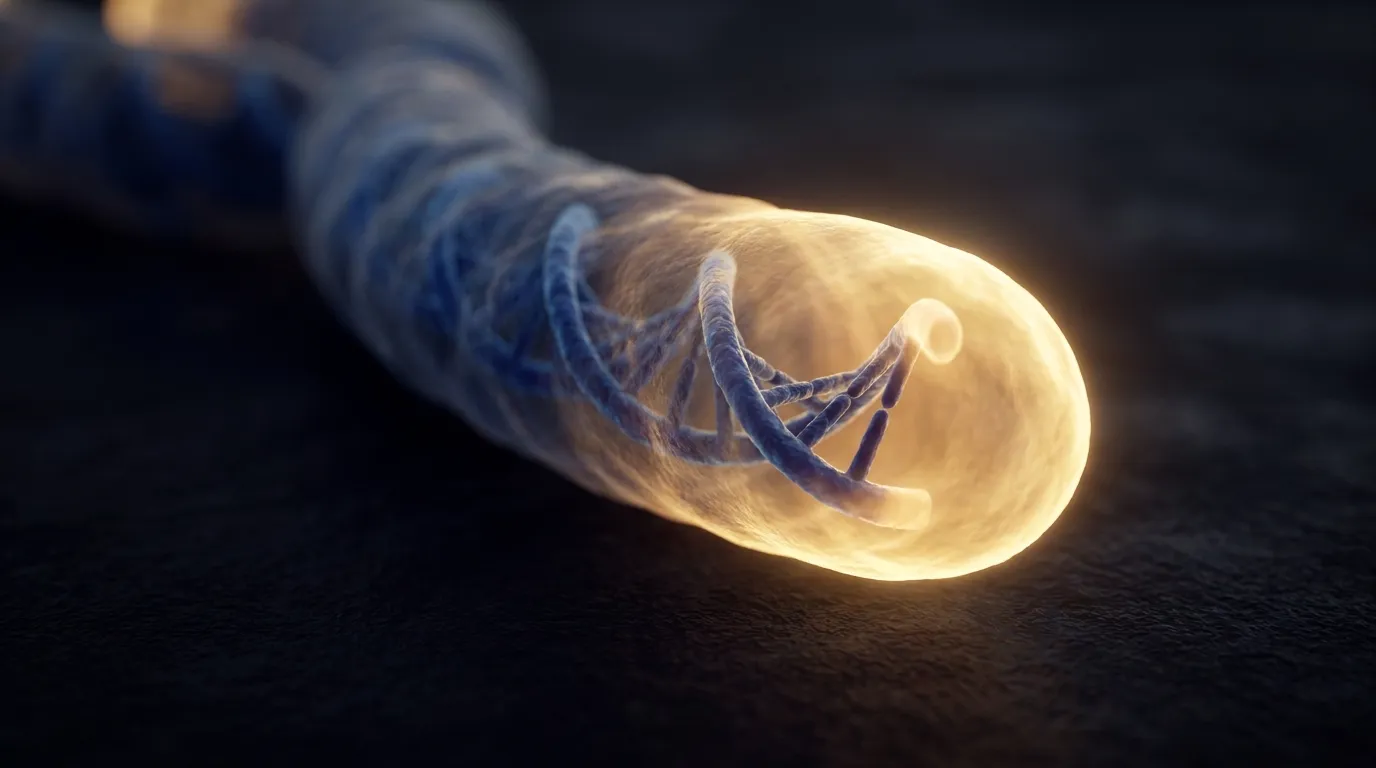
The headline idea is that Epitalon activates telomerase, the enzyme that rebuilds telomeres, the protective caps on the ends of chromosomes that normally shorten every time a cell divides. By topping telomeres back up, the theory goes, cells could keep dividing longer and resist some hallmarks of aging. This mechanism is real in the test tube but unproven as an anti-aging strategy in living people.
Here is the plain-English chain of reasoning. Every time a cell divides, its telomeres get a little shorter; when they get too short, the cell stops dividing or dies, which is part of why tissues age. Telomerase can lengthen telomeres, but most adult cells keep it switched off. The claim for Epitalon is that it can switch telomerase back on. A 2003 laboratory study from Khavinson's group reported that the peptide "induces telomerase activity and telomere elongation in human somatic cells," restarting the enzyme in cultured human fibroblasts that normally have it turned off (Bulletin of Experimental Biology and Medicine, "Epithalon peptide induces telomerase activity and telomere elongation in human somatic cells", 2003, PMID 12937682, retrieved 2026-06-15).
A follow-up paper went further, reporting that treated human cells pushed past their normal division limit (the so-called Hayflick limit), gaining extra rounds of division in culture (Bulletin of Experimental Biology and Medicine, "Peptide promotes overcoming of the division limit in human somatic cell", 2004, PMID 15455129, retrieved 2026-06-15). Beyond telomeres, Epitalon is also discussed as a regulator of the pineal-melatonin and circadian system and as an antioxidant, but a 2025 review is candid that the underlying mechanism "remains unclear" (International Journal of Molecular Sciences, "Overview of Epitalon", 2025, PMC11943447, retrieved 2026-06-15).
The detailed molecular biology (how telomerase is normally regulated, why most cells suppress it, and what restarting it could mean for cancer risk) is its own topic. We keep it at overview level here and link out to how peptides work for the foundations.
What is Epitalon used for, and what did the studies actually show?
Epitalon is studied and used mainly as an anti-aging and longevity peptide, with reported effects on telomeres, the circadian-melatonin system, antioxidant defenses, and, in animals, on lifespan and tumor rates. None of these are FDA-approved uses, and the human evidence is thin and unreplicated.
The most-cited animal result is honest in a way the marketing often is not. In a 2003 study in female mice, Epitalon raised maximum lifespan by roughly 12 percent and the lifespan of the longest-lived survivors by about 13 percent, and it cut leukemia incidence sharply, but it did not increase the group's mean (average) lifespan (Biogerontology, "Effect of Epitalon on biomarkers of aging, life span and spontaneous tumor incidence in female SHR mice", 2003, PMID 14501183, retrieved 2026-06-15). On the human side, the most-quoted figures come from elderly cohorts treated with the pineal peptide, discussed in the next section.
A quick overview of the areas Epitalon is studied for and where the evidence stands:
| Studied area | What the research suggests | Evidence level |
|---|---|---|
| Telomerase / telomere lengthening | Telomerase switched on, telomeres elongated in cultured human cells | In-vitro only; single group; not replicated |
| Animal lifespan | Higher maximum lifespan in mice; mean lifespan unchanged | Animal studies (Russian group) |
| Tumor incidence | Lower leukemia and some tumor rates in rodent models | Animal studies |
| Human longevity / mortality | Lower mortality in small elderly cohorts over years | Small, single-group human studies |
| Circadian / melatonin | Proposed normalization of melatonin rhythms with age | Early / mechanistic |
| Antioxidant effects | Reduced oxidative-stress markers | Early / mechanistic |
Two of these threads deserve a sentence of context, because they are where the "longevity" framing actually comes from. The telomere thread is the famous one: telomeres are the disposable caps on the ends of chromosomes, they shorten a little with every cell division, and short telomeres are a recognized hallmark of cellular aging, so a compound that maintains them is naturally cast as anti-aging. The pineal thread is older and quieter: Epitalon descends from a pineal-gland extract, and the pineal gland makes melatonin and helps set the body's daily and seasonal rhythms, which decline with age. Much of the early Russian work framed Epitalon as a way to keep that pineal-melatonin system working more youthfully, which is the original rationale behind the whole research program.
Because each of these is a distinct future topic, we keep them brief here. The honest headline: Epitalon is intriguing across several aging pathways in the lab and in rodents, but the human evidence has not caught up to the "immortality peptide" reputation.
How strong is the evidence really?
The evidence for Epitalon is unusually lopsided: a few striking laboratory and animal findings plus small human cohorts, almost all from one Russian research group, and essentially none of it independently replicated or confirmed in large randomized trials. That concentration in a single lab is the single most important caveat behind the hype.
The human "lifespan" headlines trace to two papers. A 2003 study reported that, over six to eight years, elderly subjects given the pineal peptide had a 1.6 to 1.8-fold lower mortality than controls, with an even larger reduction when courses were repeated annually (Neuro Endocrinology Letters, "Peptides of pineal gland and thymus prolong human life", 2003, PMID 14523363, retrieved 2026-06-15). A 2011 paper followed a small group of coronary patients for fifteen years and again reported significantly lower mortality in the treated group (Bulletin of Experimental Biology and Medicine, "Peptide geroprotector... results of 15-year follow-up", 2011, PMID 22451889, retrieved 2026-06-15). These are real, published, peer-reviewed studies, but they are also small, decades old, and from the same scientific lineage that developed the compound.
Why "promising" is not the same as "proven"
It helps to be precise about what is missing. There is no large, independent, randomized controlled trial of Epitalon, the kind of study that would actually establish whether it extends healthy human lifespan and at what dose. The in-vitro telomerase finding, dramatic as it sounds, has not been reproduced by outside laboratories, and a 2025 review notes that the mechanism "remains unclear" and that safety information "is missing" (International Journal of Molecular Sciences, "Overview of Epitalon", 2025, PMC11943447, retrieved 2026-06-15). Independent reviewers have likewise flagged the small sample sizes, reproducibility concerns, and lack of Western-standard safety data that keep these claims out of mainstream medicine (Alzheimer's Drug Discovery Foundation, Cognitive Vitality, "Epithalamin and Epithalon", retrieved 2026-06-15).
There is also a structural reason to be cautious about the human cohorts specifically. Several of the most-cited "human" studies actually used epithalamin, the crude pineal-gland preparation, rather than pure synthetic Epitalon, so even if the mortality signal is genuine, it is not cleanly attributable to the four-amino-acid molecule sold today. The cohorts were small (tens to a couple hundred people), the follow-up was long but the original treatment windows were short, and the work predates the rigorous trial-registration and pre-specification norms that modern medicine uses to guard against false positives. None of that makes the findings fake; it makes them preliminary.
This matters for a practical reason. Restarting telomerase is a double-edged idea: the same enzyme that could let healthy cells divide longer is also reactivated in most cancers to make tumor cells effectively immortal. That is exactly why a telomerase activator should clear careful, independent long-term human trials before anyone treats it as safe, and none have been done.
Our take: The most common mistake we see is reading "telomerase activation" and "fifteen-year human study" as if they were settled, mainstream science. They are real findings, but they come overwhelmingly from one group, were never independently reproduced, and have not been tested in a large modern trial. "Preliminary and unreplicated" is the honest label for Epitalon in 2026, not "proven anti-aging therapy."
What doses of Epitalon do people report using?
There is no validated dose for Epitalon, but reported research and community protocols cluster around a few milligrams per subcutaneous injection, given in short cycles of roughly ten to twenty days and repeated a few times a year. These are figures people report, not an established or recommended dose, and there is no approved label or human dose-finding trial to anchor them.
In community and clinic write-ups, the most common pattern is around 5 to 10 mg of reconstituted Epitalon per injection, taken daily across a short course and then stopped for several months before repeating, a cadence loosely modeled on the cyclic "annual course" design of the old Russian studies. A reconstituted vial is typically used within a few weeks because the cycles are short. We label all of this as a community/research convention because no regulator has reviewed a dose, the original studies used a pineal-peptide preparation rather than a standardized consumer product, and the human pharmacology is essentially unstudied (International Journal of Molecular Sciences, 2025, PMC11943447, retrieved 2026-06-15).
For orientation only, here is how people commonly describe the reported approach (not a recommendation):
| Aspect | Reported convention | Notes |
|---|---|---|
| Route | Subcutaneous injection | The dominant reported route; some report intranasal or oral, with lower expected absorption |
| Per-dose amount | ~5-10 mg, reconstituted | Community/clinic figure; no validated dose exists |
| Cycle length | ~10-20 days per course | Modeled on the cyclic design of the original studies |
| Frequency | A few short courses per year | Cycled, not taken continuously |
The detailed titration math, reconstitution volumes, and injection-site choices are a dedicated future spoke. We cover only the high-level framing here. Other longevity-oriented research peptides are sometimes discussed alongside Epitalon, but we keep those as light placeholders to avoid overlap: see how peptides work for the basics first.
Our take: Numbers like "10 mg for ten days" get repeated across vendor pages until they sound official. They are not. They are community conventions loosely echoing a decades-old study design, not the output of a human dose-finding trial, which is exactly why we never present them as a validated dose.
Is Epitalon safe?
Because Epitalon has barely been tested in modern controlled human trials, its true safety profile is unknown; the small existing studies reported few problems, but reviewers explicitly note that proper safety data are missing. "Unknown" is the honest headline, not "safe."
In the older Russian cohorts, the pineal peptide was described as well tolerated, and no dramatic adverse effects were reported. But a 2025 review states plainly that safety "information is missing," meaning there is no body of modern toxicology, pharmacokinetics, or long-term human safety data of the kind regulators expect (International Journal of Molecular Sciences, 2025, PMC11943447, retrieved 2026-06-15). On top of that, the products sold online are unregulated research chemicals, so contamination, mislabeled potency, and impurities are real risks independent of the peptide itself.
A hub-level overview of what is reported and what is theorized:
- Commonly reported (mild): injection-site reactions such as redness or irritation; anecdotal reports of drowsiness or headache. These are not from controlled trials.
- Quality-related risks: because the market is unregulated, what is actually in a given vial is unverified without independent testing.
- Theoretical, mechanism-based: because Epitalon is described as a telomerase activator, and telomerase is reactivated in most cancers, a theoretical concern is that it could in principle support the growth of existing abnormal cells. This is a caution raised by the mechanism, not a documented human outcome.
- Unknown: true long-term human safety, because the modern long-horizon data simply do not exist.
This is the hub-level summary. A fuller safety discussion, including the telomerase-and-cancer debate, would be its own dedicated guide.
Is Epitalon legal and FDA-approved?
Epitalon is not approved by the FDA or any other regulator, so there is no official safety or efficacy determination, and it is not legal to sell or prescribe as an approved medicine or to include in dietary supplements; the products sold online are unapproved "research chemicals." That status matters more than any single study.
The U.S. NIH NCATS drug database is explicit that Epitalon "has not been approved for any therapeutic and/or prophylactic use by any government health authority in the USA or Europe" and lists it as still in preclinical or clinical development (NIH NCATS Inxight Drugs, "Epitalon", retrieved 2026-06-15). It is worth noting that the same record lists an FDA orphan-drug designation, but a designation is an administrative status for studying a rare-disease candidate, not an approval to market or use the drug, a distinction the marketing around Epitalon often blurs. In practice, Epitalon is sold by research-chemical vendors labeled "not for human consumption," which is a legal and safety gray market with no regulatory oversight.
For the broader legal picture and how to evaluate a vendor before trusting anything in a vial, see are peptides legal and how to vet peptide quality.
Our take: The single most common misunderstanding is treating "FDA orphan-drug designation" or "openly sold online" as if they meant Epitalon is approved or vetted. It is neither. It is an unapproved drug sold for research use only, and easy to buy is not the same as legal, safe, or proven.

A realistic look at expectations
The "immortality peptide" and "reverse aging" stories around Epitalon come mostly from in-vitro work, rodent studies, and small unreplicated human cohorts, not from controlled modern trials, so realistic expectations should be modest and skeptical. Going in calibrated is part of using any of this information responsibly.
Two honest caveats sit on top of the hype. First, a telomerase effect in a petri dish, and a maximum-lifespan bump in mice, are a long way from proven anti-aging benefits in healthy people; the human studies that exist are small, old, and from a single group. Second, aging is multifactorial, and short subjective "I feel younger" reports are exactly the kind of anecdote that controlled trials are designed to test, and that Epitalon has not been through. The compound is genuinely scientifically interesting, which is different from being proven.
Frequently Asked Questions
The bottom line
Epitalon is one of the most seductive stories in the peptide world: a tiny four-amino-acid molecule, a Nobel-adjacent mechanism in telomerase, and headlines about reversing aging and extending human lifespan. The underlying findings are real and genuinely interesting, the in-vitro telomerase activation, the maximum-lifespan bump in mice, the lower mortality in elderly Russian cohorts. That is the honest reason it earned the "longevity peptide" reputation.
The other half of the story is discipline. Nearly all of that evidence comes from a single research group, the key results were never independently replicated, the human studies are small and decades old, the mechanism is still described as unclear, modern safety data are missing, and Epitalon is unapproved and sold only as a research chemical. The honest label is preliminary and unreplicated, not proven. If you take one thing from this hub, let it be the gap between "fascinating early science" and "validated anti-aging therapy," and the value of a qualified clinician in navigating it. From here, the natural next reads are how peptides work, are peptides legal, and how to vet peptide quality.
Sources
- Wikipedia. "Epitalon." Retrieved 2026-06-15. https://en.wikipedia.org/wiki/Epitalon
- PubChem (NIH National Library of Medicine). "Epitalon, CID 219042." Retrieved 2026-06-15. https://pubchem.ncbi.nlm.nih.gov/compound/219042
- NIH NCATS Inxight Drugs. "Epitalon (UNII O65P17785G)." Retrieved 2026-06-15. https://drugs.ncats.io/drug/O65P17785G
- Khavinson VKh, Bondarev IE, Butyugov AA. "Epithalon peptide induces telomerase activity and telomere elongation in human somatic cells." Bulletin of Experimental Biology and Medicine, 2003;135(6):590-2. PMID 12937682. Retrieved 2026-06-15. https://pubmed.ncbi.nlm.nih.gov/12937682/
- Khavinson VKh, Bondarev IE, Butyugov AA, Smirnova TD. "Peptide promotes overcoming of the division limit in human somatic cell." Bulletin of Experimental Biology and Medicine, 2004;137(5):503-6. PMID 15455129. Retrieved 2026-06-15. https://pubmed.ncbi.nlm.nih.gov/15455129/
- Khavinson VKh, Morozov VG. "Peptides of pineal gland and thymus prolong human life." Neuro Endocrinology Letters, 2003;24(3-4):233-40. PMID 14523363. Retrieved 2026-06-15. https://pubmed.ncbi.nlm.nih.gov/14523363/
- Korkushko OV, Khavinson VKh, Shatilo VB, Antonyk-Sheglova IA. "Peptide geroprotector from the pituitary gland inhibits rapid aging of elderly people: results of 15-year follow-up." Bulletin of Experimental Biology and Medicine, 2011;151(3):366-9. PMID 22451889. Retrieved 2026-06-15. https://pubmed.ncbi.nlm.nih.gov/22451889/
- Anisimov VN, Khavinson VKh, et al. "Effect of Epitalon on biomarkers of aging, life span and spontaneous tumor incidence in female Swiss-derived SHR mice." Biogerontology, 2003;4(4):193-202. PMID 14501183. Retrieved 2026-06-15. https://pubmed.ncbi.nlm.nih.gov/14501183/
- Araj M, Brzezik S, Mądra-Gackowska K, Szeleszczuk Ł. "Overview of Epitalon: Highly Bioactive Pineal Tetrapeptide with Promising Properties." International Journal of Molecular Sciences, 2025;26(6):2691. PMC11943447. Retrieved 2026-06-15. https://pmc.ncbi.nlm.nih.gov/articles/PMC11943447/
- Alzheimer's Drug Discovery Foundation, Cognitive Vitality. "Epithalamin and Epithalon (For Researchers)." Retrieved 2026-06-15. https://www.alzdiscovery.org/uploads/cognitive_vitality_media/Epithalamin-and-Epithalon-Cognitive-Vitality-For-Researchers.pdf