Melanotan 2 Side Effects: The Mole, Priapism & Melanoma Risks (2026)
Skin darkening is the intended effect of Melanotan 2 — but the side effect that actually matters is what it does to your moles: it darkens existing moles and freckles and can make new ones appear, which is exactly why dermatologists treat skin monitoring as essential and why published case reports tie it to atypical moles and melanoma. The acute experience is dominated by nausea, facial flushing, and the characteristic yawning-and-stretching reaction; the dangerous tail is small but real — priapism, changing moles, and rhabdomyolysis. This page answers the real tolerability-and-safety question with first-party data: what 600 ProtocolPlus users report from real use, anchored to the published case-report record and the regulator warnings.
Most "Melanotan 2 side effects" pages give you a generic list. We do it differently. The headline below is first-party community data — what 600 ProtocolPlus users who tracked MT-2 tolerability actually report — placed next to the published medical case reports and the regulator position as the validated backbone. For the molecule itself (how the melanocortin mechanism works, the brands, reported dosing), this page links up to the Melanotan 2 complete guide, and Melanotan 2 features in our wider roundup of the best peptides for skin and anti-aging, so this page stays a clean safety-and-tolerability hub.
Key Takeaways
- The real safety story is your moles. Among 600 ProtocolPlus users, darkening of moles and freckles (35%, 210 users) is the third most-reported effect, and 14% (84 users) report new moles appearing — and published dermatology case reports tie Melanotan to eruptive atypical (dysplastic) nevi and even melanoma. Skin darkening (55%) is the goal; the mole changes are the warning. Get a baseline dermatology skin check and monitor every mole.
- Three rare-but-serious red flags need urgent care. Priapism (a painful erection lasting over 4 hours, reported by 2%, 12 users) is a urological emergency — go to the ER. A changing mole (melanoma; 1%, 6 users) needs a dermatologist now. Rhabdomyolysis (severe muscle pain + dark urine; 0.3%, 2 users) is an ER visit.
- The everyday reaction is acute and uncomfortable, not dangerous. Nausea (40%, 240 users) leads, with facial flushing (30%, 180) and the characteristic yawning and stretching (12%, 72) — these hit within an hour of a dose and usually fade.
- Melanotan 2 is unlicensed and regulator-warned. The TGA, MHRA, and FDA have all warned against it; it is not approved anywhere, and the unregulated supply adds contamination and wrong-dose risk on top of the drug's own profile.
- Self-report ≠ trial incidence ≠ causation. There is no validated human incidence for MT-2 — these are un-adjudicated community figures, and absence of reported harm is not proof of safety.
What are the most common Melanotan 2 side effects?
Across 600 ProtocolPlus users who tracked Melanotan 2 tolerability, the most-reported effect is the intended one — skin darkening (55%, 330 users) — followed by nausea (40%, 240), darkening of moles and freckles (35%, 210), facial flushing (30%, 180), and appetite loss (18%, 108). This is a community-report ranking from our own app data, not a validated incidence table, and the standout is that the side effect that matters most for safety — mole darkening — sits right near the top.
The pattern fits what the melanocortin mechanism predicts. MT-2 activates the same receptors that drive pigment, so it darkens not just skin but moles and freckles, and it also acts on appetite and nausea centers — which is why nausea, flushing, appetite loss, and the odd-but-characteristic yawning and stretching reaction (12%, 72 users) cluster in the first hour after a dose. After that acute set, reports tail off into spontaneous erections in men (16%, 96 users), new moles appearing (14%, 84), dizziness and lethargy (10% each, 60 users), and blood-pressure changes (6%, 36). The serious tail — priapism, melanoma/changing moles, and rhabdomyolysis — is rare but is the part this page is built around.
These shares come only from our community-reported dataset and describe what people experience and log, not trial-grade incidence and not causation. The receptor-level mechanism lives on the hub; for the molecule itself see the Melanotan 2 complete guide.
Citation capsule. Among 600 ProtocolPlus users who tracked Melanotan 2 tolerability, the most-reported effects were skin darkening (55%, 330 users — the intended effect), nausea (40%, 240), darkening of moles and freckles (35%, 210), facial flushing (30%, 180), and appetite loss (18%, 108). This is first-party data reflecting what the community reports — self-reported, not validated incidence, and not proof of causation. Source: ProtocolPlus app data (side-effects/melanotan-2.json), 2026.
When should you seek urgent care or see a dermatologist on Melanotan 2?
See a dermatologist promptly for any mole that is changing, growing, or newly appeared (the melanoma red flag); go to the ER for a painful erection lasting over 4 hours (priapism), and for severe muscle pain with dark or cola-colored urine (rhabdomyolysis). These are rare — together about 3% of our reporters — but they are the effects that turn a tanning shortcut into an emergency, so they come before everything else. With Melanotan 2 there is no clinician titrating your dose and no approved label to fall back on, which makes knowing these warning signs yourself even more important.
These are not the everyday nausea-and-flushing effects. They are the small-but-serious tail, and each has a clear warning sign and a clear action. Do not try to wait them out.
Changing or new mole (melanoma)
Warning sign: a mole that changes in size, shape, color, or border, bleeds, or itches — or a new pigmented spot (the ABCDE rule). MT-2 darkens and multiplies moles, which can mask these signs.
Action: see a dermatologist promptly. Get a baseline skin check before use and monitor throughout.
Priapism (erection > 4 hours)
Warning sign: a painful, unwanted erection that will not subside, lasting more than 4 hours. Spontaneous erections are common (16%); a prolonged one is the emergency.
Action: go to the ER. Untreated priapism can cause permanent tissue damage.
Rhabdomyolysis
Warning sign: severe, unexplained muscle pain or weakness with dark, cola-colored urine — sometimes alongside racing heart and tremor (acute toxicity).
Action: go to the ER. Rhabdomyolysis can damage the kidneys and needs prompt treatment.
Because Melanotan 2 is unlicensed and the supply is unregulated, you also cannot be sure of the actual potency, sterility, or purity of what is in the vial — contamination and wrong-dose risk sit on top of the drug's own profile.
Citation capsule. Melanotan has been linked in published dermatology case reports to eruptive atypical (dysplastic) nevi and melanoma, including melanotan-associated melanoma (Paurobally et al., British Journal of Dermatology, 2011) and eruptive melanocytic naevi (Cousen et al., British Journal of Dermatology, 2009); priapism requiring emergency care (Mallory et al., Sexual Medicine, 2021); and systemic toxicity with rhabdomyolysis (Nelson et al., Clinical Toxicology, 2012). Regulators including the Australian TGA, UK MHRA, and US FDA have warned against it. Sources: see Sources block.
The signature concern: mole darkening, new moles, and melanoma monitoring
The single most important Melanotan 2 side effect is what it does to your moles: it reliably darkens existing moles and freckles (35% of our reporters) and can make new ones appear (14%), and published case reports tie it to atypical (dysplastic) nevi and melanoma — so a baseline dermatology skin check and ongoing monitoring are essential. Skin darkening is the goal, but the same melanocortin stimulation that tans you also drives pigment cells in moles, and that is where the real risk lives.
Two things are clearly established. First, the mole effect itself: dermatology clinics report that Melanotan is associated with darkening of existing moles, development of new pigmented lesions, and rapid, irregular changes in mole appearance — changes that also make early skin-cancer detection harder (Westlake Dermatology, "Melanotan II", 2026). Second, the published case reports. A striking case described a 25-year-old man who developed more than 100 new melanocytic nevi, many atypical, within weeks of a four-week course, with biopsies confirming dysplastic nevi and severe dysplasia in three lesions (Actas Dermo-Sifiliográficas / J Am Acad Dermatol, "Eruptive Dysplastic Nevi Following Melanotan Use", 2012). A 2009 report documented eruptive melanocytic naevi after melanotan injection (Cousen et al., British Journal of Dermatology, 2009), and a 2011 report described melanotan-associated melanoma (Paurobally et al., British Journal of Dermatology, 2011); a separate 2012 report documented melanotan-associated melanoma in situ (PubMed, 2012).
The more nuanced question is whether MT-2 causes melanoma, and here the evidence is genuinely unsettled: some reviews found no conclusive evidence of direct causation, and one suggested the higher melanoma risk among users could partly reflect that those users also get more UV exposure. So the honest position is two-sided — clear evidence that it changes moles, plus alarming individual case reports, but no proof of direct causation. That uncertainty does not lower the practical bar; it raises it. The ABCDE rule is the everyday tool: watch any mole for Asymmetry, Border irregularity, Color variation, Diameter over ~6 mm, and Evolution (change over time). The catch specific to Melanotan is that by darkening and multiplying moles, it changes the very signs dermatologists rely on — which is exactly why self-monitoring is not enough and a professional baseline and follow-up matter. The full melanoma-risk debate and the mechanism live on the hub; see Melanotan 2 complete guide.
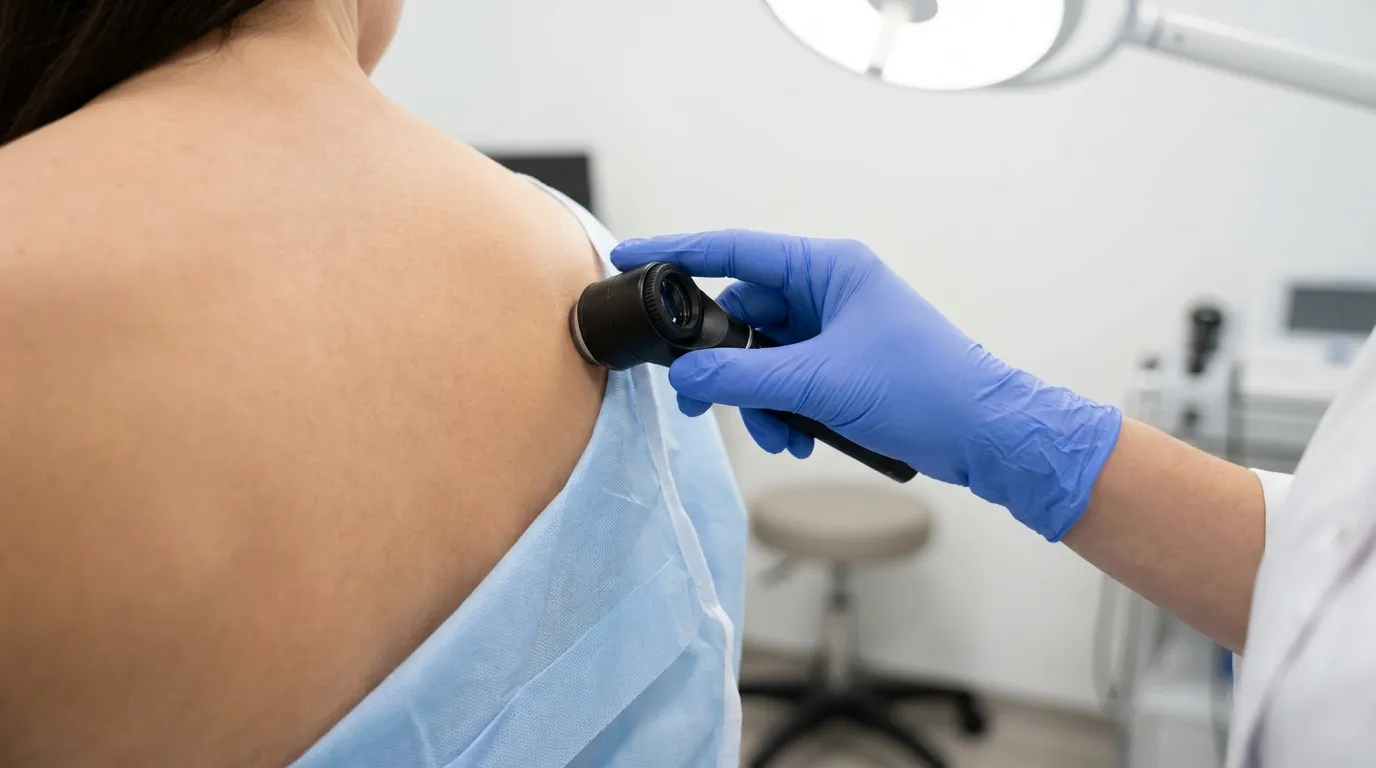
Our take: This is the section that should drive the decision. Even if Melanotan 2 does not directly cause melanoma, it darkens and multiplies moles and can make atypical lesions erupt, masking the early-warning signs used to catch skin cancer. Anyone using it should have a baseline full-skin check and ongoing dermatology monitoring — and people with fair skin, many moles, or a family history of melanoma have the most to lose.
What do the acute Melanotan 2 side effects feel like?
The acute effects are nausea, facial flushing, appetite loss, and the characteristic yawning-and-stretching reaction — they hit within an hour of a dose, are mostly mild-to-moderate, and usually fade over the following hours. Below is each common effect: what it feels like, why it happens, and what the community reports. These are descriptions of community experience, not a prescription — and remember MT-2 has no approved dose.
Nausea (40%, 240 users)
The most common non-pigment complaint, and the one people notice first. It comes from MT-2 acting on nausea and appetite centers, and it typically appears within 30 minutes to an hour of a dose and settles over the next few hours. Community practice leans on dosing in the evening (so the nausea peak passes during sleep), eating beforehand, and using lower amounts — but with no approved dose and no clinician titrating, this is community lore, not guidance.
Facial flushing and the yawning–stretching reaction (30% and 12%)
Facial flushing (180 users) is a warm red flush across the face and chest, again within the first hour, driven by the peptide's vascular effects. The yawning-and-stretching reaction (72 users) is one of the more distinctive MT-2 signatures — a wave of yawning and a strong urge to stretch shortly after dosing, thought to be a central melanocortin effect. Both are harmless and transient. Dizziness, headache, and lethargy (around 10% each) tend to travel with the flushing in the same acute window.
Spontaneous erections (16%, 96 users) — and the priapism line
In men, MT-2's melanocortin activity can trigger spontaneous erections — common, often unwanted, and usually short-lived. The reason this earns a "moderate" tag is the line it can cross: a small fraction of these become priapism, a painful erection lasting more than 4 hours, which is a urological emergency (Mallory et al., Sexual Medicine, 2021). An ordinary spontaneous erection is not an emergency; one that will not subside past 4 hours is — go to the ER, because untreated priapism can cause permanent tissue damage. (This is also why MT-2's close relative was developed as the prescription sexual-function drug PT-141.)
Appetite loss and blood-pressure changes (18% and 6%)
Appetite loss (108 users) is a mild, expected melanocortin effect and usually not a problem on its own. Blood-pressure changes (36 users) earn a moderate tag because MT-2 can shift blood pressure and heart rate; anyone with cardiovascular concerns should treat this as a reason for caution, not something to push through.
Our take: The acute effects are uncomfortable but not the danger. The danger is the slow, easy-to-miss skin story (moles) and the three emergencies (priapism, changing moles, rhabdomyolysis). If you remember one thing from the acute list, let it be the priapism line: a spontaneous erection is common; one lasting over 4 hours is an ER visit.
How honest are these numbers, and what does the evidence actually say?
There is no validated human incidence for Melanotan 2 — it was never completed as a medicine and never went through the trials that produce a real adverse-event table, so every figure here is either a community self-report or a published case report, and neither proves the compound caused any individual effect. That is the single most important honesty point on this page, and it is the opposite of an approved drug's label.
The evidence for MT-2 safety comes in two forms, and it is worth being clear about what each can and cannot tell you. The community frequencies (our N=600 dataset) describe what people report, not adjudicated incidence — they are un-adjudicated and self-reported, and the absence of a reported effect is not proof it cannot happen. The published case reports (melanoma, eruptive dysplastic nevi, priapism, rhabdomyolysis) are individual, sometimes single-patient accounts; they establish that an effect has happened and is biologically plausible, but a case report cannot give you a population rate. What does not exist for MT-2 is the middle layer — the controlled-trial incidence table that an approved drug carries. So read the numbers honestly: our 40% nausea is a community signal, the melanoma link is a documented-but-unquantified concern, and "no one has reported X" is never a safety guarantee for an unlicensed compound.
On top of all of this sits the regulatory and supply reality. Melanotan 2 is not approved by any regulator, and several have warned against it directly: the Australian TGA tells people not to risk tanning products containing melanotan (TGA, "Don't risk using tanning products containing melanotan"), the UK MHRA has warned against unlicensed melanotan tanning injections, and the US FDA has acted against marketers of unapproved injectable MT-2. Because the market is unregulated, the product itself carries contamination, wrong-potency, and non-sterile risks on top of the peptide's own profile (Westlake Dermatology, 2026). For how to think about the unregulated supply, see how to vet peptide quality.
| Effect class | What we have | What it can tell you | What it cannot |
|---|---|---|---|
| Acute (nausea, flushing, yawning) | Community self-report (N=600) + dermatology references | What is common in real use | A validated population incidence |
| Mole changes / melanoma | Community report + published case reports | That it happens and is plausible; a monitoring imperative | That MT-2 directly causes melanoma |
| Priapism, rhabdomyolysis | Community report + published case reports | That severe events occur; the warning signs | How often, in what denominator |
| Overall safety | No regulator review; warnings issued | That it is unapproved and flagged as risky | Any "safe dose" — none is established |
Who should be especially cautious with Melanotan 2?
No one can responsibly call Melanotan 2 safe, but the people with the most to lose are those with fair skin, many moles, atypical moles, or a personal or family history of melanoma — because the headline risk is what it does to moles — along with anyone with cardiovascular concerns and any man for whom a prolonged erection would be dangerous. There is no approved-use list because there is no approval; this is about who stands to be harmed most.
A few practical cautions follow from the side-effect profile. Anyone with a mole-related risk profile (fair skin, high mole count, dysplastic nevi, family history) should treat the mole-darkening and new-mole signals as disqualifying without close dermatology involvement, since MT-2 both raises the concern and masks the warning signs. People with blood-pressure or heart concerns should weigh the reported cardiovascular effects carefully. And because the unregulated supply means you cannot verify potency, sterility, or purity, the product-quality risk compounds everything above — see how to vet peptide quality. None of this page replaces a conversation with a clinician and a dermatologist; for the dosing context people reference, see the Melanotan 2 dosage calculator, framed as reported ranges, not a recommendation.
Frequently Asked Questions
The bottom line
If you came here weighing Melanotan 2, the honest answer is layered. The effect you want — skin darkening — is also the most-reported one, and the acute experience (nausea, flushing, the yawning-and-stretching reaction) is uncomfortable but not the danger. The side effect that actually matters is the quiet one: mole and freckle darkening (35%) and new moles (14%), because Melanotan both raises the melanoma concern and masks the early-warning signs dermatologists rely on. That is why a baseline skin check and ongoing monitoring are not optional.
The effects you need to watch for are the three emergencies: priapism (over 4 hours → ER), a changing or new mole (→ dermatologist), and rhabdomyolysis (severe muscle pain + dark urine → ER). And the frame around all of it is that Melanotan 2 is unlicensed, regulator-warned, and supplied by an unregulated market with no validated safety data. From here, the natural next reads are the Melanotan 2 complete guide for the molecule and the melanoma debate, the Melanotan 2 dosage calculator for the reported dosing context, and how to vet peptide quality for the unregulated-supply problem.
Sources
- Paurobally D, Jason F, Dezfoulian B, Nikkels AF. "Melanotan-associated melanoma." British Journal of Dermatology, 2011;164(6):1403-1405. DOI 10.1111/j.1365-2133.2011.10273.x. Retrieved 2026-06-18. https://academic.oup.com/bjd/article-abstract/164/6/1403/6644309
- Cousen P, Colver G, Helbling I. "Eruptive melanocytic naevi following melanotan injection." British Journal of Dermatology, 2009;161(3):707-708. DOI 10.1111/j.1365-2133.2009.09362.x. Retrieved 2026-06-18. https://academic.oup.com/bjd/article-abstract/161/3/707/6642168
- Sivyer GW. "Changes of melanocytic lesions induced by Melanotan injections and sun bed use in a teenage patient with FAMMM syndrome." Dermatology Practical & Conceptual, 2012;2(3):0203a10. PMID 23785612. Retrieved 2026-06-18. https://pmc.ncbi.nlm.nih.gov/articles/PMC3663356/
- "Eruptive Dysplastic Nevi Following Melanotan Use." Actas Dermo-Sifiliográficas (English ed.) / J Am Acad Dermatol, 2012. Retrieved 2026-06-18. https://www.actasdermo.org/en-eruptive-dysplastic-nevi-following-melanotan-articulo-S1578219012001357
- "Melanotan-associated melanoma in situ." PubMed (case report), 2012. PMID 22724573. Retrieved 2026-06-18. https://pubmed.ncbi.nlm.nih.gov/22724573/
- Mallory CW, Lopategui DM, Cordon BH. "Melanotan Tanning Injection: A Rare Cause of Priapism." Sexual Medicine, 2021;9(1):100298. DOI 10.1016/j.esxm.2020.100298. PMID 33460908. Retrieved 2026-06-18. https://pubmed.ncbi.nlm.nih.gov/33460908/
- Nelson ME, Bryant SM, Aks SE. "Melanotan II injection resulting in systemic toxicity and rhabdomyolysis." Clinical Toxicology (Phila), 2012;50(10):1169-1173. DOI 10.3109/15563650.2012.740637. PMID 23121206. Retrieved 2026-06-18. https://pubmed.ncbi.nlm.nih.gov/23121206/
- DermNet. "Melanotan II" (dermatology reference; flushing, GI, spontaneous erections, mole proliferation, rhabdomyolysis, melanonychia, encephalopathy). 2015, retrieved 2026-06-18. https://dermnetnz.org/topics/melanotan-ii
- Westlake Dermatology. "Tan Jabs: Melanotan II Is Not Worth the Risk" (mole darkening, new lesions, detection confounding, contamination). 2026. Retrieved 2026-06-18. https://www.westlakedermatology.com/trends/melanotan-II/
- Therapeutic Goods Administration (Australia). "Don't risk using tanning products containing melanotan." Retrieved 2026-06-18. https://www.tga.gov.au/news/blog/dont-risk-using-tanning-products-containing-melanotan
- U.S. Food & Drug Administration. "Notice of Opportunity for Hearing (NOOH): Manookian / Melanocorp" (action against unapproved injectable Melanotan II). Retrieved 2026-06-18. https://www.fda.gov/regulatory-information/electronic-reading-room/notice-opportunity-hearing-nooh-manookian-edward-8516
- ProtocolPlus. "Community-reported tolerability data: Melanotan 2" (side-effects/melanotan-2.json). First-party app data, 2026. N = 600 users who tracked Melanotan 2 tolerability. Self-reported community frequency, not validated incidence and not proof of causation.