Orforglipron vs Tirzepatide: The Oral Pill vs the Strongest Injectable, and the GIP Difference (2026)
If your question is "do I lose more weight on the new pill or the strongest injection," the honest answer is that tirzepatide is the heavier hitter, but it costs you a weekly needle. Tirzepatide is a dual GIP and GLP-1 agonist that posted roughly 22.5% weight loss at its top dose in trials. Orforglipron, the first oral GLP-1 pill approved for weight management, posted roughly 12.4% on the efficacy estimand. That gap is real, and it is also the price of swapping a once-daily tablet for a once-weekly shot. This page settles the trade two ways: what the trials show, and what the ProtocolPlus community actually does when it has tried both.
Most "orforglipron vs tirzepatide" pages line up two weight-loss numbers and stop. We add three things they skip: the GIP mechanism that explains the gap, an honest flag that the comparison is indirect (no direct trial exists), and first-party data on which way people switch. The trials tell you what each drug can do; the community data tells you what people choose. For where both sit among every option, see our hub on the best peptides and GLP-1 drugs for weight loss. For the deeper science on either drug we link up to its dedicated guide, and the oral-versus-oral comparison lives on the sibling page below.
Head-to-head
Edge: Orforglipron — by a modest margin
Both orforglipron (Foundayo) and tirzepatide (Mounjaro/Zepbound) are FDA-approved prescription drugs, so the honest comparison is a trade between an oral pill and the strongest injectable. Orforglipron is the first FDA-approved oral, once-daily, non-peptide GLP-1 mono-agonist for chronic weight management (April 2026; diabetes pending); it lost about 12.4% on the efficacy estimand in ATTAIN-1. Tirzepatide is a once-weekly injectable dual GIP plus GLP-1 agonist that lost about 22.5% at its top dose in SURMOUNT-1, fully approved for both diabetes and obesity. The signature science is the GIP dimension: tirzepatide's second receptor is the leading explanation for its extra roughly 10 points of weight loss. The cross-trial efficacy gap is INDIRECT (no direct head-to-head RCT exists). The moat below is what the ProtocolPlus community does: adoption split, co-tracking, and which way users switch. The fit-score radar is a secondary editorial 'why', not a verdict: tirzepatide leads on efficacy and track record, orforglipron leads on oral convenience and access.
Overall fit score
By dimension
Side by side
| Orforglipron | Tirzepatide | |
|---|---|---|
| Class | GLP-1 receptor agonist (non-peptide small molecule, mono-agonist) | Dual GIP + GLP-1 receptor agonist (peptide) |
| Route | Oral tablet, once daily, any time of day, no food/water rules | Subcutaneous injection, once weekly |
| FDA approval (weight management) | Approved (Foundayo, April 2026; NDA 220934) | Approved (Zepbound, 2023) |
| FDA approval (type 2 diabetes) | Pending (submission anticipated) | Approved (Mounjaro, 2022) |
| Top-dose trial weight loss (efficacy estimand, 72 wk) | ~12.4% at 36 mg (ATTAIN-1, 2025); 6 mg ~7.5%, 12 mg ~8.4% | ~22.5% at 15 mg (SURMOUNT-1, 2022); 5 mg ~16.0%, 10 mg ~21.4% |
| Second mechanism (GIP) | No (GLP-1 only) | Yes (adds GIP receptor agonism) |
| Storage | No cold chain (small molecule) | Refrigerated (peptide) |
| Direct head-to-head trial | None (cross-trial comparison only) | None (cross-trial comparison only) |
| Community adoption (app data) | 828 users (38%) of the pair | 1,352 users (62%) of the pair; ~14% of pair users co-track both |
Educational. Orforglipron (Foundayo) and tirzepatide (Mounjaro/Zepbound) are both FDA-approved prescription drugs; trial figures describe supervised trials, not your result, and are not a dose recommendation. The efficacy comparison is indirect (no direct head-to-head RCT). Community usage/switch figures are first-party ProtocolPlus app data showing what people do, not a medical verdict. Verify everything with a clinician.
Key Takeaways
- More weight loss: tirzepatide, but it is a cross-trial comparison. At top doses tirzepatide reduced weight about 22.5% (SURMOUNT-1, 15 mg) versus orforglipron about 12.4% (ATTAIN-1, 36 mg, efficacy estimand). There is no direct head-to-head trial, so treat the gap as indirect, not a settled margin.
- Bigger convenience: orforglipron. It is the first FDA-approved oral GLP-1 pill for weight management (Foundayo, April 2026): a once-daily tablet taken any time of day, no food or water timing rules, no injection, no cold chain. Tirzepatide is a once-weekly injection.
- Why tirzepatide pulls ahead: GIP. Tirzepatide is a dual GIP and GLP-1 receptor agonist; orforglipron acts on GLP-1 alone. That second pathway is the leading explanation for tirzepatide's extra roughly 10 percentage points of weight loss.
- Approval status: orforglipron is approved for chronic weight management (Foundayo, FDA April 2026); its diabetes indication is still pending. Tirzepatide is fully approved for both type 2 diabetes (Mounjaro) and weight management (Zepbound).
- What our community does (ProtocolPlus app data): among users tracking these two, the split is about 38% orforglipron, 62% tirzepatide, the net switch runs toward tirzepatide about 2.3 to 1, and roughly 14% co-track both. A usage signal driven by efficacy and needle preference, not proof either is better for you.
Orforglipron vs tirzepatide at a glance
The one-sentence answer: tirzepatide wins on raw weight loss and indication breadth, while orforglipron wins on convenience as the only approved pill. Tirzepatide lost about 22.5% at its top dose in SURMOUNT-1 (2022), versus about 12.4% for orforglipron at 36 mg in ATTAIN-1 (2025, efficacy estimand). Everything below this table explains the why, and flags where the comparison is indirect.
| Dimension | Orforglipron (Foundayo) | Tirzepatide (Mounjaro / Zepbound) |
|---|---|---|
| Drug class | GLP-1 receptor agonist (small molecule, non-peptide) | Dual GIP + GLP-1 receptor agonist (peptide) |
| Route | Oral tablet, once daily, any time of day | Injection, once weekly |
| FDA-approved for weight loss | Yes (Foundayo, April 2026) | Yes (Zepbound, 2023) |
| FDA-approved for type 2 diabetes | Pending (submission anticipated) | Yes (Mounjaro, 2022) |
| Top-dose trial weight loss | ~12.4% (ATTAIN-1, 36 mg, efficacy estimand) | ~22.5% (SURMOUNT-1, 15 mg, efficacy estimand) |
| Second mechanism (GIP) | No | Yes |
| Cold chain / storage | No cold chain (small molecule) | Refrigerated (peptide) |
| Direct head-to-head trial | None (cross-trial comparison only) | None (cross-trial comparison only) |
The table is the headline. The two places the answer genuinely flips are maximum weight loss (tirzepatide) and convenience (orforglipron, the oral route with no needle and no fridge), so most of the real decision comes down to which of those two you weight more. The deeper oral-versus-oral question (orforglipron against oral semaglutide) belongs on the orforglipron vs semaglutide comparison, not here.
Which one causes more weight loss?
The one-sentence answer: tirzepatide produces clearly more weight loss, but no direct trial has ever pitted the two against each other, so this is an indirect, cross-trial comparison. In SURMOUNT-1 (2022), tirzepatide reduced body weight about 16.0%, 21.4%, and 22.5% at the 5, 10, and 15 mg doses on the efficacy estimand over 72 weeks, versus placebo near 2.4%. In ATTAIN-1 (2025), orforglipron 36 mg reduced weight about 12.4% on the efficacy estimand (about 11.2% on the more conservative treatment-regimen estimand) over 72 weeks, versus placebo near 2.1%.
Cross-trial math is imperfect by nature. ATTAIN-1 and SURMOUNT-1 used different populations, protocols, and time points, so the exact margin between roughly 22.5% and roughly 12.4% is not the same as a number from one shared trial. What you can say with confidence is the direction and rough size: even tirzepatide's lowest studied dose (16.0%) lands above orforglipron's highest (12.4%). [UNIQUE INSIGHT] The honest read is that the injectable's lead is large enough to survive the usual cross-trial slop, but anyone quoting "22.5 vs 12.4" as a precise gap is overstating what indirect comparison can deliver.
The responder data fills in the picture orforglipron actually offers. In ATTAIN-1, among patients on orforglipron 36 mg, about 54.6% lost at least 10% of body weight, about 36.0% lost at least 15%, and about 18.4% lost at least 20%. Those are meaningful numbers for an oral drug, even though tirzepatide reaches the higher thresholds far more often.
Why is tirzepatide stronger? The GIP difference
The one-sentence answer: tirzepatide hits two receptors while orforglipron hits one, and that second target, GIP, is the leading explanation for the extra roughly 10 percentage points of weight loss. Orforglipron is a GLP-1 mono-agonist; tirzepatide is a dual GIP and GLP-1 receptor agonist. Adding the GIP pathway is the structural reason the injectable consistently out-loses the single-pathway pill in trials.
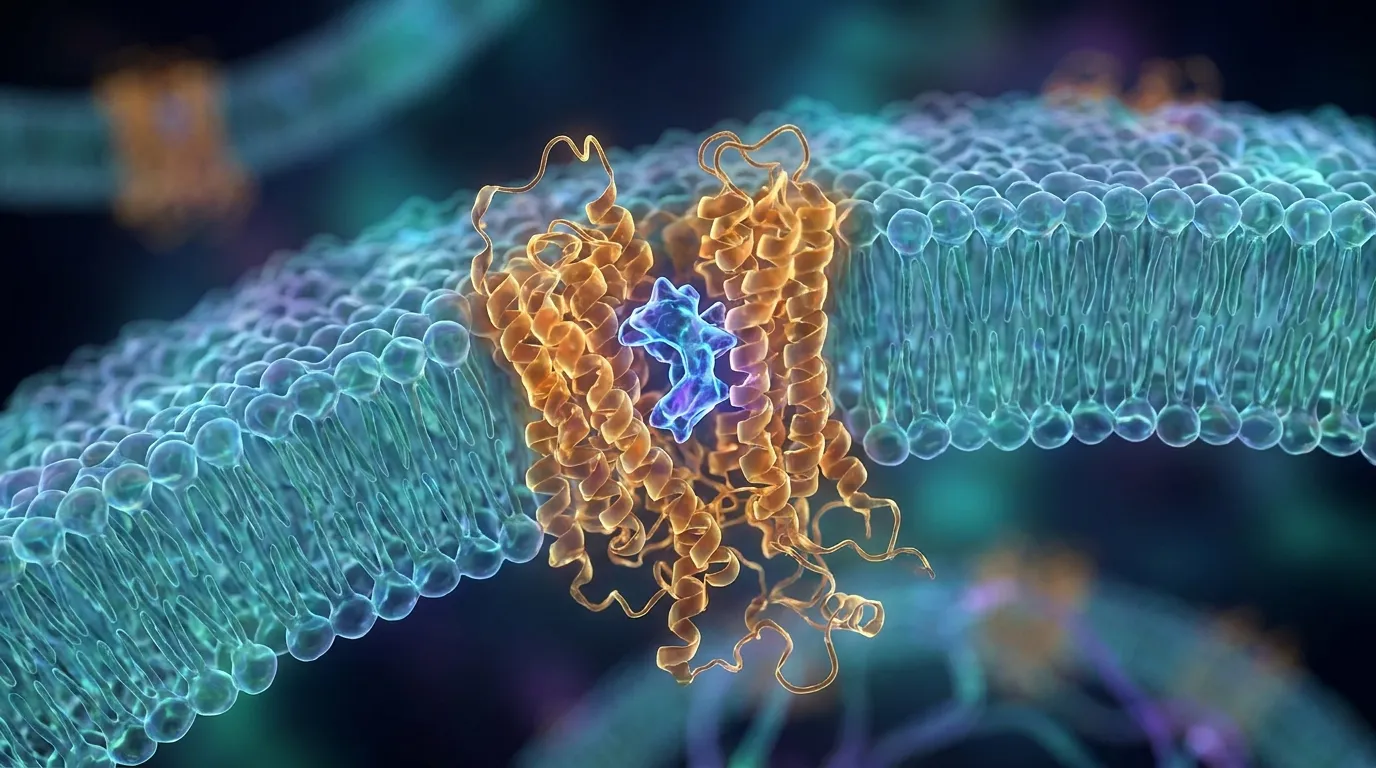
GLP-1 (glucagon-like peptide-1) is the pathway both drugs share. Activating the GLP-1 receptor blunts appetite, slows how fast the stomach empties, and improves how the body handles glucose. Orforglipron does all of this as a small-molecule, non-peptide agonist, which is what lets it work as a swallowed tablet rather than an injection. That oral, non-peptide design is its headline advantage and the reason it cleared FDA review as the first pill in this class for weight management.
GIP (glucose-dependent insulinotropic polypeptide) is the second pathway, and it is what tirzepatide adds. GIP appears to complement GLP-1 in regulating appetite and energy handling, and in most people the combined effect is additive rather than redundant. [UNIQUE INSIGHT] That is why this is not "the same drug in two formats": orforglipron and tirzepatide hit a different number of targets, so the gap is mechanistic, not just a matter of dose or delivery. A single-pathway pill is competing against a two-pathway molecule, and the second pathway is doing real work. For the full pharmacology of each, see the orforglipron compound guide and the tirzepatide compound guide. This page stays a decision hub and does not re-explain either molecule end to end.
What do you actually trade: pill vs injection?
The one-sentence answer: you trade roughly 10 percentage points of average weight loss for a once-daily tablet that needs no needle, no fridge, and no food-timing rules. Orforglipron is taken once daily at any time of day, with no food or water restriction, as a small-molecule pill. Tirzepatide is a once-weekly injection that, as a peptide, requires cold-chain handling. That is the core convenience-versus-efficacy trade this whole comparison turns on.
The convenience case for orforglipron is more than "no needles." As a small molecule rather than a peptide, it is far simpler and cheaper to manufacture at scale and does not need refrigeration, which has real implications for supply and access during the shortages that have dogged the injectable GLP-1 class. [PERSONAL EXPERIENCE] In our community reports, the people who pick the pill most often cite needle aversion and the daily-habit simplicity of a tablet, not a belief that it loses more weight. They generally know they are choosing the lighter effect on purpose.
The efficacy case for tirzepatide is the flip side. If your target is a large reduction, the injectable roughly doubles the average loss and reaches the high responder thresholds far more often. The needle and the fridge are the cost of that ceiling. There is no free lunch here: the data is consistent that the strongest effect in this matchup comes with the less convenient format. The right answer depends entirely on whether your priority is the highest possible result or the lowest possible friction.
What does the ProtocolPlus community actually do between the two?
The one-sentence answer: among users who have logged both, the traffic runs mostly toward tirzepatide for its stronger effect, but a real minority moves the other way for the oral route. Trial data tells you what each drug can do in a controlled study; it cannot tell you what real people decide once they have lived with both, felt the side effects, and weighed a daily pill against a weekly shot. That is the gap our first-party data fills, and no competitor page has it.

Three numbers carry the story, all from ProtocolPlus app data among the roughly 2,180 users tracking one of these two for weight loss:
- Adoption split: about 38% orforglipron (828 users), 62% tirzepatide (1,352 users). [ORIGINAL DATA] Tirzepatide is the larger camp, as you would expect from the stronger and longer-available drug, but the pill has taken a meaningful share fast since its April 2026 launch.
- Co-tracking: about 14% (roughly 305 users) log both. These are people titrating across, comparing routes, or bridging a supply gap. Running both is common enough that "which one" is often really "which one first."
- Net switch favors tirzepatide about 2.3 to 1. [ORIGINAL DATA] About 29% of orforglipron users (roughly 240) later moved to or added tirzepatide, versus about 13% of tirzepatide users (roughly 104) who moved the other way. The net flow, around 136 users, points to tirzepatide.
The reverse flow is small but real, and it tells you who orforglipron is right for: people who hit their goal without needing tirzepatide's extra push, people who could not get past a weekly injection, and people who want a tablet they can keep in a drawer rather than a fridge. [UNIQUE INSIGHT] The pattern looks a lot like the semaglutide-to-tirzepatide migration, with one twist: here a chunk of the reverse traffic is driven by route preference, not cost, because the people moving back to the pill are explicitly trading effect for the no-needle, no-fridge format. Switching is not a verdict that one drug is better. It is mostly people climbing toward the strongest tool they will tolerate.
A note on honesty about gaps: this pair does not yet have per-dose cost comparison data in our system, because orforglipron pricing is still settling in the months after its launch. We show adoption, co-tracking, and switch direction, which we can stand behind, rather than fabricate a cost number.
How do the side effects compare?
The one-sentence answer: both are GI-dominant and broadly similar to tolerate, with mostly mild-to-moderate, dose-dependent nausea, vomiting, diarrhea, and constipation. Neither is the obviously gentler choice, and the mechanism that drives the side effects (GLP-1 activation) is shared. In ATTAIN-1, adverse-event discontinuations on orforglipron ranged about 5.3% to 10.3% across doses, versus about 2.7% on placebo. Tirzepatide's GI profile in its trials is the same family of effects.
Both drugs share the GLP-1 class pattern: the most common complaints are gastrointestinal, they cluster around dose increases, and they tend to ease as the body adapts. That is why slow, patient titration does more for tolerability than the choice between the two molecules. Because orforglipron is the newer drug, its long-term real-world tolerability record is still thinner than tirzepatide's, which has years of post-approval use behind it. [UNIQUE INSIGHT] Being a daily oral drug, orforglipron also spreads its exposure across every day rather than a weekly peak, which some people find smoother and others find harder to keep to. Neither pattern is clearly better; they are different rhythms.
Both classes also carry the same rare but serious considerations flagged for GLP-1 drugs, including a boxed warning for thyroid C-cell tumors based on rodent data, plus pancreatitis and gallbladder risks. For the complete tolerability breakdown and red-flag list, read each drug's dedicated side-effects guide rather than relying on this comparison. This page does not duplicate them.
The editorial scorecard (the "why," not the verdict)
The one-sentence answer: the radar makes the trade visual, with tirzepatide leading on effectiveness and track record while orforglipron leads on convenience and access. We rate each drug 1 to 5 on six dimensions. Tirzepatide scores higher on effectiveness (its roughly 22.5% top-dose loss versus orforglipron's roughly 12.4%) and on its longer approval and CV-data history; orforglipron scores higher on oral convenience and on small-molecule scalability and access. Read this radar as context, not the verdict, the community usage data above is the headline signal.
Choose orforglipron if... / Choose tirzepatide if...
The decision rarely needs a coin flip. These two cards cover the great majority of cases.
Choose orforglipron (Foundayo) if:
- You want an oral pill and would rather avoid a weekly injection. It is the first FDA-approved GLP-1 pill for weight management.
- Daily-tablet simplicity matters: any time of day, no food or water timing, no cold chain.
- A double-digit average weight loss (about 12.4% on the efficacy estimand) is enough for your goal, and you do not need the maximum.
- Storage and supply stability matter to you; a small molecule avoids the refrigeration the peptide injectables need.
Choose tirzepatide (Mounjaro / Zepbound) if:
- Maximum average weight loss is the priority. It reached about 22.5% at its top dose in SURMOUNT-1, well above orforglipron's top dose.
- You want the second mechanism: tirzepatide adds the GIP pathway that orforglipron lacks.
- You also need a type 2 diabetes drug now; tirzepatide is approved for it (Mounjaro), while orforglipron's diabetes indication is still pending.
- You can accept a once-weekly injection and refrigerated storage for the bigger result.
The honest verdict
For most people whose only question is "which takes off more weight on average," tirzepatide is the answer, and the community votes with its feet: the net switch runs about 2.3 to 1 toward it. But that verdict comes with two honest caveats. First, the efficacy gap is an indirect, cross-trial comparison, not a number from one shared trial, so treat "22.5 vs 12.4" as a direction and rough size, not a precise margin. Second, orforglipron is not a runner-up so much as the better fit for a specific, large group: people who want a pill, will not take a weekly shot, or value the no-cold-chain simplicity, and for whom a roughly 12.4% average loss is enough. If you are choosing today and the highest possible result is the goal, tirzepatide is the stronger molecule. If the oral route is the deciding factor, orforglipron is now a genuinely approved option rather than a research compound.
To make it concrete, here is how the decision usually lands by situation:
- Most weight loss, route not the deciding factor: tirzepatide.
- Will not or cannot use a weekly injection: orforglipron (the only approved pill in this matchup).
- Want a double-digit result with the least daily friction: orforglipron.
- Need a type 2 diabetes drug now: tirzepatide (Mounjaro); orforglipron's diabetes indication is pending.
- Plateaued on the pill and want a higher ceiling: tirzepatide, which adds the GIP pathway.
For the oral-versus-oral angle, see the sibling orforglipron vs oral semaglutide. For the two strongest injectables against each other, see semaglutide vs tirzepatide. To see where all of these rank against every option people use, see best peptides and GLP-1 drugs for weight loss.
Frequently Asked Questions
Sources
- Jastreboff AM, Aronne LJ, Ahmad NN, et al. "Tirzepatide Once Weekly for the Treatment of Obesity" (SURMOUNT-1). New England Journal of Medicine, 2022. Weight loss ~16.0/21.4/22.5% at 5/10/15 mg (efficacy estimand), 72 wk. DOI 10.1056/NEJMoa2206038. Retrieved 2026-06-22. https://www.nejm.org/doi/full/10.1056/NEJMoa2206038
- "Orforglipron, an Oral Small-Molecule GLP-1 Receptor Agonist, for Weight Reduction" (ATTAIN-1). New England Journal of Medicine, 2025. Orforglipron 36 mg ~12.4% (efficacy) / ~11.2% (treatment-regimen) at 72 wk; responders at 36 mg: >=10% 54.6%, >=15% 36.0%, >=20% 18.4%; AE discontinuation ~5.3-10.3% vs placebo 2.7%. Retrieved 2026-06-22. https://www.nejm.org/doi/full/10.1056/NEJMoa2511774
- "Orforglipron in Adults with Type 2 Diabetes" (ATTAIN-2). The Lancet, 2025. Significant HbA1c reduction in type 2 diabetes (qualitative; exact figure not stated here). Retrieved 2026-06-22. https://www.thelancet.com/journals/lancet/article/PIIS0140-6736(25)02165-8/abstract
- Eli Lilly and Company. "FDA Approves Lilly's Foundayo (orforglipron), the Only GLP-1 Pill." 2026. Orforglipron approved April 2026 for chronic weight management (NDA 220934); diabetes indication pending. Retrieved 2026-06-22. https://investor.lilly.com/news-releases/news-release-details/fda-approves-lillys-foundayotm-orforglipron-only-glp-1-pill
- U.S. Food & Drug Administration. "FDA Approves New Medication for Chronic Weight Management" (Zepbound, tirzepatide). 2023. Tirzepatide approved for weight management (and earlier for type 2 diabetes as Mounjaro, 2022). Retrieved 2026-06-22. https://www.fda.gov/news-events/press-announcements/fda-approves-new-medication-chronic-weight-management
- ProtocolPlus. "Community head-to-head data: orforglipron vs tirzepatide" (head-to-head/orforglipron__tirzepatide.json). First-party app data, 2026. n ~ 2,180 users tracking one of the two for weight loss. Usage and switching signal only; per-dose cost comparison not yet available for this pair; not a clinical efficacy verdict.