
Tesamorelin Side Effects: The High Injection-Site Rate, the Blood-Sugar Caution & What 320 Users Report (2026)
Tesamorelin's side effects come down to three things you can actually plan around: it has the highest injection-site reaction rate of any growth-hormone peptide (the leading adverse event on its Egrifta label), it produces the usual growth-hormone-axis joint and fluid cluster (arthralgia, edema, carpal-tunnel-like tingling), and — the one to watch hardest — it can raise blood sugar by lowering insulin sensitivity, which is an explicit warning on the FDA label. This page answers the real tolerability question two ways at once: what 320 ProtocolPlus users report from real use, placed honestly next to the actual Egrifta label adverse-event rates.
Most "tesamorelin side effects" pages either reprint the label table or give you a generic symptom list. We do it differently. The headline below is first-party community data — what 320 ProtocolPlus users who tracked tesamorelin tolerability actually report — and we keep the real Egrifta label rates clearly beside it as the validated benchmark, because tesamorelin is the rare peptide that has one. Off-label, people often meet it on lists of the best peptides for muscle growth and body recomposition, so the tolerability picture is worth weighing first. For the molecule itself (what it is, the GHRH mechanism, the HIV-lipodystrophy approval, the visceral-fat trial data, dosing), this page links up to the tesamorelin complete guide so it stays a clean safety-and-tolerability hub.
Key Takeaways
- Tesamorelin is FDA-approved (Egrifta), so the comparison is real. Unlike most peptides on this site, tesamorelin has a validated FDA adverse-event table, because Egrifta is approved (since 2010, Theratechnologies) for HIV-associated lipodystrophy. We can place our community numbers next to actual label rates — most pages here can only compare to the absence of trial data.
- What our users report (N=320): the standout is an injection-site reaction (24%, 77 users, moderate) — far higher than most GH peptides — then arthralgia / joint pain (13%, 42), water retention / edema (12%, 38, moderate), numbness / tingling (10%, 32, moderate), myalgia (9%), raised blood sugar (8%, 26, moderate), headache (8%), flushing (7%), nausea (5%), and rash/hives (4%). Every reported effect was mild or moderate; none severe.
- The injection-site reaction is the signature. It is the leading adverse event on the Egrifta label too (17% vs 6% placebo there; 24% in our community), which makes tesamorelin the most injection-site-heavy peptide in this family. It is local and manageable — but it is the effect people notice first.
- The one to watch is blood sugar — and the label agrees. The Egrifta label carries an explicit warning that tesamorelin can result in glucose intolerance: 5% of trial patients shifted to an elevated HbA1c (≥6.5%) by Week 26 versus 1% on placebo. Anyone with diabetes, prediabetes, or metabolic risk should treat glucose as the effect to monitor, not the rare one to ignore.
- Off-label use carries the same cautions. Most non-prescription tesamorelin use is off-label (visceral fat in non-HIV adults, anti-aging). The molecule is identical, so the injection-site, fluid/joint, and glucose cautions apply just the same — minus the medical supervision the approved use comes with.

What are the most common tesamorelin side effects?
Across 320 ProtocolPlus users who tracked tesamorelin tolerability, the most-reported effect by a wide margin is an injection-site reaction (24%), followed by arthralgia / joint pain (13%), water retention / edema (12%), numbness or tingling (10%), and — the one we flag hardest — raised blood sugar (8%). This is a community-report ranking from our own app data, and it lines up with the pattern on the Egrifta label: a local-reaction problem on top of the classic growth-hormone-axis cluster.
The shape of the list is exactly what the drug predicts. Tesamorelin is a daily subcutaneous injection that is unusually irritating at the site — injection-site reactions are the single leading adverse event on its FDA label — which is why local reactions dominate our ranking. Behind that sits the growth-hormone-axis cluster: because tesamorelin raises your own growth hormone and IGF-1, it produces the same fluid-and-joint pattern seen with growth-hormone excess (arthralgia, peripheral edema, carpal-tunnel-like tingling). After the top cluster, reports tail off into milder effects: myalgia (9%, 29 users), headache (8%, 26), flushing (7%, 22), nausea (5%, 16), and rash or hives (4%, 13). In our dataset, six of the ten reported effects were tagged mild and four moderate; none were severe.
These shares come only from our community-reported dataset and describe what people experience and log, not trial-grade incidence and not causation. The deep mechanism and the HIV-lipodystrophy approval story live on the hub; for the molecule itself see the tesamorelin complete guide.
Citation capsule. Among 320 ProtocolPlus users who tracked tesamorelin tolerability, the most-reported effects were an injection-site reaction (24%, 77 users, moderate), arthralgia / joint pain (13%, 42), water retention / edema (12%, 38, moderate), numbness/tingling (10%, 32, moderate), and raised blood sugar (8%, 26, moderate). Every reported effect was mild or moderate; none severe. This is first-party data reflecting what the community reports - self-reported, not validated trial incidence, and not proof of causation. Source: ProtocolPlus app data (side-effects/tesamorelin.json), 2026.
When should you be cautious or seek care on tesamorelin?
No tesamorelin effect in our community was tagged severe, so there is no everyday "go to the ER" list — but three things deserve a lower threshold: a worsening glucose / blood-sugar trend (the label's stated warning, sharper if you are diabetic or pre-diabetic), a genuine hypersensitivity reaction (spreading rash, hives, swelling, trouble breathing), and fluid retention that becomes significant. These are the cautions that turn tolerability into a clinician conversation, so they come before the per-effect detail.
For an approved drug we can be specific, because the Egrifta label tells us where the real warnings sit. Below is the caution block built from the label's own Warnings & Precautions, with the metabolic one first because of what it is, not how often our community logged it.
Glucose intolerance / raised blood sugar
The warning: the Egrifta label states tesamorelin "can result in glucose intolerance." In trials, 5% of patients shifted to an elevated HbA1c (≥6.5%) by Week 26 vs 1% on placebo.
Action: check glucose status before starting and monitor it during use; if you have diabetes or prediabetes, do this with a clinician — do not dismiss an 8% report rate.
Hypersensitivity reaction
The warning sign: spreading rash, hives (urticaria), itching, facial or throat swelling, or trouble breathing — the difference between a local skin reaction and a true allergic one.
Action: a localized rash can be managed; a spreading reaction with swelling or breathing trouble is urgent — stop and get emergency care.
Significant fluid retention
The warning sign: the GH-axis edema is usually mild puffiness, but watch for marked swelling, rapid weight gain that is clearly fluid, or worsening carpal-tunnel-like numbness from that fluid compressing nerves.
Action: treat it as a dose signal and involve a clinician; persistent or worsening numbness is a reason to stop and check.
One more label-level caution that is mechanism-based, not a community report: because tesamorelin raises IGF-1, the Egrifta label advises against use in people with active malignancy, and IGF-1 should be monitored. This is a precautionary, growth-factor concern — not a documented event in our data. As with any injectable, signs of injection-site infection (spreading redness, warmth, pus, fever) also warrant a clinician.
Citation capsule. The Egrifta SV (tesamorelin) FDA label warns that treatment "can result in glucose intolerance" — 5% of patients shifted to elevated HbA1c (≥6.5%) by Week 26 vs 1% on placebo — and advises evaluating glucose status before initiating and monitoring during use. The label also lists hypersensitivity reactions (rash, urticaria) and edema-related reactions (arthralgia, peripheral edema, carpal tunnel syndrome) among the most common adverse reactions, and advises caution with IGF-1 elevation / active malignancy. Source: FDA / DailyMed Egrifta SV Prescribing Information (Warnings & Precautions; Adverse Reactions), 2025, retrieved 2026-06-18.
What do the common tesamorelin side effects feel like, and how does the community handle them?
The reported effects fall into three buckets: a local injection-site reaction that is the standout, a growth-hormone-axis fluid-and-joint cluster (arthralgia, edema, tingling), and a small but important glucose signal. Below is each commonly reported effect: what it feels like, when it tends to show up, and how the community tends to handle it. These are descriptions of common practice, not a prescription — dose decisions belong with a clinician, and for how the approved 2 mg daily dose and off-label ranges are structured the tesamorelin dosage calculator lays out the studied figures.
Injection-site reaction (24%, 77 users) — the signature
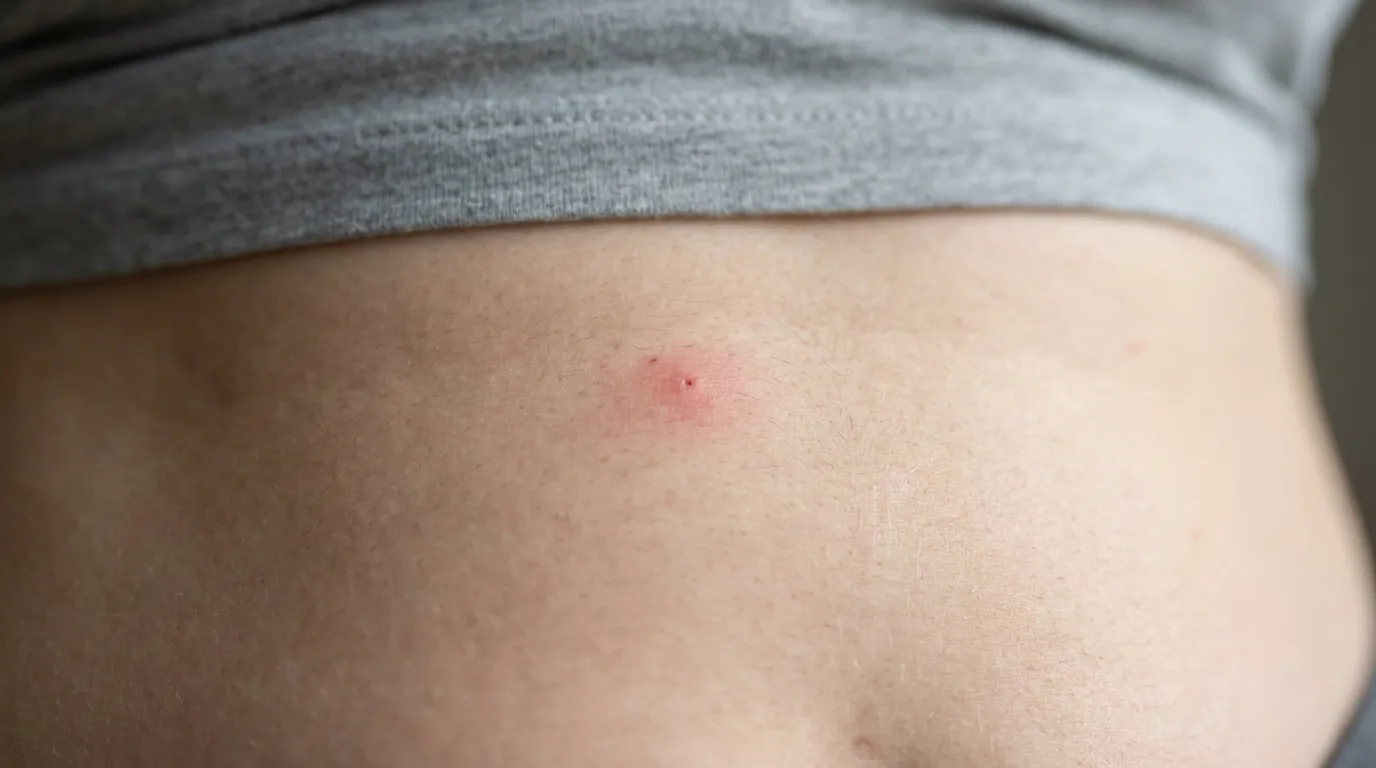
This is the standout, and it is the leading adverse event on the Egrifta label too. People describe redness, itching, a stinging sensation, swelling, or a small welt at the subcutaneous site — Egrifta is simply a more irritating daily injection than most GH peptides. It is local, not systemic, and it earns its "moderate" tag mostly from how frequently and persistently it shows up with a daily injection, not from being dangerous. Community practice is squarely about technique: rotating sites methodically (the label specifies subcutaneous abdominal injection, rotating the spot each day), letting the solution reach room temperature before injecting, using a fresh fine-gauge needle each time, injecting slowly, and not reusing a tender spot. A localized reaction that fades is expected; spreading redness with warmth, pus, or fever is a possible infection and a reason to see a clinician.
The growth-hormone-axis cluster: arthralgia (13%), water retention (12%), tingling (10%)
These three travel together because they share one cause — a raised growth-hormone axis. Arthralgia / joint pain (42 users) and myalgia (9%, 29) are the achy joints-and-muscles people associate with elevated GH. Water retention / edema (38), tagged moderate, is fluid rather than fat: puffiness, slightly swollen fingers or ankles, a fuller face, sometimes a couple of pounds on the scale that are not fat. And numbness / tingling (32), also moderate, is the downstream of that fluid — when it accumulates it can compress nerves, classically the median nerve at the wrist, producing carpal-tunnel-like pins-and-needles. The Egrifta label groups exactly these as "edema-related reactions" (arthralgia, peripheral edema, carpal tunnel syndrome). Community practice treats the whole cluster as a dose signal: it tends to ease when the dose comes down, helped by watching sodium and staying hydrated. Persistent or worsening numbness is a reason to stop and check rather than push through.
Raised blood sugar (8%, 26 users) — the one we flag hardest
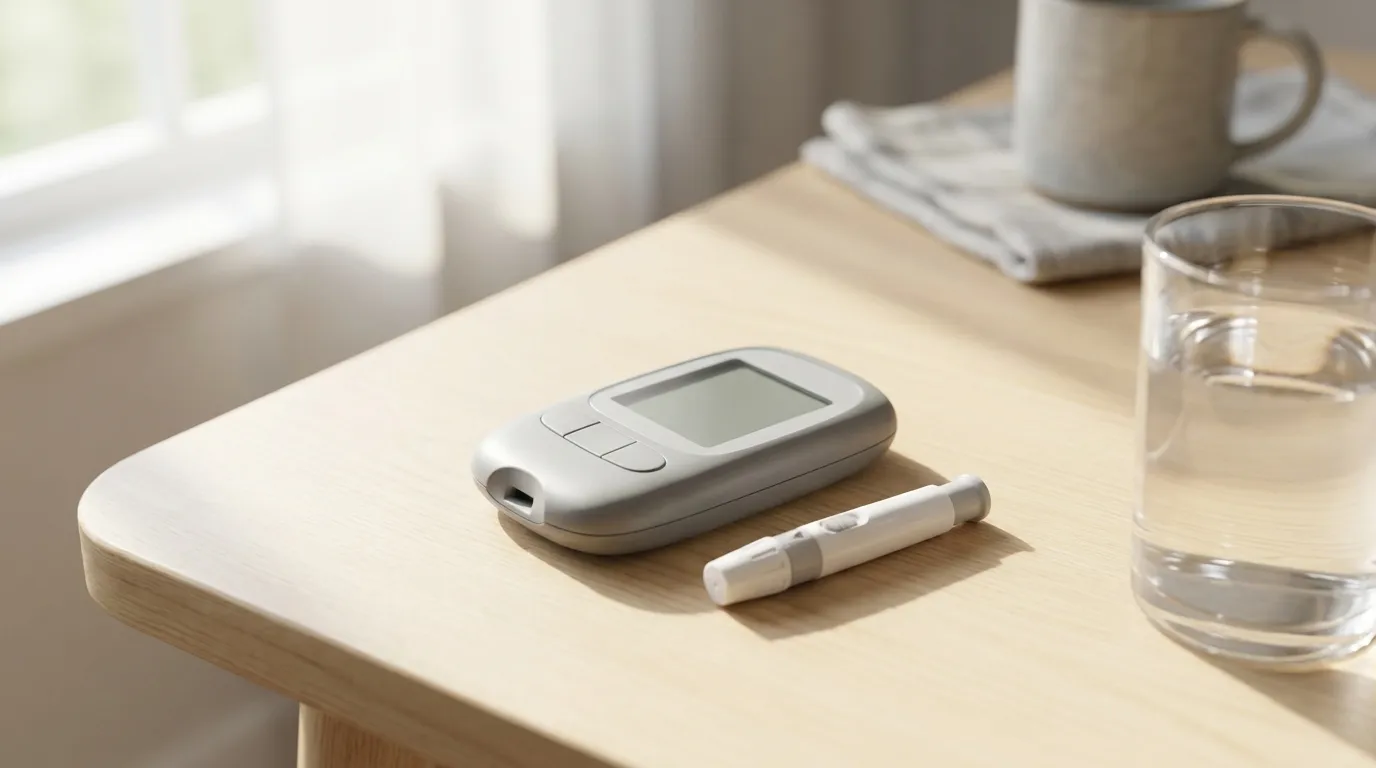
Only 8% reported it, but this is the effect we weight above its frequency, because it is metabolic and it is on the label. Growth hormone is counter-regulatory to insulin: it lowers insulin sensitivity, so raising it can nudge fasting glucose and HbA1c up. The Egrifta label states this directly — tesamorelin "can result in glucose intolerance," with 5% of trial patients crossing into an elevated HbA1c (≥6.5%) by Week 26 versus 1% on placebo — and it advises checking glucose before starting and monitoring during use. For a metabolically healthy person this is often minor and reversible; for someone with prediabetes, type 2 diabetes, or significant metabolic risk, it is the effect that actually matters. Community practice for anyone in that group is to monitor glucose (a fasting reading or a CGM) with a clinician, not to assume a low report rate means low personal risk.
The milder tail (headache, flushing, nausea, rash)
Headache (8%, 26) is non-specific and usually early. Flushing (7%, 22) is a brief warm feeling that can follow a GH-axis injection and is generally benign. Nausea (5%, 16) is mild and uncommon here. Rash or hives (4%, 13) sits at the edge of the hypersensitivity caution above: a small localized rash is usually minor, but a spreading rash with swelling or breathing trouble is the systemic allergic reaction to take seriously.
When do effects start and ease? (the time-course)
The pattern most people describe is dose-linked rather than calendar-linked. The injection-site reaction is the most immediate — it shows up with the very first injections and is an ongoing, technique-sensitive issue as long as you inject daily, rather than something that simply fades after week two. The growth-hormone-axis cluster (arthralgia, edema, tingling) tends to build over the first weeks as GH and IGF-1 rise and stay elevated, and it eases when the dose comes down — which is why the community treats puffiness and tingling as a dose signal. The glucose effect is the slowest to reveal itself: it is a gradual metabolic drift that you only see by measuring (the label's HbA1c shift was assessed at Week 26), which is exactly why monitoring matters more than waiting for a symptom. None of this is a validated protocol; it is the community pattern, and dose decisions belong with a clinician.
Our take: With tesamorelin, two effects deserve more attention than the rest. The injection-site reaction is the one you will feel first and most often — so technique (rotation, room-temperature solution, fresh needles) is the single biggest comfort lever. The blood-sugar effect is the one you will not feel until it is measured — so if you are metabolically at-risk, monitoring glucose is the single most important safety habit. The fluid-and-joint cluster sits between them as a dose signal. Go slow, rotate sites, monitor glucose, and treat persistent numbness or any spreading allergic reaction as a stop-and-check signal.
How does our community report compare to the Egrifta label rates?
Because tesamorelin is FDA-approved, we can do something most pages on this site cannot: place our community percentages next to a real, validated adverse-event table — the Egrifta label. The honest framing still matters: community self-report, controlled-trial incidence, and real-world rates are three different things, and none of them proves tesamorelin caused any single person's effect. But for tesamorelin the comparison is to a genuine label, not to the absence of one.
Two things stand out when you line them up. First, our injection-site rate (24%) runs higher than the label's (17% vs 6% placebo) — both confirm it is the leading effect and that tesamorelin is unusually injection-site-heavy, but our self-selected community, who inject daily and self-report, log it more often than the controlled trial counted it. Read that gap as "self-report tends to over-capture the effect people notice most," not as a contradiction. Second, our arthralgia (13%) sits almost exactly on the label's (13% vs 11% placebo) — a reassuring concordance, though note the label's placebo arm also reported 11%, so the drug-attributable signal there is small. The table below places our community report next to the label rates where the comparison is clean.
| Effect | ProtocolPlus community (N=320) | Egrifta label (tesamorelin) | Egrifta label (placebo) | Read it as |
|---|---|---|---|---|
| Injection-site reaction | 24% (77) | 17% | 6% | Both confirm it leads; our self-report runs higher |
| Arthralgia / joint pain | 13% (42) | 13% | 11% | Close match; small drug-attributable signal vs placebo |
| Peripheral edema / water retention | 12% (38) | 6% | 2% | Community higher; same GH-axis effect |
| Raised blood sugar (glucose) | 8% (26) | 5%* | 1%* | The label's stated warning; *HbA1c ≥6.5% shift at Wk 26 |
| Rash | 4% (13) | 4% | 2% | Close match; hypersensitivity term |
The takeaway is not that our numbers replace the label — it is that we can show you both, side by side, which almost no competitor page does. Where our community runs higher than the trial (injection-site, edema), read it as the over-capture you expect from people who inject daily and self-report the effect they notice most. Where it matches (arthralgia, rash), read it as reassuring concordance. And the glucose row is the one that matters most regardless of which number you trust, because it is the label's own warning.
Why does tesamorelin cause these side effects?
Tesamorelin's side effects trace to two distinct causes: it is an irritating daily subcutaneous injection (the injection-site reactions), and as a GHRH analog it raises your own growth hormone and IGF-1 (the fluid-and-joint cluster and the glucose effect). That split is why the injection-site reaction behaves like a local technique problem while the rest behave like growth-hormone-axis effects that respond to dose. The deep receptor-level science lives on the hub; this is the short version that explains the pattern above.
The growth-hormone pieces are worth separating. The fluid-and-joint cluster — peripheral edema, arthralgia, and the carpal-tunnel-like tingling that fluid compression causes — is the most characteristic effect of a raised GH axis, which is why the Egrifta label groups them as "edema-related reactions." The glucose effect is separate and more important than its frequency: growth hormone is counter-regulatory to insulin, so sustained elevation can raise blood sugar — the metabolic caution the label states outright. The flushing is a short-lived vasodilatory response. And the precautionary IGF-1 / malignancy caution follows from IGF-1 being a growth factor: chronically elevating it is the same signal seen in growth-hormone excess, which is why the label advises monitoring IGF-1 and avoiding use in active cancer. For the full GHRH science, the HIV-lipodystrophy approval, and dosing, see the tesamorelin complete guide.
Citation capsule. Tesamorelin is a stabilized GHRH(1-44) analog that binds the pituitary GHRH receptor to stimulate endogenous growth hormone, raising IGF-1. Growth-hormone elevation characteristically causes fluid retention (peripheral edema, carpal tunnel syndrome, arthralgia) and reduced insulin sensitivity (glucose intolerance), which is the cluster our community reports and which the Egrifta label lists among its most common adverse reactions. Injection-site reactions are local to the daily subcutaneous injection and are the label's leading adverse event (17% vs 6% placebo). Source: FDA / DailyMed Egrifta SV Prescribing Information, 2025; Falutz et al., New England Journal of Medicine, 2007.
Is tesamorelin approved and legal? (and off-label use)
Tesamorelin is FDA-approved as Egrifta — approved in 2010 (Theratechnologies) for reducing excess visceral abdominal fat in adults with HIV-associated lipodystrophy — and that is its only approved use; visceral-fat loss in non-HIV adults, anti-aging, and body recomposition are all off-label, and it is banned in sport. This is the opposite of most peptides on this site: tesamorelin has a real label and real trial data, but only for one narrow indication.
Two points matter for safety. First, off-label use carries the same side-effect cautions. The molecule is identical whether it is prescribed Egrifta or sourced off-label, so the injection-site, fluid/joint, and glucose cautions on this page apply just the same — except off-label use usually lacks the clinical supervision (baseline glucose, IGF-1 monitoring) that comes with the approved indication, which is exactly when the glucose warning matters most. Second, the WADA status: tesamorelin is on the World Anti-Doping Agency Prohibited List under class S2 (specifically S2.2.4, growth hormone releasing factors, where it is named alongside CJC-1295 and sermorelin), so it is banned at all times for tested athletes and would cause a positive test. For the full legal and approval history, the tesamorelin complete guide keeps the detail.
Citation capsule. Tesamorelin is FDA-approved as Egrifta (initial U.S. approval 2010, Theratechnologies) for the reduction of excess abdominal fat in HIV-infected patients with lipodystrophy; all other uses are off-label. It is prohibited at all times in sport under the WADA 2026 Prohibited List, class S2.2.4 (growth hormone releasing factors). Source: FDA / DailyMed Egrifta SV label, 2025; World Anti-Doping Agency 2026 Prohibited List (S2), in force 2026-01-01; retrieved 2026-06-18.
Who should be especially cautious with tesamorelin?
Tesamorelin warrants extra caution — and on the label, monitoring or avoidance — for anyone with diabetes, prediabetes, or metabolic risk (the glucose-intolerance warning), anyone with active or recent malignancy (the IGF-1 / growth-factor concern), people who are pregnant, and tested athletes. For the approved HIV indication these come with clinician oversight; for off-label use, they are still the lines to respect.
A few practical cautions follow from the profile. If your blood sugar is already a concern, the glucose effect is the one that turns a tolerability question into a metabolic one — the label itself says to check glucose status before starting and monitor during use, so do that with a clinician. If you have a cancer history, the IGF-1 elevation is a precautionary reason to involve an oncologist before any off-label use. Pregnancy is not an approved setting and is best avoided. And because off-label, research-grade ("for research use only") tesamorelin is unregulated for human use, product quality is its own caution on top of the molecule — for how to think about sourcing and third-party testing, see how to vet peptide quality. None of this page replaces a clinician conversation.
Frequently Asked Questions
The bottom line
If you came here asking what tesamorelin side effects look like, the honest answer is unusually concrete for a peptide — because tesamorelin is FDA-approved as Egrifta and has a real label to anchor to. The effect you will feel first and most often is the injection-site reaction (24% in our community, the leading adverse event on the label too), which makes tesamorelin the most injection-site-heavy growth-hormone peptide — and which technique largely tames. Behind it sits the growth-hormone-axis cluster — arthralgia (13%), water retention (12%), tingling (10%) — one pattern with one lever, the dose.
The effect you will not feel until it is measured is the one we flag hardest: raised blood sugar (8%), the label's own glucose-intolerance warning, sharper for anyone diabetic or pre-diabetic. In our community of 320 users, everything reported was mild-to-moderate, with no severe events, and our numbers sit at or above the validated Egrifta label rates — close on arthralgia and rash, higher on injection-site and edema, consistent with self-report from daily injectors. Use that side-by-side honestly: rotate injection sites, monitor glucose if you are metabolically at-risk, treat any spreading allergic reaction or persistent numbness as a stop signal, and remember the same cautions apply to off-label use. From here, the natural next reads are the tesamorelin complete guide for the molecule, the GHRH mechanism, and the HIV-lipodystrophy approval, the tesamorelin dosage calculator for how the approved 2 mg dose and off-label ranges are structured, and CJC-1295 side effects if you are comparing GH-axis peptides.
Sources
- U.S. Food & Drug Administration / NIH DailyMed. "Egrifta SV (tesamorelin) for injection — Prescribing Information" (Adverse Reactions §6.1; Warnings & Precautions §5.4 glucose intolerance; most-common-AE table, tesamorelin N=543 vs placebo N=263). 2025. Initial U.S. approval 2010, Theratechnologies. Retrieved 2026-06-18. https://dailymed.nlm.nih.gov/dailymed/lookup.cfm?setid=3d783378-b02d-4f19-99dd-0fc91a042224
- Falutz J, Allas S, Blot K, et al. "Metabolic Effects of a Growth Hormone–Releasing Factor in Patients with HIV." New England Journal of Medicine, 2007;357(23):2359-2370. DOI 10.1056/NEJMoa072375. Retrieved 2026-06-18. https://www.nejm.org/doi/full/10.1056/NEJMoa072375
- Theratechnologies / PR Newswire. "FDA Approves EGRIFTA to Treat Lipodystrophy in HIV Patients." 2010. Retrieved 2026-06-18. https://www.prnewswire.com/news-releases/fda-approves-egrifta-to-treat-lipodystrophy-in-hiv-patients-107084378.html
- Reed ML, Merriam GR, Kargi AY. "Adult Growth Hormone Deficiency — Benefits, Side Effects, and Risks of Growth Hormone Replacement." Frontiers in Endocrinology (Lausanne), 2013;4:64. PMCID: PMC3671347. Retrieved 2026-06-18. https://pmc.ncbi.nlm.nih.gov/articles/PMC3671347/
- World Anti-Doping Agency. "The 2026 Prohibited List, International Standard" (class S2.2.4, Growth Hormone Releasing Factors — tesamorelin named). Effective 2026-01-01. Retrieved 2026-06-18. https://www.wada-ama.org/sites/default/files/2025-09/2026list_en_final_clean_september_2025.pdf
- ProtocolPlus. "Community-reported tolerability data: tesamorelin" (side-effects/tesamorelin.json). First-party app data, 2026. N = 320 users who tracked tesamorelin tolerability. Self-reported community frequency, not validated incidence and not proof of causation.