Cardarine (GW-501516): The PPAR-delta Endurance Chemical, Its Rat-Cancer Problem, and Why WADA Banned It
Cardarine, also called GW-501516, is a research chemical that flips a single metabolic switch in your cells, and that one switch is the reason it is both interesting and dangerous. Activate the PPAR-delta receptor and, in mice, you get more fat-burning and dramatically more endurance. Activate that same receptor chronically and, in rats, you get tumors in organ after organ. It is one molecule with two faces, and you cannot have one without risking the other. This page is the honest map of that story: what Cardarine is, how the mechanism works, why GSK abandoned it in 2007, what WADA says, and what our community actually tracks.
Most "Cardarine guide" pages lead with the endurance hype and tuck the cancer finding into a side-effects line near the bottom. We refuse to do that, because the cancer signal and the anti-doping status are the facts that actually decide the question. For where Cardarine sits among the wider field of aerobic compounds, see our hub on the best peptides and compounds for endurance. If you came here to pick between this and Stenabolic, we keep that head-to-head on its own page and link to it below rather than re-run it here.
Key Takeaways
- Cardarine is a PPAR-delta agonist, not a SARM, not a steroid, and not a peptide. It acts on a metabolic nuclear receptor, so the usual SARM worries about testosterone suppression and post-cycle therapy are not the main issue. The main issue is cancer.
- The endurance result is rodent-only and combination-only. In mice, GW1516 plus four weeks of training raised running time by 68% and distance by 70% (Narkar et al., Cell, 2008). The drug alone, without exercise, did not raise endurance. There are zero human efficacy trials.
- Its defining red flag is cancer. A two-year GSK rat study at 5 and 40 mg/kg/day produced dose-dependent tumors across multiple organs (liver, stomach, tongue, skin, bladder, thyroid and reproductive tissue). GSK halted development in 2007 (Wikipedia, "GW501516", 2026).
- The benefit and the hazard share one mechanism. Chronic PPAR-delta signaling is pro-proliferative, so the same pathway hoped to boost endurance is the one implicated in the tumors. They cannot be cleanly separated.
- It is banned in sport and easy to detect. Cardarine sits in WADA class S4.4.1 (metabolic modulators) and has been prohibited since 2009. A sulfone metabolite is detectable in urine for up to ~40 days after a single 15 mg dose (Thevis et al., 2012).
- No validated human dose exists. Forums commonly report ~10 to 20 mg/day in 8 to 12 week runs, but that is an unvalidated community convention for a chemical with no human safety data and an animal cancer signal, not a recommendation.
[!WARNING] Banned in sport. Never approved for humans. Caused cancer in rats. Cardarine is sold as a "research chemical not for human consumption." It is on the WADA Prohibited List, detectable for roughly 40 days, and it produced dose-dependent multi-organ tumors in a two-year rat study, which is why its developer dropped it in 2007. Nothing on this page should be read as a green light to take it.
What is Cardarine (GW-501516)?
Cardarine is a synthetic PPAR-delta agonist developed as a metabolic drug candidate, and it is not a peptide, a SARM, or a steroid. GW-501516, also sold as GW1516 and "Endurobol," was created in the 1990s by GlaxoSmithKline and Ligand to treat lipid disorders. It works by switching on a single nuclear receptor that controls how cells burn fat. It was never approved, and its human development ended badly. Everything else on this page should be read through that fact.
Chemically, Cardarine is a highly selective agonist of PPAR-delta (peroxisome proliferator-activated receptor delta), reported as more than 1,000 times more selective for that receptor than for related ones (Narkar et al., Cell, 2008). When it binds PPAR-delta, it turns up a cluster of genes that drive fatty-acid oxidation and mitochondrial efficiency in muscle. The original therapeutic idea was to improve the blood-lipid profile and treat metabolic disease. That idea was abandoned, and what remains in the grey market is a chemical chasing a rodent endurance effect that has never been confirmed in a person.
Citation capsule. Cardarine (GW-501516, also GW1516 or Endurobol) is a synthetic, highly selective PPAR-delta agonist, reported as over 1,000-fold selective for that receptor, originally developed by GlaxoSmithKline and Ligand for lipid disorders. It is not a SARM, steroid, or peptide, was never approved for human use, and its development was halted in 2007. Source: Narkar et al., Cell, 2008; Wikipedia "GW501516," 2026.
Is Cardarine a SARM? The clarifier (and where the comparison lives)
No, Cardarine is not a SARM, and that distinction changes which risks matter. A SARM works on the androgen receptor, the same target as testosterone, which is why SARMs raise suppression and post-cycle-therapy questions. Cardarine does not touch the androgen receptor at all. It is a PPAR-delta agonist aimed at metabolism, so the standard SARM risk model does not apply, and importing it would be a mistake. The central concern with Cardarine is not hormonal suppression. It is the carcinogenicity signal described below.
People most often confuse Cardarine with SR9009 (Stenabolic), another non-SARM endurance chemical that acts on a different receptor. We keep that full head-to-head on its own page so this monograph can stay focused on the molecule itself. For the side-by-side, see our Cardarine versus SR9009 risk breakdown, and for the sibling compound's own deep dive see the Stenabolic (SR9009) molecule guide.
How does Cardarine work? The PPAR-delta switch
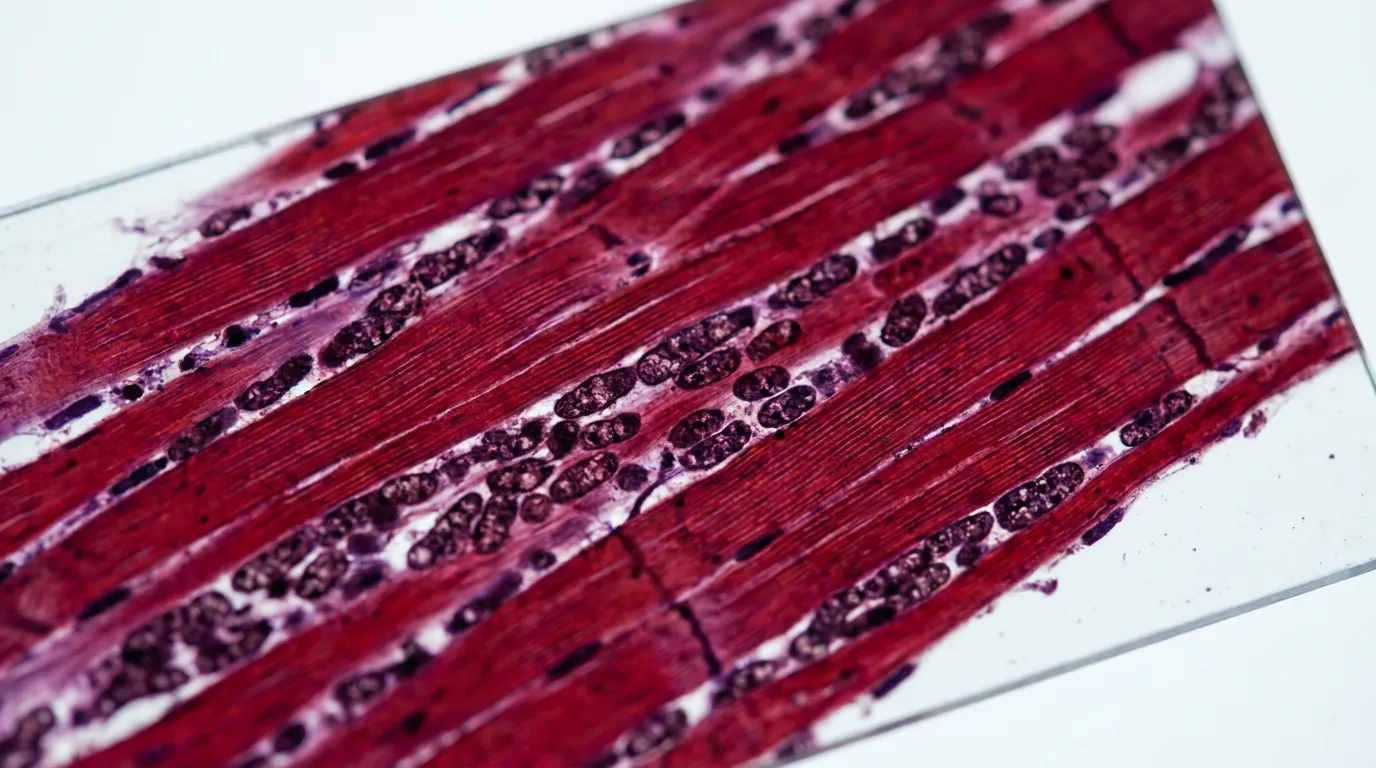
Cardarine works by binding and activating PPAR-delta, a nuclear receptor that turns on the genetic program for burning fat and building mitochondria in muscle. Think of PPAR-delta as a master dial for "use fat for fuel." When Cardarine forces that dial on, muscle cells upregulate genes for fatty-acid oxidation and mitochondrial efficiency. That is the mechanism behind every endurance and fat-loss claim you have read. It is real biology, and it is exactly why the compound is also hazardous.
In the foundational mouse work, PPAR-delta activation upregulated a suite of metabolic genes, including Ucp3, Cpt1b, Pdk4, and the master regulator PGC-1a (Narkar et al., Cell, 2008). Together these shift muscle toward oxidative, fatigue-resistant fibers and ramp up the cellular machinery for endurance. This is the source of the "exercise mimetic" or "exercise in a pill" framing the supplement market borrowed. The framing oversells it, though, because the mouse data come with a critical condition explained in the next section: the drug needed exercise to do anything for endurance.
[UNIQUE INSIGHT] Here is the thread that ties this whole page together, and that most guides miss: PPAR-delta is not a niche endurance switch. It sits at the center of cell metabolism, proliferation, and survival. Chronic PPAR-delta signaling is pro-proliferative and anti-apoptotic, meaning it can push cells to keep growing and resist dying. So the very mechanism that makes Cardarine attractive for endurance is, when run continuously, the mechanism implicated in the tumors. One receptor, two faces. You do not get a clean version of the benefit that leaves the hazard behind, because they are the same switch.
What does Cardarine do for endurance, and is there human evidence?
In mice, Cardarine plus training produced a large endurance jump, but there is zero human evidence, because no human efficacy trial of any phase has ever been run. This is the single biggest gap between Cardarine's reputation and its record. The famous numbers are real, but they come from rodents, and they only appeared when the drug was paired with exercise. Taken alone, without training, the compound did not improve endurance even in mice.
The specifics matter. In the Narkar study, mice given GW1516 at 5 mg/kg/day combined with four weeks of treadmill training ran 68% longer in time and 70% farther in distance than trained controls (Narkar et al., Cell, 2008). The crucial caveat, stated in the same paper, is that the drug given to sedentary mice without exercise did not raise endurance. So the honest reading is "training amplifier in mice," not "endurance pill." You will sometimes see a "+50% VO2max" figure quoted around Cardarine; that claim is not in the primary research and we do not use it. The defensible numbers are the combination-only +68% time and +70% distance, in mice.
Citation capsule. In mice, GW-501516 at 5 mg/kg/day combined with four weeks of treadmill training increased running time by 68% and running distance by 70% versus trained controls, but the drug given without exercise did not improve endurance, and no human efficacy trial of any phase has ever been conducted. Source: Narkar et al., "AMPK and PPAR-delta Agonists Are Exercise Mimetics," Cell, 2008.
Does Cardarine cause cancer? The finding that ended its development
Yes, Cardarine caused cancer in animals, and that finding is the single most important fact about it. In a standard two-year carcinogenicity program, rats given Cardarine developed dose-dependent tumors across many different organs. The result was serious enough that GSK terminated the entire development program in 2007. There is no human data showing that a smaller "fitness dose" avoids this, because the human studies that would answer that question were never done.
The specifics are what make this hard to wave away. GSK dosed Han Wistar rats at 5 and 40 mg/kg/day for 104 weeks, and the animals developed dose-dependent tumors across multiple organ systems, including liver, stomach, tongue, skin, bladder, thyroid, and reproductive tissue (Wikipedia, "GW501516", 2026). Two features make the signal especially credible. First, it was dose-dependent: the tumors got worse as the dose rose, which is the classic fingerprint of a true carcinogenic effect rather than a chance cluster. Second, the tumors appeared in many unrelated tissues at once, which points to the drug's core mechanism rather than a quirk of one cell type.

[UNIQUE INSIGHT] The common counter-argument, that the rat doses were far higher than a person would take, is weaker than it sounds. The standard two-year rodent assay is the deliberate, regulator-accepted way to surface exactly this hazard, and a dose-response curve that is already climbing at the doses tested is not reassuring about lower, longer human exposure. More fundamentally, the cancer signal is most likely on-target. PPAR-delta activation is itself pro-proliferative, so the carcinogenicity is probably an extension of the drug's intended mechanism, not a contaminant or an off-target fluke. That is why you cannot promise a "clean low dose." The hazard rides on the same switch as the hoped-for benefit. Anyone presenting Cardarine as "safe because it is not a steroid" is omitting the exact reason it was abandoned.
Citation capsule. In a two-year GSK carcinogenicity study, Han Wistar rats dosed with GW-501516 at 5 and 40 mg/kg/day for 104 weeks developed dose-dependent tumors across multiple organs, including liver, stomach, tongue, skin, bladder, and thyroid. GSK terminated the compound's development in 2007 as a result. Source: GSK toxicology data, summarized in Wikipedia "GW501516," 2026.
Is Cardarine being explored for any legitimate medical use?
Not as the molecule itself, no, although the receptor it targets is still a research interest. PPAR-delta as a drug target has been examined in metabolic and vascular research, because activating it shifts how cells handle fat and energy. But GW-501516 specifically was abandoned over the carcinogenicity finding, and in 2008 the World Anti-Doping Agency had already added it to the Prohibited List rather than any pharmacopeia (Wikipedia, "GW501516", 2026). The pathway is interesting science; this particular drug is a discontinued compound, not a medicine.
What about cholesterol and cardiovascular effects?
In rodents, activating PPAR-delta shifts how the body handles blood fats, but a moved animal marker is not a human heart-health outcome, and the same chronic activation cannot be cleanly separated from the cancer signal. The original therapeutic pitch for GW-501516 was lipid disorders, and in animal models PPAR-delta activation lowered triglycerides and altered cholesterol fractions. None of that has ever been confirmed as a benefit in a person, because no human trial was run.
The mechanism is the reason for the optimism, and also the reason for caution. PPAR-delta is a master regulator of fatty-acid oxidation, so switching it on changes lipid handling in muscle, liver, and the vessel wall (Narkar et al., Cell, 2008). That is genuinely why GSK first chased it as a dyslipidemia drug. But a surrogate marker that moves in a rodent, such as a lower triglyceride number, is not the same as fewer heart attacks in humans. Surrogate endpoints routinely fail to translate into real outcomes, and here there is no outcome data of any kind.
[UNIQUE INSIGHT] Here is the part the "good for cholesterol" claims skip. The chronic PPAR-delta activation that is supposed to deliver the lipid benefit is the same chronic, pro-proliferative signaling implicated in the multi-organ tumors. You cannot run the receptor long enough and hard enough to reshape someone's lipid panel without running the exact pathway that produced cancer in rats. The hoped-for cardiovascular upside and the carcinogenicity are not two separate dials you can set independently. They are downstream of one switch, which is why a "heart-healthy dose" is not a thing anyone can responsibly promise.
Citation capsule. GW-501516 was originally developed as a lipid-disorder drug because PPAR-delta activation alters fatty-acid oxidation and, in animal models, shifts triglycerides and cholesterol fractions. No human trial has confirmed any cardiovascular benefit, and the same chronic PPAR-delta signaling behind the hoped-for lipid effect is the pro-proliferative mechanism implicated in the rat carcinogenicity. Source: Narkar et al., Cell, 2008; Wikipedia "GW501516," 2026.
Is Cardarine banned by WADA, and will it fail a drug test?
Yes, Cardarine is banned by WADA at all times, and yes, a drug test can catch it for weeks. It is not a "competition-only" restriction. GW1516 is prohibited in and out of competition, and anti-doping labs have a validated, sensitive test for it. The detection window is long enough that there is no realistic "wash-out" timing trick. For any athlete subject to testing, using Cardarine is a straightforward path to an anti-doping rule violation.
On the listing itself, Cardarine has been prohibited since 2009 and currently sits in class S4.4 (Metabolic Modulators), specifically item S4.4.1, which enumerates AMPK activators, PPAR-delta agonists such as GW1516, and Rev-erb agonists (WADA, "Prohibited List", 2026). Older USADA materials reference the historical numbering "S4.5," so you may see both; the current classification is S4.4.1, and it is a Non-Specified substance (USADA, "What Should Athletes Know About GW1516?", 2026). USADA also notes plainly that GW1516 has not undergone human studies, which is the rare case of an anti-doping body warning athletes that a banned substance is also simply unsafe.
How long is Cardarine detectable? The ~40-day window
Cardarine is detectable in urine for up to about 40 days after a single dose, which is unusually long. The compound is extensively metabolized, and one of its breakdown products, the sulfone metabolite, lingers and is the marker labs hunt for. That long tail is why timing-based evasion does not work in practice. A test taken more than a month after a single dose can still return positive.
In the detection pharmacokinetic work, the sulfone metabolite of GW1516 was detectable by LC-MS/MS in urine for up to roughly 40 days after a single 15 mg oral dose, with a limit of detection around 4 pg/mL (Thevis et al., 2012). The parent compound's half-life is estimated at roughly 12 to 24 hours based on limited animal and pharmacokinetic data, so the long detection window reflects the persistence of metabolites, not the parent drug. We frame the half-life cautiously because robust human pharmacokinetic data simply do not exist.
The only notable human-exposure entry in the entire literature is not an efficacy study at all, and that fact is worth sitting with. In 2024, a case report described a positive anti-doping test attributed to suspected interindividual transmission of GW1516 through intimate contact (PMC11269478, 2024). In other words, the single most-cited human-exposure paper on Cardarine is about an athlete who appears to have tested positive without knowingly taking it, not about whether the drug does anything. It documents how sensitive the urine assay is and how easily even secondhand exposure gets flagged. It says nothing about endurance, fat loss, or safety.
[UNIQUE INSIGHT] Step back and the picture is stark. After roughly two decades of grey-market sale, the closest thing to "human Cardarine data" in the peer-reviewed record is a doping-transmission case report, not one efficacy trial, not one safety study, not even a Phase 1. That is the clearest possible illustration of the evidence gap: every claim about what Cardarine does for a person is an extrapolation from mice. For the broader legal picture beyond sport, see our guide to whether research peptides and chemicals are legal.
Is Cardarine legal?
Cardarine is not approved by any regulator, so it is not legal to sell or use as a medicine or a dietary supplement, and the products online are unapproved "research chemicals." There is no legitimate prescription route, because GW-501516 was never approved and its development was halted. The vials sold online are labeled "not for human consumption," which is both a legal hedge by sellers and an accurate description of the compound's status. Easy to buy is not the same as legal, safe, or effective.
In practice, Cardarine occupies the same grey market as other research chemicals: it is sold for "research use only," buyers use it off-label anyway, and there is no quality oversight, so mislabeled potency and impurities are real risks on top of the compound's own hazards. On top of that, it is a WADA-prohibited substance, so for anyone in tested sport the legal and competitive risk compounds. Before researching any such path, the responsible groundwork is the same as for any unapproved compound. See how to read a certificate of analysis and vet a vendor and confirm the rules that apply to your situation.
What doses of Cardarine were studied, and what do people report?
The only validated Cardarine doses are animal doses, and the human figures you see online are an unvalidated community convention, not a recommendation. This is a critical distinction. The dose used in the famous endurance study was a milligram-per-kilogram dose in mice. There is no human dose with any safety or efficacy backing, because no human trial was ever run. So every "protocol" you find is built on forum consensus, not data.
For reference, the studied endurance dose was 5 mg/kg/day in mice (Narkar et al., Cell, 2008), and the detection-study human exposure was a single 15 mg oral dose used to characterize the test, not to study benefit (Thevis et al., 2012). In the community, forums commonly report roughly 10 to 20 mg/day in 8 to 12 week runs. We report that strictly as an observed convention, with the caveats foregrounded: there is no human efficacy or safety data, and there is an animal carcinogenicity signal. It is a description of what some people do, never a dose that "works" or a suggestion to use it.
What does the ProtocolPlus community track for Cardarine?
Among ProtocolPlus users who log Cardarine, most are chasing endurance, with a meaningful minority tracking it for fat loss, and this is a usage signal only, not evidence that it works. No study and no vendor page tells you how real people actually use a research chemical. Our first-party data can, with one firm caveat: it describes self-reported behavior, not trial incidence, efficacy, or safety. What people track does not make a compound effective, and it certainly does not make it safe.
The honest value of this data is context, not endorsement. It shows that Cardarine is used primarily as an endurance compound, which lines up with the rodent mechanism, and that a smaller group uses it for fat loss, which also follows from the PPAR-delta fat-oxidation story. Neither pattern is evidence of benefit. The chart and callout below report the goal split exactly as logged, framed as self-reported usage, not trial data. For how people fold compounds like this into training blocks, see our overview of compounds people track for cycling and conditioning.
[PERSONAL EXPERIENCE] In our experience moderating compound trackers, the gap between how a chemical is marketed and how it is actually logged is itself informative. Cardarine's endurance-heavy goal split mirrors the marketing, but the people who stick with logging tend to be the same ones asking, in the notes, about the cancer data and the detection window. That tells us the audience is more risk-aware than the sales pages assume, which is exactly the audience this monograph is written for.
Frequently Asked Questions
The honest verdict
Cardarine is the clearest example of a compound whose marketing kept running long after its science said stop. The original science was real: activate PPAR-delta, and in mice paired with training you get a striking endurance jump, up 68% in time and 70% in distance. That is the reason it earned its "exercise in a pill" reputation, and it is genuinely interesting biology. But that is also the entire case for it, and it is rodent, combination-only, and never confirmed in a human.
The other half of the story is the part the sales pages omit. The same PPAR-delta switch that drives the endurance effect is pro-proliferative, and when GSK ran the standard two-year rat study, the animals developed dose-dependent tumors across at least seven organ systems, which ended development in 2007. Add a WADA ban since 2009, a ~40-day detection window, and zero human safety data, and the honest label is not "endurance peptide" but "abandoned, banned, animal carcinogen." If you take one thing from this monograph, let it be that the benefit and the hazard are the same switch, and you cannot buy one without the other. The most defensible move is a clinician-guided plan and legal, studied options. From here, the natural next reads are the Cardarine versus SR9009 comparison, the legality overview, and the quality-vetting guide.
Sources
- World Anti-Doping Agency. "The Prohibited List" (2026): GW1516 (GW501516, Cardarine) listed under S4.4 Metabolic Modulators, item S4.4.1 (PPAR-delta agonists); prohibited at all times since 2009. Retrieved 2026-06-22. https://www.wada-ama.org/en/prohibited-list
- U.S. Anti-Doping Agency (USADA). "What Should Athletes Know About GW1516?": GW1516 prohibited; safety warning to athletes; "has not undergone human studies"; historical S4.5 numbering now S4.4.1. Retrieved 2026-06-22. https://www.usada.org/spirit-of-sport/what-should-athletes-know-gw1516/
- Narkar VA, Downes M, Yu RT, et al. "AMPK and PPAR-delta Agonists Are Exercise Mimetics." Cell, 2008;134(3):405-415. PPAR-delta selectivity (>1000x); upregulation of Ucp3, Cpt1b, Pdk4, PGC-1a; PPAR-delta as master regulator of fatty-acid oxidation in muscle, liver and vessel wall (lipid-handling mechanism behind the original dyslipidemia rationale); combination GW1516 + training increased running time +68% and distance +70% in mice; drug alone did not raise endurance. Retrieved 2026-06-22. https://pubmed.ncbi.nlm.nih.gov/18674809/
- GW501516. Wikipedia (citing GSK toxicology data and the WADA listing): originally developed by GSK/Ligand for lipid disorders (PPAR-delta as a metabolic/vascular drug target), GW-501516 itself abandoned over carcinogenicity; two-year Han Wistar rat carcinogenicity study at 5 and 40 mg/kg/day over 104 weeks, dose-dependent multi-organ tumors (liver, stomach, tongue, skin, bladder, thyroid, reproductive), development terminated 2007; added to the WADA Prohibited List in 2008/2009. Retrieved 2026-06-22. https://en.wikipedia.org/wiki/GW501516
- Thevis M, Sobolevsky T, et al. "Detection of GW501516 and its metabolites in human urine." Detection pharmacokinetics: sulfone metabolite detectable in urine by LC-MS/MS up to ~40 days after a single 15 mg oral dose; LOD ~4 pg/mL; extensive metabolism via sulfur oxidation to sulfoxide and sulfone; half-life ~12-24 h. 2012 (PMID 22977012). Retrieved 2026-06-22. https://pubmed.ncbi.nlm.nih.gov/22977012/
- Case report on suspected interindividual transmission of GW1516 via intimate contact producing a positive anti-doping test (a doping case, not an efficacy study; the only notable human-exposure entry in the peer-reviewed literature, underscoring that zero efficacy or safety trials of any phase exist). PMC11269478, 2024. Retrieved 2026-06-22. https://www.ncbi.nlm.nih.gov/pmc/articles/PMC11269478/
- ProtocolPlus. "Community tracking data: Cardarine (GW-501516)" (tracking_overview and goal_distribution). First-party app data, 2026. Self-reported usage signal only (endurance versus fat-loss goal split); not trial incidence, efficacy, or a safety verdict.