Best Peptides for Cycling: What the Community Uses — and the Doping Reality (2026)
The single compound cyclists in our community use most is Cardarine (GW-501516) — and it is the one we flag hardest on the whole page, because it is not a peptide, it was abandoned in development for causing cancer in animals, and real riders have failed tests for it. That fact frames everything here: cycling is the sport where "endurance in a pill" stopped being a metaphor and became a string of doping cases, so a usage ranking led by a banned carcinogen is exactly the place to be most honest. This is the cycling spoke of our endurance cluster — it answers what riders actually reach for to move power-to-weight, fat oxidation, and recovery across big volume, then sets every option against the sport's brutal testing reality.
Most "peptides for cycling" content is a generic endurance listicle with a stock photo of a bike. We do it differently. The headline ranking below comes from first-party usage data — what ~3,000 ProtocolPlus cyclists actually track — and the science is built around the cyclist's real performance model: watts per kilogram, the fat-oxidation engine that lets you hold power for hours, and recovery from the volume that breaks riders down. For the deep science on any single molecule we link up to its dedicated guide, and we keep the doping history front and centre, because in cycling it is not background colour — it is the decision.
Key Takeaways
- What the cycling community uses (not an efficacy ranking): across ~3,000 ProtocolPlus cyclists, the top three are Cardarine (24%, 720 users), MOTS-c (20%, 600), and NAD+ (14%, 420) (ProtocolPlus app data).
- The #1 pick is the worst one. Cardarine (GW-501516) is not a peptide; it is a PPARδ research chemical whose development was halted after dose-dependent cancers in rats, anti-doping authorities have issued health warnings, and real cyclists have been banned for it (Valery Kaykov and Miguel Ubeto, 2013). It leads our ranking because people use it, not because it is safe.
- Usage is not proof. No compound on this list has a human cycling-performance trial behind it. The endurance signals (Cardarine, MOTS-c, SLU-PP-332, SR9009) are from mice; the recovery angle (NAD+, BPC-157) is indirect and mostly animal-evidenced.
- Cycling is the most-tested endurance sport. It pioneered the Athlete Biological Passport (UCI, 2008), and almost everything here is WADA-prohibited: Cardarine, Stenabolic, SLU-PP-332 and MOTS-c as metabolic modulators (S4.4); BPC-157 as a non-approved substance (S0).
- Licensed/UCI-tested? The honest answer is short. Filter the selector to "tested" and almost the whole list disappears — only NAD+ and 5-amino-1MQ are not currently on the Prohibited List, and neither is a proven cycling aid.
- The real levers are watts and weight. Cycling performance is power-to-weight (W/kg) and the fat-oxidation engine behind sustained power — both built by training, not by a vial.
What peptides does the ProtocolPlus cycling community use?
Across ~3,000 ProtocolPlus cyclists, Cardarine is the single most-tracked compound (24%) — unsurprising given its cycling-doping notoriety — followed by the mitochondrial peptide MOTS-c (20%) and the recovery cofactor NAD+ (14%). This is a usage ranking from our own app data, not a clinical verdict on what works best for cycling — and the compound at the top carries the most serious risk on the page.
The split tells the cyclist's story directly. The top of the list is the "fuel-economy and power" crowd: Cardarine and MOTS-c are the most-reached-for compounds anyone uses when chasing more sustained aerobic output and better fat-burning — the levers that decide W/kg over a long climb or a long road race. NAD+ rises to third on a recovery logic, because cyclists ride enormous weekly volume and between-ride recovery becomes the limiter. After that, usage spreads into a tail of exercise-mimetics and recovery agents: the non-peptide research chemicals SLU-PP-332 (12%) and Stenabolic (12%), the soft-tissue peptide BPC-157 (10%), and the oral metabolic compound 5-amino-1MQ (8%).
These shares come only from our community-usage dataset and describe behavior, not efficacy. A compound can be widely used and barely evidenced at the same time, that describes this entire list, and the #1 pick most of all. Read the chart below as "what cyclists reach for," then cross-check it against the cycling-performance science and the doping read further down, where the picture changes hard.
Citation capsule. Among ~3,000 ProtocolPlus users who logged cycling as a goal, the most-tracked compounds were Cardarine/GW-501516 (24%, 720 users), MOTS-c (20%, 600), and NAD+ (14%, 420). This is first-party usage data reflecting what the community uses, not a clinical efficacy ranking and not a safety ranking, and the top pick is a non-peptide research chemical halted for animal carcinogenicity. Source: ProtocolPlus app data (goals/cycling.json), 2026.
| Rank | Compound | Usage share | Users | Type | WADA status |
|---|---|---|---|---|---|
| 1 | Cardarine (GW-501516) ⚠ | 24% | 720 | NOT a peptide | Prohibited (S4.4); halted for animal cancers; riders banned |
| 2 | MOTS-c | 20% | 600 | Peptide | Prohibited (S4.4) |
| 3 | NAD+ | 14% | 420 | Cofactor | Not currently prohibited |
| 4 | SLU-PP-332 | 12% | 360 | NOT a peptide | Prohibited (S4.4 metabolic modulator) |
| 5 | Stenabolic (SR9009) | 12% | 360 | NOT a peptide | Prohibited (S4.4) |
| 6 | BPC-157 | 10% | 300 | Peptide | Prohibited (S0 non-approved) |
| 7 | 5-Amino-1MQ | 8% | 240 | NOT a peptide | Not currently prohibited |
ProtocolPlus app data, n ≈ 3,000 cyclists (goals/cycling.json, 2026). A usage signal, not a clinical efficacy or safety ranking.
The cycling community's top picks (by usage)
The three most-used cycling compounds are Cardarine, MOTS-c, and NAD+ — a carcinogenic research chemical that has banned real cyclists, a mitochondrial peptide, and a recovery cofactor. Each card pairs the usage share with the honest reason cyclists pick it and the caveat that comes with it — and the #1 pick gets the loudest caveat on the page.
These three account for roughly 58% of cycling usage in our cohort. Notice what the split is telling you: the top two (Cardarine, MOTS-c) are the compounds with an actual fat-oxidation/aerobic mechanism in animals — the levers a cyclist would want for W/kg over a long effort — while NAD+ wins on a recovery logic. Popularity here tracks "interesting mechanism for cycling" far more than "proven in people," and the most-used compound of all is the one no rider should touch.
Cardarine (GW-501516) ⚠
Why cyclists pick it: a PPARδ agonist with the strongest animal fat-oxidation and endurance signal — the most-discussed "fuel-economy and watts" compound in the cycling scene.
Honest caveat: not a peptide. Development was halted after dose-dependent cancers in rats across multiple organs. Real cyclists (Kaykov, Ubeto, 2013) were banned for it, and it is WADA-prohibited. Highest risk on the page — we list it because people use it, not because it is defensible.
MOTS-c
Why cyclists pick it: a mitochondrial-derived peptide tied to fat oxidation and metabolic flexibility — the "engine efficiency" bet for holding power for hours once glycogen runs low. It is itself exercise-induced and rises sharply after a hard ride.
Honest caveat: human performance data is thin and mechanistic (mouse-only); research-grade only; explicitly named on the WADA list as a prohibited AMPK activator.
NAD+ ✓
Why cyclists pick it: a cellular-energy cofactor used for recovery across the big weekly volume and back-to-back ride days that define cycling training.
Honest caveat: the cycling benefit is indirect and unproven in humans, and delivery is debated. Its one real virtue is regulatory — it is one of only two picks here not currently banned.
The long tail (ranks 4–7): the remaining ~42% of usage spreads across the non-peptide exercise-mimetics SLU-PP-332 (12%) and Stenabolic (12%), the recovery peptide BPC-157 (10%) for knee, tendon, and crash-road-rash durability, and the oral metabolic compound 5-amino-1MQ (8%). Notice the quiet bright spot: NAD+ and 5-amino-1MQ are the only two on the whole list that are not currently WADA-prohibited — which is exactly why they matter for a licensed rider, even though neither is a proven cycling aid. Each gets a mini-section in the mechanism families below.
Why cycling is its own performance problem
A cyclist is not just an endurance athlete — the sport reduces performance to a single brutal number, watts per kilogram, and then asks you to hold a high fraction of it for hours, which makes the fat-oxidation engine and recovery from huge volume the things that actually decide races. Understanding this model is what separates a real cycling rationale from a recycled endurance listicle, so this is where the spoke goes deep. Each demand below maps to a family of compounds you recognise from the ranking — and to why the doping history is so specific to this sport.
To put the scale in view: cycling is an enormous market — roughly 42.5 million Americans rode for fitness in 2024, against a global bicycle market valued near USD 72-79 billion (Statista, "Cycling — statistics & facts," 2025, retrieved 2026-06-17). That size, plus a culture obsessed with measurable watts, is exactly why cycling became the sport where "endurance in a pill" was tried hardest and tested for most aggressively.
Demand 1 — Power-to-weight (W/kg), the number that decides everything
The first demand is the one every cyclist tracks. On any climb or sustained effort, what matters is not raw watts but watts per kilogram of body mass, because you have to move your own weight up the road. In moderately trained cyclists, relative functional threshold power (FTP in W/kg) was strongly associated with race performance (r = 0.74), and relative power normalised to body mass predicted race time better than absolute power or even VO2max (Sørensen et al., "The Validity of Functional Threshold Power and Maximal Oxygen Uptake for Cycling Performance," Sports, 2019, retrieved 2026-06-17). This is why the "fuel-economy and lean" framing drives the top of our ranking: cyclists are not chasing bulk, they are chasing sustainable power at the lowest possible weight — and that is precisely the space the PPARδ and exercise-mimetic compounds claim to occupy.
This is the link Cardarine and the exercise-mimetics target. Cardarine (a PPARδ agonist) and AICAR (an AMPK activator) come from the landmark "exercise in a pill" work, where AICAR alone raised running endurance roughly 44% in sedentary mice and Cardarine plus training raised it further (Narkar et al., "AMPK and PPARδ Agonists Are Exercise Mimetics," Cell, 2008, retrieved 2026-06-17). The catch no cycling listicle states: every one of those numbers is from mice, Cardarine's strong effect needed training alongside it, and the compound was later abandoned for causing cancer.
Demand 2 — The fat-oxidation engine (holding power for hours)
The second demand is fuel. You store only enough carbohydrate for roughly a couple of hours of hard riding, so any long road race, gran fondo, or multi-hour climbing day depends on how much fat you can burn at race intensity — sparing glycogen for the decisive moments. The capacity is real and measurable: maximal fat oxidation peaks at "Fatmax," around 56% of VO2max in endurance-trained athletes versus lower in the untrained, and fat-oxidation capacity correlates with long-course endurance performance (Maunder et al., "Contextualising Maximal Fat Oxidation During Exercise," Frontiers in Physiology, 2018, retrieved 2026-06-17). The honest nuance from that same review: the link between fat-burning and performance is better understood as metabolic flexibility and delayed carbohydrate reliance than as a guaranteed "glycogen-sparing makes you faster" effect.
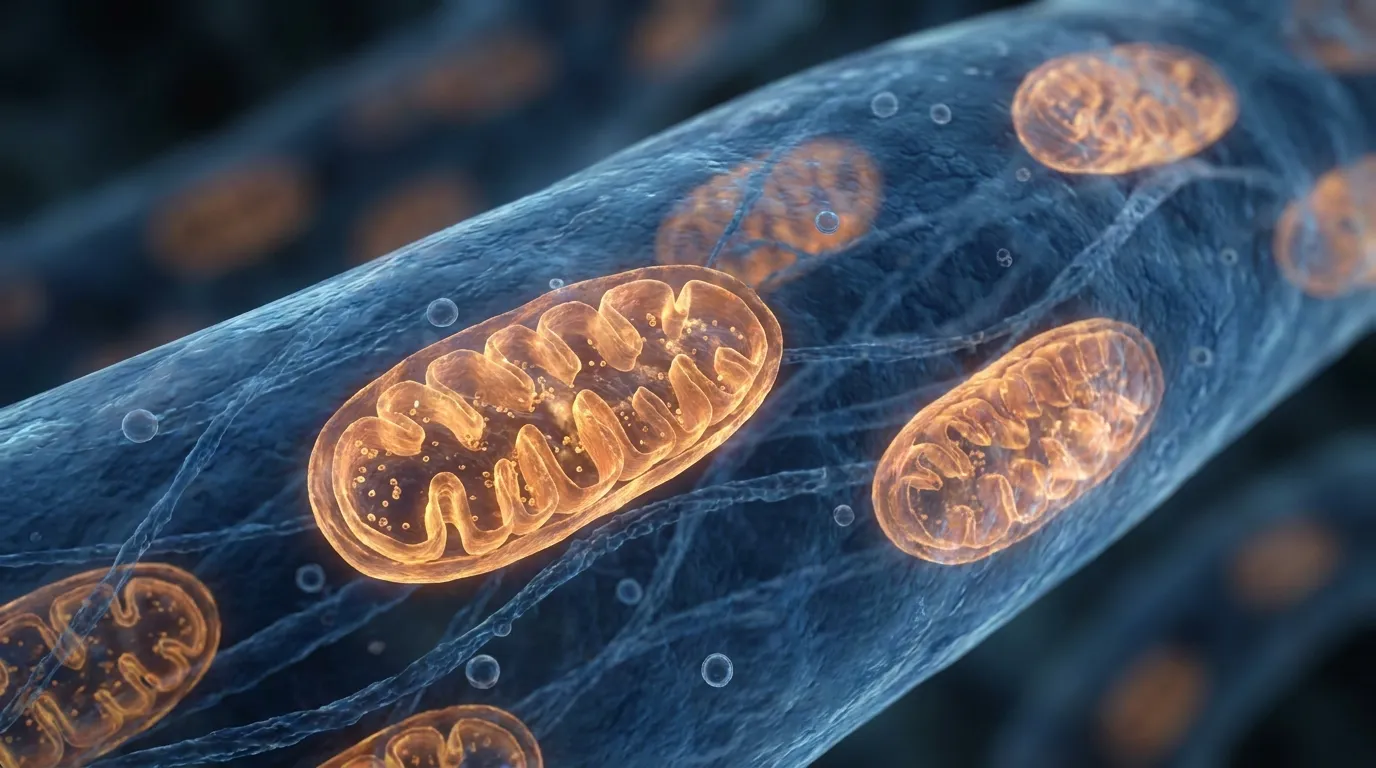
This is the link the mitochondrial compounds chase. MOTS-c, the community's #2, is a mitochondrial-derived peptide that activates AMPK — the same nutrient-sensing pathway exercise activates — and a 2021 study showed it is itself exercise-induced and improved running capacity in young, middle-aged, and old mice, with reduced fat mass and increased lipid utilisation; in humans, skeletal-muscle MOTS-c rose sharply after a cycling exercise protocol (Reynolds et al., "MOTS-c is an exercise-induced mitochondrial-encoded regulator," Nature Communications, 2021, retrieved 2026-06-17). That fat-oxidation fit — a compound that nudges the metabolic engine a cyclist lives on — is the entire rationale for MOTS-c sitting at #2 here. The caveat, stated plainly: the performance data is from mice, and the human result is that MOTS-c responds to exercise, not that injecting it makes you faster.
Demand 3 — Recovery across enormous volume
The third demand is recovery, and cycling generates more of it to manage than almost any sport. Serious cyclists ride 10, 15, even 25 hours a week — volume a runner's joints could never absorb, which the bike permits precisely because it is low-impact. That makes the limiter not single-session damage but the cumulative ability to back up hard days, week after week, without the system breaking down. This is the rationale for NAD+ ranking third: a cellular-energy cofactor used to support the between-ride turnaround. BPC-157 sits here too, used for the knee, tendon, and connective-tissue durability that high pedalling volume stresses, plus the road-rash and crash recovery that are an occupational hazard of the sport. Neither has a direct power mechanism; both are recovery bets, and the underlying logic (the rider who holds a 16-week block beats the one who breaks down) is the soundest reasoning in this category, even though the human evidence that these specific compounds deliver it is absent.
Demand 4 — Why "endurance in a pill" is so loaded in cycling
The last demand is not physiological — it is historical, and it shapes how every compound on this page should be read. Cycling is the sport with the deepest, most documented doping history of any, and the compounds people reach for here did not appear in a vacuum. The reason a fat-oxidation pill or a mitochondrial peptide sounds plausible to a cyclist is that the sport spent decades proving that endurance can be pharmacologically enhanced — through erythropoietin (EPO), which raises oxygen-carrying capacity and genuinely works. That is exactly why cycling built the most aggressive testing system in sport: the UCI launched the Athlete Biological Passport in 2008, the first international federation to do so, and the first to sanction riders on passport evidence alone (Zorzoli & Rossi, "Implementation of the biological passport: the experience of the International Cycling Union," Drug Testing and Analysis, 2010, retrieved 2026-06-17). The full extent of the EPO-and-blood era was laid out in the USADA investigation that produced a lifetime ban and stripped results back to 1998 in the US Postal case (USADA, "U.S. Postal Service Pro Cycling Team Investigation," 2012, retrieved 2026-06-17).
That history is why this page handles the doping question more loudly than any other in our cluster. When GW-501516 (Cardarine) emerged as the next "endurance in a pill," cycling was the first sport to catch riders using it, and the testing culture means a licensed cyclist faces a near-certainty of being caught on top of every health risk. The doping context is not background; for a cyclist, it is the decision.
Citation capsule. Cycling performance is governed by power-to-weight (relative FTP in W/kg predicted race time at r = 0.74, better than absolute power or VO2max; Sørensen et al., Sports 2019), the fat-oxidation engine (maximal fat oxidation peaks near 56% VO2max in trained athletes; Maunder et al., Front Physiol 2018), and recovery across very high training volume. The compounds the community uses target these demands pharmacologically — Cardarine via PPARδ, MOTS-c via AMPK/fat oxidation, NAD+/BPC-157 via recovery — but the supporting performance data is from mice, not human cycling trials. Cycling also pioneered the Athlete Biological Passport (UCI, 2008), making it the most heavily tested endurance sport.
Mechanism families: how the candidates group
Sorted by what they actually do, the seven candidates fall into three families — mitochondrial exercise-mimetics, a metabolic cofactor, and a recovery peptide — and the family that dominates the top of the cycling ranking is the one with the worst safety record. Grouping them this way shows why the ranking looks the way it does and keeps each molecule's deep science on its own hub.
Mitochondrial / exercise-mimetics — Cardarine, MOTS-c, SLU-PP-332, Stenabolic, 5-amino-1MQ
This family chases Demand 1 and Demand 2 directly: oxidise more fat, mimic the exercise signal, raise the power you can hold at a given weight. MOTS-c is the peptide of the group and the community's #2; the rest are small molecules, not peptides — a distinction every competitor blurs. Cardarine (PPARδ) and Stenabolic (REV-ERB) have the loudest animal endurance stories and the worst safety problems; Stenabolic has the added flaw of near-zero oral bioavailability, so the popular oral capsules cannot reproduce the injected-mouse results. SLU-PP-332 (a pan-ERR agonist) is the newest and most preclinical, increasing running capacity in mice but with no human data at all. 5-amino-1MQ (an NNMT inhibitor) is the oral, metabolism-adjacent outlier with a small following and no human cycling data. For the full molecular story, see the MOTS-c complete guide; for the research-chemical trio, the Cardarine (GW-501516) guide, the SLU-PP-332 guide, and the Stenabolic (SR9009) guide.
Metabolic cofactor — NAD+
The cofactor family is the upstream-support idea: keep the cellular energy machinery topped up across big volume. NAD+ is central to mitochondrial energy metabolism and declines with age, which is the rationale cyclists cite for between-ride recovery — but the benefit is indirect and unproven, and IV-to-intracellular delivery is debated. Its one practical virtue is regulatory: it is not currently WADA-prohibited. More: the NAD+ guide.
Recovery / soft-tissue — BPC-157
This family targets Demand 3: heal faster, ride more. BPC-157 is the most-used recovery peptide in sport, valued for soft-tissue and tendon resilience under high pedalling volume and for crash-and-road-rash recovery. It has no direct power mechanism and is mostly animal-evidenced. We keep it shallow here on purpose — the tendon, gut, and injury-healing angles are their own intents. Full science: the BPC-157 complete guide.
Which cycling compound fits your situation?
The decision turns on three questions the selector asks — injectable or oral, do you race licensed/UCI-tested, and how experienced you are — and for a cyclist the tested question is decisive, because cycling tests harder than any other endurance sport. The matrix below sets all seven candidates against the dimensions that actually decide it, including route and WADA status.
This table is the "why" behind the usage ranking — editorial context, not the headline. The selector quiz at the top runs the same logic interactively. The single most important filter is tested: choose it and the list collapses to two options, because almost every compound cyclists use is prohibited in sport. That is not a quirk of our data — it is the honest reality of pharmacological cycling enhancement.
| Compound | Family | Route | WADA status | Human cycling evidence | Picked when… |
|---|---|---|---|---|---|
| Cardarine ⚠ | PPARδ (NOT a peptide) | Oral | Prohibited (S4.4) | None; halted for animal cancers; riders banned | (We do not recommend it — listed because it is used) |
| MOTS-c | Mito exercise-mimetic (peptide) | Injectable | Prohibited (S4.4) | None (mouse only) | You want the fat-oxidation/efficiency bet and accept research-grade risk |
| NAD+ | Cofactor | Injectable | Not prohibited | None proven (indirect) | You are tested or value a non-banned recovery option (but unproven) |
| SLU-PP-332 | ERR exercise-mimetic (NOT a peptide) | Oral | Prohibited (S4.4) | None (mouse only, preclinical) | You are experimenting at the frontier (high uncertainty) |
| Stenabolic | REV-ERB (NOT a peptide) | Oral | Prohibited (S4.4) | None; poor oral absorption | (Mechanism interest only; oral form likely inert) |
| BPC-157 | Recovery (peptide) | Inj./oral | Prohibited (S0) | None (mostly animal) | Knee/tendon durability or crash recovery is the bottleneck |
| 5-Amino-1MQ | Metabolic (NOT a peptide) | Oral | Not prohibited | None (mouse only) | Tested, oral-only, and willing to experiment |
Aerobic power versus recovery — and the WADA wall behind both
Map the two things cyclists actually want — more sustainable aerobic power and faster recovery across volume — against each compound, and the picture explains the whole ranking: the compounds that lean hardest on the power side are also the most banned and the most dangerous, while the only allowed options lean recovery and do the least. This view is the differentiator no cycling listicle shows.
The grouped bars below score each leading compound (editorially, 0-5) on how directly it targets aerobic power versus recovery, with its WADA status flagged underneath. Cardarine and the exercise-mimetics own the power column — and carry the prohibition and, for Cardarine, the carcinogenicity flag. NAD+ leans recovery and is one of only two bars that is not banned. Read it as a coverage map, not an efficacy claim — every score is "what it aims at," not "what it proves."
Discussed in cycling but not in our cohort
A few things get talked about constantly in cycling circles but barely register in our usage data — and the loudest of all, EPO, is the one that makes this entire category so fraught. Covering these honestly is part of being a complete spoke; we keep each brief because none is a community pick.
EPO and blood manipulation are the elephant in the room of any cycling-performance discussion. Erythropoietin raises oxygen-carrying capacity and genuinely improves endurance — it is the most effective endurance enhancer cycling has ever seen, which is exactly why the sport built the biological passport to catch it and why the US Postal investigation reads the way it does. We mention it to make a point, not as an option: the mechanism that actually works in cycling (oxygen delivery) is not what our community uses, and it sits behind the heaviest sanctions in sport. AICAR, the original AMPK-activating "exercise mimetic" that raised endurance in sedentary mice, gets named whenever cyclists discuss fat-adaptation pharmacology; it has no human cycling data and is a WADA-prohibited metabolic modulator. And the honest punchline belongs to collagen, food-derived peptides, and structured carbohydrate fueling — not research chemicals at all. The interventions with the best human evidence for a cyclist are oral, legal, and unglamorous: a fueling plan that delivers enough carbohydrate per hour, and the base training that builds the fat-oxidation engine no vial reliably moves.
The doping reality: WADA status, by compound — and the cycling cases
For a licensed cyclist, the ranking above is mostly a list of ways to fail a test — five of the seven candidates are on the WADA Prohibited List, cycling tests harder than any other endurance sport, and the community's #1 pick has already banned real riders. This is the section that matters most if you race under a UCI licence, and it is where the community usage data and the safe-for-competition reality diverge hardest.
Three points decide it. First, the metabolic modulators (class S4.4) — Cardarine, Stenabolic, SLU-PP-332, AICAR, and MOTS-c, which is explicitly named on the list as a prohibited AMPK activator — are banned at all times. Second, the non-approved substances (class S0) — BPC-157, neither approved for human use by any regulator and named on the list since January 2022 — are banned at all times. Only NAD+ and 5-amino-1MQ are not currently named on the Prohibited List, and that is the entire reason they survive the tested filter in the selector. But cycling's history with Cardarine specifically is not theoretical: GW-501516 has produced real cycling-doping cases — Valery Kaykov (RusVelo) was sanctioned in 2013 in what was reported as the first case in any sport, and Miguel Ubeto (Lampre-Merida) was banned the same year (INRNG, "The Kaykov Case," 2013, retrieved 2026-06-17; VeloNews, "Lampre's Miguel Ubeto suspended for GW1516 sulfone," 2013, retrieved 2026-06-17). The default sanction for a violation is a four-year ban — career-ending for most riders.
Citation capsule. Under the WADA Prohibited List, the cycling candidates split across two classes plus two not-listed compounds: S4.4 metabolic modulators (Cardarine/GW-501516, Stenabolic/SR9009, SLU-PP-332, AICAR, and MOTS-c, named as a prohibited AMPK activator) and S0 non-approved substances (BPC-157, on the list since January 2022). NAD+ and 5-amino-1MQ are not currently listed (though WADA's list is non-exhaustive). Cardarine/GW-501516 has produced real cycling-doping sanctions (Kaykov and Ubeto, 2013). Cycling pioneered the Athlete Biological Passport (UCI, 2008). Licensed/UCI-tested riders should assume a substance is prohibited unless verified. Sources: WADA Prohibited List S4.4/S0; USADA (GW1516, BPC-157); INRNG/VeloNews (cycling cases); Zorzoli & Rossi (UCI biological passport).
Why Cardarine does not belong in any cyclist's plan
The cycling community's #1 pick is the one we flag hardest on this entire page: Cardarine is not a peptide, it has no human safety data, its development was abandoned because it caused cancer in animals, and it has already ended cyclists' careers. No fat-oxidation upside justifies that, and in the most-tested endurance sport, the doping sanction makes the math worse than anywhere else.
Cardarine (GW-501516) is a PPARδ agonist that produced strong fat-oxidation and endurance effects in mice — which is exactly why it circulates in cycling forums as a "watts and fuel-economy" compound and why it is, by usage, our community's top pick. But its development was halted after long-term rodent studies showed dose-dependent cancers across multiple organs, a finding treated as established by anti-doping authorities, who have issued explicit health warnings stating it was pulled from trials for causing cancer and urging athletes not to use it (USADA, "What Should Athletes Know About GW1516?", retrieved 2026-06-17; Sport Integrity Australia, "GW1516 Information", retrieved 2026-06-17). For an unproven cycling benefit, an animal carcinogenicity signal plus an unknown human safety profile is not a trade any rational cyclist should make — and for a licensed rider, in a sport that pioneered the biological passport and already caught Kaykov and Ubeto, it is a near-certain four-year ban on top. We rank it because people use it; we are telling you not to.
What's realistic to expect — and how to read the claims
If you are weighing one of these compounds for your watts or your recovery, the realistic expectation is "no measurable, proven benefit in a human cyclist" — and the testimonials you will find in forums and Strava comments are exactly the kind of evidence that misleads. Setting that expectation honestly is more useful than any ranking.
Three habits keep you grounded. First, separate animal numbers from human promises: "44% more endurance" in mice is a real finding, not a prediction for your FTP, and the mouse-to-human gap in this field is enormous. Second, distrust the personal-best story: anyone using these compounds is almost always also training with structure, losing weight to chase W/kg, sleeping, and fueling with intent, so improvement gets credited to the vial when the training and the weight loss did the work. Third, weight the downside correctly: for an unproven upside, an unknown long-term safety profile (and, for Cardarine, a known carcinogenicity signal) is a bad trade, and for a licensed rider a near-certain sanction makes the expected value plainly negative. The things that reliably move a cyclist's performance are the unglamorous ones: structured intervals to raise FTP, the base work that builds the fat-oxidation engine, a sensible racing weight, fueling, iron, and sleep. Nothing on this community ranking belongs in that category yet.
Go deeper: the hub and your sibling sports
This is the cycling spoke of our endurance cluster — if you want the full aerobic-performance overview, or you came tracking a specific number or a different distance, start with the hub or a sibling spoke instead. Each inherits this page's honest framing and goes deep on its own context.
Endurance (hub)
The flagship overview — the full aerobic-performance science and the whole candidate field. the endurance hub
VO2max
What physiologically moves your VO2max, and what our community's VO2max data shows. peptides and VO2max
Ultra-Marathon
The extreme endurance end — backyard ultras, 100-mile feats, Runner's Gut and massive-volume recovery. peptides for ultra-marathon
Running
The everyday and hobby runner's guide — broad, accessible, recovery-led. peptides for runners
For the molecule-level science behind the leaders, see the Cardarine (GW-501516) guide and the MOTS-c guide; and before sourcing anything, how to vet peptide quality and are peptides legal.
What the community does is not what is proven, or safe
Treat the cycling usage ranking as a popularity signal shaped by mechanism appeal, forum hype, and availability — not as evidence of what works or what is safe. The clearest proof is that the community's #1 compound, Cardarine, is a research chemical whose own development was abandoned because it caused cancer in animals, and which has already banned real cyclists.
Three honest framings sit on top of every number on this page. First, no compound here has a positive human cycling trial — the headline effects (Cardarine, MOTS-c, SLU-PP-332, SR9009) are from mice, and the recovery angles (NAD+, BPC-157) are indirect and mostly animal-evidenced. Second, Cardarine's record is disqualifying on two counts: GW-501516's development was halted after long-term rodent studies showed dose-dependent cancers, and it sits at the centre of real cycling-doping sanctions in a sport that tests harder than any other. Third, research-grade vials carry quality risk — unknown potency, purity, and sterility — that no usage statistic captures, on top of compounds that are themselves unproven.
Our take: Read this page as two layers that mostly disagree. The usage chart tells you what real cyclists reach for; the science and safety read tell you how little supports it. When those two diverge as sharply as they do here — a carcinogen that has banned riders sitting at #1 — trust the evidence, not the crowd. The most defensible "cycling peptide" decision for almost everyone is the unglamorous one: build the W/kg and the fat-oxidation engine that training actually moves, get to a sensible racing weight, and treat everything on this list as experimental at best and, in Cardarine's case, dangerous.
Who should not go near these
These compounds are not for anyone racing under a UCI or other tested licence, not for anyone outside research or clinical oversight, and Cardarine and Stenabolic are not for anyone, full stop. The honest contraindication list here is short and firm.
A few hard lines. Licensed/UCI-tested cyclists should treat the entire top of this list as a failed test waiting to happen — five of seven candidates are WADA-prohibited, cycling tests more aggressively than any other endurance sport, and "I didn't know" is not a defence in a sport that already banned Kaykov and Ubeto for the exact compound at #1. Anyone considering Cardarine or Stenabolic should weigh that these are non-peptide research chemicals with a carcinogenicity signal (Cardarine) and near-zero oral bioavailability plus off-target effects (Stenabolic) — there is no version of the risk-reward that favours them for an unproven cycling benefit. And for every research peptide here, the responsible answer is the same: there is no validated safe-use protocol for cycling, so they belong in a trial or under a clinician, not in a self-directed cycle. None of this page is a substitute for that conversation.
Frequently Asked Questions
The bottom line
If you came here for a single "best peptide for cycling," the honest answer is uncomfortable: there isn't one with human evidence behind it, and the community's most-used option is the one to avoid most. Cardarine sits at #1 by usage because it has the loudest fat-oxidation story in animals — but it is a non-peptide research chemical abandoned for causing cancer, it has banned real cyclists, and in the most-tested endurance sport it is a near-certain sanction. MOTS-c and the other mitochondrial compounds have more interesting mechanisms and only mouse data; the recovery options (NAD+, BPC-157) act indirectly and are mostly animal-evidenced. And the interventions that actually move a cyclist's watts and weight are the ones no vial can sell you: structured training, the fat-oxidation base, a sensible racing weight, and a fueling plan.
For a licensed rider the practical answer is shorter still: almost everything here is prohibited, the two compounds that are not (NAD+, 5-amino-1MQ) are not proven to work, and cycling will catch you. The selector at the top narrows the field to your constraints, but the most defensible cycling decision is the one this whole page keeps circling back to: build the power-to-weight and the aerobic engine that actually respond to training, and treat these compounds as experimental at best and, in Cardarine's case, dangerous. From here, the natural next reads are the endurance hub for the full aerobic-performance picture, the science on the lead compound at the Cardarine (GW-501516) guide, and, before sourcing anything, how to vet peptide quality and are peptides legal.
Sources
- Sørensen A, Aune TK, Rangul V, Dalen T. "The Validity of Functional Threshold Power and Maximal Oxygen Uptake for Cycling Performance in Moderately Trained Cyclists." Sports (Basel), 2019, 7(10):217. Retrieved 2026-06-17. https://doi.org/10.3390/sports7100217
- Maunder E, Plews DJ, Kilding AE. "Contextualising Maximal Fat Oxidation During Exercise: Determinants and Normative Values." Frontiers in Physiology, 2018, 9:599. Retrieved 2026-06-17. https://doi.org/10.3389/fphys.2018.00599
- Reynolds JC, Lai RW, Woodhead JST, et al. "MOTS-c is an exercise-induced mitochondrial-encoded regulator of age-dependent physical decline and muscle homeostasis." Nature Communications, 2021, 12:470. Retrieved 2026-06-17. https://doi.org/10.1038/s41467-020-20790-0
- Narkar VA, Downes M, Yu RT, et al. "AMPK and PPARδ Agonists Are Exercise Mimetics." Cell, 2008, 134(3):405–415. Retrieved 2026-06-17. https://www.sciencedirect.com/science/article/pii/S0092867408008386
- Zorzoli M, Rossi F. "Implementation of the biological passport: the experience of the International Cycling Union." Drug Testing and Analysis, 2010, 2(11-12):542–7. Retrieved 2026-06-17. https://pubmed.ncbi.nlm.nih.gov/21204287/
- U.S. Anti-Doping Agency (USADA). "What Should Athletes Know About GW1516?" Retrieved 2026-06-17. https://www.usada.org/spirit-of-sport/what-should-athletes-know-gw1516/
- U.S. Anti-Doping Agency (USADA). "U.S. Postal Service Pro Cycling Team Investigation" (Reasoned Decision). 2012. Retrieved 2026-06-17. https://www.usada.org/athletes/results/u-s-postal-service-pro-cycling-team-investigation/
- U.S. Anti-Doping Agency (USADA). "BPC-157: Experimental Peptide Creates Risk for Athletes." Retrieved 2026-06-17. https://www.usada.org/spirit-of-sport/bpc-157-peptide-prohibited/
- Sport Integrity Australia. "GW1516 Information." Retrieved 2026-06-17. https://www.sportintegrity.gov.au/what-we-do/anti-doping/substance-education/gw1516-information
- INRNG. "The Kaykov Case: Black Market Drug Detected" (GW501516 / Valery Kaykov, RusVelo). 2013. Retrieved 2026-06-17. https://inrng.com/2013/04/valery-kaykov-gw501516/
- VeloNews. "Lampre's Miguel Ubeto suspended for GW1516 sulfone." 2013. Retrieved 2026-06-17. https://www.velonews.com/2013/05/news/lampres-miguel-ubeto-suspended-for-gw1516-sulfone_286846
- World Anti-Doping Agency. "The Prohibited List" — S4.4 Metabolic Modulators (GW1516, SR9009, AICAR, MOTS-c, SLU-PP-332 class), S0 Non-Approved Substances (BPC-157, added 2022). Retrieved 2026-06-17. https://www.wada-ama.org/en/prohibited-list
- Statista. "Cycling — statistics & facts." 2025. Retrieved 2026-06-17. https://www.statista.com/topics/1686/cycling/
- ProtocolPlus. "Community goal-usage data: cycling" (goals/cycling.json). First-party app data, 2026. n ≈ 3,000 cyclists. Usage signal, not a clinical efficacy or safety ranking.