
Best Peptides for Endurance & Aerobic Performance: What the Community Uses (2026)
The compounds most used for endurance in our community are the mitochondrial peptide MOTS-c and the non-peptide PPARδ agonist Cardarine, followed by the recovery peptides BPC-157 and TB-500 — but "most used" is a long way from "proven," and for a drug-tested athlete almost the entire list is banned. This is the flagship hub for the sport-and-endurance cluster: it answers what real users reach for, explains the aerobic-performance science honestly, and tells you the doping status of every option before you read another word about it.
Most "best peptides for endurance" lists rank compounds by an author's opinion and quietly conflate true aerobic-performance agents with recovery peptides. We do it differently. The headline ranking below comes from first-party usage data — what ~5,200 ProtocolPlus users training for endurance actually track — and we keep the editorial "why," the mechanism science, and the safety read clearly separate. For the deep dive on any single molecule we link up to its dedicated guide, and for your specific sport or biometric we link down to a focused spoke, so this page stays a clean decision hub.
Key Takeaways
- What the community uses (not an efficacy ranking): across ~5,200 ProtocolPlus users training for endurance, the top four are MOTS-c (22%, 1,144 users), Cardarine (18%, 936), BPC-157 (12%, 624), and TB-500 (9%, 468) (ProtocolPlus app data).
- Usage is not proof. No injectable peptide on this list has a human endurance trial behind it. The strongest endurance signals (MOTS-c, Cardarine, SLU-PP-332, SR9009) are from mice; the recovery peptides (BPC-157, TB-500) are mostly animal data too.
- Cardarine is not a peptide and is dangerous. GW-501516 is a research chemical whose development was halted after it caused dose-dependent cancers in rats across multiple organs. It is on this list because people use it, not because it is safe.
- Almost everything here is banned in sport. Under the WADA Prohibited List, MOTS-c, Cardarine, SR9009, and AICAR are prohibited metabolic modulators (S4.4); CJC-1295 and ipamorelin are prohibited peptide hormones (S2); BPC-157 and TB-500 are prohibited non-approved substances (S0).
- Drug-tested? The honest answer is short. Filter the selector to "tested" and almost the whole list disappears — only NAD+ and 5-amino-1MQ survive (not currently prohibited), and neither is a proven endurance aid.
- The real lever is the boring one. Aerobic performance is built by mitochondrial biogenesis, oxidative capacity, and recovery — the same things training drives. These compounds are, at best, unproven attempts to nudge that biology.

What peptides does the ProtocolPlus community use for endurance?
Across ~5,200 ProtocolPlus users training for endurance, MOTS-c is the most-tracked compound (22%), followed closely by the non-peptide PPARδ agonist Cardarine (18%), then the recovery peptides BPC-157 (12%) and TB-500 (9%). This is a usage ranking from our own app data, not a clinical verdict on what works best — and several of these carry real risk.
The pattern follows two different motivations. The top of the list is the "exercise-in-a-pill" crowd: MOTS-c and Cardarine are the most-discussed compounds anyone reaches for when chasing more aerobic output directly. Right behind them sits a recovery-first cohort using BPC-157 and TB-500 to keep training volume high without breaking down. After that, usage spreads into a long tail of exercise-mimetics and cofactors: SLU-PP-332 (9%), NAD+ (9%), Stenabolic (7%), the GH-axis recovery pair CJC-1295 (6%) and ipamorelin (5%), and the oral metabolic compound 5-amino-1MQ (3%).
These shares come only from our community-usage dataset and describe behavior, not efficacy. A compound can be widely used and barely evidenced at the same time, that describes most of this list. Read the chart below as "what people in the community reach for," then cross-check it against the mechanism science and the safety-and-doping read further down, where the picture changes sharply.
Citation capsule. Among ~5,200 ProtocolPlus users who logged endurance as a goal, the most-tracked compounds were MOTS-c (22%, 1,144 users), Cardarine/GW-501516 (18%, 936), BPC-157 (12%, 624), and TB-500 (9%, 468). This is first-party usage data reflecting what the community uses, not a clinical efficacy ranking and not a safety ranking. Source: ProtocolPlus app data (goals/endurance.json), 2026.
The community's top picks (by usage)
The community's four most-used endurance compounds are MOTS-c, Cardarine, BPC-157, and TB-500 — one mitochondrial peptide, one carcinogenic research chemical, and two recovery peptides. Each card pairs the usage share with the honest reason people pick it and the caveat that comes with it.
These four account for roughly 61% of endurance usage in our cohort. Notice what the split is really telling you: the two compounds at the top (MOTS-c, Cardarine) are the ones with an actual aerobic-performance mechanism in animals, while the two right behind them (BPC-157, TB-500) win on a different logic — they help you recover and keep training, which is itself a performance lever. Popularity here tracks "interesting mechanism" far more than "proven in people."
MOTS-c
Why people pick it: a mitochondrial-derived peptide tied to exercise capacity and metabolic flexibility — the most-tracked endurance peptide in our data and the closest thing to an "aerobic" mechanism.
Honest caveat: human performance data is thin and mechanistic; research-grade only; explicitly named on the WADA list as a prohibited AMPK activator.
Cardarine (GW-501516) ⚠
Why people pick it: a PPARδ agonist with the strongest animal endurance signal — the most-discussed non-peptide "endurance" compound.
Honest caveat: not a peptide. Development was halted after dose-dependent cancers in rats across multiple organs. Prohibited in sport. High risk — we list it because people use it, not because it is defensible.
BPC-157
Why people pick it: used for soft-tissue recovery and gut tolerance that let athletes keep training volume high — a recovery lever, not a direct aerobic one.
Honest caveat: mostly animal data; not approved for human use anywhere; prohibited in sport as a non-approved substance.
TB-500 (Thymosin β-4)
Why people pick it: a thymosin β-4 fragment used for systemic recovery and soft-tissue resilience under high training load.
Honest caveat: animal data; research peptide; prohibited in sport as a non-approved substance.
The long tail (ranks 5–10): the remaining ~39% of usage spreads across the exercise-mimetic SLU-PP-332 (9%), the cofactor NAD+ (9%), the REV-ERB agonist Stenabolic (7%), the GH-axis recovery pair CJC-1295 (6%) and ipamorelin (5%), and the oral metabolic compound 5-amino-1MQ (3%). Notice the one quiet bright spot: NAD+ and 5-amino-1MQ are the only two on the whole list that are not currently WADA-prohibited — which is exactly why they matter for tested athletes, even though neither is a proven endurance aid. Each gets a mini-section in the mechanism families below.
The aerobic-performance science: what actually moves endurance
Endurance is a chain — your muscles have to make energy, your blood has to deliver oxygen to feed it, and your body has to recover enough to do it again tomorrow — and almost every compound on this list is an attempt to nudge one link in that chain. Understanding the chain is what separates a real mechanism from hype, so this is where the hub goes deep. Each link below maps to a family of compounds you will recognise from the ranking.
The honest headline first: aerobic capacity is overwhelmingly trainable, and the gold-standard measure of it — VO2max, the maximal rate at which you can consume oxygen during exercise — has been the accepted index of cardiorespiratory fitness since the 1960s and improves with aerobic training, though heredity sets a personal ceiling (UC Davis Sports Medicine, "VO2max", retrieved 2026-06-16). Every compound here is, at best, an unproven attempt to do pharmacologically what training already does reliably.
Why walk the whole chain instead of just listing compounds? Because once you can see which link a compound targets, the hype evaluates itself. A compound that nudges Link 1 (mitochondrial density) in a mouse is interesting but unproven in you; a compound that touches no link at all is a placebo with a price tag; and the only link with a powerful, proven human effect — Link 3, oxygen delivery — is the one the community ranking conspicuously avoids, because the things that move it are the most banned and dangerous substances in sport. The chain is the filter. Read each family below against it.
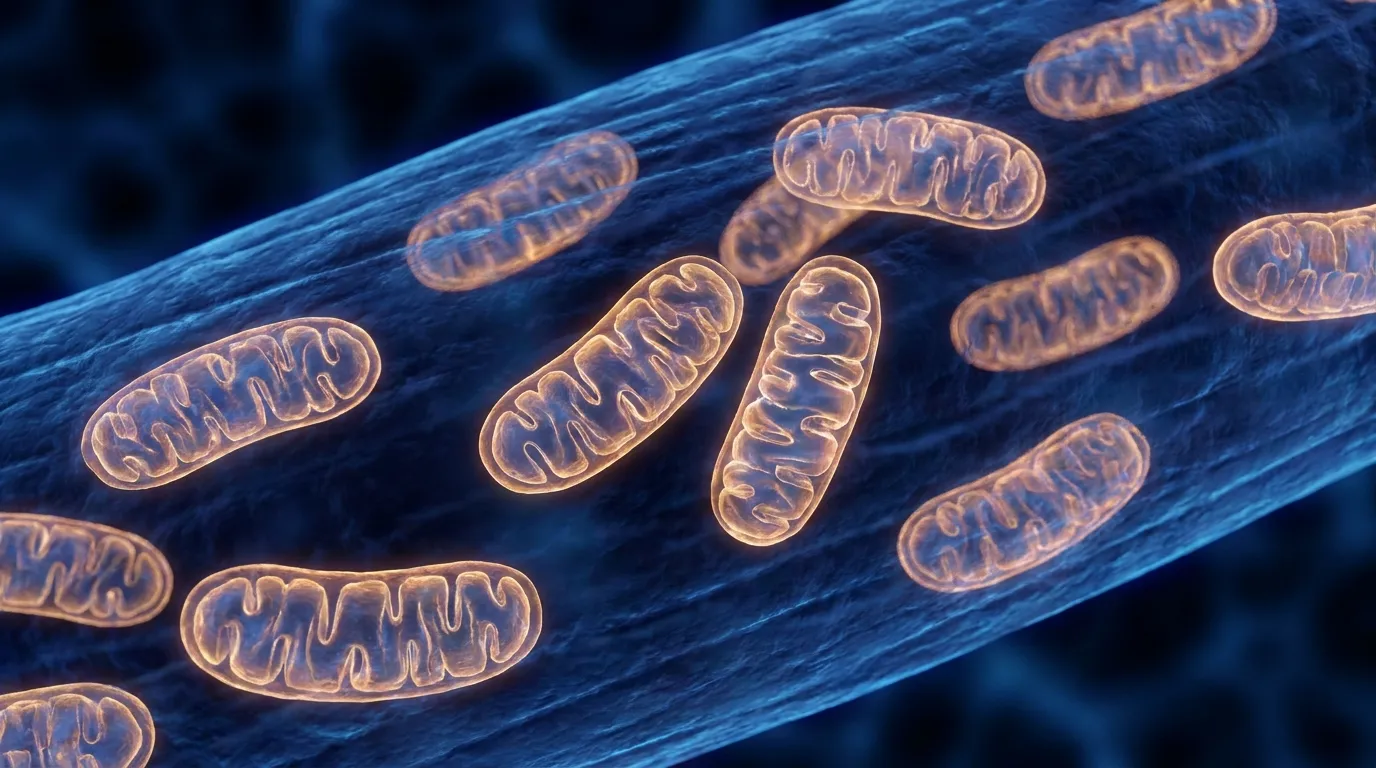
Link 1 — Mitochondrial biogenesis (making more engines)
The first link is mitochondrial density. Endurance training works largely by building more and better mitochondria in your muscle, and the master coordinator of that process is PGC-1α, which is induced by endurance exercise — a 2025 systematic review and meta-analysis of randomized trials found endurance exercise reliably raises skeletal-muscle PGC-1α and mitochondrial biogenesis markers (pooled effect size ≈ 1.17) (PubMed, "Exercise and mitochondrial biogenesis: a systematic review and meta-analysis of RCTs," 2025, retrieved 2026-06-16). More mitochondria means more capacity to burn fuel aerobically before you hit your ceiling.
This is the link the "exercise-mimetic" compounds target. MOTS-c, the community's #1, is a mitochondrial-derived peptide encoded in the mitochondrial genome that activates AMPK — the same nutrient-sensing pathway exercise activates — and a 2021 study showed it is itself exercise-induced and improved running performance in young, middle-aged and old mice (Reynolds et al., "MOTS-c is an exercise-induced mitochondrial-encoded regulator," Nature Communications, 2021, retrieved 2026-06-16). AICAR (an AMPK activator) and Cardarine (a PPARδ agonist) come from the landmark "exercise in a pill" work, where AICAR alone raised running endurance ~44% in sedentary mice and Cardarine plus training raised it further (Narkar et al., "AMPK and PPARδ Agonists Are Exercise Mimetics," Cell, 2008, retrieved 2026-06-16). The catch that no listicle states: every one of those numbers is from mice, and Cardarine's strong effect needed training alongside it.
Link 2 — Oxidative capacity and fuel-switching (running the engines efficiently)
Having mitochondria is not enough; they have to use oxygen and the right fuel efficiently. PPARδ — the receptor Cardarine targets — is a master switch for fat oxidation and oxidative muscle-fibre programming, which is the mechanistic story behind the "fat-burning endurance" claims. A parallel target is the circadian-metabolic regulator REV-ERB, which Stenabolic (SR9009) activates; in mice, REV-ERB agonism shifted metabolism and increased exercise capacity (Solt et al., "Regulation of circadian behaviour and metabolism by synthetic REV-ERB agonists," Nature, 2012, retrieved 2026-06-16). SR9009 has a fatal practical flaw, though: near-zero oral bioavailability, so the popular oral capsules cannot reproduce the injected-mouse results.
The newest entry in this link is SLU-PP-332, a synthetic pan-ERR (ERRα/β/γ) agonist acting through an ERRα-dependent mechanism that increased running capacity in mice — they ran roughly 70% longer and 45% farther (Billon et al., "Synthetic ERR agonist enhances exercise capacity," ACS Chemical Biology, 2023, retrieved 2026-06-16). It is worth stating plainly, because every competitor gets this wrong: SLU-PP-332, Cardarine and Stenabolic are small molecules, not peptides. People file them under "endurance peptides," but chemically they are not peptides at all.
There is a deeper reason the "exercise in a pill" framing keeps disappointing in the move from mice to people. These compounds reproduce one transcriptional signal of exercise — they switch on some of the same fat-oxidation and oxidative-fibre genes that training does — but endurance adaptation is the integrated product of dozens of signals (mechanical loading, calcium flux, blood-flow shear, hormonal shifts) firing together over months. A single-pathway agonist mimics a fragment of that, in a mouse with a mouse's metabolism, often at doses and routes that do not translate. That is why the headline percentages keep shrinking the closer the science gets to a human, and why none has produced a positive human endurance result despite years of attention.
Link 3 — Oxygen delivery (the link the bans really target)
Aerobic output is capped by how much oxygen your blood can carry, which is why the most powerful — and most policed — performance enhancers in endurance history act on this link rather than on the muscle. Erythropoietin-class agents (EPO) raise red-blood-cell mass and oxygen-carrying capacity; they genuinely work, and they are exactly why endurance sport is so heavily tested. None of the peptides in our community ranking acts meaningfully on this link, which is part of why their real-world endurance payoff is so uncertain — and a useful reality check against the hype: the compounds people actually use here are not the ones with the strongest known mechanism.
Link 4 — Recovery as a performance multiplier
The last link is the one the recovery cohort bets on. You do not get fitter from a hard session; you get fitter from recovering from it and adapting. Anything that lets you absorb more quality training without injury or breakdown is, indirectly, an endurance intervention — which is the entire rationale for BPC-157 and TB-500 ranking third and fourth despite having no direct aerobic mechanism. This is not a trivial lever: high-volume endurance training lives close to the edge of overuse injury and connective-tissue breakdown, and the athlete who can hold 12 consistent weeks beats the one who builds for three and then breaks down for two. The recovery cohort is, in effect, trying to buy training availability — the cumulative weeks of quality work that actually drive aerobic adaptation — rather than a direct boost to oxygen or mitochondria. Whether these peptides deliver that in humans is unproven, but the underlying logic (consistency compounds) is the soundest reasoning anywhere in this category. The GH-axis pair CJC-1295 and ipamorelin sit here too, used for the sleep and recovery quality that supports training, not for any direct effect on oxygen or mitochondria. And the cofactor angle — NAD+, central to mitochondrial energy metabolism and declining with age — is the same idea one step upstream: support the cellular machinery, recover better, train more. The evidence that injected NAD+ improves human endurance is, however, absent; a 2025 review keeps that caveat firmly, and a 2025 study even found severe muscle NAD+ depletion did not compromise exercise tolerance, undercutting the simple "more NAD+ = more endurance" story (npj Metabolic Health and Disease, "NAD+ metabolism and mitochondria," 2025, retrieved 2026-06-16).
Citation capsule. Endurance performance depends on mitochondrial biogenesis (coordinated by PGC-1α, induced by exercise), oxidative and fuel-switching capacity (PPARδ, REV-ERB, ERR pathways), oxygen delivery (red-cell mass), and recovery. The compounds the community uses for endurance target these pathways pharmacologically — MOTS-c and AICAR via AMPK, Cardarine via PPARδ, SR9009 via REV-ERB, SLU-PP-332 via ERR — but the supporting performance data is from mice, not human trials. Sources: Cell 2008 (Narkar); Nature Communications 2021 (Reynolds); Nature 2012 (Solt); ACS Chemical Biology 2023 (Billon); PubMed 2025 meta-analysis (PGC-1α).
Mechanism families: how the candidates group
Sorted by what they actually do, the ten candidates fall into four families — mitochondrial exercise-mimetics, recovery and soft-tissue peptides, GH-axis recovery peptides, and metabolic cofactors. Grouping them this way shows why the ranking looks the way it does and keeps each molecule's deep science on its own hub.
Mitochondrial / exercise-mimetics — MOTS-c, SLU-PP-332, Cardarine, Stenabolic, 5-amino-1MQ
This family chases Link 1 and Link 2 directly: make more mitochondria, oxidise more fuel, mimic the exercise signal. MOTS-c is the peptide of the group and the community's #1; the rest are small molecules. Cardarine (PPARδ) and Stenabolic (REV-ERB) have the loudest animal endurance stories and the loudest safety problems. SLU-PP-332 (ERR) is the newest and most preclinical. 5-amino-1MQ (an NNMT inhibitor) is the oral, metabolism-adjacent outlier with a small following and no human endurance data. For the full molecular story on the lead compound, see the MOTS-c complete guide; for the research-chemical pair, the Cardarine (GW-501516) guide and the Stenabolic (SR9009) guide.
Recovery / soft-tissue — BPC-157, TB-500
This family targets Link 4: heal faster, train more. BPC-157 and TB-500 are the most-used recovery peptides in sport, valued for soft-tissue and tendon resilience and (for BPC-157) gut tolerance under high mileage. Neither has a direct aerobic mechanism, and both are mostly animal-evidenced. We keep them shallow here on purpose — the tendon, gut, and injury-healing angles are their own intents. Full science: the BPC-157 complete guide and the TB-500 complete guide.
GH-axis recovery — CJC-1295, ipamorelin
The GH-axis pair sits at Link 4 one level up: support sleep and recovery quality through growth-hormone release rather than touching the muscle or blood directly. CJC-1295 (a GHRH analog) is usually paired with ipamorelin (a clean GHRP) for sleep and recovery that supports training volume. The endurance link is indirect and unproven. Deeper dives: the CJC-1295 guide and the ipamorelin guide.
Cofactors — NAD+
The cofactor family is the upstream-support idea: keep the cellular energy machinery topped up. NAD+ is central to mitochondrial energy metabolism and declines with age, which is the rationale — but the endurance benefit is indirect and unproven, and IV-to-intracellular delivery is debated. Its one practical virtue is regulatory: it is not currently WADA-prohibited. More: the NAD+ guide.
Discussed but not in our community cohort
A few endurance compounds get talked about constantly but barely register in our usage data, and one of them holds the only genuinely human endurance evidence in this entire field — and it is not an injectable. Covering these honestly is part of being a complete hub; we keep each brief because none is a community pick.
SS-31 / Elamipretide is a mitochondria-targeting peptide that stabilises cardiolipin in the inner mitochondrial membrane, improving how efficiently mitochondria produce energy. It appears in evidence-led endurance guides as a top "aerobic-mechanism" peptide, and it is in human clinical trials for mitochondrial disease — but not for athletic endurance, where the data is preclinical. It is the most mechanistically interesting peptide our community largely ignores. Humanin, a mitochondrial-derived peptide and sibling of MOTS-c, sits in the same bucket: real cytoprotective biology, no human endurance trial.
EPO and its analogs are the elephant in the room. Erythropoietin genuinely raises oxygen-carrying capacity and improves endurance — it is the most effective endurance enhancer ever studied, which is precisely why it is among the most heavily policed and dangerous, with a long record of blood-thickening deaths in cycling. We mention it to be complete and to make a point: the mechanism that actually works (oxygen delivery, Link 3) is not what the community uses; the peptides people reach for act on weaker links.
The honest punchline belongs to collagen and food-derived peptides. The strongest human evidence for any "peptide" improving endurance does not come from an injectable at all — a randomised trial found a specific bioactive collagen-peptide protocol alongside concurrent training improved a running time-trial outcome (Springer, Sports Medicine – Open, "Bioactive collagen peptides and concurrent training," 2023, retrieved 2026-06-16). It is a small, specific result, but it is real, oral, legal, and human — the opposite of everything at the top of our community ranking. If you want the best-evidenced "endurance peptide," it is a food peptide, not a research chemical.
How aerobic physiology actually sets your ceiling
Your endurance ceiling is set by three things training improves and these compounds mostly cannot: how much oxygen your heart and blood can deliver, how efficiently your muscles extract and use it, and how high a percentage of your VO2max you can hold without fatiguing. This is the physiology the whole field is trying to shortcut, and understanding it is the best defence against hype.
VO2max itself is a delivery-and-extraction product: cardiac output (how much blood your heart pumps) multiplied by how much oxygen your muscles pull from that blood. Aerobic training improves both sides — it enlarges stroke volume and expands capillary and mitochondrial density — which is why a trained athlete can have a VO2max roughly double an untrained person's. But VO2max is only the ceiling; two more factors decide real-world endurance. Lactate threshold — the intensity at which lactate starts accumulating faster than you can clear it — determines what fraction of that ceiling you can sustain, and elite endurance athletes are distinguished as much by a high threshold as by a high VO2max. Exercise economy — how little oxygen you burn at a given pace — is the third lever, and it is largely a product of accumulated training and technique.
This is the uncomfortable context for every compound on this page. Mitochondrial exercise-mimetics target one input (oxidative capacity) in animals; none has been shown to raise human VO2max, threshold, or economy in a trial. The recovery peptides help you train more, which can raise all three over time — but indirectly, and only if the underlying training is sound. There is no pharmacological shortcut here that both works in humans and is allowed in sport; the biology that responds is the biology you train.
Which endurance compound fits your situation?
The decision turns on three questions the selector asks: do you want injectable or oral, are you drug-tested in competition, and how new are you to performance compounds — and the drug-tested question changes everything. The matrix below sets all ten candidates against the dimensions that actually decide it, including route and WADA status.
This table is the "why" behind the usage ranking — editorial context, not the headline. The selector quiz at the top runs the same logic interactively. The single most important filter is drug-tested: choose it and the list collapses almost to nothing, because almost every compound here is prohibited in sport. That is not a quirk of our data — it is the honest reality of pharmacological endurance enhancement.
| Compound | Family | Route | WADA status | Human endurance evidence | Picked when… |
|---|---|---|---|---|---|
| MOTS-c | Mito exercise-mimetic (peptide) | Injectable | Prohibited (S4.4) | None (mouse only) | You want the most-tracked "aerobic" peptide and accept research-grade risk |
| Cardarine ⚠ | PPARδ (NOT a peptide) | Oral | Prohibited (S4.4) | None; halted for animal cancers | (We do not recommend it — listed because it is used) |
| BPC-157 | Recovery (peptide) | Injectable | Prohibited (S0) | None (mostly animal) | Recovery and gut tolerance are the bottleneck |
| TB-500 | Recovery (peptide) | Injectable | Prohibited (S0) | None (animal) | Systemic soft-tissue resilience under high load |
| SLU-PP-332 | ERR exercise-mimetic (NOT a peptide) | Oral | Prohibited (S4.4 class) | None (mouse only, preclinical) | You are experimenting at the frontier (high uncertainty) |
| NAD+ | Cofactor | Injectable | Not prohibited | None proven (indirect) | You are tested and want something not banned (but unproven) |
| Stenabolic | REV-ERB (NOT a peptide) | Oral | Prohibited (S4.4) | None; poor oral absorption | (Mechanism interest only; oral form likely inert) |
| CJC-1295 | GH-axis recovery (peptide) | Injectable | Prohibited (S2) | None (indirect) | Sleep/recovery quality is the goal |
| Ipamorelin | GH-axis recovery (peptide) | Injectable | Prohibited (S2) | None (indirect) | A cleaner GHRP for recovery support |
| 5-Amino-1MQ | Metabolic (NOT a peptide) | Oral | Not prohibited | None (mouse only) | Tested, oral-only, and willing to experiment |
The doping reality: WADA status, by compound
For a drug-tested athlete, the endurance ranking above is mostly a list of ways to fail a test — eight of the ten candidates are on the WADA Prohibited List, across three different classes. This is the section that matters most if you compete, and it is where the community usage data and the safe-for-competition reality diverge hardest.
Three points decide it. First, the metabolic modulators (class S4.4) — Cardarine, Stenabolic, AICAR, and MOTS-c, which is explicitly named on the list as a prohibited AMPK activator — are banned at all times. Second, the peptide hormones and growth factors (class S2) — CJC-1295 and ipamorelin among the GH-secretagogues — are banned at all times. Third, the non-approved substances (class S0) — BPC-157 and TB-500, neither approved for human use by any regulator — are banned at all times as well. Only NAD+ and 5-amino-1MQ are not currently prohibited, and that is the entire reason they survive the drug-tested filter in the selector.
Citation capsule. Under the WADA Prohibited List, the endurance candidates split across three classes: S4.4 metabolic modulators (Cardarine/GW-501516, Stenabolic/SR9009, AICAR, and MOTS-c, named as a prohibited AMPK activator); S2 peptide hormones and growth factors (CJC-1295, ipamorelin); and S0 non-approved substances (BPC-157, TB-500). NAD+ and 5-amino-1MQ are not currently prohibited. Drug-tested athletes should assume a substance is prohibited unless verified. Sources: WADA Prohibited List S4.4 (metabolic modulators); USADA athlete advisories on GW1516 and BPC-157; BSCG TB-500 status.
Effect-signal vs evidence quality: the inverse the hype hides
Plot what each compound reportedly does against how good the evidence is, and the relationship runs backwards: the compounds with the loudest endurance signal have the weakest human evidence and the worst safety. This fourth view is the differentiator no listicle shows, and it is the single most honest way to read the whole field.
The pattern is consistent. Cardarine has the strongest reported endurance effect and the worst record — animal-only data, halted for cancer, banned. MOTS-c and SLU-PP-332 have real mechanisms but only mouse data. The recovery peptides have indirect rationales and animal evidence. NAD+ and 5-amino-1MQ are the "safest on paper" picks precisely because they do the least. Nowhere on this chart is there a compound that is both well-evidenced in humans and strongly effective for endurance — that quadrant is empty, and any list that implies otherwise is selling something.
Go deeper: pick your sport or biometric
This hub stays at the decision-and-overview altitude on purpose — your specific sport, distance, or biometric changes which compounds, recovery demands, and risks matter most, so each has its own focused guide. If you came here as a runner, a cyclist, or someone tracking a number, start with the spoke below; it inherits this hub's honest framing and goes deep on your context.
VO2max
What physiologically moves your VO2max, and what our community's VO2max data shows. peptides and VO2max
Running
The everyday and hobby runner's guide — broad, accessible, recovery-led. peptides for runners
Ultra-Marathon
The extreme end — backyard ultras, 500 km feats, massive-volume recovery and runner's gut. peptides for ultra-marathon
Cycling
Aerobic plus power, with the sport's heavy doping context handled directly. peptides for cycling
Hyrox / CrossFit
Mixed-modal engine plus recovery and injury, where endurance meets strength. peptides for Hyrox & CrossFit
HRV / Autonomic Recovery
Readiness and autonomic recovery, with what the community's HRV data shows. peptides and HRV
For combat-sports athletes weighing sparring recovery, weight cuts, and grappling joints, the dedicated guide is peptides for combat sports. And for the recovery-first angle that underpins half this ranking, see peptides for recovery.

What's realistic to expect — and how to read the claims
If you are weighing one of these compounds, the realistic expectation for endurance is "no measurable, proven benefit in a human" — and the loud testimonials you will find online are exactly the kind of evidence that misleads. Setting that expectation honestly is more useful than any ranking.
Three habits keep you grounded. First, separate animal numbers from human promises: "ran 70% farther" and "44% more endurance" are real findings in mice, not predictions for you, and the gap between rodent and human results in this field is enormous. Second, distrust the before-and-after story: anyone using these compounds is almost always also training, sleeping, and eating with intent, so improvement gets credited to the vial when the training did the work — a confound that no anecdote can untangle. Third, weight the downside correctly: for an unproven upside, an unknown long-term safety profile (and, for Cardarine, a known carcinogenicity signal) is a bad trade, and for a tested athlete a near-certain sanction makes the expected value plainly negative. The compounds that reliably move endurance — the ones with real human data — are the unglamorous ones: structured training, adequate iron and sleep, and a handful of legal supplements with modest, repeatable effects. Nothing on this community ranking belongs in that category yet.
What the community does is not what is proven, or safe
Treat the usage ranking as a popularity signal shaped by hype, mechanism appeal, and availability — not as evidence of what works or what is safe. The clearest proof is that the community's #2 compound, Cardarine, is a research chemical whose own development was abandoned because it caused cancer in animals.
Three honest framings sit on top of every number on this page. First, no compound here has a positive human endurance trial — the headline effects (MOTS-c, Cardarine, SLU-PP-332, SR9009) are from mice, and the recovery peptides are mostly animal-evidenced. Second, Cardarine's safety record is disqualifying: GW-501516's development was halted after long-term rodent studies showed dose-dependent cancers across multiple organs — findings reported in GSK preclinical (toxicology) data and treated as established by anti-doping authorities, who issued health warnings (USADA, "What athletes should know about GW1516", retrieved 2026-06-16; Sport Integrity Australia, "GW1516 — popular but deadly," 2018, retrieved 2026-06-16). Third, research-grade vials carry quality risk — unknown potency, purity, and sterility — that no usage statistic captures, on top of compounds that are themselves unproven.
Our take: Read this page as two layers that mostly disagree. The usage chart tells you what real people reach for; the science and safety read tell you how little supports it. When those two diverge as sharply as they do here — a carcinogen at #2, no human trials anywhere — trust the evidence, not the crowd. The most defensible "endurance peptide" decision for most people is the unglamorous one: train the aerobic system that actually responds, and treat everything on this list as experimental at best and dangerous at worst.
Who should not go near these
These compounds are not for anyone competing under drug testing, not for anyone outside research or clinical oversight, and Cardarine and Stenabolic are not for anyone, full stop. The honest contraindication list here is unusually short and unusually firm.
A few hard lines. Drug-tested athletes should treat the entire top of this list as a failed test waiting to happen — eight of ten candidates are WADA-prohibited, and "I didn't know" is not a defence. Anyone considering Cardarine or Stenabolic should weigh that these are non-peptide research chemicals with a carcinogenicity signal (Cardarine) and near-zero oral bioavailability plus REV-ERB-independent off-target effects (Stenabolic) — there is no version of the risk-reward that favours them for an unproven endurance benefit. And for every research peptide here, the responsible answer is the same: there is no validated safe-use protocol for endurance, so they belong in a trial or under a clinician, not in a self-directed cycle. None of this page is a substitute for that conversation.
Frequently Asked Questions
The bottom line
If you came here for a single "best peptide for endurance," the honest answer is uncomfortable: there isn't one with human evidence behind it. The community's most-used options — MOTS-c and Cardarine — have the most interesting mechanisms in animals and the least support in people, and Cardarine carries a disqualifying carcinogenicity record on top. The recovery peptides BPC-157 and TB-500 rank highly for a sound reason (recovery is a real performance lever) but act indirectly and are mostly animal-evidenced. And the one genuinely human-evidenced "endurance peptide" in this whole field turned out to be an oral, legal food peptide, not anything in the injectable top four — a result worth sitting with before you reach for a vial.
For a drug-tested athlete the practical answer is shorter still: almost everything here is prohibited, and the two compounds that are not (NAD+, 5-amino-1MQ) are not proven to work. The selector at the top narrows the field to your constraints — injectable or oral, tested or not — but the most defensible endurance decision is the one this whole page keeps circling back to: build the aerobic system that actually responds to training, and treat these compounds as experimental at best. From here, the natural next reads are your sport's spoke above, the science on the lead compound at the MOTS-c guide, and, before sourcing anything, how to vet peptide quality and are peptides legal.
Sources
- Narkar VA, Downes M, Yu RT, et al. "AMPK and PPARδ Agonists Are Exercise Mimetics." Cell, 2008, 134(3):405–415. Retrieved 2026-06-16. https://www.sciencedirect.com/science/article/pii/S0092867408008386
- Reynolds JC, Lai RW, Woodhead JST, et al. "MOTS-c is an exercise-induced mitochondrial-encoded regulator of age-dependent physical decline and muscle homeostasis." Nature Communications, 2021, 12:470. Retrieved 2026-06-16. https://www.nature.com/articles/s41467-020-20790-0
- Solt LA, Wang Y, Banerjee S, et al. "Regulation of circadian behaviour and metabolism by synthetic REV-ERB agonists." Nature, 2012, 485:62–68. Retrieved 2026-06-16. https://www.nature.com/articles/nature11030
- Billon C, Schoepke E, Avdagic A, et al. "A Synthetic ERR Agonist Induces an Acute Aerobic Exercise Response and Enhances Exercise Capacity." ACS Chemical Biology, 2023. Retrieved 2026-06-16. https://pubs.acs.org/doi/abs/10.1021/acschembio.2c00720
- "The impact of exercise on mitochondrial biogenesis in skeletal muscle: a systematic review and meta-analysis of RCTs." PubMed, 2025 (PMID 40459444). Retrieved 2026-06-16. https://pubmed.ncbi.nlm.nih.gov/40459444/
- "The role of NAD+ metabolism and its modulation of mitochondria in aging and disease." npj Metabolic Health and Disease, 2025. Retrieved 2026-06-16. https://www.nature.com/articles/s44324-025-00067-0
- U.S. Anti-Doping Agency (USADA). "What Should Athletes Know About GW1516?" and "BPC-157: Experimental Peptide Creates Risk for Athletes." Retrieved 2026-06-16. https://www.usada.org/spirit-of-sport/what-should-athletes-know-gw1516/
- Sport Integrity Australia. "GW1516 — Popular but Deadly." 2018. Retrieved 2026-06-16. https://www.sportintegrity.gov.au/news/integrity-blog/2018-10/gw1516-popular-deadly
- World Anti-Doping Agency. "The Prohibited List" — S4.4 Metabolic Modulators (GW1516, SR9009, AICAR, MOTS-c), S2 Peptide Hormones & Growth Factors (CJC-1295, ipamorelin), S0 Non-Approved Substances (BPC-157, TB-500). Retrieved 2026-06-16. https://www.wada-ama.org/en/prohibited-list
- Banner Substance Control Group (BSCG). "TB-500 — Status, Risks, and Bans in Sport and Military." Retrieved 2026-06-16. https://www.bscg.org/blogs/single/tb-500-status-risks-and-bans-in-sport-and-military
- UC Davis Sports Medicine. "VO2max Description." Retrieved 2026-06-16. https://health.ucdavis.edu/sports-medicine/resources/vo2description
- ProtocolPlus. "Community goal-usage data: endurance" (goals/endurance.json). First-party app data, 2026. n ≈ 5,200 users training for endurance. Usage signal, not a clinical efficacy or safety ranking.