Best Peptides for Combat Sports (MMA, BJJ, Boxing, Muay Thai): What Fighters Use (2026)
The compounds fighters and grapplers most use are the recovery peptides BPC-157 and TB-500 for the joint and soft-tissue battering of sparring and grappling, followed by the GLP-1 drugs (semaglutide, tirzepatide) for the weight cut and GHK-Cu for cuts and skin — but "most used" is a long way from "proven," and for a licensed, drug-tested fighter most of that recovery list is banned. This is the combat-sports guide to the sport-and-endurance cluster: it answers what real fighters reach for across five different needs, separates the genuinely serious safety topics from the merely unproven, and gives you the doping status of every option before you read another word.
Most "peptides for MMA" lists rank compounds by an author's opinion and lump every need into one undifferentiated stack. We do it differently. The headline ranking below comes from first-party usage data — what ~3,000 ProtocolPlus users training in combat sports actually track — and we split it by the real fighter needs: sparring recovery, joint and connective durability, the weight cut, cut and skin healing, and brain/neuro interest. For the deep dive on any single molecule we link up to its dedicated guide, and for the weight-cut science we link sideways to our weight-loss hub, so this page stays a clean decision tool.
Key Takeaways
- What the community uses (not an efficacy ranking): across ~3,000 ProtocolPlus combat-sport users, the top three are BPC-157 (24%, 720 users), TB-500 (16%, 480), and a tie between the weight-cut GLP-1 semaglutide (12%, 360) and MOTS-c (12%, 360), with GHK-Cu (10%, 300) close behind (ProtocolPlus app data).
- Usage is not proof. None of the recovery peptides (BPC-157, TB-500) has a human combat-sports trial behind it — the evidence is mostly animal soft-tissue data. The GLP-1s are the only well-evidenced compounds here, and that evidence is for weight loss, not for fighting.
- The weight cut and head trauma are the dangerous parts. Making weight with a GLP-1 stacks appetite suppression on top of dehydration and can blunt the rehydration a fighter needs before competing; Semax is a Russian nootropic with no evidence as a concussion or TBI treatment. Neither topic is something to self-manage.
- Drug-tested? The list changes completely. Under USADA/VADA/WADA, BPC-157 and TB-500 are prohibited as non-approved substances (S0), MOTS-c is a prohibited metabolic modulator, and CJC-1295 is a prohibited peptide hormone (S2). The GLP-1 weight-cut agents, GHK-Cu and Semax are not currently listed — but verify before competing, because lists change.
- The honest punchline: the best-evidenced thing a fighter can do for recovery is still the boring stuff — sleep, food, load management, and physiotherapy. These compounds are, at best, unproven attempts to nudge that.
What peptides does the combat-sports community use?
Across ~3,000 ProtocolPlus users training in combat sports, BPC-157 is the most-tracked compound (24%), followed by TB-500 (16%), then a tie between the weight-cut GLP-1 semaglutide (12%) and the metabolic peptide MOTS-c (12%), with GHK-Cu for cuts (10%) close behind. This is a usage ranking from our own app data, not a clinical verdict on what works best for fighting.
The pattern maps cleanly onto how a fight camp actually breaks the body. The top of the list is the recovery cohort: BPC-157 and TB-500 together account for 40% of usage, because the relentless joint stress of grappling and the cumulative micro-trauma of striking are what end most fighters' weeks, not the fights themselves. Right behind them sit two different motivations — the weight cut (semaglutide, then tirzepatide) and the "gas tank" interest (MOTS-c) — followed by the skin-and-cuts cohort using GHK-Cu. The long tail is the GH-axis recovery option CJC-1295 (8%) and the neuro-curious end, Semax (8%).
These shares come only from our community-usage dataset and describe behavior, not efficacy. A compound can be widely used and barely evidenced at the same time — that describes most of this list. Read the chart below as "what fighters in the community reach for," then cross-check it against the need-by-need science and the doping read further down, where the picture changes sharply for anyone who competes.
Citation capsule. Among ~3,000 ProtocolPlus users who logged combat sports as a goal, the most-tracked compounds were BPC-157 (24%, 720 users), TB-500 (16%, 480), semaglutide (12%, 360), MOTS-c (12%, 360), and GHK-Cu (10%, 300). This is first-party usage data reflecting what the community uses, not a clinical efficacy ranking and not a safety ranking. Source: ProtocolPlus app data (goals/combat-sports.json), 2026.
The community's top picks (by usage)
The community's four most-used combat-sport compounds are BPC-157, TB-500, semaglutide, and MOTS-c — two recovery peptides, one weight-cut drug, and one metabolic peptide. Each card pairs the usage share with the honest reason fighters pick it and the caveat that comes with it.
These four account for roughly 64% of combat-sport usage in our cohort. Notice what the split is telling you: fighters are not chasing one thing. The recovery pair wins because connective-tissue durability is the real bottleneck in a fight camp; the weight-cut drug ranks because making weight is the sport's defining ordeal; and MOTS-c rides "gas tank" curiosity. Popularity here tracks "solves a fight-camp problem people feel" far more than "proven in a trial."
BPC-157
Why fighters pick it: the recovery staple — joint and tendon stress from grappling and striking, plus gut tolerance through the worst of a camp. The single most-tracked compound in our combat cohort.
Honest caveat: mostly animal data; not approved for human use anywhere; prohibited in sport as a non-approved substance (S0).
TB-500 (Thymosin β-4)
Why fighters pick it: a thymosin β-4 fragment used for systemic soft-tissue resilience across the cumulative wear of a fight camp — the recovery cohort's second staple.
Honest caveat: animal data; research peptide; prohibited in sport (growth-factor class, S2).
Semaglutide (the weight cut) ✓
Why fighters pick it: appetite and body-weight control to drop a class or make the off-season cut easier — the best-evidenced compound here, and not currently banned.
Honest caveat: the evidence is for weight loss, not fighting; making weight via appetite suppression stacks on top of dehydration risk; GI effects can wreck a camp. Verify WADA status before competing.
MOTS-c
Why fighters pick it: a mitochondrial-derived peptide tracked for the "gas tank" — metabolic conditioning for championship rounds.
Honest caveat: human performance data is thin and mechanistic; research-grade only; a prohibited metabolic modulator in sport.
The rest of the field (ranks 5–8): the remaining ~36% of usage spreads across tirzepatide (10%) — a stronger weight-cut option some use off-season — GHK-Cu (10%) for cuts and skin, the GH-axis recovery peptide CJC-1295 (8%), and Semax (8%) at the neuro-curious end. Notice the quiet pattern: three of those four (tirzepatide, GHK-Cu, Semax) are not currently on the WADA list, which is exactly why they matter for fighters who compete under testing. Each gets a need-section below.
The five fighter needs: which peptides map to what
Combat sports do not have one peptide problem — they have five, and the community uses a different compound for each: recovery and durability, the weight cut, cuts and skin, the gas tank, and the brain. Sorting the candidates by need is what separates a real rationale from a copied stack, so this is where the guide goes deep. Each need below maps to compounds you will recognise from the ranking.
The honest headline first: the thing that actually keeps fighters healthy across a camp is unglamorous and well-evidenced — progressive load management, sleep, nutrition, skilled physiotherapy, and not over-sparring. Every compound here is, at best, an unproven attempt to buy a little more of what those already deliver. With that framing fixed, here is what each need is really asking of the biology.
Need 1 — Recovery and connective durability (BPC-157, TB-500)
The first and largest need is keeping joints, tendons, and gut intact through the grind. Grappling loads the small joints — fingers, wrists, shoulders, knees — in positions they are not built for, and striking adds repetitive micro-trauma; the fighter who can hold twelve consistent weeks of hard training beats the one who breaks down for two out of every six. This is the rationale behind BPC-157 and TB-500 sitting first and second.
The science is genuinely interesting and genuinely thin. BPC-157 is a synthetic peptide derived from a fragment of a protein found in gastric juice, studied mostly in rodents for accelerated healing of tendon, muscle, and gut tissue and for an angiogenic (blood-vessel-forming) effect on injured tissue. The catch the listicles skip: almost all of that is animal data, there is no controlled human trial showing it heals a fighter's tendon, and the U.S. Anti-Doping Agency states plainly that "BPC-157 has not been extensively studied in humans" and its use "is not supported by medical literature" (USADA, "BPC-157: Experimental Peptide Creates Risk for Athletes", retrieved 2026-06-17). TB-500 is a synthetic version of a region of thymosin β-4, a protein involved in cell migration and tissue repair, with a similar evidence profile: animal repair data, no combat-sports trial. We keep both shallow here on purpose — the full tendon, gut, and injury-healing science is its own intent. For the deep dives, see the BPC-157 complete guide and the TB-500 complete guide; for the recovery-first angle that underpins this whole cohort, peptides for recovery.
Need 2 — The weight cut (semaglutide, tirzepatide)
The second need is the sport's defining ordeal, and it is where the only well-evidenced compounds on this page live — for the wrong purpose. Combat sports run on weight classes, and most fighters compete well below their walking weight, descending through a long fat-loss phase in camp and then an acute water cut in the final days. The GLP-1 drugs semaglutide (as Wegovy) and tirzepatide (as Zepbound) attack the first phase: they suppress appetite and slow gastric emptying, and in supervised obesity trials they produce the largest pharmacological weight loss yet recorded — semaglutide around 14.9% of body weight over 68 weeks in STEP 1, and tirzepatide around 20.9% at the 15 mg dose over 72 weeks in SURMOUNT-1 (Wilding et al., "Once-Weekly Semaglutide in Adults with Overweight or Obesity," NEJM, 2021, retrieved 2026-06-17; Jastreboff et al., "Tirzepatide Once Weekly for the Treatment of Obesity," NEJM, 2022, retrieved 2026-06-17).
Here is the honest, fighter-specific problem no listicle states. Those trials studied people with obesity over many months, not lean athletes shedding the last kilos before a weigh-in. Using a GLP-1 to make weight stacks appetite suppression and slowed gastric emptying on top of the dehydration of a water cut — which can blunt the very rehydration and refuel a fighter relies on to be safe and strong on fight night, and can drive muscle loss during a steep deficit. Rapid, aggressive weight-cutting is already one of the most dangerous things in the sport, with a documented history of severe harm; adding a drug that suppresses intake to it is not a clever shortcut. This is not weight-cutting advice — it is the opposite: a warning that the popular crossover use is riskier than it looks, and belongs under medical supervision if at all. For the actual science of how these drugs drive weight loss, the dosing, and the side-effect profile, see our dedicated hub: the best peptides for weight loss guide. The one genuine upside for a competing fighter is regulatory — the GLP-1s are not currently on the WADA list (verify before competing).
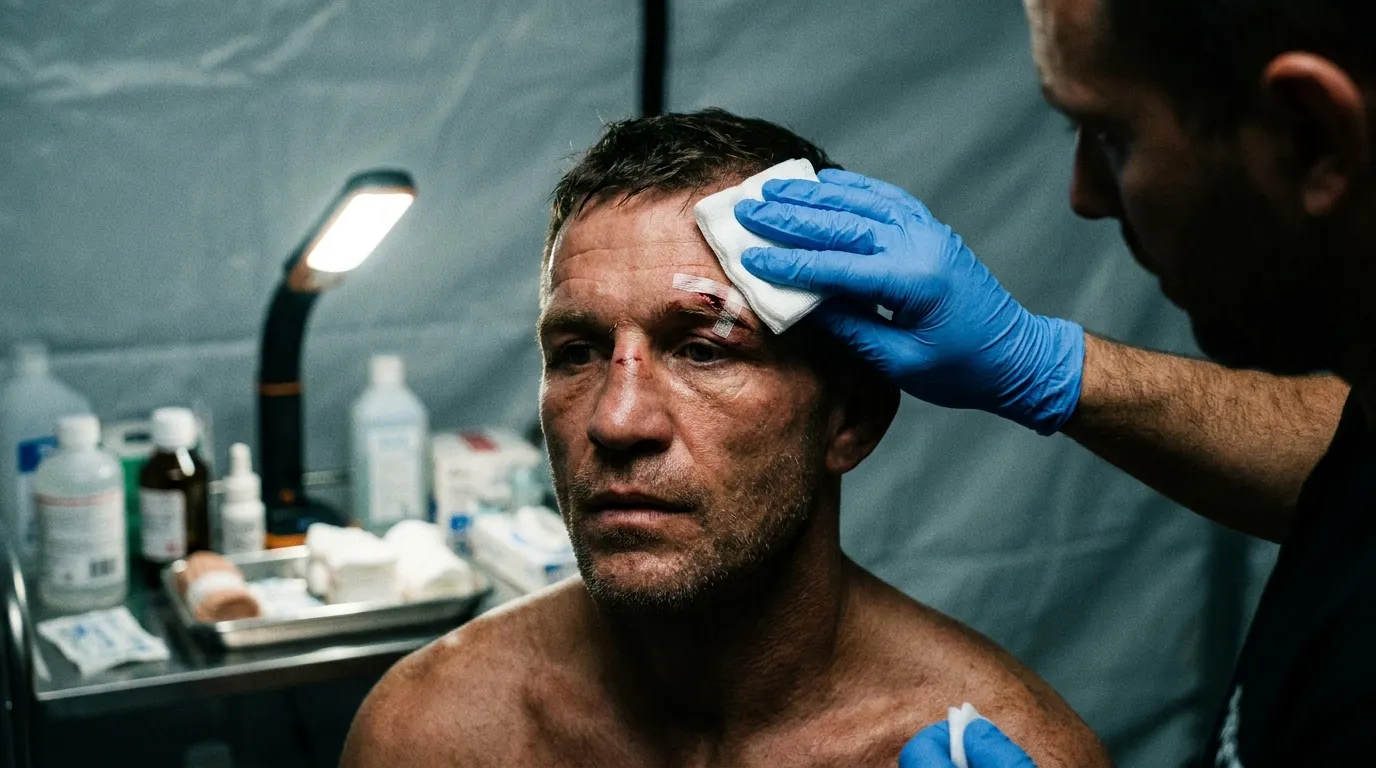
Need 3 — Cuts and skin healing (GHK-Cu)
The third need is unique to combat sports and almost completely uncovered by competitors: skin. Boxers and MMA fighters split eyebrows and cheeks; grapplers fight mat burns, cauliflower ear, and the ever-present gym risk of skin infections. GHK-Cu is a naturally occurring copper-binding tripeptide (glycine-histidine-lysine bound to copper) present in human plasma, and it is the one compound here with a real human-tissue rationale for its actual use — in skin. In wound and dermatology research it stimulates components of the extracellular matrix including collagen and elastin, promotes angiogenesis and wound closure, and appears to suppress the inflammatory phase that drives scarring; in controlled animal wound models, GHK-Cu (but not the copper-free peptide) significantly increased collagen accumulation (Pickart & Margolina, "Regenerative and Protective Actions of the GHK-Cu Peptide," International Journal of Molecular Sciences, 2018, retrieved 2026-06-17).
Two honest caveats keep this in proportion. First, the strongest GHK-Cu evidence is topical and cosmetic (skin appearance, wound healing in models), not controlled trials of injectable use in athletes — the injectable route fighters discuss is off-label and research-grade. Second, "helps skin remodel" is not "closes a fight-night laceration faster," which no trial has tested. Its appeal for fighters is real and its regulatory status is favourable — it is not currently on the WADA list — but treat the skin-and-scar benefit as plausible-and-unproven for this use. Deeper science: the GHK-Cu complete guide; for the broader skin angle, peptides for skin and anti-aging.
Need 4 — The gas tank (MOTS-c) and GH-axis recovery (CJC-1295)
The fourth need is conditioning and the deeper recovery the gas tank depends on. MOTS-c is a mitochondrial-derived peptide that activates AMPK — the same nutrient-sensing pathway exercise activates — and rises with exercise; fighters track it for metabolic conditioning and "championship-round" endurance, alongside newer exercise-mimetic research chemicals like SLU-PP-332 that chase the same engine. But its performance data is from mice, not fighters, and it is a prohibited metabolic modulator in sport. CJC-1295, a growth-hormone-releasing-hormone analog usually paired with a GHRP, sits one level up: it is used for the sleep and growth-hormone-mediated recovery that supports training volume, with an indirect and unproven link to performance and a place on the prohibited list (S2 peptide hormones). Neither touches the thing that most reliably builds a gas tank, which is structured aerobic and anaerobic conditioning. For the molecule science and the broader aerobic context, see the MOTS-c guide, the CJC-1295 guide, and the cluster hub, peptides for endurance and aerobic performance.
Need 5 — Brain and neuro interest (Semax) — handle with care
The fifth need is the one that deserves the most caution, because it sits next to the most serious health issue in combat sports: repetitive head trauma. Semax is a synthetic heptapeptide derived from a fragment of ACTH, developed and used in Russia, where it is on that country's list of essential medicines and is prescribed for stroke and cognitive indications. Fighters track it for focus and general neuro interest — and, in some corners, out of curiosity about head-trauma recovery. That curiosity is exactly where honesty matters most.
Three hard facts. First, Semax is not approved by the FDA or EMA, and its evidence base is overwhelmingly Russian, with limited international replication and a mechanism the literature itself describes as not fully understood (Wikipedia, "Semax," summarising its Russian regulatory status and evidence base, retrieved 2026-06-17). Second, there is no credible evidence that Semax treats concussion, chronic traumatic encephalopathy, or any traumatic brain injury — using it as if it were a brain-protective or concussion-recovery agent is unsupported and potentially dangerous, because it could delay real medical care for a head injury. Third, while Semax is not currently on the WADA list, that does not make it safe or proven. If you are concerned about the neurological cost of your sport, the answer is a neurologist and honest load management, not a research peptide. Treat this need as the one where the gap between "people are curious" and "anything is proven" is widest. More on the molecule: the Semax guide, and the cognitive angle, peptides for focus and cognition.
Which combat-sport compound fits your situation?
The decision turns on three questions the selector asks — what is your main need (recovery, weight cut, or neuro), are you drug-tested by a commission or promotion, and do you want injectable or oral — and the drug-tested question changes the list completely. The matrix below sets all eight candidates against the dimensions that actually decide it, including route and WADA status.
This table is the "why" behind the usage ranking — editorial context, not the headline. The selector quiz at the top runs the same logic interactively. The single most important filter is drug-tested: choose it and the recovery staples vanish, because BPC-157, TB-500, MOTS-c and CJC-1295 are all prohibited — leaving a genuinely different, mostly weight-cut-and-skin list. That is not a quirk of our data; it is the honest reality of pharmacology in a tested sport.
| Compound | Need | Route | WADA status | Human combat evidence | Picked when… |
|---|---|---|---|---|---|
| BPC-157 | Recovery / joints / gut | Injectable | Prohibited (S0) | None (mostly animal) | Connective-tissue durability is the bottleneck and you are not tested |
| TB-500 | Recovery / soft tissue | Injectable | Prohibited (S2) | None (animal) | Systemic resilience under camp load, untested |
| Semaglutide ✓ | Weight cut | Injectable | Not currently listed | Weight-loss only (not fighting) | The fat-loss phase of the cut is the problem (with medical supervision) |
| Tirzepatide ✓ | Weight cut (stronger) | Injectable | Not currently listed | Weight-loss only (not fighting) | Off-season drop to a lower class (with medical supervision) |
| MOTS-c | Gas tank / metabolic | Injectable | Prohibited (S4-class) | None (mouse only) | Conditioning curiosity, untested |
| GHK-Cu ✓ | Cuts / skin | Injectable/topical | Not currently listed | Skin/wound (topical), not fight cuts | Skin integrity, scars, cauliflower ear are the focus |
| CJC-1295 | GH-axis recovery | Injectable | Prohibited (S2) | None (indirect) | Sleep and recovery quality, untested |
| Semax ✓ | Neuro interest | Injectable/nasal | Not currently listed | None; NOT a TBI treatment | Focus curiosity only — never as concussion care |
The doping reality: WADA/USADA status, by compound
For a licensed, drug-tested fighter, the recovery half of this ranking is a list of ways to fail a test — but unlike most "peptides for sport" pages, the picture here genuinely splits, because the weight-cut and skin compounds are not currently banned. This is the section that matters most if you compete under a commission or promotion, and it is where the usage data and the safe-for-competition reality diverge.
Three groups decide it. First, the prohibited research peptides: BPC-157 is banned at all times as a non-approved substance (the S0 class), and the U.S. Anti-Doping Agency has explicitly warned athletes that it is prohibited and unproven (USADA, "BPC-157", retrieved 2026-06-17); TB-500 and CJC-1295 fall in the peptide-hormone and growth-factor classes (S2); and MOTS-c is treated as a prohibited metabolic modulator. Second, the not-currently-listed group: the GLP-1 weight-cut agents (semaglutide, tirzepatide), GHK-Cu, and Semax are not named on the current WADA Prohibited List — which is why the selector's drug-tested filter leaves exactly those. Third, the verify-before-you-trust-it rule: "not listed today" is not "cleared forever." Lists change yearly, contaminated research-grade vials cause inadvertent positives, and a commission can have its own rules. A drug-tested fighter should assume a substance is prohibited until they have checked it against the current list and their own anti-doping body (USADA, "2026 WADA Prohibited List" advisory, retrieved 2026-06-17).
Citation capsule. Under the WADA Prohibited List, the combat-sport candidates split: BPC-157 is prohibited as a non-approved substance (S0); TB-500 and CJC-1295 as peptide hormones / growth factors (S2); MOTS-c as a metabolic modulator. The GLP-1 weight-cut agents (semaglutide, tirzepatide), GHK-Cu, and Semax are not currently named on the list. Drug-tested fighters should verify current status with USADA/VADA and their commission before competing, as lists change and contaminated products cause inadvertent positives. Sources: WADA 2026 Prohibited List; USADA athlete advisories (BPC-157; 2026 List).
What the human evidence actually supports
If you are weighing one of these compounds, the realistic expectation for fighting performance is "no proven, fight-specific benefit in a human" — and the testimonials you will find in gym group chats are exactly the kind of evidence that misleads. Setting that expectation honestly is more useful than any ranking.
Three habits keep you grounded. First, separate animal data from human promises: BPC-157 and TB-500's tendon and tissue results are real in rodents, but "healed a rat's Achilles" is not "will heal your knee," and there is no controlled human combat trial for either. Second, distrust the before-and-after story: anyone using these compounds is almost always also resting more, sleeping better, and managing load with intent during the deload they took to "run the peptide" — so the recovery gets credited to the vial when the rest did the work. Third, weight the downside correctly: for an unproven upside you are accepting an unknown long-term safety profile, research-grade quality risk (unknown potency, purity, sterility), and — for a tested fighter — a near-certain sanction on half the list and an inadvertent-positive risk on the rest. The interventions that reliably keep fighters healthy are the unglamorous ones: progressive load, sleep, nutrition, skilled physiotherapy, and a sane weight-management plan. Nothing on this community ranking has earned a place above those yet.
What the community does is not what is proven, or safe
Treat the usage ranking as a popularity signal shaped by fight-camp problems, mechanism appeal, and availability — not as evidence of what works or what is safe for combat sports. The two genuinely serious topics on this page, the weight cut and head trauma, are precisely the ones where following the crowd can do real harm.
Three honest framings sit on top of every number here. First, no recovery peptide on this list has a positive human combat-sports trial — the evidence is animal soft-tissue data, and the one well-evidenced class (the GLP-1s) is evidenced for weight loss, not fighting. Second, the dangerous uses are dangerous: making weight with a GLP-1 layered onto a water cut, and treating Semax as if it were concussion care, are both genuinely risky misreadings of these compounds, not clever edges. Third, research-grade vials carry quality risk that no usage statistic captures, on top of compounds that are themselves unproven for this purpose.
Our take: Read this page as two layers that mostly disagree. The usage chart tells you what real fighters reach for; the need-by-need science tells you how little of it is proven for fighting, and how serious the two riskiest uses are. When those layers diverge this sharply, trust the evidence and a clinician over the crowd. The most defensible decision for most fighters is the unglamorous one: train smart, recover with sleep and food and physiotherapy, manage weight sanely under supervision, and treat everything on this list as experimental — and, if you compete, presumptively a doping risk.
Who should not go near these
These compounds are not for anyone competing under drug testing who has not verified status, not for anyone managing the weight cut or a head injury without medical supervision, and not for anyone outside research or clinical oversight. The honest contraindication list here is short and firm.
A few hard lines. Drug-tested fighters should treat the recovery half of this list as a failed test waiting to happen and verify every "not currently listed" compound against the current rules and a contaminated-supplement risk — "I didn't know" is not a defence. Anyone cutting weight should not add a GLP-1's appetite suppression and slowed gastric emptying to a dehydration cut without a clinician managing it; aggressive weight-cutting already has a documented history of severe harm. Anyone worried about head trauma should see a neurologist, not reach for Semax, which is not a treatment for concussion or any brain injury. And for every research peptide here, the responsible answer is the same: there is no validated safe-use protocol for combat sports, so they belong in a trial or under a clinician, not in a self-directed cycle. None of this page is a substitute for that conversation.
Frequently Asked Questions
The bottom line
If you came here for a single "best peptide for combat sports," the honest answer is uncomfortable: there isn't one with human, fight-specific evidence behind it. The community's most-used options — BPC-157 and TB-500 — rank highly for a sound reason, because connective-tissue recovery is the real bottleneck of a fight camp, but their evidence is animal data and both are banned for tested fighters. The only well-evidenced compounds here are the GLP-1 weight-cut drugs, and their evidence is for weight loss, not fighting — and using them to make weight is one of the riskier ideas on this page, not a clever edge. GHK-Cu has a genuine skin rationale and Semax has none for the head-trauma curiosity that draws fighters to it.
For a drug-tested fighter the practical answer is shorter: the recovery half of this list is prohibited, and the half that is not currently listed (GLP-1s, GHK-Cu, Semax) is unproven and still demands verification. The selector at the top narrows the field to your need and your testing situation, but the most defensible decision is the one this whole page keeps circling back to: train and recover the way that actually works — sleep, food, load management, physiotherapy, and a sane, supervised weight plan — and treat these compounds as experimental at best and a doping risk at worst. From here, the natural next reads are the cluster hub at peptides for endurance and aerobic performance, the weight-cut science at peptides for weight loss, the recovery angle at peptides for recovery, and, before sourcing anything, how to vet peptide quality and are peptides legal.
Sources
- U.S. Anti-Doping Agency (USADA). "BPC-157: Experimental Peptide Creates Risk for Athletes." Retrieved 2026-06-17. https://www.usada.org/spirit-of-sport/bpc-157-peptide-prohibited/
- U.S. Anti-Doping Agency (USADA). "Athlete Advisory: What's New on the 2026 WADA Prohibited List?" Retrieved 2026-06-17. https://www.usada.org/spirit-of-sport/2026-wada-prohibited-list/
- World Anti-Doping Agency. "The Prohibited List" — S0 Non-Approved Substances (BPC-157), S2 Peptide Hormones, Growth Factors, Related Substances & Mimetics (TB-500, CJC-1295), S4 Hormone & Metabolic Modulators (MOTS-c). Retrieved 2026-06-17. https://www.wada-ama.org/en/prohibited-list
- Wilding JPH, Batterham RL, Calanna S, et al. "Once-Weekly Semaglutide in Adults with Overweight or Obesity" (STEP 1). New England Journal of Medicine, 2021, 384:989–1002. Retrieved 2026-06-17. https://www.nejm.org/doi/full/10.1056/NEJMoa2032183
- Jastreboff AM, Aronne LJ, Ahmad NN, et al. "Tirzepatide Once Weekly for the Treatment of Obesity" (SURMOUNT-1). New England Journal of Medicine, 2022, 387:205–216. Retrieved 2026-06-17. https://www.nejm.org/doi/full/10.1056/NEJMoa2206038
- Pickart L, Margolina A. "Regenerative and Protective Actions of the GHK-Cu Peptide in the Light of the New Gene Data." International Journal of Molecular Sciences, 2018, 19(7):1987. Retrieved 2026-06-17. https://www.ncbi.nlm.nih.gov/pmc/articles/PMC6073405/
- "Semax." Wikipedia (summarising Russian regulatory status, Russian List of Vital & Essential Drugs, absence of FDA/EMA approval, and limited mechanism evidence). Retrieved 2026-06-17. https://en.wikipedia.org/wiki/Semax
- ProtocolPlus. "Community goal-usage data: combat sports" (goals/combat-sports.json). First-party app data, 2026. n ≈ 3,000 combat-sport users. Usage signal, not a clinical efficacy or safety ranking.