Ipamorelin: The Complete Guide to the Selective GH Peptide (2026)
Ipamorelin is a synthetic five-amino-acid peptide that nudges your own pituitary gland to release a clean, short pulse of growth hormone, without the cortisol, prolactin, and intense hunger that older compounds in its class trigger. That selectivity is its whole reputation: it was literally named in the research as "the first selective growth hormone secretagogue." The catch is that this reputation outran its evidence. Ipamorelin was developed by a major pharmaceutical company, tested in humans, failed its only late-stage trial, and today is sold not as a medicine but as an unapproved research chemical.
If you have heard ipamorelin described as a gentler GHRP, or seen it paired with CJC-1295 for recovery, sleep, and body composition, this guide is the high-level map of the whole compound. We cover what it actually is, how its mechanism works, what it is studied and used for, the dose ranges people report, side effects, the honest safety picture, and its research-only legal status. Each section is a clear overview; the deep-dive topics (a full dosing chart, the side-effect deep-dive, the CJC-1295 stack, injection technique) point to dedicated guides so this page stays a clean hub, and you can see where it ranks among the best peptides for muscle growth.
Key Takeaways
- Ipamorelin is a synthetic pentapeptide growth-hormone secretagogue (GHS) that mimics ghrelin at the GHS-R1a receptor to make your body release its own growth hormone (GH). Sequence: Aib-His-D-2-Nal-D-Phe-Lys-NH2 (Wikipedia, "Ipamorelin", retrieved 2026-06-15).
- Its defining trait is selectivity. In the 1998 discovery study it released GH as potently as GHRP-6 but, unlike GHRP-6 and GHRP-2, did not significantly raise ACTH or cortisol even at doses "more than 200-fold higher than the ED50 for GH release" (European Journal of Endocrinology, Raun et al., 1998).
- It is not FDA-approved. Its furthest development was a Phase 2 trial by Helsinn Therapeutics for postoperative ileus, which was discontinued for lack of efficacy. It is sold as a research chemical, not a medicine (Wikipedia, "Ipamorelin", retrieved 2026-06-15).
- Pharmacokinetics: ipamorelin has a short terminal half-life of about 2 hours, with a subcutaneous peak (Tmax) around 15-30 minutes and a single GH pulse that fades quickly (Pharmaceutical Research, Gobburu et al., 1999).
- Reported doses cluster around 200-300 mcg once to a few times daily by subcutaneous injection, often run in cycles of weeks to months. These are community/research figures, not a validated or recommended dose. The full ladder is a future dosing chart spoke.
- Regulatory status shifted recently. The FDA placed ipamorelin in Category 2 ("significant safety risks") of its interim 503A compounding list in September 2023, then removed it in September 2024 after the nomination was withdrawn; it remains unapproved and is not freely compoundable (FDA, 503A Bulk Drug Substances, retrieved 2026-06-15).
What is ipamorelin?
Ipamorelin is a synthetic peptide made of five amino acids that tells your pituitary gland to release a pulse of your own growth hormone, while leaving other stress hormones largely untouched. It belongs to a family of compounds called growth hormone secretagogues (GHS), or growth-hormone-releasing peptides (GHRPs). It is studied and used mostly for body composition, recovery, sleep, and anti-aging goals.
Chemically, ipamorelin is the pentapeptide Aib-His-D-2-Nal-D-Phe-Lys-NH2 (CAS 170851-70-4; PubChem CID 20754357), originally developed by Novo Nordisk (Wikipedia, "Ipamorelin", retrieved 2026-06-15). It is a true peptide, which is why it has to be injected; taken by mouth it would be broken down in the gut before it could work. That is an important contrast with MK-677 (ibutamoren), a non-peptide secretagogue in the same broad family that survives as an oral pill. If injectable peptides are new to you, start with our what are peptides and how peptides work guides.
The single most important fact about ipamorelin is its status: it is not approved by the FDA or any other drug regulator for any use. It exists in a modest body of research, and separately in a large unapproved "research chemical" market. Everything else in this guide should be read through that lens.
Citation capsule. Ipamorelin is a synthetic pentapeptide growth-hormone secretagogue (sequence Aib-His-D-2-Nal-D-Phe-Lys-NH2; CAS 170851-70-4; PubChem CID 20754357) originally developed by Novo Nordisk. It is a selective ghrelin/GHS-R1a agonist that stimulates pituitary GH release with minimal effect on cortisol, prolactin, or ACTH. It reached Phase 2 trials for postoperative ileus (Helsinn), which were discontinued for lack of efficacy, and is not approved by any regulator for human use. Sources: European Journal of Endocrinology (Raun et al., 1998); Wikipedia, "Ipamorelin," 2026.
How does ipamorelin work?
Ipamorelin works by imitating ghrelin, the body's "hunger hormone," at a receptor in the pituitary called the GHS-R1a, which triggers the gland to release a burst of growth hormone, much like a natural GH pulse. Because it acts on a specific receptor, it tends to release GH in a clean pulse rather than a flat, around-the-clock flood, which is meant to mimic the body's own rhythm.
In plain terms, your pituitary already releases GH in pulses, mostly at night. Ipamorelin essentially "rings the doorbell" on the cells that store GH and prompts them to release a dose on demand. A 2020 review of growth hormone secretagogues describes the mechanism this way: these compounds act on the growth hormone secretagogue receptor (GHS-R1a), the same receptor targeted by the natural hormone ghrelin, to stimulate GH release from the anterior pituitary (JCSM Rapid Communications, Ishida et al., 2020, retrieved 2026-06-15).
What made ipamorelin notable is how selectively it does this. The original 1998 discovery paper reported that "ipamorelin released GH from primary rat pituitary cells with a potency and efficacy similar to GHRP-6," yet, unlike GHRP-6 and GHRP-2, "ipamorelin did not release ACTH or cortisol in levels significantly different from those observed" with GHRH, holding that selectivity at doses "more than 200-fold higher than the ED50 for GH release" (European Journal of Endocrinology, Raun et al., "Ipamorelin, the first selective growth hormone secretagogue," 1998, retrieved 2026-06-15).
Here is what that selectivity buys, in simple terms:
- GH release via GHS-R1a: the core action; it triggers a pulse of the body's own growth hormone, which in turn raises IGF-1 from the liver.
- Minimal cortisol / ACTH: unlike older GHRPs, it does not meaningfully spike the stress hormone cortisol at standard doses, which is its main selling point.
- Minimal prolactin: it stimulates GH "without any change in prolactin," another contrast with less selective secretagogues.
- Less appetite stimulation: because it engages the ghrelin pathway more selectively, it is reported to cause less of the intense hunger seen with GHRP-6.

The receptor-and-signaling deep dive (how GHS-R1a signals, why pulsatile release matters) is its own topic. We keep it at overview level here and link out to how peptides work for the foundations.
What is ipamorelin used for?
Ipamorelin is studied and used mainly to raise the body's own growth hormone for recovery, body composition (more lean mass, less fat), better sleep, and anti-aging goals; its one real clinical target was postoperative gut function, which failed in trials. None of the body-composition uses are FDA-approved; they are the directions early research and community use have pointed.
The honest origin story matters here. Ipamorelin was not developed as a bodybuilding compound. Because the ghrelin pathway also drives gut motility, it was investigated clinically for postoperative ileus (the temporary paralysis of the gut after surgery). That program, run in Phase 2 by Helsinn Therapeutics, "was discontinued due to lack of efficacy" (Wikipedia, "Ipamorelin", retrieved 2026-06-15). Everything you read about muscle, fat, sleep, and skin is off-label community and clinic use built on its GH-raising mechanism, not on completed trials for those outcomes.
A quick overview of the areas ipamorelin is studied or used for, and where the evidence stands:
| Studied / reported area | What proponents and early research suggest | Evidence level |
|---|---|---|
| Postoperative gut function (ileus) | The actual clinical target; ghrelin pathway aids gut motility | Phase 2 trial, discontinued for lack of efficacy |
| GH / IGF-1 elevation | Reliably triggers a GH pulse and raises IGF-1 | Strong mechanistic + early human PK/PD data |
| Body composition (lean mass, fat loss) | More lean mass, reduced fat via GH/IGF-1 | Extrapolated from GH biology; no large ipamorelin trials |
| Recovery / injury | Faster tissue recovery | Anecdotal / mechanistic |
| Sleep quality | Deeper sleep (GH peaks during slow-wave sleep) | Anecdotal; consistent user reports |
| Anti-aging / skin | Collagen, skin elasticity, "rejuvenation" | Marketing-led; weak direct evidence |
Because each of these is a distinct future spoke, we keep them brief here. The honest headline: ipamorelin reliably does the one mechanistic thing it claims (raise GH), but the leap from "raises GH" to "transforms body composition and reverses aging" is mostly extrapolation, not proven outcomes.
How strong is the evidence for ipamorelin?
The evidence for ipamorelin is solid on mechanism but thin on outcomes: it clearly raises growth hormone in humans, but it has no completed trial showing it improves muscle, fat, sleep, or aging, and its one late-stage trial failed. That gap between "we know what it does to a hormone" and "we know it does something useful for you" is the most important thing to understand.
The strong part is pharmacology. Human pharmacokinetic-pharmacodynamic work confirmed that ipamorelin produces a clean, dose-dependent GH pulse with a short half-life of about 2 hours (Pharmaceutical Research, Gobburu et al., "Pharmacokinetic-Pharmacodynamic Modeling of Ipamorelin, a Growth Hormone Releasing Peptide, in Human Volunteers," 1999, retrieved 2026-06-15). The discovery science is well-cited, and the selectivity claim has held up. The weak part is everything downstream: there is no large randomized trial demonstrating that ipamorelin builds meaningful muscle, strips fat, or slows aging in healthy people, and its only late-stage clinical program (postoperative ileus) was stopped for lack of efficacy (Wikipedia, "Ipamorelin", retrieved 2026-06-15).
Our take: The most common mistake we see is treating "it raises GH" as if it automatically means "it will recomp your body." Raising a hormone is necessary but not sufficient. The body-composition promises around ipamorelin rest on GH biology in general, not on outcome trials of ipamorelin specifically, which is exactly why we label them as extrapolation, not established benefit.
What doses of ipamorelin do people report using?
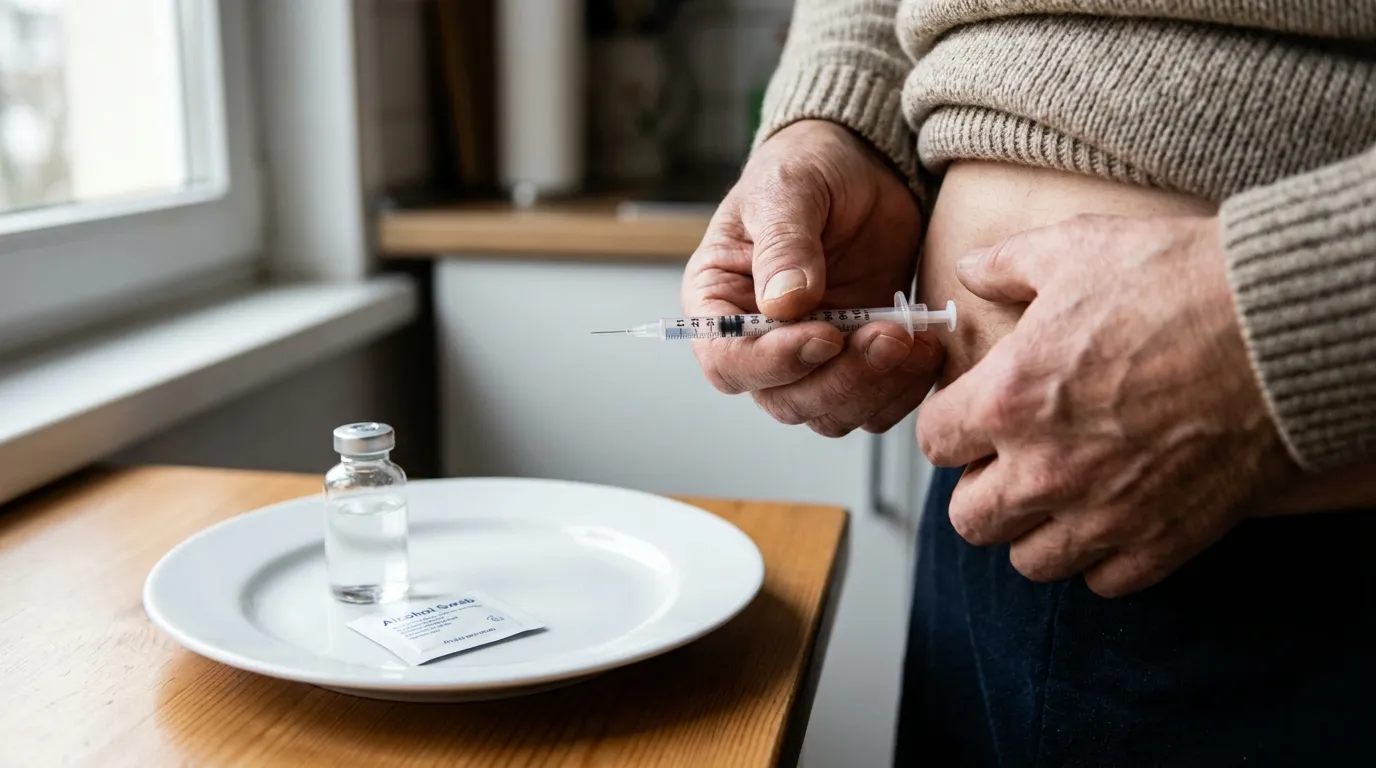
There is no validated dose for ipamorelin, but reported research and community protocols cluster around 200 to 300 mcg per dose, given once to a few times daily by subcutaneous injection, often run in cycles of weeks to months. These are figures people report, not an established or recommended dose, and there is no approved label to anchor them.
The most commonly cited range is 200-300 mcg per injection, frequently dosed once or twice daily (some report up to three times daily for body-composition goals), by subcutaneous injection (Peptides Insider, "Ipamorelin: GH Peptide," 2026, retrieved 2026-06-15). A common convention is to dose at night and/or away from meals, because food (especially carbohydrate and fat) blunts the GH response, and because GH naturally peaks during deep sleep. Many users describe running it in cycles of roughly 8 to 12 weeks or longer rather than continuously. We label all of this as a community/research convention because no regulator has reviewed a dose, and ipamorelin's documented human data are about its GH pulse and pharmacokinetics, not about an optimal body-composition protocol.
The detailed titration ladder, dose-conversion math, reconstitution volumes, injection-site choices, and timing-around-food rules are a dedicated spoke. We cover only the high-level framing here and link out to the our peptide dosing calculator, the our peptide reconstitution calculator, and the general peptide injections guide.
For orientation only, here is how people commonly describe the reported approach (not a recommendation):
| Parameter | Reported convention | Notes |
|---|---|---|
| Dose per injection | 200-300 mcg | Some report up to 300-500 mcg/day split across doses |
| Frequency | 1-3x/day | Often at night and/or pre-bed |
| Route | Subcutaneous injection | Peptide; not active orally |
| Timing vs food | On an empty stomach | Food blunts the GH pulse |
| Cycle length | ~8-12+ weeks | Commonly cycled, sometimes with a GHRH like CJC-1295 |
Our take: Numbers like "300 mcg twice a day" get repeated so often they start to sound official. They are not. They are community conventions built on ipamorelin's GH-pulse pharmacology, not on human dose-finding trials for body composition, which is exactly why we never present them as a validated dose.
How does ipamorelin compare to CJC-1295 and other peptides?
Ipamorelin is a GHRP (it tells the pituitary to release GH on demand), while CJC-1295 is a GHRH analog (it tells the pituitary to make more GH and respond more strongly), which is why the two are so often stacked: they push the same outcome through two complementary doors. Compared with older GHRPs like GHRP-6 and GHRP-2, ipamorelin's edge is cleanliness, less cortisol, prolactin, and hunger.
In rough terms, ipamorelin and CJC-1295 work better together than either alone because they hit different parts of the GH-release machinery, and the combination is the most popular GH-peptide pairing in the community. Versus the older GHRPs, the 1998 research is the reason ipamorelin is preferred for tolerability: it matched GHRP-6's GH-releasing potency without the ACTH and cortisol spikes (European Journal of Endocrinology, Raun et al., 1998, retrieved 2026-06-15). The same cleanliness-versus-power trade-off is the heart of our hexarelin vs ipamorelin comparison. Compared with MK-677, ipamorelin is shorter-acting and injected, where MK-677 is long-acting and oral but carries a clearer signal for raised blood sugar and water retention.
| Compound | Class | Route | Distinct trait |
|---|---|---|---|
| Ipamorelin | GHRP (GHS) | Subcutaneous | Selective GH pulse; minimal cortisol/prolactin |
| CJC-1295 | GHRH analog | Subcutaneous | Amplifies GH production; commonly stacked with ipamorelin |
| GHRP-6 / GHRP-2 | GHRP (GHS) | Subcutaneous | Strong GH release but more hunger, cortisol, prolactin |
| Sermorelin | GHRH analog | Subcutaneous | Short-acting GHRH; older clinic standard |
| MK-677 | Non-peptide GHS | Oral | Long-acting; raises blood sugar; oral convenience |
The full comparison, the CJC-1295 stack rationale, dosing ratios, and the GHRP-vs-GHRH distinction, is its own spoke. We keep it short here to avoid overlapping that future article: see ipamorelin and CJC-1295 stack guide, ipamorelin vs sermorelin comparison, and the oral-versus-injectable take in ipamorelin vs MK-677.
What are the side effects of ipamorelin?
Ipamorelin is generally described as well tolerated, with mostly mild reported side effects like injection-site reactions, headache, flushing, dizziness, and water retention; its real long-term safety in healthy people is unknown because it was never approved or studied long-term. "Mostly mild, but poorly characterized long-term" is the honest headline, not "safe."
In the short clinical exposures that exist, ipamorelin's safety profile looked favorable, which is consistent with its selective mechanism, minimal cortisol and prolactin elevation lowers the burden of the hormonal side effects seen with cruder secretagogues (JCSM Rapid Communications, Ishida et al., 2020, retrieved 2026-06-15). But because no regulator approved it and there are no long-term human studies, the long-horizon picture is simply unknown, and any compound that raises GH and IGF-1 carries theoretical concerns at the upper end.
A hub-level overview of what is reported and what is theorized:
- Commonly reported (mild): injection-site redness or irritation; headache; facial flushing or warmth; lightheadedness; mild water retention; occasional fatigue (anecdotal).
- Possible with GH elevation: transient effects on insulin sensitivity and blood sugar, joint aches, or numbness/tingling are described with GH-raising compounds generally, though ipamorelin is reported to be milder here than MK-677.
- Quality-related risks: because the market is unregulated, contamination, mislabeled potency, or impurities are real concerns independent of the peptide itself.
- Theoretical, longer-term: sustained elevation of GH/IGF-1 is the mechanism behind concerns common to all GH secretagogues; long-term effects of chronic use in healthy people have not been studied.
This is the hub-level summary. A full side-effect deep-dive, including the IGF-1 and insulin discussion and how researchers frame it, is a dedicated spoke: ipamorelin side effects and safety deep-dive.
Is ipamorelin safe and legal?
Ipamorelin is not approved by any regulator, so there is no official safety determination, and it is not legal to sell or prescribe as an approved medicine or to include in dietary supplements; the products sold online are unapproved "research chemicals." Its regulatory status in the US has also been unusually eventful in the last two years.
On safety, short-term and mechanistic data look reassuring for a selective secretagogue, but "reassuring in short studies" is not the same as "established safe," and there are no long-term human trials. On legality, ipamorelin sits in a gray zone that recently shifted: the FDA placed ipamorelin in Category 2 ("significant safety risks") of its interim 503A bulk-drug-substances list in September 2023, which barred compounding pharmacies from using it for human compounding. Then, in September 2024, the FDA removed ipamorelin (and several other peptides) from Category 2 after the nominators withdrew their nominations, and the Pharmacy Compounding Advisory Committee took up ipamorelin for review (FDA, "Bulk Drug Substances Used in Compounding Under Section 503A", retrieved 2026-06-15; Alliance for Pharmacy Compounding, 2024, retrieved 2026-06-15).
Crucially, removal from Category 2 is not approval and not a green light to compound or sell ipamorelin for human use; it means the substance is out of the "significant safety risks" tier and awaiting formal evaluation. It remains an unapproved drug, sold "for research use only." For the full legal picture and how to evaluate a vendor, see are peptides legal and how to vet peptide quality.
Our take: The single most common misunderstanding is reading "the FDA removed it from the risky list" as "the FDA approved it." It did not. Ipamorelin is still an unapproved drug with no human-use marketing authorization. Easy to buy, and out of one regulatory bucket, is not the same as approved or proven safe.
How do people obtain ipamorelin?
Because ipamorelin is unapproved, the main way people access it is by buying unapproved "research chemical" vials online, which is a legal and safety gray market; some wellness clinics have offered it via compounding, though the FDA's 2023-2024 actions made that pathway uncertain. There is no straightforward "get an FDA-approved prescription" route for an unapproved drug.
Two channels dominate. The first is the research-peptide market: vendors sell lyophilized ipamorelin "for research use only," and buyers reconstitute and use it off-label. That market carries real risks of mislabeled potency, impurities, and non-sterile product, with no regulatory oversight. The second is anti-aging and "longevity" clinics that have historically offered ipamorelin (often with CJC-1295) as a compounded prescription; the FDA's Category 2 placement and subsequent review have made the compounding pathway legally unsettled (FDA, 503A Bulk Drug Substances, retrieved 2026-06-15).
If you are researching that path despite the risks, the responsible groundwork is the same as for any research peptide:
- Confirm the legal status for your country and situation, including sport and workplace rules. See are peptides legal.
- Demand a certificate of analysis (COA) from independent third-party testing, and learn to read it for identity and purity. See how to vet peptide quality.
- Understand handling before anything else. Reconstitution and cold storage are not optional. See getting started with peptides and the peptide injections guide.
- Talk to a qualified clinician who can weigh your specific health situation, interactions, and contraindications.
We are describing what people do, not endorsing it. Using an unapproved drug means accepting unknown risks with no regulatory safety net.
A realistic look at expectations
The dramatic "10 pounds of muscle, melted fat, reversed aging" stories around ipamorelin come mostly from GH marketing and anecdotes, not controlled human results, so realistic expectations should be modest: better sleep and recovery are the most commonly and plausibly reported effects, while big body recomposition is far less certain. Going in calibrated is part of using any of this information responsibly.
Two honest caveats sit on top of the hype. First, ipamorelin's documented effect is a GH pulse and an IGF-1 rise; turning that into visible body change depends heavily on training, nutrition, sleep, and time, and there is no outcome trial to promise a number. Second, the subjective wins people report most consistently, deeper sleep and a sense of faster recovery, are also the hardest to separate from expectation and from simply paying more attention to recovery. For grounded before-and-after context and how to read transformation claims, see peptides before and after.
Frequently Asked Questions
The bottom line
Ipamorelin is a clean idea executed well at the receptor level. It earned its "first selective growth hormone secretagogue" title honestly: it triggers a GH pulse about as strongly as the older GHRPs while sparing the cortisol, prolactin, and hunger that made those compounds unpleasant. For the narrow job of nudging the body's own growth hormone, the pharmacology is genuinely elegant, and that is the real reason it became a community favorite, usually alongside CJC-1295.
The other half of the story is discipline. Ipamorelin is unapproved, its one late-stage trial failed, it has no outcome studies for the muscle-fat-aging goals people buy it for, and it is sold only as an unregulated research chemical with no guarantee of what is in the vial, against a US regulatory backdrop that has shifted twice in two years. The honest label is investigational. If you take one thing from this hub, let it be the gap between "reliably raises a hormone" and "proven to change your body," and the value of a qualified clinician in navigating it. From here, the natural next reads are how to vet peptide quality, are peptides legal, and getting started with peptides.
Sources
- Raun, K., Hansen, B.S., Johansen, N.L., et al. "Ipamorelin, the first selective growth hormone secretagogue." European Journal of Endocrinology, 1998. Retrieved 2026-06-15. https://pubmed.ncbi.nlm.nih.gov/9849822/
- Gobburu, J.V., Agersø, H., Jusko, W.J., Ynddal, L. "Pharmacokinetic-Pharmacodynamic Modeling of Ipamorelin, a Growth Hormone Releasing Peptide, in Human Volunteers." Pharmaceutical Research, 1999. Retrieved 2026-06-15. https://pubmed.ncbi.nlm.nih.gov/9879640/
- Wikipedia. "Ipamorelin." Retrieved 2026-06-15. https://en.wikipedia.org/wiki/Ipamorelin
- Ishida, J., Saitoh, M., Springer, J., et al. "Growth hormone secretagogues: history, mechanism of action, and clinical development." JCSM Rapid Communications, 2020. Retrieved 2026-06-15. https://onlinelibrary.wiley.com/doi/full/10.1002/rco2.9
- U.S. Food and Drug Administration. "Bulk Drug Substances Used in Compounding Under Section 503A of the FD&C Act." Retrieved 2026-06-15. https://www.fda.gov/drugs/human-drug-compounding/bulk-drug-substances-used-compounding-under-section-503a-fdc-act
- Alliance for Pharmacy Compounding. "Statement of the Alliance for Pharmacy Compounding (peptides)." 2024. Retrieved 2026-06-15. https://join.a4pc.org/hubfs/PDFs/APC-Peptides-Statement-March-1-2024.pdf
- Peptides Insider. "Ipamorelin: GH Peptide — Dosage, Benefits & Safety (2026)." Retrieved 2026-06-15. https://peptidesinsider.com/peptides/ipamorelin
- PubChem. "Ipamorelin (CID 20754357)." Retrieved 2026-06-15. https://pubchem.ncbi.nlm.nih.gov/compound/20754357