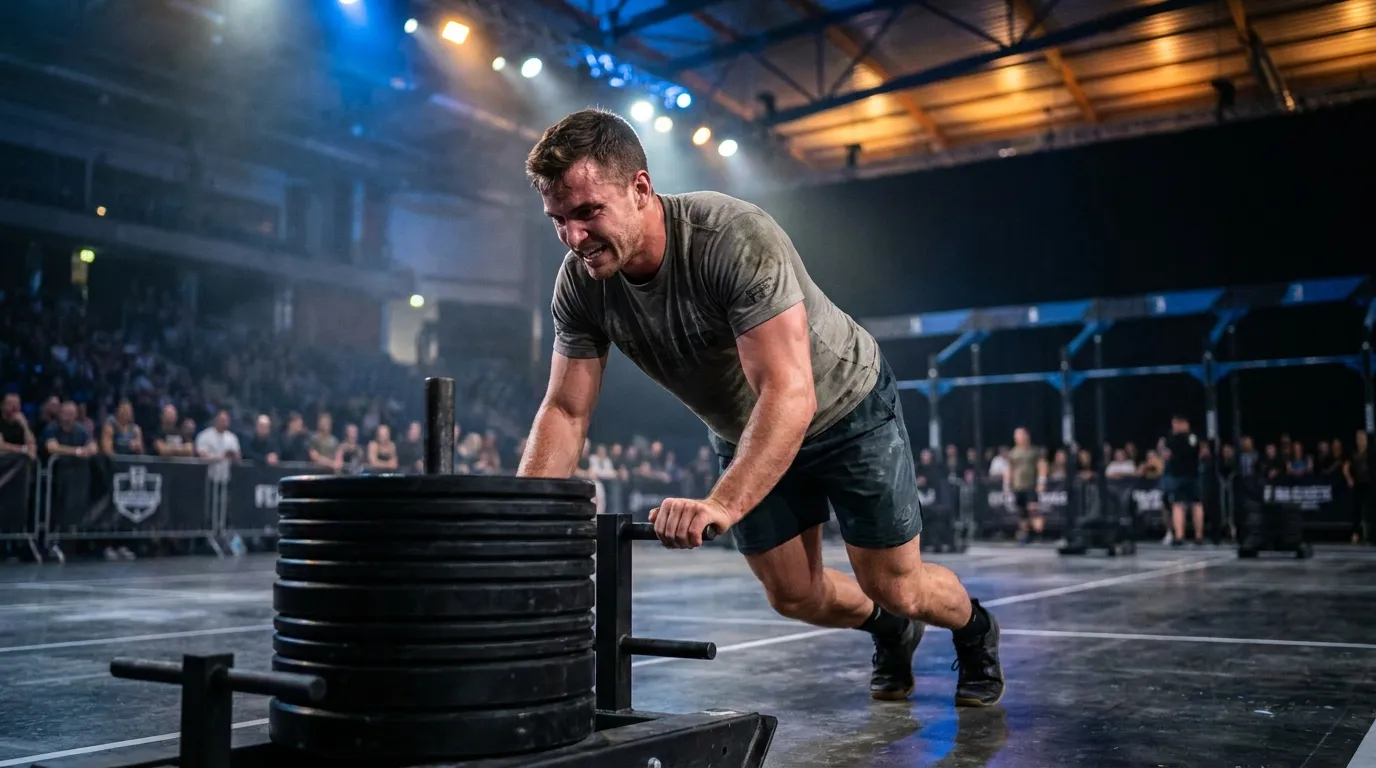
Best Peptides for Hyrox (and CrossFit): What the Community Actually Uses (2026)
The compounds Hyrox and CrossFit athletes use most in our community are the mitochondrial peptide MOTS-c, the recovery peptide BPC-157, and the non-peptide PPARδ agonist Cardarine — the mixed-modal engine first, then recovery, then a high-risk endurance research chemical — but "most used" is a long way from "proven," and for a drug-tested athlete almost the entire list is banned. Hyrox is a brutally specific demand: eight 1 km runs interleaved with eight functional stations, so the people here are chasing two things at once — an aerobic engine that holds across the runs and the repeated-effort recovery to survive the stations. This page answers the real question two ways: what the functional-fitness community actually reaches for, and what the evidence honestly says about each option.
Most "peptides for Hyrox" or "peptides for CrossFit" pages either ignore the sport and treat you like any gym-goer, or list recovery peptides with no map to what the event does to your body. We do it differently. The headline ranking below comes from first-party usage data — what ~3,400 ProtocolPlus functional-fitness users actually track — and we map each compound to the things that limit a Hyrox or CrossFit athlete: the run-plus-station engine, recovery between hard sessions, and the joints high-volume functional training breaks. For the science on any molecule we link up to its guide and the endurance hub, and for the pure-aerobic metric across to the VO2max guide, so this page stays a clean decision guide.
Key Takeaways
- What the functional-fitness community uses (not an efficacy ranking): across ~3,400 ProtocolPlus Hyrox and CrossFit users, the top three are MOTS-c (20%, 680 users), BPC-157 (18%, 612), and the non-peptide Cardarine/GW-501516 (16%, 544) — the aerobic engine, then recovery, then a high-risk endurance research chemical (ProtocolPlus app data).
- Usage is not proof. No injectable peptide on this list has a human Hyrox or CrossFit trial behind it. MOTS-c and Cardarine rest on mouse performance data; BPC-157 and TB-500 rest on animal tendon-and-soft-tissue data.
- The sport is mixed-modal, and the engine is why MOTS-c leads. A simulated Hyrox runs ~86 minutes, with the runs taking longer than the stations and the whole thing spent at a "very hard" heart-rate intensity — so the community reaches first for the aerobic-engine peptide, then for recovery to survive the stations.
- Cardarine is not a peptide and is dangerous. GW-501516 is a research chemical whose development was halted after it caused dose-dependent cancers in rats across multiple organs. It is on this list because people use it, not because it is safe.
- Almost everything here is banned in sport. Under the WADA Prohibited List, BPC-157 and TB-500 are S0 non-approved substances, MOTS-c is an S4.4 metabolic modulator (named on the list as a prohibited AMPK activator), Cardarine is an S4.4 metabolic modulator, and CJC-1295/ipamorelin are S2 peptide hormones. Only NAD+ is not currently prohibited — and it is not a proven performance aid.
- Drug-tested? The honest answer is short. Filter the selector to "tested" (CrossFit Games and elite Hyrox drug-test) and almost the whole list disappears — only NAD+ survives, and it is unproven.
What peptides does the Hyrox and CrossFit community use?
Across ~3,400 ProtocolPlus Hyrox and CrossFit users, MOTS-c is the most-tracked compound (20%), followed by the recovery peptide BPC-157 (18%) and the non-peptide PPARδ agonist Cardarine (16%). This is a usage ranking from our own app data, not a clinical verdict on what works best for functional fitness — and several of these carry real risk.
The pattern reflects how a Hyrox or CrossFit athlete thinks about their body. The lead pick, MOTS-c, is an aerobic-engine bet: a Hyrox time is decided by whether your running engine holds across eight 1 km efforts wrapped around fatiguing stations, so the community reaches first for the most-discussed "mitochondrial" peptide. Right behind it sits recovery — BPC-157 — because high-volume functional training is hard on shoulders, knees, and low backs, and the athlete who keeps training beats the one who keeps getting hurt. The #3 pick, Cardarine, is the high-risk endurance play. After that, usage spreads into a tail: TB-500 (12%), NAD+ (12%), CJC-1295 (8%), the exercise-mimetic SLU-PP-332 (8%), and the clean GHRP ipamorelin (6%).
These shares come only from our community-usage dataset and describe behavior, not efficacy. A compound can be widely used and barely evidenced at the same time, that describes most of this list. Read the chart below as "what functional-fitness athletes reach for," then cross-check it against the engine science, the injury map, and the doping read further down, where the picture changes sharply.
Citation capsule. Among ~3,400 ProtocolPlus users who logged Hyrox or CrossFit as a goal, the most-tracked compounds were MOTS-c (20%, 680 users), BPC-157 (18%, 612), Cardarine/GW-501516 (16%, 544), TB-500 (12%, 408), and NAD+ (12%, 408). This is first-party usage data reflecting what the community uses, not a clinical efficacy ranking and not a safety ranking. Source: ProtocolPlus app data (goals/hyrox-crossfit.json), 2026.
The community's top picks (by usage)
The functional-fitness community's three most-used compounds are MOTS-c, BPC-157, and Cardarine — one mitochondrial engine peptide, one recovery peptide, and one carcinogenic research chemical. Each card pairs the usage share with the honest reason athletes pick it and the caveat that comes with it.
These three account for roughly 54% of usage in our cohort. The split says how functional-fitness athletes think: the top pick is the aerobic engine (MOTS-c), because a Hyrox is won on the runs, and #2 is recovery (BPC-157), because the stations and the volume break you. Only at #3 does a pure-endurance compound appear — and it is the one with the worst safety record on the list.
MOTS-c
Why athletes pick it: a mitochondrial-derived peptide tied to aerobic capacity and metabolic flexibility — the "engine" play for the run-and-station format, and the most-tracked performance peptide in our functional-fitness data.
Honest caveat: human performance data is thin and mechanistic; research-grade only; explicitly named on the WADA list as a prohibited AMPK activator.
BPC-157
Why athletes pick it: the recovery go-to for the joints functional training beats up — shoulders, knees, low back, elbows — used to keep training volume high between sessions. A durability lever, not a direct aerobic one.
Honest caveat: mostly animal data; not approved for human use anywhere; prohibited in sport as a non-approved substance (S0).
Cardarine (GW-501516) ⚠
Why athletes pick it: a PPARδ agonist with the strongest animal endurance signal — discussed for the run portions and as a fat-oxidation "engine" play.
Honest caveat: not a peptide. Development was halted after dose-dependent cancers in rats across multiple organs. Prohibited in sport. High risk — we list it because people use it, not because it is defensible.
The long tail (ranks 4–8): the remaining ~46% of usage spreads across the recovery peptide TB-500 (12%), the cofactor NAD+ (12%), the GH-axis recovery peptide CJC-1295 (8%), the exercise-mimetic SLU-PP-332 (8%), and the clean GHRP ipamorelin (6%). The one quiet bright spot: NAD+ is the only compound on the whole list that is not currently WADA-prohibited — which is exactly why it matters for tested athletes, even though it is not a proven performance aid. Each gets a mini-section below.
What actually limits a Hyrox or CrossFit athlete — and which compound targets it
A functional-fitness athlete is limited by three things: the size of the mixed-modal engine that has to hold across runs and stations, how fast you recover between hard sessions, and whether your joints survive the high-volume load — and almost every compound on this list is an attempt to nudge one of those three. This is the section that earns this page its place, because no competitor maps peptides to what the event actually does to your body.
The honest headline first: Hyrox is an endurance event with a strength tax. A 2025 study that simulated a full Hyrox found it took about 86.5 minutes, with athletes spending roughly 80% of that time at a "very hard" intensity, and crucially the running portion took longer than the stations (about 51 versus 33 minutes) while the stations drove blood-lactate higher — and faster finishers had higher VO2max, more endurance volume, and lower body fat (Brandt et al., "Acute physiological responses and performance determinants in Hyrox," Frontiers in Physiology, 2025, retrieved 2026-06-17). That single result explains the whole community ranking: this is an aerobic-dominant event with repeated-effort spikes, so people reach first for an engine peptide, then for recovery. Every compound here is, at best, an unproven attempt to do pharmacologically what training already does reliably.
Need 1 — The mixed-modal engine (the run-and-station demand)
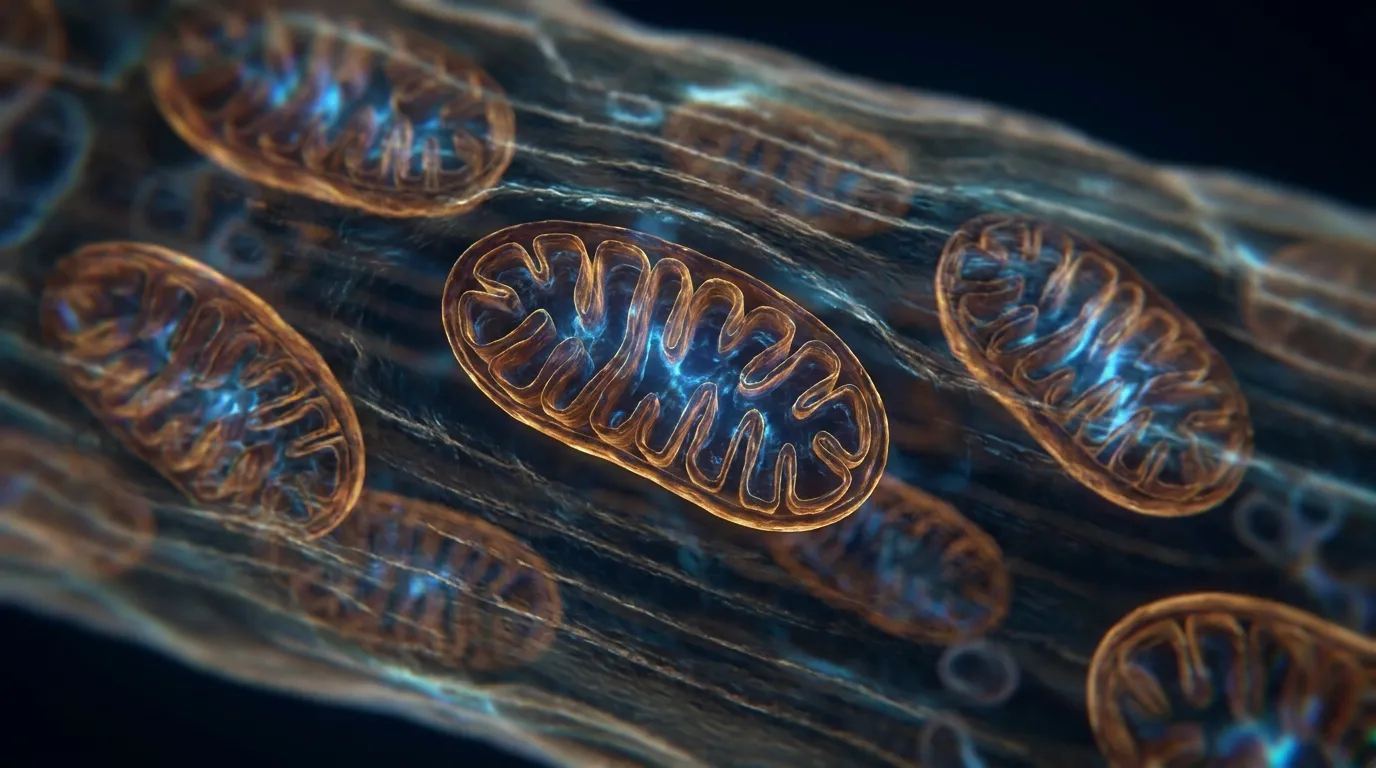
The thing that decides a Hyrox time is the engine, and it is a specific kind: aerobic capacity big enough to run eight kilometres at pace, plus the metabolic flexibility to keep working through eight fatiguing stations without the legs filling with lactate. Because the runs take longer than the stations and the whole event sits at a very-hard intensity, the aerobic base is the dominant determinant — which is why the community's #1 pick is an aerobic-engine peptide, not a recovery one. Endurance training builds this engine through PGC-1α, the master coordinator of mitochondrial biogenesis, and the aerobic-engine compounds try to mimic that signal pharmacologically.
MOTS-c, the community's #1, is a mitochondrial-derived peptide that activates AMPK — the same nutrient-sensing pathway exercise activates — and improved running performance in young, middle-aged, and old mice while rising naturally with exercise in humans (Reynolds et al., "MOTS-c is an exercise-induced mitochondrial-encoded regulator," Nature Communications, 2021, retrieved 2026-06-17). Cardarine (PPARδ) is the fat-oxidation story, and it appeals to a Hyrox athlete specifically: the runs happen on tired legs between strength stations, so anything that spares glycogen and shifts the muscle toward burning fat would, in theory, leave more in the tank for the back half. Cardarine comes from the landmark "exercise in a pill" work, where it plus training raised running endurance in mice far beyond training alone — roughly 68% longer run time and 70% farther (Narkar et al., "AMPK and PPARδ Agonists Are Exercise Mimetics," Cell, 2008, retrieved 2026-06-17). The crucial, usually-omitted detail: the strong effect needed training alongside it; the compound alone was weak. SLU-PP-332 (a pan-ERR agonist) is the newest entry — mice ran roughly 70% longer and 45% farther (Billon et al., "A Synthetic ERR Agonist Enhances Exercise Capacity," ACS Chemical Biology, 2023, retrieved 2026-06-17). State the obvious thing every competitor gets wrong: Cardarine and SLU-PP-332 are small molecules, not peptides. And every headline number above is from a mouse, not an athlete.
There is a deeper reason the "exercise in a pill" framing keeps disappointing from mice to people. These compounds reproduce one transcriptional signal of training — a fragment of the fat-oxidation and oxidative-fibre program — but real aerobic adaptation is the integrated product of dozens of signals firing together over months. That is why the headline percentages shrink the closer the science gets to an athlete, and why none has produced a positive human result. For the full mechanism chain — VO2max as cardiac output times oxygen extraction, the oxygen-delivery link the bans really target, and the inverse between effect size and evidence quality — see the endurance hub, which owns that science; the pure-aerobic ceiling is the territory of the VO2max guide.

Need 2 — Joint and soft-tissue durability (what functional training breaks)
The second lever is staying intact under high-volume, high-variety functional load. This is not a minor concern: a systematic review and meta-analysis put the injury incidence at roughly 3.2 injuries per 1,000 training hours, with the shoulder (~26%), the spine and low back (~24%), and the knee (~18%) the most-injured regions (Klimek et al., "Musculoskeletal Injuries in CrossFit: a systematic review and meta-analysis," German Journal of Sports Medicine, 2021, retrieved 2026-06-17). Those regions map onto the movements: overhead and pulling work (wall balls, SkiErg, farmers carry, pull-ups, snatches) loads the shoulder; the sled push and pull, deadlifts, and heavy carries load the low back; and lunges, box jumps, and squats load the knee. This is the link BPC-157 and TB-500 target, and it is why BPC-157 is the community's #2.
The interest comes from animal data. BPC-157 promoted Achilles tendon-to-bone healing in rats — improving load-to-failure, stiffness, and collagen organisation, and counteracting corticosteroid-impaired healing (Krivic et al., "Achilles detachment in rat and stable gastric pentadecapeptide BPC 157," Journal of Orthopaedic Research, 2006, retrieved 2026-06-17), with later work showing it supports tendon-fibroblast outgrowth, survival, and migration (Chang et al., "The promoting effect of pentadecapeptide BPC 157 on tendon healing," Journal of Applied Physiology, 2011, retrieved 2026-06-17). TB-500, a thymosin-β4 fragment, is used for the same systemic soft-tissue resilience, on animal and mechanistic data for cell migration and angiogenesis. The catch that no listicle states: those are rat tendons and cell models, the human evidence is essentially absent for the injected fragments, and both compounds are WADA-prohibited. The connective-tissue and tendon science in full belongs to each molecule's own guide — see the BPC-157 complete guide and the TB-500 complete guide.
It is worth being precise about where the rationale is strongest and weakest. The connective-tissue story lines up best with the tendinopathies and soft-tissue overload of repetitive overhead and pulling volume — the irritated shoulder and elbow, the cranky patellar tendon. For acute traumatic injuries (a torn muscle, a rolled ankle off a box) and low-back pain driven by loading mechanics under fatigue, the rationale is much thinner even in theory, because those are not primarily a tissue-healing-speed problem. The honest pattern is the one that shows up across sport: the injuries where the animal data is most suggestive (tendon) are not always the ones functional-fitness athletes most commonly get (shoulder impingement, low-back strain, traumatic knee), and none of it is confirmed in a CrossFit or Hyrox athlete. A recovery peptide here cannot fix bad programming or sloppy technique; it is, at most, an unproven attempt to shorten the tissue side of recovery.
Need 3 — Recovery between hard sessions
The third lever is what separates the athlete who strings together twelve consistent weeks from the one who builds for three and then breaks down. You do not get fitter from a brutal metcon or a heavy interval session; you get fitter from recovering from it and adapting, so anything that lets you absorb more quality training without breakdown is, indirectly, a performance intervention. For a Hyrox or CrossFit athlete this is concrete: the training mixes high-intensity conditioning, running volume, and strength work in the same week, the central-nervous-system and connective-tissue cost stacks up fast, and the limiter in a race build is often how well you bounce back between the two or three hard sessions a week rather than how hard any single one is.
This is the shared rationale behind the recovery cohort — BPC-157 and TB-500 for the tissue side, and the GH-axis pair CJC-1295 + ipamorelin for the sleep-and-recovery side that supports volume. NAD+ sits here too as an upstream cofactor: central to mitochondrial energy metabolism and declining with age, it is the "support the machinery, recover better, train more" bet. Whether any of these delivers in functional-fitness athletes is unproven, but the underlying logic — consistency compounds — is the soundest reasoning in the whole category. The honest limit of that logic: even at its best, recovery support buys you training availability, not free fitness, and only if the training, sleep, and fuelling underneath it are already sound.
CrossFit: the same compounds, a varied-modal demand
CrossFit athletes in our community reach for the same shortlist as Hyrox athletes — MOTS-c, BPC-157, Cardarine — but the emphasis tilts toward joint durability, because CrossFit's constantly-varied, high-skill movements punish connective tissue harder than Hyrox's fixed run-and-station format. The compounds are shared; the reason for reaching for them shifts.
Where Hyrox is a predictable mixed-modal grind that rewards a big aerobic engine, CrossFit is varied-modal: Olympic lifts, gymnastics skills, and high-rep metcons in unpredictable combinations, often performed for time under fatigue. That is the profile behind the injury data above — the shoulder, low back, and knee lead because overhead pressing, snatching, kipping gymnastics, and heavy squatting under fatigue load those joints repeatedly. So while the aerobic-engine logic still applies (a metcon is still a conditioning test), the durability need is relatively louder for a CrossFitter, which is why BPC-157 and TB-500 interest runs high in this part of the cohort. The honest read is the same in both sports: no human trial shows any of these compounds reduces CrossFit injuries or improves a benchmark, and the most reliable durability levers are the unglamorous ones — sound mechanics, progressive loading, and managing weekly volume.
What functional-fitness athletes actually stack (observed usage, not advice)
We cannot prescribe a stack, but we can show what the Hyrox and CrossFit community actually combines — and in our data it clusters into three honest patterns: an engine-plus-repair stack, a recovery stack, and a small drug-tested option. Read this as observed behavior, framed against the evidence, not as a protocol to copy.
The most common combination logged is the engine-plus-repair pattern — MOTS-c paired with BPC-157 — used by athletes building the engine while keeping the joints intact through high volume; both halves are unproven in humans and WADA-banned. A second cluster is the recovery pattern, where BPC-157 and TB-500 are logged together (the "Wolverine" pairing from functional-fitness forums), sometimes with CJC-1295 and ipamorelin added for sleep. The third and smallest cluster is what tested athletes are left with: essentially NAD+ (or its oral precursor NMN) on its own, the only option in our cohort not currently prohibited. The honest read across all three: stacking multiplies unknowns. None of these combinations has a human Hyrox or CrossFit trial, the research-grade vials carry their own purity-and-sterility risk, and "what people stack" is a popularity signal — not evidence that any combination is effective or safe. The soundest "stack" any functional-fitness athlete can run is structured training, sleep, and fuelling.
How each candidate fits the athlete (mini-profiles)
The eight candidates fall into three groups — the aerobic engine, recovery and soft-tissue peptides, and metabolic cofactors — and each links up to its full science so this page never re-explains a molecule. These profiles are deliberately short; the deep dive lives on each compound's hub.
- MOTS-c (engine, #1) — the lead "engine" peptide; AMPK activation, mouse data, WADA S4.4 (named). the MOTS-c guide.
- BPC-157 (recovery/durability, #2) — the all-rounder for shoulders, knees, low back, elbows; animal tendon data, WADA S0. the BPC-157 guide.
- Cardarine / GW-501516 (engine, #3) — non-peptide PPARδ agonist, loud animal endurance signal, halted-for-cancer record. We do not recommend it. the Cardarine (GW-501516) guide.
- TB-500 (recovery/durability, #4) — thymosin-β4 fragment for soft-tissue resilience; animal data, WADA S0. the TB-500 guide.
- NAD+ (cofactor, #5) — cellular-energy cofactor; benefit indirect and unproven, but the only one in our cohort not currently WADA-prohibited. the NAD+ guide.
- CJC-1295 (GH-axis recovery, #6) — GHRH analog for sleep/recovery; indirect, WADA S2. the CJC-1295 guide.
- SLU-PP-332 (engine, #7) — preclinical non-peptide ERR exercise-mimetic; mouse-only, no human data. the SLU-PP-332 guide.
- Ipamorelin (GH-axis recovery, #8) — clean GHRP paired with CJC-1295; no direct data, WADA S2. the ipamorelin guide.
For the full mechanism families and compounds beyond our cohort (SS-31, Stenabolic, 5-amino-1MQ), the endurance hub groups every candidate.
Which compound fits your situation?
The decision turns on three questions the selector asks: injectable or oral, are you drug-tested in competition, and how new are you to performance compounds — and the drug-tested question changes everything. The matrix below sets all eight candidates against the dimensions that actually decide it, including route and WADA status.
This table is the "why" behind the usage ranking — editorial context, not the headline. The selector quiz at the top runs the same logic interactively. The single most important filter is drug-tested: choose it and the list collapses to almost nothing, because almost every compound here is prohibited in sport. Filter to oral-only and you are left with Cardarine and SLU-PP-332 — both WADA-banned non-peptide research chemicals, which is its own kind of warning.
| Compound | Family | Route | WADA status | Human Hyrox/CrossFit evidence | Picked when… |
|---|---|---|---|---|---|
| MOTS-c | Engine (peptide) | Injectable | Prohibited (S4.4) | None (mouse only) | You want the most-tracked "engine" peptide and accept research-grade risk |
| BPC-157 | Recovery (peptide) | Injectable | Prohibited (S0) | None (mostly animal) | Joint durability and recovery are the bottleneck |
| Cardarine ⚠ | PPARδ (NOT a peptide) | Oral | Prohibited (S4.4) | None; halted for animal cancers | (We do not recommend it — listed because it is used) |
| TB-500 | Recovery (peptide) | Injectable | Prohibited (S0) | None (animal) | Systemic soft-tissue resilience under high volume |
| NAD+ | Cofactor | Injectable | Not prohibited | None proven (NMN has a runner RCT) | You are tested and want something not banned (but unproven) |
| CJC-1295 | GH-axis recovery (peptide) | Injectable | Prohibited (S2) | None (indirect) | Sleep and recovery quality is the goal |
| SLU-PP-332 | ERR mimetic (NOT a peptide) | Oral | Prohibited (S4.4 class) | None (mouse only, preclinical) | You are experimenting at the frontier (high uncertainty) |
| Ipamorelin | GH-axis recovery (peptide) | Injectable | Prohibited (S2) | None (indirect) | A cleaner GHRP for recovery support |
The doping reality: what a tested athlete can actually use
If you compete in drug-tested CrossFit (the Games and its qualifiers test) or at elite Hyrox, the ranking above is mostly a list of ways to fail a test — seven of the eight community-tracked compounds are on the WADA Prohibited List, across three classes. This is where the community usage data and the safe-for-competition reality diverge hardest.
Three points decide it. First, the non-approved substances (class S0) — BPC-157 and TB-500, neither approved for human use — are prohibited at all times; USADA states plainly that BPC-157 falls under S0 (USADA, "BPC-157: Experimental Peptide Creates Risk for Athletes", retrieved 2026-06-17). Second, the metabolic modulators — MOTS-c, named on the list as a prohibited AMPK activator (class S4.4), and Cardarine/GW-501516 (class S4.4) — are banned at all times (USADA, "What Should Athletes Know About GW1516?", retrieved 2026-06-17). Third, the peptide hormones (class S2) capture the GH-axis pair CJC-1295 and ipamorelin. Only NAD+ is not currently prohibited — the lone survivor of the drug-tested filter. One caveat even there: WADA's S0 catch-all means any non-approved drug could be deemed prohibited, so "not currently prohibited" is not the same as "permitted" or "safe."
Citation capsule. Under the WADA Prohibited List, the Hyrox and CrossFit candidates split across three classes: S0 non-approved substances (BPC-157, TB-500); metabolic modulators (MOTS-c, named as a prohibited AMPK activator under S4.4; Cardarine/GW-501516 under S4.4); and S2 peptide hormones and growth factors (CJC-1295, ipamorelin, and the exercise-mimetic SLU-PP-332 as a prohibited metabolic modulator). NAD+ is not currently prohibited, though the S0 catch-all still applies. Drug-tested athletes should assume a substance is prohibited unless verified. Sources: WADA Prohibited List S0/S4.4/S4.4/S2; USADA advisories on BPC-157, MOTS-c, and GW1516.
So what can a tested, competitive functional-fitness athlete reach for? The answer is short and unglamorous: the evidence-based levers are training, sleep, and fuelling — and among ingestibles, the strongest human data for an aerobic effect belongs to a legal, oral option. A randomized, double-blind trial in 48 amateur runners found that NMN (an oral NAD+ precursor), 600–1,200 mg/day for six weeks alongside training, improved aerobic-capacity markers versus placebo in a dose-dependent way, though it did not raise peak VO2max (Liao et al., "Nicotinamide mononucleotide supplementation enhances aerobic capacity in amateur runners," Journal of the International Society of Sports Nutrition, 2021, retrieved 2026-06-17). It is the closest thing here to a tested-athlete-friendly aerobic option — oral, legal, and human — the opposite of everything at the top of our usage ranking.
What's realistic to expect — and how to read the claims
If you are weighing one of these compounds, the realistic expectation for Hyrox or CrossFit performance is "no measurable, proven benefit in a human" — and the loud forum testimonials are exactly the kind of evidence that misleads. Three habits keep you grounded. First, separate animal numbers from human promises: "ran 70% farther" is a real finding in mice, not a prediction for your next Hyrox PR or Fran time. Second, distrust the before-and-after story: an athlete using these compounds is almost always also training, sleeping, and fuelling with intent, so a new benchmark gets credited to the vial when the training block did the work. Third, weight the downside correctly: for an unproven upside, an unknown safety profile (and, for Cardarine, a known carcinogenicity signal) is a bad trade, and for a tested athlete a near-certain sanction makes the expected value plainly negative. The interventions that reliably make you better at Hyrox and CrossFit are the unglamorous ones with real human data — a bigger aerobic base, sound mechanics, progressive loading, and adequate recovery.
What the community does is not what is proven, or safe
Treat the usage ranking as a popularity signal shaped by hype, mechanism appeal, and availability — not as evidence of what works for functional fitness or what is safe. The clearest proof is that the community's #3 compound, Cardarine, is a research chemical whose own development was abandoned because it caused cancer in animals.
Three honest framings sit on top of every number here. First, no compound has a positive human Hyrox or CrossFit trial — BPC-157 and TB-500 rest on animal soft-tissue data, the engine compounds on mouse performance data. Second, Cardarine's safety record is disqualifying: GW-501516's development was halted after long-term rodent studies showed dose-dependent cancers across multiple organs — findings treated as established by anti-doping and public-health authorities, who issued warnings (Sport Integrity Australia, "GW1516 — popular but deadly," 2018, retrieved 2026-06-17). Third, research-grade vials carry quality risk — unknown potency, purity, and sterility — that no usage statistic captures.
Our take: Read this page as two layers that mostly disagree. The usage chart tells you what real Hyrox and CrossFit athletes reach for; the engine science, the injury map, and the safety read tell you how little supports it. When those diverge as sharply as they do here — a carcinogen at #3, no human trials anywhere — trust the evidence, not the crowd. The most defensible decision for most functional-fitness athletes is the unglamorous one: build the aerobic engine, train the movements well, manage your volume, and treat everything on this list as experimental at best and dangerous at worst.
Who should not go near these
These compounds are not for anyone competing under drug testing, not for anyone outside research or clinical oversight, and Cardarine is not for anyone, full stop. The honest contraindication list here is short and firm.
A few hard lines. Drug-tested athletes — anyone in the CrossFit Games pathway or competing as an elite-tier Hyrox athlete — should treat the top of this list as a failed test waiting to happen; seven of eight candidates are WADA-prohibited, and "I didn't know" is not a defence. Anyone considering Cardarine should weigh that it is a non-peptide research chemical with a carcinogenicity signal — no version of the risk-reward favours it for an unproven benefit. For every research peptide here, there is no validated safe-use protocol for Hyrox or CrossFit, so they belong in a trial or under a clinician, not a self-directed cycle. And if you are new to functional fitness, the highest-return moves are not on this page at all — they are consistent aerobic base-building, coached movement mechanics, and a sensible progression of training volume.
Frequently Asked Questions
The bottom line
If you came here for a single "best peptide for Hyrox or CrossFit," the honest answer is uncomfortable: there isn't one with human evidence behind it. The community leads with the aerobic engine — MOTS-c at #1, on mouse data — because a Hyrox is decided on the runs, and follows with recovery (BPC-157) because the stations and the volume break the joints. The #3 pick, Cardarine, has an interesting endurance mechanism in mice and a disqualifying carcinogenicity record on top. The one genuinely human, aerobic-performance datum in this space points not at any injectable but at oral NMN — worth sitting with before you reach for a vial.
For a drug-tested athlete the practical answer is shorter still: almost everything here is prohibited, and the one compound that is not (NAD+) is not proven to work. The selector at the top narrows the field to your constraints — injectable or oral, tested or not, new or experienced — but the most defensible decision is the one this page keeps circling back to: build the engine and the durability your body actually responds to. From here, the natural next reads are the endurance hub for the full mechanism science, the VO2max guide for the pure-aerobic ceiling, the runners guide if your running is the limiter, the HRV and recovery guide for readiness, and, before sourcing anything, how to vet peptide quality and are peptides legal.
Sources
- Brandt T, Ebel C, Lebahn C, et al. "Acute physiological responses and performance determinants in Hyrox — a new running-focused high intensity functional fitness trend." Frontiers in Physiology, 2025, 16:1519240. Retrieved 2026-06-17. https://www.frontiersin.org/articles/10.3389/fphys.2025.1519240/full
- Klimek C, Ashbeck C, Brook AJ, Durall C. "Musculoskeletal Injuries in CrossFit: a systematic review and meta-analysis of injury rates and locations." German Journal of Sports Medicine, 2021, 7. Retrieved 2026-06-17. https://www.germanjournalsportsmedicine.com/archive/archive-2021/issue-7/musculoskeletal-injuries-in-crossfitr-a-systematic-review-and-meta-analysis-of-injury-rates-and-locations/
- Reynolds JC, Lai RW, Woodhead JST, et al. "MOTS-c is an exercise-induced mitochondrial-encoded regulator of age-dependent physical decline and muscle homeostasis." Nature Communications, 2021, 12:470. Retrieved 2026-06-17. https://www.nature.com/articles/s41467-020-20790-0
- Narkar VA, Downes M, Yu RT, et al. "AMPK and PPARδ Agonists Are Exercise Mimetics." Cell, 2008, 134(3):405–415. Retrieved 2026-06-17. https://www.sciencedirect.com/science/article/pii/S0092867408008386
- Billon C, Schoepke E, Avdagic A, et al. "A Synthetic ERR Agonist Induces an Acute Aerobic Exercise Response and Enhances Exercise Capacity." ACS Chemical Biology, 2023. Retrieved 2026-06-17. https://pubs.acs.org/doi/abs/10.1021/acschembio.2c00720
- Krivic A, Anic T, Seiwerth S, et al. "Achilles detachment in rat and stable gastric pentadecapeptide BPC 157: promoted tendon-to-bone healing and opposed corticosteroid aggravation." Journal of Orthopaedic Research, 2006, 24(5):982–989. Retrieved 2026-06-17. https://onlinelibrary.wiley.com/doi/abs/10.1002/jor.20096
- Chang CH, Tsai WC, Lin MS, et al. "The promoting effect of pentadecapeptide BPC 157 on tendon healing involves tendon outgrowth, cell survival, and cell migration." Journal of Applied Physiology, 2011, 110(3):774–780. Retrieved 2026-06-17. https://pubmed.ncbi.nlm.nih.gov/21030672/
- Liao B, Zhao Y, Wang D, et al. "Nicotinamide mononucleotide supplementation enhances aerobic capacity in amateur runners: a randomized, double-blind study." Journal of the International Society of Sports Nutrition, 2021, 18(1):54. Retrieved 2026-06-17. https://pmc.ncbi.nlm.nih.gov/articles/PMC8265078/
- U.S. Anti-Doping Agency (USADA). "BPC-157: Experimental Peptide Creates Risk for Athletes," "What Is the MOTS-c Peptide?" and "What Should Athletes Know About GW1516?" Retrieved 2026-06-17. https://www.usada.org/spirit-of-sport/bpc-157-peptide-prohibited/
- Sport Integrity Australia. "GW1516 — Popular but Deadly." 2018. Retrieved 2026-06-17. https://www.sportintegrity.gov.au/news/integrity-blog/2018-10/gw1516-popular-deadly
- World Anti-Doping Agency. "The Prohibited List" — S0 Non-Approved Substances (BPC-157, TB-500), S4.4 Metabolic Modulators (MOTS-c, named AMPK activator), S4.4 Metabolic Modulators (GW1516/Cardarine), S2 Peptide Hormones & Growth Factors (CJC-1295, ipamorelin). Retrieved 2026-06-17. https://www.wada-ama.org/en/prohibited-list
- ProtocolPlus. "Community goal-usage data: Hyrox & CrossFit" (goals/hyrox-crossfit.json). First-party app data, 2026. n ≈ 3,400 functional-fitness users. Usage signal, not a clinical efficacy or safety ranking.