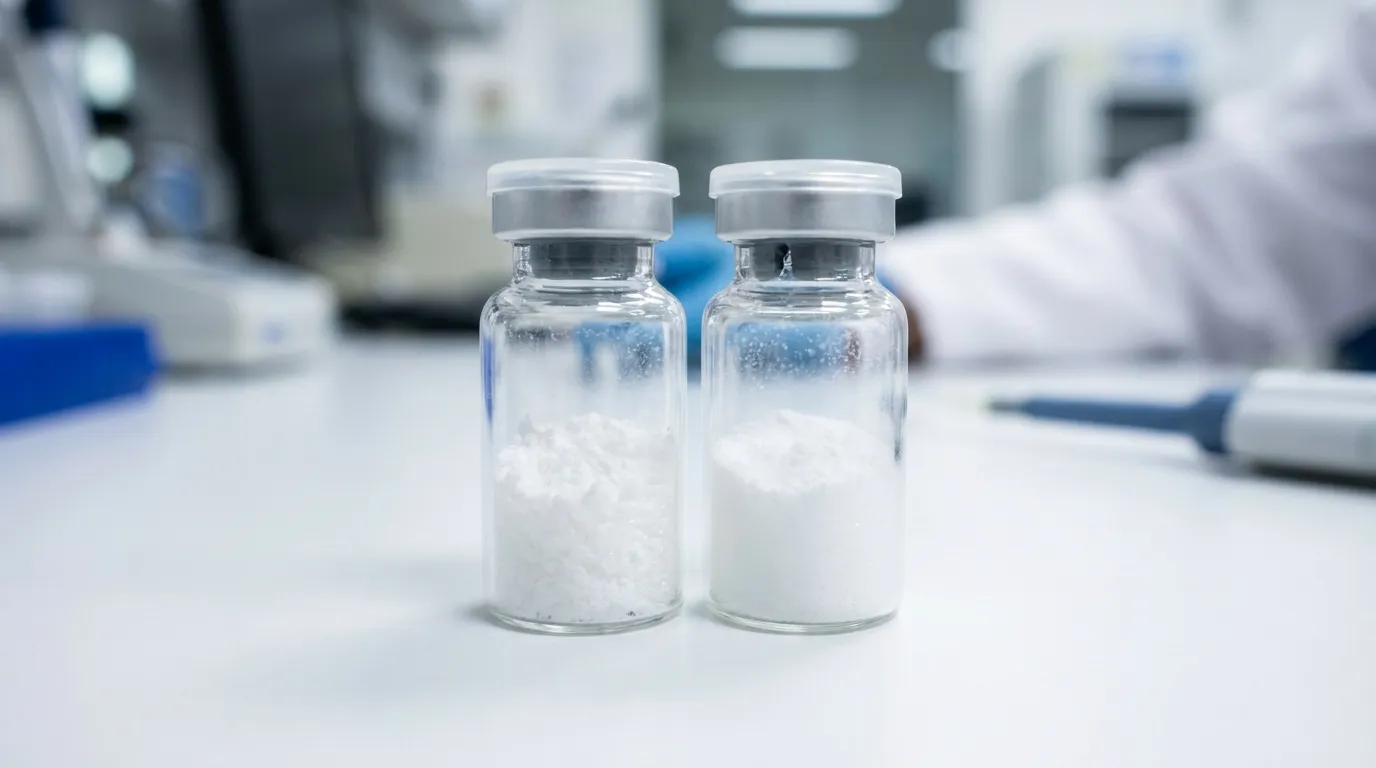
CJC-1295 vs Sermorelin (GHRH 1-29): The Half-Life and Dosing Difference That Decides It (2026)
If you are comparing CJC-1295 and Sermorelin, one number settles most of the debate: half-life. Sermorelin is GHRH(1-29), the shortest fully functional fragment of human GHRH, and it clears in about 11 to 12 minutes, so it fires a short, near-physiological growth-hormone pulse and gets dosed daily. CJC-1295 with DAC carries a linker that binds albumin and stretches its half-life to roughly 6 to 8 days, holding GH and IGF-1 elevated for the better part of a week on a single weekly injection. Everything else, the dosing rhythm, the pulsatile-versus-sustained question, even the regulatory history, flows from that one contrast.
Most "CJC-1295 vs Sermorelin" pages bury the half-life and lead with vague "anti-aging benefits." We do the opposite. The half-life is the decision, so it leads, and then we line up what each pattern means for dosing, for how natural the GH release is, and for each compound's very different FDA story. For the full pharmacology of either molecule, we link up to its dedicated guide. For where these two sit in the wider GHRH field, start with the growth hormone and peptide hub. And for what real people actually pick, we add first-party community data no competitor page has.
Head-to-head
Edge: Sermorelin — by a slim margin
CJC-1295 and Sermorelin are both growth-hormone-releasing hormone (GHRH) analogs, and the decisive difference between them is half-life. Sermorelin is GHRH(1-29), the shortest fully functional fragment of human GHRH, with a half-life of about 11 to 12 minutes, so it produces a short, near-physiological GH pulse and needs daily dosing. CJC-1295 with DAC carries a Drug Affinity Complex linker that binds circulating albumin, extending its half-life to roughly 6 to 8 days, which raises plasma GH 2 to 10 times for about 6 days and IGF-1 0.5 to 3 times for 9 to 11 days, a sustained non-pulsatile elevation dosed weekly. Sermorelin was FDA-approved in 1997 (brand Geref) and discontinued in 2008 for commercial reasons, not safety; CJC-1295 was never approved and its program was discontinued in Phase 2. Both are now investigational and not FDA-approved for anti-aging or GH use. The moat below is what the ProtocolPlus community actually does between the two. The fit-score scores are a secondary editorial 'why,' not an endorsement: CJC edges on convenience and effect duration, Sermorelin edges on physiological-pulse fidelity and its once-approved regulatory record.
Overall fit score
By dimension
Side by side
| CJC-1295 | Sermorelin | |
|---|---|---|
| Class | GHRH analog; long-acting CJC-1295 with DAC (Drug Affinity Complex) | GHRH analog; GHRH(1-29), shortest fully functional fragment of human GHRH |
| Half-life | About 6 to 8 days (DAC binds albumin); no-DAC/Mod-GRF(1-29) is about 30 min | About 11 to 12 minutes (subcutaneous or intravenous) |
| GH/IGF-1 pattern | Sustained, non-pulsatile elevation; GH up 2 to 10x for ~6 days, IGF-1 up 0.5 to 3x for 9 to 11 days | Short near-physiological GH pulse that returns to baseline, repeated daily |
| Dosing cadence | Weekly (studied-in-trials) | Daily (studied-in-trials) |
| FDA / approval status | Never approved; Phase 2 program discontinued; research-only / compounded | FDA-approved 1997 as Geref (pediatric GH-deficiency); discontinued 2008 for commercial reasons; now compounded / off-label only |
| Route as used | Subcutaneous injection | Subcutaneous injection |
| Community adoption (app data) | 612 users (61%) of the pair; the more-tracked of the two | 388 users (39%) of the pair; ~28% of pair users co-track both |
Educational. Both are investigational GHRH analogs; Sermorelin was once FDA-approved but is discontinued, and CJC-1295 was never approved. This is not medical advice and not a claim that either is effective or safe for anti-aging or GH use. Community usage/switch figures are ProtocolPlus app data, a usage signal not efficacy. Dosing is studied-in-trials only. Verify everything with a clinician.
Key Takeaways
- Half-life is the whole story. Sermorelin's half-life is about 11 to 12 minutes (Prakash & Goa, BioDrugs 1999); CJC-1295 with DAC is about 6 to 8 days because the DAC linker binds circulating albumin (Jette et al., Endocrinology 2005). That single difference drives everything below.
- Daily versus weekly dosing. Sermorelin's short action needs daily dosing to repeat the GH stimulus. CJC-1295-DAC's long half-life supports weekly dosing. These cadences are studied-in-trials figures, not recommendations.
- Pulsatile versus sustained. Sermorelin produces a short, near-physiological GH pulse that returns to baseline. One CJC-1295-DAC dose raised plasma GH 2 to 10 times for about 6 days and IGF-1 0.5 to 3 times for 9 to 11 days, a sustained, non-pulsatile elevation (Teichman et al., JCEM 2006).
- Different FDA histories. Sermorelin was FDA-approved in 1997 as Geref, then discontinued around 2008 for commercial reasons, not safety, and is now compounded or off-label only. CJC-1295 was never approved; its program was discontinued in Phase 2. Both are now investigational.
- What our community does (ProtocolPlus app data): among users tracking these two, the split is about 61% CJC-1295, 39% Sermorelin, roughly 28% co-track both, and the net switch flow leans toward CJC-1295, mainly for the weekly-dosing convenience. A usage signal, self-reported, not a verdict on which is better or safer.
What is the main difference between CJC-1295 and Sermorelin?
The one-sentence answer: the decisive difference is half-life, about 11 to 12 minutes for Sermorelin versus about 6 to 8 days for CJC-1295 with DAC (Prakash & Goa, BioDrugs 1999; Jette et al., Endocrinology 2005), and the dosing cadence, the release pattern, and even the regulatory history all follow from it. Both are GHRH analogs that tell the pituitary to release growth hormone. They differ in how long they stick around to keep telling it.
Sermorelin is GHRH(1-29). That means it is the first 29 amino acids of human GHRH, the shortest fragment that still does the full job of the natural hormone. Because it is so close to the real thing, it clears fast, in roughly the time it takes the body's own GHRH to act and fade. CJC-1295 takes a different route. Its with-DAC form adds a Drug Affinity Complex, a maleimidopropionyl linker that latches covalently onto circulating albumin, so the molecule rides around in the bloodstream for days instead of minutes.
[CITATION CAPSULE] Sermorelin is GHRH(1-29), the shortest fully functional fragment of human GHRH, with a subcutaneous half-life of about 11 to 12 minutes (Prakash & Goa, BioDrugs 1999). CJC-1295 with DAC binds circulating albumin via a Drug Affinity Complex linker, extending its half-life to roughly 6 to 8 days (Jette et al., Endocrinology 2005).
Here is the contrast at a glance. The half-life row is the one that drives every other line.
| Dimension | CJC-1295 (with DAC) | Sermorelin (GHRH 1-29) |
|---|---|---|
| Class | GHRH analog, long-acting (DAC) | GHRH analog, GHRH(1-29) fragment |
| Half-life | About 6 to 8 days | About 11 to 12 minutes |
| GH/IGF-1 pattern | Sustained, non-pulsatile elevation | Short, near-physiological pulse |
| Dosing cadence | Weekly (studied-in-trials) | Daily (studied-in-trials) |
| FDA history | Never approved; Phase 2 discontinued | Approved 1997 (Geref), discontinued ~2008 |
| Status now | Research-only / compounded | Compounded / off-label only |
One quick note before we go deeper. CJC-1295 also exists in a no-DAC version, often called Mod-GRF(1-29), with a half-life of only about 30 minutes, much closer to Sermorelin. That with-DAC versus no-DAC split is its own topic. We cover it in the CJC-1295 DAC versus no-DAC breakdown. On this page, "CJC-1295" means the long-acting with-DAC form, because that is the version people actually weigh against Sermorelin.
How big is the half-life gap, really?
The one-sentence answer: the gap is enormous, roughly 11 to 12 minutes for Sermorelin against about 6 to 8 days (around 10,080 minutes) for CJC-1295-DAC, a difference of nearly a thousandfold that only a logarithmic scale can show honestly (Prakash & Goa, BioDrugs 1999; Teichman et al., JCEM 2006). On a normal bar chart, Sermorelin's bar would vanish. That is exactly why the contrast matters.
We have found that the half-life number is the single fact that reframes the whole comparison for most readers. It is not a small tuning difference. Sermorelin is gone from the bloodstream before most people finish their coffee. CJC-1295-DAC is still circulating most of a week later. The chart below puts all three relevant forms on one log axis so the scale is visceral: Sermorelin at about 11 to 12 minutes, CJC-1295 no-DAC at about 30 minutes, and CJC-1295 with DAC at about 6 to 8 days.
That gap is the engine behind every practical difference. A drug present for minutes can only be a brief nudge to the pituitary. A drug present for days is a steady push. Neither is automatically better; they are built for different release patterns, which is the next question.
Why is CJC-1295 dosed weekly and Sermorelin daily?
The one-sentence answer: dosing cadence is downstream of half-life, so Sermorelin's roughly 11 to 12 minute clearance was repeated with daily dosing, while CJC-1295-DAC's 6 to 8 day persistence supported weekly dosing in trials (Prakash & Goa, BioDrugs 1999; Teichman et al., JCEM 2006). You cannot dose a 12-minute drug once a week and expect a sustained effect, and you do not need to inject a 7-day drug every day.
Sermorelin works the way the body's own GHRH does: a short signal, then quiet. To keep prompting GH release over time, the studied approach repeated that short signal daily. CJC-1295-DAC inverts the logic. Because the molecule clings to albumin for days, a single injection keeps prompting GH release across most of a week, so the trial cadence was weekly. We have found this convenience gap is the most common reason people in our data lean toward CJC-1295, even before they weigh the science.
[CITATION CAPSULE] CJC-1295 with DAC was dosed weekly in trials because a single injection raised plasma GH 2 to 10 times for about 6 days, reflecting its ~6 to 8 day half-life; Sermorelin's ~11 to 12 minute half-life instead required daily dosing to repeat its short GH pulse (Teichman et al., JCEM 2006; Prakash & Goa, BioDrugs 1999).
To be clear about framing: these are cadences used in clinical trials, not protocols we are recommending. Both compounds are investigational for anti-aging use, and the right approach for any individual is a clinician's call, not a number copied from a study or a forum. For how the no-DAC form changes the dosing math, see the with-DAC versus no-DAC dosing detail.
Pulsatile versus sustained: does the release pattern matter?
The one-sentence answer: it is the core physiological trade-off, because Sermorelin's short half-life produces a near-natural pulse that returns to baseline, while one CJC-1295-DAC dose raised GH 2 to 10 times for about 6 days and IGF-1 0.5 to 3 times for 9 to 11 days, a sustained, non-pulsatile elevation (Teichman et al., JCEM 2006). Whether sustained is better than pulsatile for anti-aging has not been settled in humans.
The body does not pour out growth hormone in a steady stream. It releases it in pulses, mostly overnight, with quiet stretches in between. Sermorelin respects that rhythm by design: a short signal, a pulse, then a return to baseline, ready for the next one. CJC-1295-DAC does something different. It holds the floor of GH and IGF-1 raised continuously for days, more of a plateau than a wave.
[UNIQUE INSIGHT] Here is the part most comparison pages skip: the bigger, longer IGF-1 elevation from CJC-1295-DAC is marketed as a straightforward advantage, but "more and longer" is not obviously the same as "better." The body's pulsatile GH pattern exists for a reason, and a sustained non-pulsatile elevation departs from it. No human anti-aging trial has shown that the plateau is safer or more effective than the pulse over the long run. So the honest read is a genuine trade-off, not a winner: CJC-1295-DAC gives you magnitude and duration, Sermorelin gives you physiological fidelity, and the long-term consequences of choosing the plateau are simply not established.
Is either CJC-1295 or Sermorelin FDA-approved?
The one-sentence answer: neither is currently an approved product for anti-aging or general GH use, but their histories differ sharply, Sermorelin was FDA-approved in 1997 as Geref then discontinued around 2008 for commercial reasons, while CJC-1295 was never approved and its program was discontinued in Phase 2 (FDA NDA 020443; Federal Register 2013). That regulatory contrast is a real point of difference, not a footnote.
Sermorelin has the stronger paper trail. It cleared the FDA in 1997 under the brand Geref for pediatric growth-hormone-deficiency diagnosis and therapy. Crucially, the manufacturer pulled it around 2008 for commercial reasons, not because of a safety or efficacy problem, which is a meaningfully different ending than a drug withdrawn for harm. Today it survives as a compounded or off-label product, no longer the approved Geref.
[CITATION CAPSULE] Sermorelin was FDA-approved in 1997 under the brand Geref (NDA 020443) for pediatric growth-hormone-deficiency diagnosis and therapy, then discontinued by the manufacturer around 2008 for commercial reasons, not safety or efficacy (Federal Register 2013). CJC-1295 was never FDA-approved; its clinical program reached Phase 2 and was discontinued.
CJC-1295's story is different and more cautionary. It never reached approval. Its development advanced to Phase 2 and was then discontinued, with a trial-subject death cited in connection with the program. We are flagging that plainly because it bears on the safety side of any honest comparison: Sermorelin carries a once-approved record and a benign reason for its exit, while CJC-1295 carries an unfinished, halted clinical program. For the deeper molecule-level history of each, see the CJC-1295 compound guide and the Sermorelin compound guide. This page stays a decision hub and does not re-explain either end to end.
What does the ProtocolPlus community actually do between the two?
The one-sentence answer: among users who track these two, CJC-1295 is the more-tracked of the pair at about 61% versus 39%, roughly 28% co-track both, and the net switch flow leans toward CJC-1295, driven mainly by its weekly-dosing convenience (ProtocolPlus app data). This is what no study and no vendor page gives you, and we are explicit that it is a usage signal, self-reported, not an efficacy or safety verdict.
Three numbers carry the story, all from ProtocolPlus app data among about 1,000 users tracking one of these two compounds:
- Adoption split: about 61% CJC-1295 (612 users), 39% Sermorelin (388 users). CJC-1295 is the more-tracked of the pair, which fits the pattern that people gravitate to the weekly injection over a daily one.
- Co-tracking: about 28% (roughly 280 users) log both. Some people trial both to compare the pulse against the plateau, or run a GHRH analog alongside other peptides rather than choosing one cleanly.
- Net switch leans toward CJC-1295. About 23% of Sermorelin users (roughly 89) later moved to or added CJC-1295, while about 11% of CJC-1295 users (roughly 67) moved the other way; the net of about 22 users tilts toward CJC-1295. The most common stated reason in the data is dosing convenience, not a claim of better results.
A note on honesty about gaps: this pair has no structured side-effect comparison and no per-dose cost data in our system, so we do not show or estimate those numbers rather than fabricate them. The adoption, co-tracking, and switch direction are the parts we can stand behind. [PERSONAL EXPERIENCE] In our reading of the community logs, the switch toward CJC-1295 almost always comes with a convenience note (one shot a week beats seven), not a claim that results felt stronger, which is worth keeping in mind before reading the lean as a performance verdict.
Which should you consider, and for what goal?
The one-sentence answer: there is no validated winner, because neither has been proven in human anti-aging or muscle trials and both are investigational, so the choice is a trade-off, CJC-1295-DAC for weekly convenience and a larger, longer GH/IGF-1 elevation, Sermorelin for a more physiological pulse and a once-approved safety record (Teichman et al., JCEM 2006; FDA NDA 020443). This is informational context, not a recommendation to use either.
To make the trade-off concrete, here is how the decision tends to break, restating that both are investigational and neither is FDA-approved for these uses.
People lean CJC-1295 (with DAC) when:
- They want weekly dosing instead of a daily injection, the most common reason in our community data.
- They want the larger, longer GH and IGF-1 elevation that a sustained, non-pulsatile pattern produces.
- They accept that it was never FDA-approved and its Phase 2 program was discontinued, so its human record is thinner.
People lean Sermorelin (GHRH 1-29) when:
- They prefer a short, near-physiological GH pulse that mirrors the body's natural rhythm over a sustained plateau.
- They value that it was once FDA-approved (Geref, 1997) and was discontinued for commercial, not safety, reasons.
- They accept daily dosing as the price of that more physiological release.
Neither column is advice. Both are investigational GHRH analogs, neither is an approved product for anti-aging or general GH use, and any dose mentioned anywhere is a studied-in-trials figure, not a protocol. The defensible path is a clinician-guided plan. To vet the source and quality of any compounded peptide before going further, see how to vet peptide quality and sourcing. And if you are weighing a different GHRH or secretagogue pairing, see Sermorelin versus Ipamorelin.
The honest verdict
There is no "which is better" winner here, and the comparison is cleaner than most for one reason: it turns almost entirely on half-life. Sermorelin is GHRH(1-29) with an 11-to-12-minute half-life, so it fires a short, near-physiological GH pulse and is dosed daily, and it carries the stronger regulatory record (FDA-approved in 1997 as Geref, discontinued in 2008 for commercial reasons). CJC-1295 with DAC binds albumin for 6 to 8 days, holds GH and IGF-1 elevated continuously, and is dosed weekly, but it was never approved and its Phase 2 program was discontinued.
To make the takeaway concrete:
- If you want convenience: CJC-1295-DAC's weekly dosing is the draw, and it is why our community leans toward it.
- If you want a natural release pattern: Sermorelin's short pulse mirrors the body's own rhythm better than a sustained plateau.
- If you weigh regulatory history: Sermorelin was once FDA-approved and exited for commercial reasons; CJC-1295 was never approved and its program was halted.
- If you want certainty: there is none for anti-aging use; both are investigational, and neither has the human trials to call a real winner.
For the molecule-level science, see the CJC-1295 guide and the Sermorelin guide. For the DAC chemistry that creates the whole half-life gap, see CJC-1295 with-DAC versus no-DAC.
Frequently Asked Questions
Sources
- Prakash A, Goa KL. "Sermorelin: A Review of its Use in the Diagnosis and Treatment of Children with Idiopathic Growth Hormone Deficiency." BioDrugs, 1999;12(2):139-157. Sermorelin = GHRH(1-29), shortest fully functional fragment of human GHRH; half-life about 11 to 12 minutes. Retrieved 2026-06-22. https://pubmed.ncbi.nlm.nih.gov/10705746/
- Jette L, Leger R, Thibaudeau K, et al. "Human Growth Hormone-Releasing Factor (hGRF) 1-29-Albumin Bioconjugates Activate the GRF Receptor on the Anterior Pituitary in Rats." Endocrinology, 2005;146(7):3052-3058. DAC (Drug Affinity Complex) mechanism: maleimidopropionyl linker binds circulating albumin to extend half-life. Retrieved 2026-06-22. https://pubmed.ncbi.nlm.nih.gov/15817669/
- Teichman SL, Neale A, Lawrence B, et al. "Prolonged Stimulation of Growth Hormone (GH) and Insulin-Like Growth Factor I Secretion by CJC-1295, a Long-Acting Analog of GH-Releasing Hormone, in Healthy Adults." Journal of Clinical Endocrinology & Metabolism, 2006;91(3):799-805. Single CJC-1295-DAC dose raised plasma GH 2 to 10x for about 6 days and IGF-1 0.5 to 3x for 9 to 11 days; half-life about 6 to 8 days; weekly dosing. Retrieved 2026-06-22. https://pubmed.ncbi.nlm.nih.gov/16352683/
- U.S. Food and Drug Administration. New Drug Application (NDA) 020443, Geref (sermorelin acetate). FDA approval 1997 for pediatric growth-hormone-deficiency diagnosis/therapy; brand later discontinued. Retrieved 2026-06-22. https://www.accessdata.fda.gov/scripts/cder/daf/
- Xu B. "Growth Hormone-Releasing Hormone." In Handbook of Hormones (Academic Press), 2016. Sermorelin/Geref approval history and discontinuation around 2008 for commercial reasons (not safety or efficacy). Retrieved 2026-06-22. https://www.sciencedirect.com/book/9780128010280/handbook-of-hormones
- Federal Register. Determination that Geref (sermorelin acetate) was not withdrawn for reasons of safety or effectiveness (2013). Confirms the discontinuation was commercial, not safety-driven. Retrieved 2026-06-22. https://www.federalregister.gov/
- ProtocolPlus. "Community head-to-head data: CJC-1295 vs Sermorelin" (head-to-head/cjc-1295__sermorelin.json). First-party app data, 2026. n about 1,000 users tracking one of the two. CJC-1295 61% (612) vs Sermorelin 39% (388); about 28% co-track both; net switch about 22 users toward CJC-1295. A self-reported usage and switching signal only; no side-effect or cost comparison available for this pair; not a clinical efficacy or safety verdict.