Sermorelin: The Complete Guide to the GHRH (1-29) Peptide (2026)
Sermorelin is a synthetic 29-amino-acid peptide that copies the active business end of your body's own growth-hormone-releasing hormone (GHRH), so instead of injecting growth hormone directly, it nudges your pituitary gland to make and release its own. That single design choice, working with your natural rhythm rather than overriding it, is why sermorelin has stayed popular for decades, from a 1990s pediatric diagnostic drug to today's anti-aging and wellness clinics.
If you have seen sermorelin marketed as a "natural HGH alternative," ranked among the best peptides for muscle growth, or paired with ipamorelin or CJC-1295, this guide is the high-level map of the whole compound. We cover what it actually is, how its mechanism works, what it is studied and used for, the dosing ranges people report, side effects, realistic results, the honest safety picture, and its unusually nuanced legal status (once FDA-approved, now prescription-compounded or research-grade). Each section is a clear overview; the deep-dive topics (a full dosing chart, the ipamorelin and CJC-1295 comparisons, side-effect management, injection technique) point to dedicated guides so this page stays a clean hub.
Key Takeaways
- Sermorelin is a synthetic analog of the first 29 amino acids of human GHRH (it is literally called "GHRH (1-29)"), the shortest fragment that keeps the full hormone's growth-hormone-releasing activity (Wikipedia, "Sermorelin", retrieved 2026-06-15).
- It works indirectly: it binds the GHRH receptor on the pituitary and prompts your own gland to release growth hormone in natural pulses, rather than supplying outside growth hormone like HGH injections do (Wikipedia, "Sermorelin", retrieved 2026-06-15).
- Its regulatory status is unique among peptides. It was FDA-approved as Geref (pediatric GH-deficiency diagnosis and treatment) but that approval was withdrawn in 2008 for commercial, not safety, reasons (U.S. FDA / Federal Register, 2013, retrieved 2026-06-15). Today it is legally prescribed and compounded, and also sold research-grade.
- It has a very short half-life of about 11-12 minutes with roughly 6% bioavailability by subcutaneous injection, which is intentional: a brief, pulse-like signal that mimics natural GHRH (RxList, "Sermorelin Acetate" clinical pharmacology, retrieved 2026-06-15).
- Reported doses cluster around 200-500 mcg once daily, injected subcutaneously before bed, often 5 nights per week. These are clinic and community conventions, not a one-size dose. The full ladder is a future dosing chart spoke.
- It is banned in sport. Sermorelin is on the World Anti-Doping Agency Prohibited List under class S2 (Peptide Hormones, Growth Factors, Related Substances and Mimetics) (WADA Prohibited List, retrieved 2026-06-15).
What is sermorelin?
Sermorelin is a synthetic peptide made of 29 amino acids that reproduces the active region of human growth-hormone-releasing hormone (GHRH), so it tells the body to make its own growth hormone. It is also written as "sermorelin acetate" in its salt form, or as GHRH (1-29). It was first developed as a medicine and is studied today mostly for age-related growth-hormone decline, body composition, sleep, and recovery.
Chemically, your natural GHRH is a 44-amino-acid hormone, but researchers found that the first 29 amino acids contain essentially all of its growth-hormone-releasing power; sermorelin is exactly that fragment, the shortest fully functional piece of GHRH (Wikipedia, "Sermorelin", retrieved 2026-06-15). An important framing point: this makes sermorelin a growth hormone secretagogue (a compound that makes your gland secrete more), not growth hormone itself. If injectable peptides are new to you, start with our what are peptides and how peptides work guides.
The single most distinctive fact about sermorelin is its history: unlike most "research peptides," it was once a fully FDA-approved drug sold as Geref, and that history shapes everything about its legal status today. We unpack that nuance fully in the safety-and-legal section below.
Citation capsule. Sermorelin (sermorelin acetate; GHRH (1-29)) is a synthetic 29-amino-acid peptide reproducing the active fragment of human growth-hormone-releasing hormone. It binds the GHRH receptor to stimulate pituitary growth-hormone release. Formerly FDA-approved as Geref (approval withdrawn 2008 for commercial reasons). Molecular formula C149H246N44O42S; CAS 86168-78-7; PubChem CID 16132413; DrugBank DB00010. Source: Wikipedia, "Sermorelin," 2026; PubChem; U.S. FDA, 2013.
How does sermorelin work?
Sermorelin works by binding to the growth-hormone-releasing hormone receptor (GHRHR) on the pituitary gland, which prompts your own gland to produce and release growth hormone in natural, pulse-like bursts. It does not put growth hormone into your body; it asks your body to make more of its own. That is the core difference from synthetic HGH.
In plain terms, think of GHRH as the "go" signal your brain normally sends to your pituitary. Sermorelin is a stand-in for that signal. Because it copies the natural messenger, the growth-hormone release it triggers stays under your body's own controls, in particular the braking hormone somatostatin, so it tends to produce GH in bursts that mirror natural rhythms rather than a flat, artificial elevation (Wikipedia, "Sermorelin", retrieved 2026-06-15). After the pituitary releases growth hormone, the GH travels to the liver and tissues and raises IGF-1, the downstream hormone responsible for many of growth hormone's effects.
A defining feature is its very short half-life of about 11-12 minutes after subcutaneous or intravenous dosing, with peak blood levels in roughly 5-20 minutes and only about 6% absolute bioavailability by the under-the-skin route (RxList, "Sermorelin Acetate" clinical pharmacology, retrieved 2026-06-15). That sounds like a weakness, but it is the point: a brief, sharp signal mimics a natural GHRH pulse better than a long-lasting one would, and the resulting growth-hormone pulse keeps working for hours after the sermorelin molecule itself is gone.
Here is what each part of the mechanism contributes, in simple terms:
- GHRH receptor binding: sermorelin docks onto the same pituitary receptor as your natural GHRH, the "release growth hormone" switch.
- Pulsatile GH release: because your own feedback loops stay in charge, GH comes out in bursts, not a constant flood, which is closer to natural physiology.
- Somatostatin safety brake: if growth hormone gets too high, your body's own somatostatin can still rein it in, an internal limit that direct HGH injections bypass.
- Downstream IGF-1: the released growth hormone raises IGF-1, the hormone behind much of GH's effect on muscle, fat, and repair.

The receptor-and-feedback deep dive (how somatostatin gates the pulse, how IGF-1 feedback works) is its own topic. We keep it at overview level here and link out to how peptides work for the foundations.
How does sermorelin compare to direct HGH?
The key difference is that sermorelin asks your body to make its own growth hormone, while synthetic HGH supplies growth hormone directly, so sermorelin keeps your natural feedback controls in place and HGH overrides them. That makes sermorelin's effect gentler and more physiologic, but also slower and milder.
With direct human growth hormone (somatropin), you inject the finished hormone, so blood levels can be pushed well above natural and stay elevated, bypassing the somatostatin brake. With sermorelin, the ceiling is set by your own pituitary and feedback loops, so you cannot easily flood the system, and if your pituitary cannot respond, sermorelin will not work. The practical trade-off: HGH is more powerful and predictable but carries the risks of supraphysiologic hormone levels, while sermorelin is milder, self-limiting, and depends on a functioning pituitary.
| Feature | Sermorelin (GHRH 1-29) | Direct HGH (somatropin) |
|---|---|---|
| What you inject | A signal to release GH | The hormone itself |
| GH pattern | Natural pulses, self-limiting | Sustained, can exceed natural |
| Feedback brake | Somatostatin still works | Bypassed |
| Requires working pituitary | Yes | No |
| Relative effect | Milder, gradual | Stronger, faster |
This comparison stays at hub level. For a closely related head-to-head on cost, monitoring, and who each suits, see our Sermorelin vs Tesamorelin comparison.
What is sermorelin used for?
Sermorelin is used and studied mainly for age-related growth-hormone decline and its downstream goals (body composition, sleep, recovery, and vitality), and it was originally an FDA-approved diagnostic and treatment tool for pediatric growth-hormone deficiency. None of the modern anti-aging uses are FDA-approved; they are off-label and clinic-driven.
The compound has two distinct lives. Its original medical use was clinical: Geref was approved for the diagnostic evaluation of growth-hormone secretion and for treating children with growth-hormone deficiency or growth failure (RxList, "Sermorelin Acetate", retrieved 2026-06-15). Its modern use is in anti-aging, wellness, and TRT-style clinics, where it is prescribed off-label to adults whose growth hormone naturally declines with age, on the theory that restoring more youthful GH pulses can help body composition, sleep, and recovery; for how that GH-peptide path differs from testosterone therapy, see our sermorelin and GH peptides versus TRT comparison.
The human evidence for these adult benefits is real but modest and mostly from small, older studies. In aging adults, GHRH-based treatment has been reported to raise IGF-1 and improve some body-composition and strength measures: for example, Khorram, Laughlin and Yen (1997) reported elevated IGF-1 and lean-mass gains in men aged 55-71, and Vittone and colleagues (1997) reported strength improvements in older men (Innerbody, "Sermorelin", retrieved 2026-06-15).
A quick overview of where sermorelin is used and how the evidence stands:
| Use | What it is for | Evidence level |
|---|---|---|
| Pediatric GH deficiency (historic) | Diagnosis and treatment of GH deficiency in children | FDA-approved use (Geref), now discontinued product |
| GH-secretion testing | Diagnostic stimulation of pituitary GH release | Established clinical use |
| Adult anti-aging / GH decline | Body composition, sleep, recovery, vitality | Off-label; small older human studies |
| Sleep quality | Deeper slow-wave sleep via GH pulse timing | Limited human data |
| Athletic recovery | Faster recovery, lean mass | Anecdotal / extrapolated; banned in sport |
Because each adult goal is a distinct future spoke, we keep them brief here. The honest headline: sermorelin has a genuine clinical pedigree, but the modern anti-aging claims rest on small studies and clinic experience, not large modern trials.
What doses of sermorelin do people report using?
There is no single official adult anti-aging dose, but reported clinical and community protocols cluster around 200-500 mcg once daily, injected subcutaneously about an hour before bed, often 5 nights per week. These are conventions from compounding-clinic practice and community use, anchored by the original drug's much higher diagnostic dosing, not a one-size prescription.
The most commonly cited modern range is 200-500 mcg per day by subcutaneous injection at night, timed to align with the body's natural overnight GH surge, frequently dosed 5 nights on with 2 nights off (PeptideDeck, "Sermorelin Complete Guide", retrieved 2026-06-15). For historical context, the original Geref drug used much larger amounts (clinical studies used roughly 1-2 mg daily, and the diagnostic test used about 1 microgram per kilogram as a single dose), which is why the modern low-dose anti-aging approach is a different convention rather than a label dose (Innerbody, "Sermorelin", retrieved 2026-06-15). We label the modern figures as clinic/community conventions because there is no current FDA-approved label to anchor an adult anti-aging dose.
The detailed titration ladder, dose-conversion math, reconstitution volumes, and injection-site rotation are a dedicated spoke. We cover only the high-level framing here and link out to the full sermorelin dosing and titration chart, the step-by-step reconstitution guide, and the general peptide injections guide.
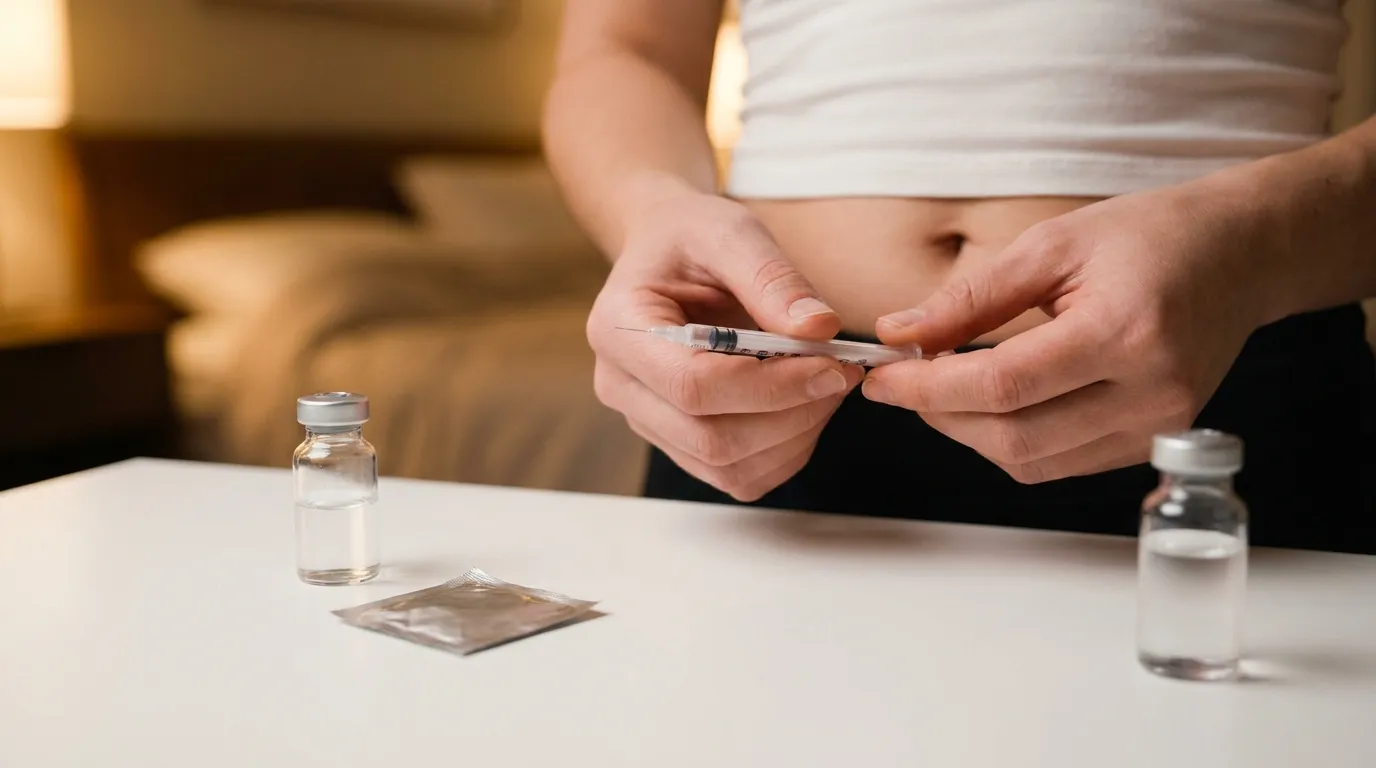
For orientation only, here is how people commonly describe the reported approach (not a recommendation):
| Parameter | Commonly reported | Notes |
|---|---|---|
| Modern dose | 200-500 mcg, once daily | Subcutaneous, before bed |
| Timing | ~60 min before sleep, empty stomach | Aligns with natural overnight GH pulse |
| Frequency | 5 nights on, 2 off | Common weekly pattern |
| Cycle length | ~3-6 months, then a break | Reassess with labs (IGF-1) |
| Historic drug dose | ~1-2 mg/day; ~1 mcg/kg test | Original Geref, much higher |
Our take: The gap between the historic Geref doses (milligrams) and the modern anti-aging doses (hundreds of micrograms) trips a lot of people up. They are not the same use. Modern low-dose protocols are a clinic convention aimed at gently restoring GH pulses, not the higher diagnostic or pediatric dosing of the original approved drug. We never present either as a personal prescription.
What results does sermorelin produce, and how fast?
Sermorelin's reported results are gradual and cumulative: better sleep and recovery often come first (within weeks), while body-composition and skin changes build over months, and they are generally milder than direct HGH. Because it relies on your own pituitary, results vary a lot between people and are not guaranteed.
In the typical clinic and community account, the early wins people report are improved sleep quality and recovery in the first few weeks, followed over two to six months by gradual changes in body composition (modest fat loss, slightly improved lean mass), energy, and skin quality. These line up with the small human studies showing raised IGF-1 and some lean-mass and strength benefit in older adults (Innerbody, "Sermorelin", retrieved 2026-06-15). The honest caveat: much of the "before and after" content online is anecdotal, and improvements like better sleep are easy to feel but hard to attribute to sermorelin alone.
Our take: If you are expecting an HGH-like transformation, sermorelin will likely disappoint. Its appeal is the opposite, a gentler, more natural nudge to GH that is felt first as sleep and recovery. Treat dramatic "before and after" claims with skepticism and track objective markers like IGF-1 with a clinician.
A realistic, hub-level timeline of what people commonly report (not a guarantee):
- Weeks 1-4: deeper sleep, sometimes faster recovery; this is the most consistently reported early effect.
- Months 1-3: gradual energy and recovery changes; IGF-1 typically rising on labs.
- Months 3-6: modest body-composition and skin changes for some; clinics often reassess and cycle here.
- Highly individual: non-responders exist, especially if the pituitary response is limited.
For grounded context on reading transformation claims, see peptides before and after.
What are the side effects of sermorelin?
Sermorelin's most common side effects are mild and local, mainly injection-site reactions, with occasional flushing, headache, dizziness, or nausea; serious effects are rare, but long-term safety in healthy adults is not well studied. Its decades of clinical use give it a more reassuring track record than most research peptides, but "well tolerated in trials" is not the same as "risk-free for everyone."
In the original clinical use, the most common side effect was irritation at the injection site, with less common reports of flushing, headache, dizziness, sleepiness, restlessness, and nausea (Innerbody, "Sermorelin", retrieved 2026-06-15). Because sermorelin raises growth hormone and IGF-1, the same theoretical cautions that apply to any GH-raising therapy apply here too: it should be avoided or used carefully in people with active cancer or certain other conditions, which is part of why it is meant to be used under medical supervision.
A hub-level overview of what is reported:
- Common (mild): injection-site redness, swelling, or irritation.
- Less common: flushing, headache, dizziness, sleepiness, restlessness, nausea.
- Theoretical / supervision-related: because it raises GH and IGF-1, caution in active cancer and certain conditions; contraindicated in pregnancy and breastfeeding.
- Quality-related (research-grade): for non-pharmacy product, contamination or mislabeled potency are real risks independent of the peptide itself.
This is the hub-level summary. A full side-effect deep-dive and how clinicians manage them is a dedicated spoke: sermorelin side effects and safety deep-dive.
How does sermorelin compare to ipamorelin and CJC-1295?
Sermorelin, ipamorelin, and CJC-1295 all raise growth hormone, but by different routes: sermorelin and CJC-1295 are GHRH analogs that signal the "release" pathway, while ipamorelin works through a separate ghrelin-receptor pathway, which is why ipamorelin is often stacked with a GHRH analog. Sermorelin is the short-acting, most natural-mimicking GHRH; CJC-1295 is a longer-acting GHRH variant.
In rough terms: sermorelin is the original short-half-life GHRH (1-29) that produces a quick, natural pulse; CJC-1295 is a modified GHRH analog engineered to last longer (especially the DAC version) for fewer, steadier signals; and ipamorelin is a selective growth-hormone secretagogue that hits the ghrelin/GHS receptor instead, adding a complementary pulse with minimal effect on other hormones. Because GHRH analogs and ghrelin-pathway peptides act on different receptors, a GHRH peptide plus ipamorelin is the most common growth-hormone "stack."
The full comparisons, including the CJC-1295 DAC-versus-no-DAC nuance and the popular CJC-1295-plus-ipamorelin stack, are their own spokes. We keep this short to avoid overlapping those articles: see sermorelin vs ipamorelin comparison, CJC-1295 vs Sermorelin comparison, and our existing guides to CJC-1295 and ipamorelin.
How does sermorelin compare to tesamorelin?
Sermorelin and tesamorelin are both GHRH analogs that signal the pituitary to release growth hormone, but they sit on opposite ends of the regulatory spectrum: tesamorelin is a currently FDA-approved prescription drug (Egrifta) with a specific medical indication, while sermorelin is no longer an approved finished product. They share a mechanism class but differ in approval status, durability, and intended use.
In plain terms, tesamorelin is a stabilized GHRH analog: it is GHRH (1-44) with a chemical modification that makes it last longer and resist breakdown, whereas sermorelin is the shorter GHRH (1-29) fragment with its very brief, natural-like pulse. The most important practical difference is legal standing. Tesamorelin (brand Egrifta) was FDA-approved in November 2010 to reduce excess visceral abdominal fat in adults with HIV-associated lipodystrophy, making it the first FDA-approved treatment for that condition and a synthetic growth-hormone-releasing factor analog (Drugs.com, "Egrifta WR (tesamorelin) FDA Approval History", retrieved 2026-06-15). That approval is current: in 2025 the FDA cleared a newer once-weekly-reconstitution formulation, EGRIFTA WR (tesamorelin F8), for the same HIV-lipodystrophy indication (Theratechnologies, "Theratechnologies Receives FDA Approval for EGRIFTA WR (Tesamorelin F8)", retrieved 2026-06-15). Sermorelin, by contrast, has no FDA-approved finished product since Geref was discontinued in 2008, so it is reached only via compounding or research-grade channels.
Both peptides increase your own growth hormone through the same GHRH-receptor pathway, so both are GHRH analogs rather than ghrelin-pathway secretagogues like ipamorelin. The class map is simplest to hold this way: GHRH analogs (sermorelin, CJC-1295, tesamorelin) all push the "release growth hormone" button on the pituitary, while GHRPs / ghrelin-pathway secretagogues (ipamorelin and the other "-relins") act on a separate receptor, which is why one of each class is the classic stack.
| Feature | Sermorelin | Tesamorelin (Egrifta) | CJC-1295 | Ipamorelin |
|---|---|---|---|---|
| Mechanism class | GHRH analog | GHRH analog | GHRH analog | GHRP / ghrelin-pathway secretagogue |
| Receptor | GHRH receptor | GHRH receptor | GHRH receptor | Ghrelin / GHS receptor |
| Fragment / design | GHRH (1-29), short | Stabilized GHRH (1-44) | Modified GHRH (±DAC) | Synthetic pentapeptide |
| FDA status | No approved product (Geref withdrawn) | FDA-approved (HIV lipodystrophy) | Not FDA-approved | Not FDA-approved |
| Typical positioning | Anti-aging, GH decline | HIV visceral-fat reduction | Longer-acting GH signal | Selective GH pulse, low side effects |
This stays at hub level on purpose: tesamorelin is its own roster compound with its own approved indication, dosing, and safety profile, so the full head-to-head lives in a dedicated spoke rather than here, to avoid duplicating that article. For the detailed comparison see sermorelin vs tesamorelin comparison, and for the class siblings our guides to CJC-1295 and ipamorelin.
Is sermorelin safe and legal?
Sermorelin's legal status is genuinely nuanced: it was once FDA-approved (as Geref) but no FDA-approved sermorelin product exists today, so it is now legally obtained either by prescription through a compounding pharmacy, or, separately, sold as a research-grade chemical not for human use. It is not a controlled substance, but it is also not an over-the-counter supplement, and it is banned in sport.
Here is the history in plain terms. Geref (sermorelin acetate) was FDA-approved (the diagnostic and pediatric indications), but the product was discontinued in 2008 for commercial reasons, and the FDA formally determined it was not withdrawn for reasons of safety or effectiveness (U.S. FDA / Federal Register, "Determination That GEREF (Sermorelin Acetate) Injection ... Were Not Withdrawn From Sale for Reasons of Safety or Effectiveness", 2013, retrieved 2026-06-15). That distinction matters: it is why sermorelin can still be legally prescribed and made by compounding pharmacies under 503A/503B pharmacy law today, even though it is no longer an FDA-approved finished drug. So a prescribed, pharmacy-compounded sermorelin is a legitimate medical route; a vial bought from a "research chemical" vendor "for research use only" is a separate, unregulated channel with no quality guarantee.
On safety, sermorelin's decades of clinical use make its short-term tolerability better characterized than most peptides, but its long-term use for anti-aging in healthy adults has not been studied in large modern trials, so unknowns remain. On sport, sermorelin is banned: it appears on the World Anti-Doping Agency Prohibited List under class S2 (Peptide Hormones, Growth Factors, Related Substances and Mimetics), so athletes and many service members face additional rules (WADA Prohibited List, retrieved 2026-06-15). For the full legal picture and how to evaluate a vendor, see are peptides legal and how to vet peptide quality.
Our take: Sermorelin is one of the few "peptides" with a real FDA-approval history, and that gets oversimplified in both directions. It is not an approved drug you can buy off the shelf, and it is also not just another gray-market research chemical. The honest framing: legitimately available by prescription and compounding, separately sold research-grade, not OTC, and banned in sport.
Is sermorelin banned in sport (WADA / USADA)?
Yes. Sermorelin is banned for athletes: it is on the World Anti-Doping Agency (WADA) Prohibited List in class S2, prohibited at all times, both in and out of competition, and the U.S. Anti-Doping Agency (USADA) explicitly names sermorelin as prohibited. Any athlete in a tested sport, and many military service members, should treat sermorelin as off-limits without a rarely granted exemption.
Here is the practical picture. WADA lists growth-hormone-releasing hormone and its analogs under category S2 (Peptide Hormones, Growth Factors, Related Substances and Mimetics), and the relevant sub-section (S2.2, growth hormone, its fragments and releasing factors) specifically names GHRH analogs, including CJC-1293, CJC-1295, sermorelin, and tesamorelin, as prohibited (Drugs.com, "S2. Peptide Hormones, Growth Factors, Related Substances And Mimetics" (WADA Prohibited List), retrieved 2026-06-15). Crucially, S2 substances are prohibited at all times, meaning the ban applies year-round, not only on competition days, because USADA explains that "peptide hormones and releasing factors are prohibited at all times under section S2.2 of the World Anti-Doping Agency (WADA) Prohibited List" (USADA, "6 Things to Know About Peptide Hormones and Releasing Factors", retrieved 2026-06-15).
USADA addresses sermorelin directly. It confirms that sermorelin is prohibited because of "its ability to enhance muscle growth, endurance, and recovery by boosting endogenous hGH production," and it warns that a therapeutic use exemption is a long shot: "it is highly unlikely a TUE would be approved for Sermorelin, as it is not a first-line treatment for growth hormone deficiency and there are alternative treatments available" (USADA, "What Should Athletes Know About Sermorelin?", retrieved 2026-06-15). Two points matter for athletes. First, the ban applies regardless of how the peptide is obtained: a clinician's prescription and a compounding pharmacy do not make sermorelin permissible in tested sport. Second, this is not unique to sermorelin: its whole mechanism class is caught. The same S2.2 language sweeps in the GHRH analogs (CJC-1295, tesamorelin) and, separately, the ghrelin-pathway secretagogues and GH-releasing peptides such as ipamorelin, so switching to a "different" GH peptide does not move an athlete out of the prohibited zone.
A quick orientation for anyone bound by anti-doping rules:
- Category: WADA Prohibited List class S2 (peptide hormones, growth factors, related substances and mimetics).
- When: Prohibited at all times, in-competition and out-of-competition alike.
- Named substance: sermorelin is listed explicitly as a GHRH analog under S2.2; so are CJC-1295 and tesamorelin.
- TUE: highly unlikely to be granted for sermorelin, per USADA.
- Who it affects: athletes in WADA/USADA-tested sports, and many military and tactical-athlete programs that mirror the WADA list.
Our take: If you compete in any drug-tested sport, the "natural HGH alternative" framing around sermorelin is a trap. WADA and USADA do not care that it works with your own physiology; raising endogenous growth hormone is exactly the point of the S2 ban. Treat sermorelin, and every GH-releasing peptide, as prohibited at all times, and never rely on a prescription as a defense.
How do people obtain sermorelin?
People get sermorelin two main ways: legitimately, by getting a prescription from a licensed clinician (often an anti-aging, TRT, or telehealth clinic) and having it made by a compounding pharmacy; or, separately, by buying research-grade vials online "for research use only." The prescription route is the legitimate medical path; the research-chemical route is an unregulated gray market.
Because sermorelin can be legally compounded, the most legitimate access is clinical: a clinician evaluates you (often including baseline labs like IGF-1), writes a prescription, and a 503A/503B compounding pharmacy prepares the vials. This route gives you medical oversight and a pharmacy's quality controls. The other route is the research-peptide market, where vendors sell lyophilized sermorelin not for human consumption, with no regulatory oversight and real risks of mislabeled potency, impurities, or non-sterile product.
If you are researching the responsible path, the groundwork is the same as for any growth-hormone peptide:
- Confirm the legal status and rules for your country, sport, and workplace. See are peptides legal.
- Prefer the prescription/compounding route for medical oversight; if evaluating research-grade product, demand a certificate of analysis (COA) from independent testing. See how to vet peptide quality.
- Understand handling before anything else. Reconstitution and cold storage are not optional. See getting started with peptides and the peptide injections guide.
- Get baseline and follow-up labs (such as IGF-1) with a qualified clinician who can weigh your specific health situation.
We are describing what people do, not endorsing self-treatment. Using any GH-raising therapy without medical supervision means accepting risks a clinician would otherwise help you manage.
A realistic look at expectations
Sermorelin is best understood as a gentle, physiologic nudge to your own growth hormone, not a shortcut to dramatic transformation, so realistic expectations are modest, gradual, and individual. Going in calibrated is part of using this information responsibly.
Two honest caveats sit on top of the marketing. First, because sermorelin works through your own pituitary, results depend on how well your gland responds, and some people respond little. Second, the most-felt early benefit, better sleep, is also the easiest to attribute incorrectly, so objective markers (like IGF-1 on labs) matter more than how you feel in week one. For grounded before-and-after context, see peptides before and after.
Frequently Asked Questions
The bottom line
Sermorelin is the rare peptide that bridges the medical and the biohacking worlds. As GHRH (1-29), it copies your body's own "release growth hormone" signal and lets your pituitary do the work, keeping natural feedback in charge. That gives it a gentler, more physiologic profile than direct HGH, a genuine FDA-approval history (as Geref), and a relatively well-characterized short-term safety record, which is why anti-aging and wellness clinics have leaned on it for years.
The discipline is in the nuance. Sermorelin is no longer an approved product, its modern anti-aging doses are clinic conventions rather than a validated label, the supporting human studies are small and older, and it is banned in sport. The honest framing is "legitimately available by prescription and compounding, separately sold research-grade, milder than HGH, and best tracked with labs and a clinician." From here, the natural next reads are our guides to CJC-1295 and ipamorelin, plus how to vet peptide quality and are peptides legal.
Sources
- Wikipedia. "Sermorelin." Retrieved 2026-06-15. https://en.wikipedia.org/wiki/Sermorelin
- U.S. Food and Drug Administration / Federal Register. "Determination That GEREF (Sermorelin Acetate) Injection, 0.5 Milligrams Base/Vial and 1.0 Milligrams Base/Vial, and GEREF (Sermorelin Acetate) Injection, 0.05 Milligrams Base/Amp, Were Not Withdrawn From Sale for Reasons of Safety or Effectiveness." 2013. Retrieved 2026-06-15. https://www.federalregister.gov/documents/2013/03/04/2013-04827/determination-that-geref-sermorelin-acetate-injection-05-milligrams-basevial-and-10-milligrams
- RxList. "Sermorelin Acetate (Sermorelin): Side Effects, Uses, Dosage, Interactions, Warnings" (clinical pharmacology). Retrieved 2026-06-15. https://www.rxlist.com/sermorelin-acetate-drug.htm
- Innerbody Research. "Sermorelin Peptide: Benefits, Safety, & Buying Advice." Retrieved 2026-06-15. https://www.innerbody.com/sermorelin
- World Anti-Doping Agency. "The Prohibited List" (class S2: Peptide Hormones, Growth Factors, Related Substances and Mimetics). Retrieved 2026-06-15. https://www.wada-ama.org/en/prohibited-list
- Drugs.com / World Anti-Doping Agency. "S2. Peptide Hormones, Growth Factors, Related Substances And Mimetics" (Anti-Doping Prohibited List; names GHRH analogs CJC-1293, CJC-1295, sermorelin, tesamorelin under S2.2). Retrieved 2026-06-15. https://www.drugs.com/wada/s2-peptide-hormones-growth-factors-and-related-substances.html
- U.S. Anti-Doping Agency (USADA). "What Should Athletes Know About Sermorelin?" Retrieved 2026-06-15. https://www.usada.org/spirit-of-sport/athletes-know-sermorelin/
- U.S. Anti-Doping Agency (USADA). "6 Things to Know About Peptide Hormones and Releasing Factors." Retrieved 2026-06-15. https://www.usada.org/spirit-of-sport/6-things-know-peptide-hormones/
- Drugs.com. "Egrifta WR (tesamorelin) FDA Approval History." Retrieved 2026-06-15. https://www.drugs.com/history/egrifta-wr.html
- Theratechnologies Inc. "Theratechnologies Receives FDA Approval for EGRIFTA WR (Tesamorelin F8) to Treat Excess Visceral Abdominal Fat in Adults with HIV and Lipodystrophy." Retrieved 2026-06-15. https://www.theratech.com/news-releases/news-release-details/theratechnologies-receives-fda-approval-egrifta-wrtm-tesamorelin/
- PubChem. "Sermorelin," Compound CID 16132413. Retrieved 2026-06-15. https://pubchem.ncbi.nlm.nih.gov/compound/16132413
- PeptideDeck. "Sermorelin: Dosage, Benefits, Side Effects & Before and After (2026)." Retrieved 2026-06-15. https://www.peptidedeck.com/blog/sermorelin-complete-guide
- GoodRx. "Geref (sermorelin): Drug Basics and Frequently Asked Questions." Retrieved 2026-06-15. https://www.goodrx.com/geref/what-is
- Guide to Peptide. "Sermorelin: Complete Guide to the GHRH (1-29) Analog (2026)." Retrieved 2026-06-15. https://guidetopeptide.com/sermorelin-complete-guide/