Sermorelin Side Effects: The Gentlest GHRH, the Geref Label & What 350 Users Report (2026)
Sermorelin's side effects are best understood through one lens: it is the gentlest growth-hormone-axis peptide on the bench. Because it copies your body's own GHRH and has a half-life of barely 11-12 minutes, it produces a quick, natural-like growth-hormone pulse rather than the days-long elevation of a long-acting analog — so the classic GH-axis effects (fluid retention, head-rush flushing, injection-site reactions) show up milder and shorter than with CJC-1295. This page answers the real tolerability question two ways at once: what 350 ProtocolPlus users report from real use, held against the one thing that makes sermorelin unusual — it actually had an FDA label (Geref), so some real adverse-event data exists, including the rare throat-tightness the label noted.
Most "sermorelin side effects" pages give you the same paraphrased list with no real numbers and no sense of how mild it is relative to its GH-axis cousins. We do it differently. The headline below is first-party community data — what 350 ProtocolPlus users who tracked sermorelin tolerability actually report — and we keep two things beside it: the "gentlest GHRH" framing that explains why these effects are mild and short-lived, and an honest accounting of the Geref-era label data versus today's unmonitored compounded product. People usually reach sermorelin as one of the best peptides for muscle growth and GH-axis recovery, so its tolerability is worth knowing first. For the molecule itself (what it is, the GHRH mechanism, dosing, legal status), this page links up to the sermorelin complete guide so it stays a clean safety-and-tolerability hub.
Key Takeaways
- These are mild growth-hormone-axis side effects — the gentlest of the GHRH family. Sermorelin is a short-acting GHRH (1-29) analog with an ~11-12 minute half-life, so it triggers a brief, natural GH pulse rather than sustained elevation. Almost everything our community reports is mild and short-lived.
- What our users report (N=350): the most-reported effect is a mild injection-site reaction (15%, 52 users), then flushing / head-rush (10%, 35), headache (8%, 28), and mild water retention (7%, 25, moderate). Seven of ten reported effects were tagged mild, three moderate, and none severe.
- It is unusual among peptides: it once had an FDA label (Geref). Because sermorelin was an approved drug (withdrawn around 2008 for commercial, not safety, reasons), there is a real labeled adverse-event record — injection-site reactions, flushing, headache, dizziness, and, rarely, throat tightness / trouble swallowing — which is why we can speak to its safety more concretely than for a pure research chemical.
- It is milder than CJC-1295, and that is mechanistic. CJC-1295 keeps growth hormone elevated for days; sermorelin clears in minutes. That short, pulsatile signal is why water retention and flushing are reported less and resolve faster than with the longer-acting analogs.
- The honest caveat is product quality, not pharmacology. The Geref-era label described a regulated, quality-controlled drug. Today's compounded or research-grade sermorelin has no current FDA safety-monitoring label, and the most concrete real-world risk is an unregulated vial, not the molecule itself.
What are the most common sermorelin side effects?
Across 350 ProtocolPlus users who tracked sermorelin tolerability, the most-reported effects are a mild injection-site reaction (15%), flushing or head-rush (10%), headache (8%), and mild water retention (7%) — almost all mild, short-lived, and gentler than the same effects on longer-acting GH-axis peptides. This is a community-report ranking from our own app data, sitting alongside the genuine adverse-event record from the original Geref label.
The pattern is exactly what sermorelin's mechanism predicts. It is a GHRH (growth-hormone-releasing hormone) analog, so it nudges your own pituitary to release growth hormone — but because it clears in roughly 11-12 minutes, the GH pulse is brief and natural-like rather than a sustained flood. After the top cluster, reports tail off into milder, less specific effects: dizziness (6%, 21 users), numbness or tingling (6%, 21, moderate), nausea (5%, 18), restlessness or hyperactivity (4%, 14), and two rare ones — throat tightness or trouble swallowing (2%, 7, moderate) and pallor (2%, 7). In our dataset, seven of the ten reported effects were tagged mild and three moderate; none were severe.
These shares come only from our community-reported dataset and describe what people experience and log, not validated incidence. A mild list from a self-selected group is consistent with sermorelin being well tolerated — and consistent with sermorelin's decades-long clinical pedigree — but it is equally consistent with under-reporting and short follow-up. The deep mechanism and the GHRH receptor science live on the hub; for the molecule itself see the sermorelin complete guide.
Citation capsule. Among 350 ProtocolPlus users who tracked sermorelin tolerability, the most-reported effects were a mild injection-site reaction (15%, 52 users), flushing/head-rush (10%, 35), headache (8%, 28), and mild water retention (7%, 25, moderate); throat tightness/trouble swallowing was reported by 2% (7). Seven of ten effects were tagged mild, three moderate, none severe. This is first-party data reflecting what the community reports - self-reported, not validated incidence, and not proof of causation. The same effect set appears in the original FDA-approved Geref label. Source: ProtocolPlus app data (side-effects/sermorelin.json), 2026; RxList, "Sermorelin Acetate" (FDA label rev. 2001).
When should you seek urgent care? (the rare red flags)
Sermorelin's reported effects are overwhelmingly mild, and our community logged no severe events — but two situations deserve a lower threshold to stop and get help: any sign of a true allergic reaction, and the throat-tightness / trouble-swallowing that the original Geref label specifically noted. These are uncommon, but a side-effect page that buries them is doing you a disservice.
Because sermorelin once carried an FDA label, we are not guessing at the serious end of the spectrum: the Geref label listed injection-site reactions and a set of mild systemic effects as common, and noted rarer reports including tightness in the chest, throat tightness, and difficulty swallowing. Those last ones can overlap with the early signs of a hypersensitivity reaction, which is why they are the red flags worth memorizing even though only 2% of our community reported anything in that category.
Throat tightness / trouble swallowing
Warning sign: a tight feeling in the throat or chest, or difficulty swallowing, shortly after injecting.
Action: stop and seek medical care; if it comes with swelling of the lips/tongue, hives, or trouble breathing, treat it as a possible allergic reaction and call emergency services.
Signs of an allergic reaction
Warning sign: spreading hives, facial/lip/tongue swelling, wheezing, or trouble breathing.
Action: stop immediately and call emergency services. True hypersensitivity to any injectable is rare but serious.
Injection-site infection
Warning sign: spreading redness, warmth, pus, or fever — not the small, fading pink mark of a normal local reaction.
Action: see a clinician. This is a risk of any at-home injection, sharper with unregulated product.
Our community logged no severe events, and these are uncommon — but they are the situations where "wait and see" is the wrong call. Everything else on this page is mild and self-limiting.
Citation capsule. The original FDA-approved Geref (sermorelin acetate) label listed injection-site reactions as the most common adverse event, with mild systemic effects (flushing, headache, dizziness, nausea, restlessness, pallor, altered taste) and rarer reports of chest tightness, throat tightness, and difficulty swallowing. Throat tightness or trouble swallowing — reported by 2% of our community — can overlap with early hypersensitivity signs and warrants stopping and seeking care. Source: RxList, "Sermorelin Acetate" (reproducing the FDA label, revision 2001), retrieved 2026-06-18.
What else should you know? (GH-axis context & product quality)
Beyond the mild reported list, three things give the real safety picture: sermorelin's effects are the growth-hormone axis at a low volume, the modern compounded product has no safety-monitoring label, and a small minority of people get a transient throat or chest sensation worth respecting. These are the "known unknowns" most pages skip.
For an approved drug you can open a current label and read a validated adverse-event table. Sermorelin used to have one — the Geref label — but that product was withdrawn around 2008, so the modern compounded or research-grade versions ship with no current FDA safety-monitoring label and no post-market surveillance. The right block for sermorelin is therefore a mix of real labeled data and honest gaps.
These are GH-axis effects, dialed down
Sermorelin raises your own growth hormone, so the effects belong to the same family as CJC-1295 — fluid retention, flushing, occasional tingling. The difference is volume: the short, pulsatile signal keeps each effect mild and brief.
Metabolic / IGF-1 cautions still apply
Any GH-raising therapy can nudge insulin sensitivity and raises IGF-1, a growth factor — so the standard cautions (metabolic risk, active cancer) apply here too, even though our community did not report a glucose signal. Mild dose, real biology.
Product quality is the real risk
The Geref-era safety record describes a regulated drug. A 503A-compounded prescription has pharmacy controls; a "research use only" vial does not — contamination, wrong peptide, or mislabeled potency are the concrete real-world hazards, not the molecule.
What do the reported sermorelin side effects feel like, and how does the community handle them?
The reported effects are mostly mild and short-lived: a small sting or pink mark at the injection site, a brief warm flush right after dosing, the odd headache, and a touch of puffiness that is gentler than on longer-acting GH peptides. Below is each commonly reported effect — what it feels like, when it shows up, and how the community tends to handle it. These are descriptions of common practice, not a prescription; dose decisions belong with a clinician, and for how protocols are structured the sermorelin dosage calculator lays out the reported ranges.
Injection-site reaction (15%, 52 users)
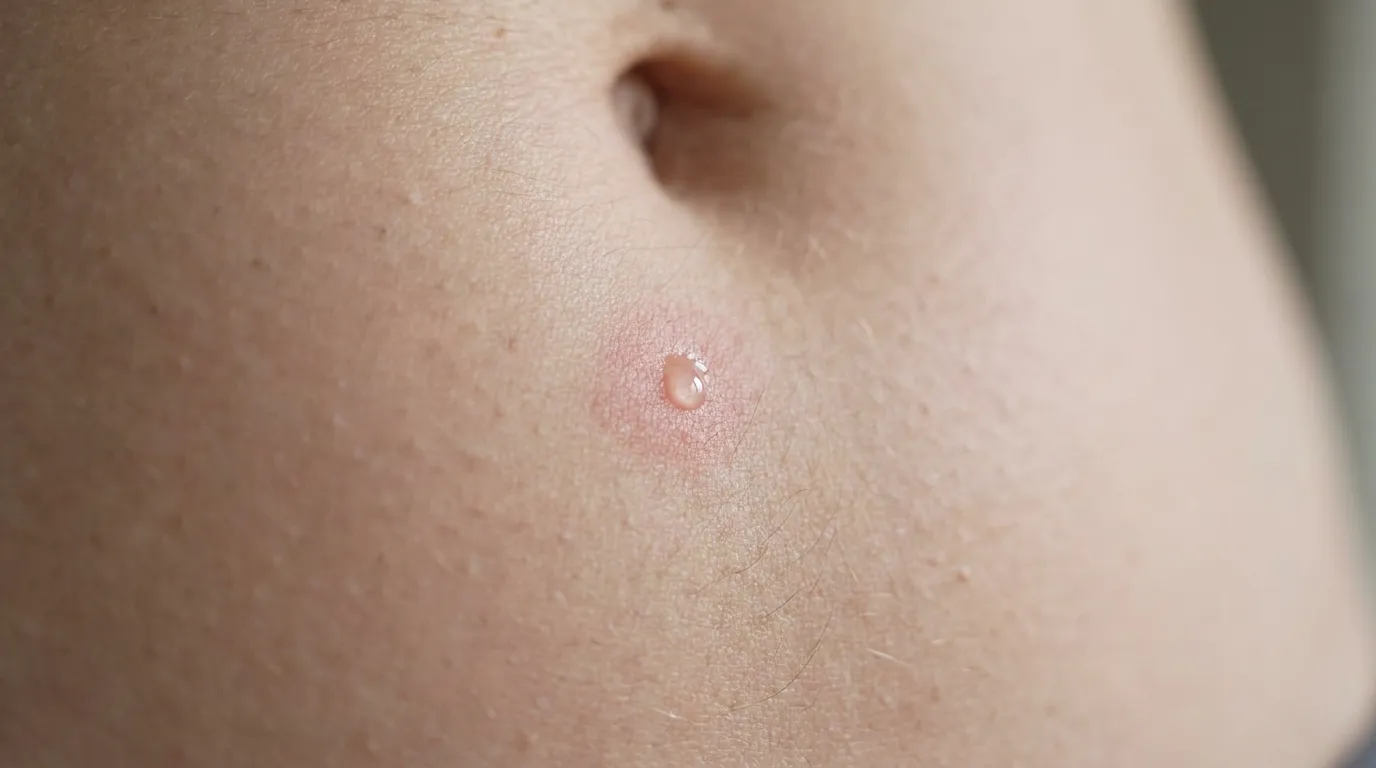
The most-reported effect, and a mild local one: a small sting on injecting, a pink mark, mild swelling, or brief itching at the subcutaneous site — usually the abdomen, since sermorelin is typically dosed before bed. It fades within hours to a day. Community practice is unremarkable: rotate sites so no spot gets repeatedly irritated, let the alcohol swab dry before injecting, and use a fresh fine-gauge needle each time. A small fading mark is normal; spreading redness, warmth, or pus is not, and belongs in the red-flag block above.
Flushing and head-rush (10%, 35 users)
The GH-axis "signature" effect people most often ask about by name. Shortly after injecting, some users feel a wave of warmth, a flushed face, or a brief light-headed "head rush." It comes from transient vasodilation — blood vessels widening for a short window — and is typically brief and benign, fading within minutes. Community practice is to inject while seated, give it a few minutes before standing or driving, and stay hydrated. It is distinctive enough to startle the first time, but on its own it is usually the least concerning effect on the list.
Headache and the milder neuro tail (8% headache; dizziness 6%; restlessness 4%)
Headache (8%) is common, non-specific, and usually early — often settling as the body adjusts over the first weeks. Dizziness (6%) frequently overlaps with the post-injection flushing, which is why hydration and a seated injection help both. Restlessness or a mild "wired" feeling (4%) is reported by a minority; because sermorelin is dosed at night, people who notice it sometimes shift the timing slightly earlier in the evening with a clinician's input. None of these were tagged worse than mild in our data.
Water retention (7%, 25 users) — milder than its GH-axis cousins
Tagged moderate, but notably less reported than on longer-acting GHRH analogs. People describe a touch of puffiness — slightly fuller fingers or face, occasionally a pound or two on the scale that is fluid, not fat. It is the same growth-hormone fluid effect seen across this class, but sermorelin's short half-life means it tends to be smaller and to settle faster. Community practice treats it as a gentle dose signal: watch sodium and hydration, and it usually eases on its own. This is the clearest place sermorelin's "gentlest GHRH" character shows up — covered head-to-head below.
Numbness, tingling, nausea, pallor (the rare tail)
Numbness or tingling (6%, moderate) is mechanistically linked to fluid retention compressing nerves — the carpal-tunnel-like sign of the GH axis — and like the puffiness it tends to be milder and to ease at a lower dose; persistent or worsening numbness is a stop-and-check signal, not something to push through. Nausea (5%) is usually mild and transient. Pallor (2%) — a brief paleness, sometimes alongside the head-rush — was on the original Geref label and is generally fleeting. Throat tightness or trouble swallowing (2%) is the one rare effect we pull out of this tail and into the red-flag block, because of what it can overlap with.
Our take: The single most useful lens with sermorelin is "this is the GH axis at a low volume." Flushing, a little puffiness, the odd headache — they are the same effects as the stronger GH peptides, just smaller and shorter because the signal clears in minutes. Go slow, treat puffiness or tingling as a gentle dose signal, and reserve a lower threshold for two things only: anything that feels like throat tightness or swelling, and any sign of an infected injection site.
How does sermorelin compare to CJC-1295 on side effects?
Sermorelin and CJC-1295 are GH-axis cousins, but sermorelin is the gentler one by design: its ~11-12 minute half-life produces a brief, natural GH pulse, while CJC-1295 keeps growth hormone elevated for hours to days — which is mechanistically why CJC-1295's water retention, tingling, and flushing tend to be reported more often and last longer. If you are choosing between them, this is the tolerability difference that matters most.
The mechanism explains the whole gap. The longer a GH-axis peptide keeps growth hormone elevated, the more time the fluid-retention cluster (puffiness, nerve-compression tingling, joint aches) has to build. Sermorelin's signal is over in minutes, so those effects stay small; CJC-1295, especially the long-acting DAC version, sustains the signal for days, so the same effects are amplified. Our own community data lines up with this: water retention sits at 7% for sermorelin versus 14% for CJC-1295, and tingling at 6% versus 12%. That is two different self-selected communities, not a controlled comparison — but the direction matches the pharmacology cleanly. For the deep CJC-1295 picture, see its own CJC-1295 side effects page.
How does our community report compare to the "official" Geref label?
Here sermorelin is unusual: there is real label data to anchor to, because it was once the FDA-approved drug Geref — so the honest comparison is "community self-report vs the original Geref adverse-event record," not the "no data at all" framing that applies to pure research peptides. That genuine label is sermorelin's biggest trust advantage over its GH-axis cousins, but it comes with two honest caveats.
The first caveat is timing: the Geref label was withdrawn around 2008, so today's compounded sermorelin ships with no current safety-monitoring label and no post-market surveillance — the historical record is real but frozen. The second is methodology: much of the original labeled adverse-event data came from intravenous diagnostic dosing, a single test injection to evaluate pituitary function, which is a different exposure from chronic subcutaneous self-injection for anti-aging. So the labeled record is reassuring on what effects occur and that they are mild, but it is a weaker guide to the long-term safety of years of nightly use. Stacking the evidence honestly:
| Evidence source | What it tells us about side effects | Strength for modern long-term safety |
|---|---|---|
| ProtocolPlus community (N=350) | What users report: a gentle GH-axis cluster (injection-site, flushing, headache, mild water retention) + a rare tail; no severe events logged | Weak — self-reported, self-selected, short follow-up, no causation |
| Original Geref FDA label (rev. 2001) | A real adverse-event list: injection-site reactions common; mild systemic effects; rare chest/throat tightness, difficulty swallowing | Moderate for short-term tolerability — but largely IV diagnostic dosing |
| GHRH / GH-excess literature | The GH-axis cluster (fluid retention, paresthesia) is dose- and duration-related; sermorelin's short half-life limits it | Moderate by analogy; explains why sermorelin is mild |
| Current FDA safety-monitoring label | — | Does not exist (Geref withdrawn ~2008) |
| Long-term safety trial of chronic anti-aging use | — | Does not exist (modern uses are off-label) |
The takeaway is not "sermorelin is risky." It is the opposite of most peptide pages: sermorelin actually has a track record, it is mild, and its short half-life is the reason. But the label is historical, the modern product is unmonitored, and the long-term anti-aging use is unstudied — so "well tolerated in trials decades ago" is not the same as "proven safe for years of nightly use today."
Why does sermorelin cause these side effects (and so mildly)?
Every sermorelin side effect traces to one cause: as a GHRH analog it raises your own growth hormone and IGF-1 — but because it copies natural GHRH and clears in minutes, that signal is brief and self-limiting, which is exactly why the GH-axis effects show up mild and short-lived instead of strong and sustained. That single mechanism explains both the pattern and the gentleness.
The pieces separate cleanly. The fluid-retention effects (mild water retention, occasional tingling) are the most characteristic GH effect, kept small because the GH pulse is short. The flushing/head-rush is a brief vasodilatory response around the injection, not a GH-cluster effect. The throat/chest tightness noted on the old label is rare and can shade into hypersensitivity, which is why it sits in the red-flag block. And the theoretical IGF-1 cautions (the standard "avoid in active cancer" line) follow from IGF-1 being a growth factor — a mechanism-level caution, not a documented harm in our data. Sermorelin's somatostatin "brake" stays in charge, too, which is part of why it is harder to push the GH axis as far as a direct or long-acting agent. For the full GHRH science and the half-life detail, see the sermorelin complete guide.
Citation capsule. Sermorelin is a synthetic GHRH (1-29) analog with a short human half-life of roughly 11-12 minutes, cleaved by the enzyme DPP-4, producing a brief pulsatile growth-hormone release under the body's own somatostatin feedback. That short, self-limiting signal is the mechanistic reason its growth-hormone-axis effects (fluid retention, flushing, paresthesia) are milder and shorter-lived than those of the long-acting analog CJC-1295, whose DAC version sustains GH elevation for days. Source: ScienceDirect, "Sermorelin — an overview," 2026; Ishida et al., JCSM Rapid Communications, 2020.
Who should be especially cautious with sermorelin?
Because the modern compounded product has no current safety-monitoring label and long-term anti-aging use is unstudied, the cautious default is "not without a clinician" — and the caution is sharper for anyone with a personal or family cancer history (the IGF-1 concern), anyone with significant metabolic risk, anyone pregnant or breastfeeding, and any tested athlete. These follow from the mechanism and the missing modern data, not from a current label.
A few practical lines follow. If you have a personal or family cancer history, the theoretical IGF-1 / growth-factor concern is worth raising with a clinician before starting, because the uncertainty cuts the wrong way. If your blood sugar is already a concern, any GH-raising therapy can nudge insulin sensitivity, so it is sensible to monitor even though our community did not flag a glucose signal. Pregnancy and breastfeeding are contraindications for GH-raising therapy. And tested athletes must treat sermorelin as off-limits: it is on the World Anti-Doping Agency Prohibited List under class S2 (peptide hormones, growth factors, and releasing factors), prohibited at all times, and a therapeutic-use exemption is highly unlikely — a prescription does not make it permissible in sport. Finally, because the research-grade product is unregulated, product quality is its own caution on top of the molecule; for sourcing, see how to vet peptide quality. None of this page replaces a clinician conversation — with an off-label, unmonitored compound, that conversation matters more, not less.
Citation capsule. Sermorelin is banned in sport: it appears on the WADA Prohibited List under class S2 (peptide hormones, growth factors, related substances and mimetics; growth-hormone-releasing factors), prohibited at all times in and out of competition, and USADA names it explicitly and states a therapeutic-use exemption is highly unlikely. The ban applies regardless of a clinician's prescription. Source: USADA, "What Should Athletes Know About Sermorelin?", retrieved 2026-06-18; World Anti-Doping Agency, "The Prohibited List" (class S2).
Frequently Asked Questions
The bottom line
If you came here asking what sermorelin side effects look like, the honest answer is genuinely more reassuring than for most peptides — with two honest caveats. The reassuring part: sermorelin is the gentlest growth-hormone-axis peptide, because its ~11-12 minute half-life produces a brief, natural GH pulse rather than the days-long elevation of CJC-1295. In our community of 350 users, the effects were a mild cluster — injection-site reactions (15%), flushing (10%), headache (8%), and milder-than-its-cousins water retention (7%) — with everything tagged mild or moderate and no severe events. And uniquely, sermorelin once had a real FDA label (Geref), so that mildness is backed by an actual adverse-event record, not just mechanism.
The caveats are the parts most pages skip, so we won't. First, that label is historical: it was withdrawn around 2008, and today's compounded or research-grade sermorelin has no current safety-monitoring label, no post-market surveillance, and no study of long-term nightly use — so absence of reported harm is not proof of safety. Second, the rare throat-tightness / trouble-swallowing the Geref label noted, and any sign of an allergic reaction, are the two things to treat as stop-and-seek-care signals, even though they are uncommon. Use that framing to make a clear-eyed decision with a clinician, and remember the most concrete real-world risk is often the unregulated vial, not the molecule. From here, the natural next reads are the sermorelin complete guide for the molecule, mechanism, and legal status, the sermorelin dosage calculator for how protocols are structured, the CJC-1295 side effects page for the longer-acting cousin, and how to vet peptide quality for sourcing.
Sources
- RxList. "Sermorelin Acetate (Sermorelin): Side Effects, Uses, Dosage, Interactions, Warnings" (reproducing the FDA-approved Geref label, revision 2001; page updated 2022). Retrieved 2026-06-18. https://www.rxlist.com/sermorelin-acetate-drug.htm
- U.S. Food and Drug Administration / Federal Register. "Determination That GEREF (Sermorelin Acetate) Injection ... Were Not Withdrawn From Sale for Reasons of Safety or Effectiveness." 2013. Retrieved 2026-06-18. https://www.federalregister.gov/documents/2013/03/04/2013-04827/determination-that-geref-sermorelin-acetate-injection-05-milligrams-basevial-and-10-milligrams
- ScienceDirect Topics. "Sermorelin — an overview" (pharmacology, half-life, DPP-4 cleavage, GHRH (1-29)). Retrieved 2026-06-18. https://www.sciencedirect.com/topics/medicine-and-dentistry/sermorelin
- Ishida J, Saitoh M, Springer J, et al. "Growth hormone secretagogues: history, mechanism of action, and clinical development." JCSM Rapid Communications, 2020;3(1):25-37. Retrieved 2026-06-18. https://onlinelibrary.wiley.com/doi/full/10.1002/rco2.9
- Healthline. "Sermorelin Therapy Benefits, Risks, Uses, Approval, and Side Effects" (updated 2025-08-01). Retrieved 2026-06-18. https://www.healthline.com/health/sermorelin
- U.S. Anti-Doping Agency (USADA). "What Should Athletes Know About Sermorelin?" Retrieved 2026-06-18. https://www.usada.org/spirit-of-sport/athletes-know-sermorelin/
- World Anti-Doping Agency. "The Prohibited List" (class S2: Peptide Hormones, Growth Factors, Related Substances and Mimetics — growth-hormone-releasing factors). Retrieved 2026-06-18. https://www.wada-ama.org/en/prohibited-list
- ProtocolPlus. "Community-reported tolerability data: Sermorelin" (side-effects/sermorelin.json). First-party app data, 2026. N = 350 users who tracked sermorelin tolerability. Self-reported community frequency, not validated incidence and not proof of causation.