
FOXO4-DRI: The Senolytic Peptide Chasing 'Zombie Cell' Clearance
FOXO4-DRI is a synthetic peptide, one of the more experimental entries among the best peptides for longevity, designed to do something the longevity field has chased for years: selectively kill off "zombie cells," the worn-out senescent cells that linger in aging tissue and quietly damage their neighbors. It became famous from a single 2017 mouse study that reported aged animals growing back fur, regaining fitness, and recovering kidney function after treatment. The honest catch is that this is where the story stops: FOXO4-DRI has never been tested in a human, has no human safety data, and is not approved by any regulator.
This page is the high-level map of the whole compound, written to separate the real science from the hype. We cover what FOXO4-DRI actually is, the clever mechanism behind it (blocking the FOXO4-p53 interaction so senescent cells can finally self-destruct), what the 2017 study and its follow-ups genuinely showed, how it sits next to other senolytics, the doses used in mice, the safety blank, and its research-only legal status. Each section is a clear overview; the deep-dive topics point to dedicated guides so this page stays a clean hub.
Key Takeaways
- FOXO4-DRI is a synthetic D-retro-inverso (DRI) peptide that acts as a senolytic, meaning it is designed to selectively push senescent ("zombie") cells into programmed cell death while sparing healthy cells (Baar et al., Cell, 2017, PMID 28340339, retrieved 2026-06-16).
- It works by disrupting the FOXO4-p53 interaction. In senescent cells, the FOXO4 protein holds the tumor-suppressor p53 hostage in the nucleus to block apoptosis; FOXO4-DRI evicts p53, triggering cell-intrinsic (mitochondrial) apoptosis (Baar et al., Cell, 2017, retrieved 2026-06-16).
- Its fame rests on one 2017 mouse study. In fast-aging and naturally aged mice, the peptide reportedly restored fitness, restored fur density, and restored renal (kidney) function, and it counteracted chemotherapy toxicity (Baar et al., Cell, 2017, retrieved 2026-06-16).
- There are zero human trials and no human safety data. Every result comes from mice and cell cultures; FOXO4-DRI is not FDA-approved and remains in the preclinical / development stage (Fight Aging!, 2026, retrieved 2026-06-16).
- Mouse dosing was intermittent and injected (repeated parenteral doses over weeks). No validated human dose exists, and the specific animal milligram-per-kilogram figures should never be read as a human protocol (Baar et al., Cell, 2017, retrieved 2026-06-16).
- It is a different bet than Epitalon. FOXO4-DRI kills aged cells via FOXO4-p53; Epitalon chases a telomerase / pineal angle. They are not interchangeable. See our Epitalon guide.
What is FOXO4-DRI?
FOXO4-DRI is a lab-made peptide built to selectively destroy senescent cells, the aged "zombie" cells that stop dividing but refuse to die and instead leak inflammatory signals into surrounding tissue. Its name describes its design: it is based on a fragment of the FOXO4 protein, and "DRI" stands for D-retro-inverso, a mirror-image construction that makes the peptide resistant to being broken down. It is studied as a senolytic, a class of compound that clears senescent cells.
In plainer terms, think of senescent cells as broken machines on a factory floor that the body never quite hauls away. They accumulate with age and after stresses like chemotherapy, and their inflammatory output (the "senescence-associated secretory phenotype," or SASP) is linked to tissue aging. FOXO4-DRI was engineered to flip the off-switch these cells use to avoid self-destruction. It is also marketed under the name Proxofim and is catalogued in chemical databases as PubChem CID 167312269 (PubChem, "Foxo4-dri", retrieved 2026-06-16). If injectable research peptides are new to you, start with our how peptides work guide.
The single most important fact about FOXO4-DRI is its maturity level: it is entirely preclinical. There is no approved product, no human trial, and no human dose. Everything else in this guide should be read through that lens.
Citation capsule. FOXO4-DRI (also sold as Proxofim) is a synthetic D-retro-inverso peptide derived from the region of the FOXO4 protein that interacts with the tumor-suppressor p53. It is designed as a senolytic: it disrupts the FOXO4-p53 interaction to selectively drive senescent cells into apoptosis. It is not approved by any regulator and has no human data. Source: Baar et al., Cell, 2017 (PMID 28340339); PubChem CID 167312269; Wikipedia, "FOXO4-DRI," 2026.

How does FOXO4-DRI work?
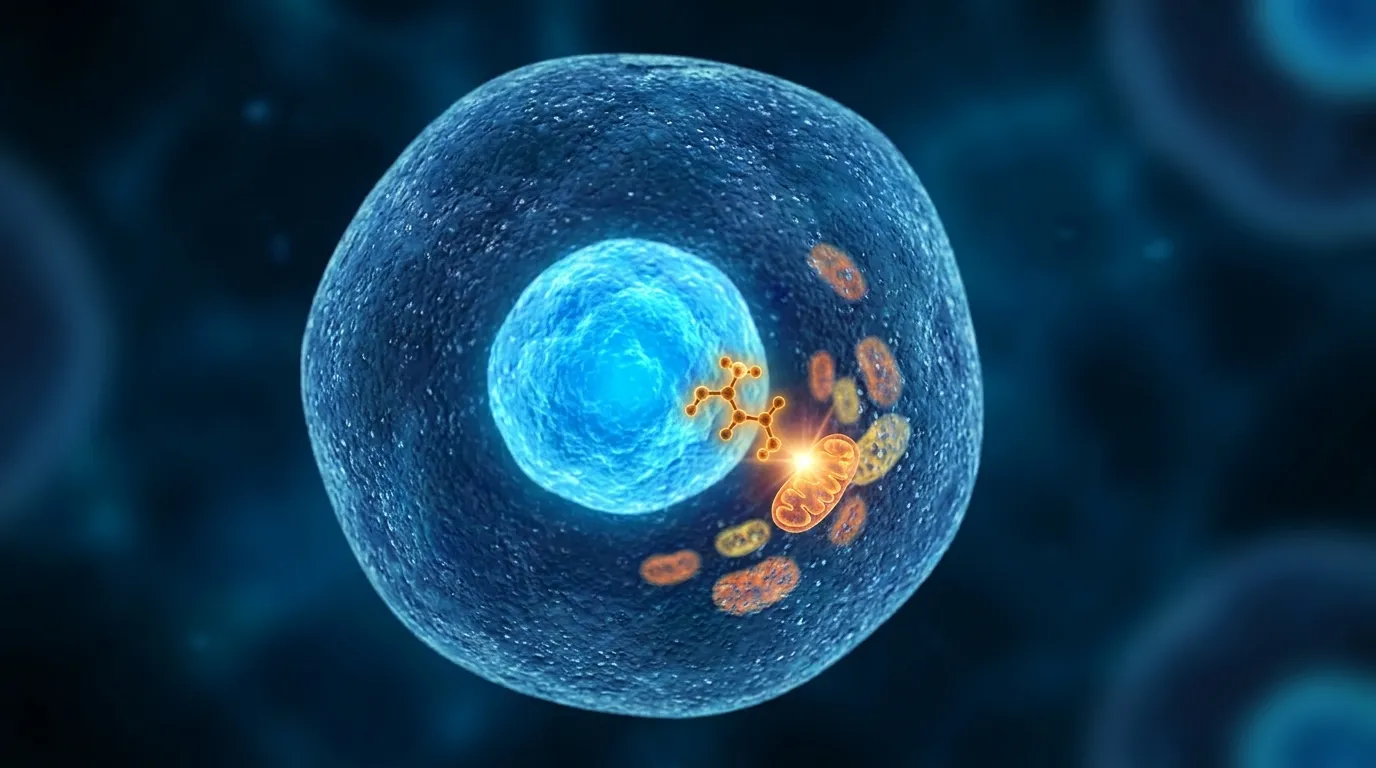
FOXO4-DRI works by breaking up a partnership inside senescent cells: the FOXO4 protein normally clamps onto the tumor-suppressor p53 and keeps it trapped in the nucleus, which blocks the cell's self-destruct program, and FOXO4-DRI pries that pair apart so p53 can finally trigger apoptosis. The result is that aged "zombie" cells die while healthy cells, which do not rely on this trick, are largely left alone. This is the entire reason it is called a "targeted" senolytic, and it comes from mouse and cell studies, not humans.
Here is the chain of reasoning in everyday language. Senescent cells survive partly because they hold p53, a master "should this cell die?" decision-maker, in a kind of holding cell within the nucleus. FOXO4 is the guard. FOXO4-DRI is a decoy shaped like the part of FOXO4 that grips p53, so it competes for the binding spot, the guard loses its grip, and p53 is released. Freed p53 then moves toward the mitochondria and switches on cell-intrinsic apoptosis, the cell's built-in demolition pathway. The 2017 study described exactly this, reporting that the peptide caused "p53 nuclear exclusion and cell-intrinsic apoptosis" selectively in senescent cells (Baar et al., "Targeted Apoptosis of Senescent Cells Restores Tissue Homeostasis in Response to Chemotoxicity and Aging," Cell, 2017, retrieved 2026-06-16).
What each piece contributes, in simple terms:
- FOXO4 (the guard): elevated in senescent cells, it sequesters p53 in the nucleus and prevents apoptosis, which is how a "zombie" cell stays alive.
- The DRI design (durability): the mirror-image D-retro-inverso build resists enzymes that would normally chew up a peptide, helping it survive long enough to act.
- p53 release (the trigger): once evicted from the nucleus, p53 engages the mitochondrial (intrinsic) apoptosis pathway, and the senescent cell dies.
- Selectivity (the point): healthy cells do not depend on FOXO4 holding p53 hostage, so they are largely spared, which is the whole appeal versus a blunt cell-killer.
The deeper molecular biology (how p53 chooses between repair and death, why senescent cells over-produce FOXO4, and what selectively killing cells could mean for tissue regeneration) is its own topic. We keep it at overview level here and link out to how peptides work for the foundations.
What did the famous 2017 mouse study show?
The 2017 study that made FOXO4-DRI famous reported that, in fast-aging and naturally aged mice, the peptide restored fitness, brought back fur density, and recovered kidney function, and that it also blunted the toxicity of chemotherapy. Those are striking, headline-grade results, but they happened in mice, and they are the single foundation the compound's reputation is built on.
The paper, led by Marjolein Baar in Peter de Keizer's lab and published in the journal Cell, is titled "Targeted Apoptosis of Senescent Cells Restores Tissue Homeostasis in Response to Chemotoxicity and Aging" (Baar et al., Cell, 2017, 169(1):132-147, DOI 10.1016/j.cell.2017.02.031, retrieved 2026-06-16). The team designed the peptide to interfere with FOXO4-p53, then tested it in two settings: mice with a fast-aging genetic condition and ordinary old mice. They reported that treated animals regained physical fitness (running and exploratory behavior), regrew fur in regions that had thinned, and recovered measures of renal function, while healthy tissue was largely undamaged.
It is worth being precise about what this does and does not mean. The result is genuinely important as a proof-of-concept that targeting the FOXO4-p53 interaction can clear senescent cells in a living animal. It is not evidence that FOXO4-DRI rejuvenates people, reverses human aging, or is safe for anyone to use. The leap from "remarkable in mice" to "works and is safe in humans" is exactly the gap this compound has never crossed.
Our take: Almost every FOXO4-DRI claim you will read online traces back to this one 2017 mouse paper, often without saying so. It is a strong, frequently cited study, but "one landmark animal paper plus follow-ups" is a thin foundation for a longevity reputation. Treat the fur-and-kidney headlines as mouse findings, not human promises.
What is FOXO4-DRI studied for?
FOXO4-DRI is studied almost entirely as an anti-aging / senolytic tool, with preclinical work spanning general tissue rejuvenation, joint cartilage cells, blood-vessel aging, and age-related testosterone decline in mice. None of these are approved uses, and every one of them sits in animals or cell cultures.
Beyond the founding 2017 paper, a small but growing set of follow-ups has probed specific tissues. Researchers reported that FOXO4-DRI could selectively remove senescent cells from laboratory-expanded human cartilage cells (chondrocytes), a model relevant to joint repair (Senolytic Peptide FOXO4-DRI Selectively Removes Senescent Cells From in vitro Expanded Human Chondrocytes, PMC8116695, 2021, retrieved 2026-06-16). A 2020 study reported that the peptide targeted senescent Leydig cells and eased age-related testosterone insufficiency in aged mice (Aging (Aging-US), 2020, retrieved 2026-06-16). More recent work has examined endothelial (blood-vessel) cell senescence and vascular aging in aged and progeroid mice (FOXO4-DRI regulates endothelial cell senescence via the p53 signaling pathway, PMC12852416, 2024, retrieved 2026-06-16).
A quick overview of where FOXO4-DRI has been studied, and how mature each line is:
| Studied area | What preclinical research suggests | Evidence level |
|---|---|---|
| General tissue aging | Restored fitness, fur, and kidney function | Mouse studies (2017 landmark) |
| Chemotherapy toxicity | Reduced doxorubicin-related side effects | Mouse studies (2017) |
| Joint / cartilage cells | Cleared senescent human chondrocytes in vitro | Cell-culture study |
| Vascular aging | Reduced endothelial senescence, improved vessel function | Mouse / cell studies (recent) |
| Testosterone decline | Cleared senescent Leydig cells, eased low testosterone | Mouse studies |
Because each of these is a distinct future spoke, we keep them brief here. The honest headline: FOXO4-DRI is intriguing across several tissues in animals, but the human evidence is simply not there yet.
How strong is the evidence for FOXO4-DRI?
The evidence for FOXO4-DRI is entirely preclinical: a landmark mouse study plus a handful of follow-up animal and cell-culture papers, and exactly zero human trials. That is the most important sentence on this page. There is no "small human pilot study" caveat to add here, because there are none at all.
To put the maturity in perspective, FOXO4-DRI is not approved by the FDA or any other regulator, has no registered human clinical trial, and has no human safety or pharmacokinetic data (Fight Aging!, "People Are Still Working on the Senolytic Peptide FOXO4-DRI," 2026, retrieved 2026-06-16). The compound has attracted commercial interest (biotech efforts have formed around the de Keizer lab's work, and newer "ES2" peptides reported to be several times more potent than FOXO4-DRI have been described in the literature), but all of that remains preclinical (eBioMedicine (The Lancet), "Development of a novel senolytic by precise disruption of FOXO4-p53 complex," 2021, retrieved 2026-06-16).
Why "no human data" is the whole story
It helps to be blunt about how empty the human file is. With many research peptides, you can at least point to one or two small human pilot studies. With FOXO4-DRI there is nothing of the sort: no Phase 1 trial, no healthy-volunteer safety study, no published human pharmacokinetics telling us how the peptide behaves in a person's body. That matters for a practical reason. Senolytics as a class are designed to kill cells, and killing cells in the wrong place or at the wrong dose is exactly the kind of effect that early human safety trials exist to catch. Without them, no one can responsibly estimate a safe human dose, the right interval, or the risks. The animal results are a reason to keep researching the compound, not a reason to use it.
Our take: The most common mistake we see is reading "senescent-cell clearance reversed aging signs" as if it were a human finding. It is a mouse finding. FOXO4-DRI may turn out to matter, but in 2026 the honest label is "promising in animals, unproven and untested in people."
How does FOXO4-DRI compare to other senolytics?
FOXO4-DRI is one of several senolytics being researched, but it is the least clinically advanced: rivals like dasatinib plus quercetin and fisetin have actually reached human trials, while FOXO4-DRI has not left the lab. Its distinguishing feature is mechanism, not maturity. It is a peptide that blocks a specific protein interaction (FOXO4-p53), whereas most other senolytics are small molecules that hit different survival pathways.
The senolytic field is broader than this one peptide. The combination of dasatinib (a cancer drug) and quercetin (a plant flavonoid), usually written "D+Q," is the most clinically advanced senolytic approach and has been tested in small early-phase human trials. Fisetin, another flavonoid, has a favorable safety profile and has also entered human studies. Navitoclax (ABT-263) is a potent senolytic but carries dose-limiting toxicity. FOXO4-DRI sits apart from all of these on mechanism, and behind all of them on evidence, since it has no human data at all. For a sense of how different the longevity-peptide bets are, FOXO4-DRI is fundamentally a cell-killing approach, which is the opposite of compounds chasing cell maintenance or telomere upkeep.
A high-level comparison (not a recommendation of any of these):
| Senolytic | Type | Mechanism (high level) | Human trial data |
|---|---|---|---|
| FOXO4-DRI | Peptide | Disrupts FOXO4-p53, releases p53 to trigger apoptosis | None (preclinical only) |
| Dasatinib + Quercetin | Small molecules | Block senescent-cell survival pathways | Yes, small early-phase trials |
| Fisetin | Flavonoid | Broad senolytic, favorable safety | Yes, in human studies |
| Navitoclax (ABT-263) | Small molecule | Inhibits BCL-2 / BCL-xL survival proteins | Studied; dose-limiting toxicity |
That is the hub-level contrast, kept deliberately brief to avoid overlapping future comparison articles. The clearest takeaway: FOXO4-DRI is the mechanistically elegant but least-proven option in a field where even the front-runners are still early.
What doses of FOXO4-DRI were used in mice?
There is no validated human dose for FOXO4-DRI, and there cannot be one yet because it has never been given to a person in a study; the only real dosing information comes from mouse experiments, where it was injected intermittently over a period of weeks. Any specific human "protocol" circulating online is not anchored to human trial data and should be treated as unverified.
In the founding research, FOXO4-DRI was administered to mice by injection (parenteral) on an intermittent schedule rather than continuously, repeated over weeks (Baar et al., Cell, 2017, retrieved 2026-06-16). We are deliberately not publishing a specific milligram-per-kilogram figure as a target, because the exact animal dose does not translate to a human dose, and reproducing an animal number as if it were a protocol is precisely the error this hub exists to prevent. What is solid is the shape of the regimen in animals: injected, intermittent, and time-limited.
This is the single most important place to apply caution. With most peptides we can point to "community/research conventions" as a labeled, non-validated reference point. With FOXO4-DRI even that is shaky, because it is a cell-killing senolytic with zero human safety work behind it, so an online "dose" carries unusually high uncertainty. The responsible framing is simple: there is no established human dose, full stop.
Our take: When you see a confident FOXO4-DRI "dosing protocol" online, ask where the number comes from. The honest answer is almost always "extrapolated from a mouse study," which is not a human dose. We will not present an invented figure as guidance.
How often is FOXO4-DRI actually tracked?
FOXO4-DRI is one of the most lightly tracked compounds in the ProtocolPlus app, which fits its status as a fringe, preclinical-only research peptide rather than a mainstream protocol. In our data it accounts for a tiny sliver of all logged activity, a useful signal that even within an experimentation-friendly community, very few people are actually using it.
In our dataset, FOXO4-DRI shows roughly 112 tracking users and about 700 logged doses, out of a community total of 27,272 unique trackers and 233,668 logged doses recorded between September 2024 and June 2026. That puts FOXO4-DRI at well under one percent of all logged doses, far below high-traffic recovery and metabolic peptides. The donut chart below visualizes just how small that share is. These figures are a usage signal, not a safety or efficacy claim.
Is FOXO4-DRI safe and legal?
FOXO4-DRI is not approved by any regulator, has no human safety data at all, and is sold only as an unapproved "research chemical," so there is no official safety determination and no legal route to use it as a medicine. For a compound whose job is to kill cells, the complete absence of human safety testing is the headline, not a footnote.
On safety, the honest answer is that we do not know. The animal studies did not report obvious gross toxicity at the doses tested, and the design aims to spare healthy cells, but "looked acceptable in mice" is worlds apart from "established safe in humans," and there is no human safety study to point to (Baar et al., Cell, 2017, retrieved 2026-06-16). Theoretical concerns that researchers raise about senolytics in general (off-target cell death, immune or wound-healing effects, and uncertainty about long-term consequences of clearing cells) all apply here and are unquantified for FOXO4-DRI in people. On legality, FOXO4-DRI is not an approved drug and is not a dietary ingredient; the vials sold online are unapproved research chemicals labeled "not for human consumption" (Fight Aging!, 2026, retrieved 2026-06-16). For the general legal picture and how to evaluate a vendor, see are peptides legal and how to vet peptide quality.
Our take: With most research peptides we say "easy to buy is not the same as safe or legal." With a senolytic that has never been in a human and is built to trigger cell death, that warning is sharper, not softer. No one can responsibly call an untested cell-killing compound safe.

How do people obtain FOXO4-DRI, and should they?
Because FOXO4-DRI is unapproved, the only way people access it is by buying unapproved "research chemical" vials online, which is an unregulated gray market with no quality guarantees, and given the complete lack of human data, the responsible answer for personal use is to wait for real trials. There is no prescription route and no clinical-trial enrollment widely available for the general public.
The research-peptide market is where most online searches for FOXO4-DRI end up: vendors sell lyophilized powder "for research use only," with no oversight of identity, purity, or sterility. For a senolytic with zero human safety data, that combination of unknown product quality and unknown biological risk is unusually unfavorable. We describe this to inform, not to endorse it.
If you are researching this space despite the risks, the responsible groundwork is the same as for any research peptide:
- Confirm the legal status for your country and situation. See are peptides legal.
- Demand a certificate of analysis (COA) from independent third-party testing, and learn to read it for identity and purity. See how to vet peptide quality.
- Understand that there is no validated human dose, so any "protocol" you find is extrapolated, not established.
- Talk to a qualified clinician who can weigh your specific health situation, especially given this compound's cell-killing mechanism and untested status.
Using an unapproved, untested senolytic means accepting unknown risks with no regulatory safety net and no human evidence to fall back on.
A realistic look at expectations
The "reverse aging" excitement around FOXO4-DRI comes from one set of mouse experiments, not from human results, so realistic expectations should be heavily skeptical. Going in calibrated is part of using any of this information responsibly.
Two honest caveats sit on top of the hype. First, animal rejuvenation does not reliably predict human outcomes, and senolytics in particular have a long history of looking exciting in mice before the human picture turns out to be more complicated. Second, there is no way to verify any personal "result" with FOXO4-DRI, because there is no validated outcome measure, no dose, and no human safety baseline to compare against. For grounded context on how to read dramatic transformation claims, the broader longevity-peptide picture is a useful companion read: see our Epitalon guide, which covers a very different anti-aging mechanism.
Frequently Asked Questions
The bottom line
FOXO4-DRI is one of the most scientifically interesting ideas in the longevity space: a peptide engineered to exploit a specific molecular weakness so that worn-out "zombie" cells finally self-destruct, while healthy cells carry on. The 2017 mouse study that put it on the map is a genuine landmark, and the steady trickle of follow-up work on cartilage, blood vessels, and testosterone keeps the idea alive.
The other half of the story is discipline. FOXO4-DRI has never been in a human study, has no human safety data, is not approved by any regulator, and is sold only as an unregulated research chemical built to kill cells. The honest label is preclinical, full stop. If you take one thing from this hub, let it be the size of the gap between "rejuvenated mice in one famous paper" and "tested and safe in people," and the wisdom of letting real human trials, not online vendors, decide whether this compound ever earns its reputation. From here, the natural next reads are the Epitalon guide for a contrasting longevity mechanism, how to vet peptide quality, and are peptides legal.
Sources
- Baar MP, et al. "Targeted Apoptosis of Senescent Cells Restores Tissue Homeostasis in Response to Chemotoxicity and Aging." Cell, 2017; 169(1):132-147. DOI 10.1016/j.cell.2017.02.031. PMID 28340339. Retrieved 2026-06-16. https://pubmed.ncbi.nlm.nih.gov/28340339/
- PubChem. "Foxo4-dri," CID 167312269. Retrieved 2026-06-16. https://pubchem.ncbi.nlm.nih.gov/compound/167312269
- Wikipedia. "FOXO4-DRI." Retrieved 2026-06-16. https://en.wikipedia.org/wiki/FOXO4-DRI
- "Senolytic Peptide FOXO4-DRI Selectively Removes Senescent Cells From in vitro Expanded Human Chondrocytes." PMC8116695, 2021. Retrieved 2026-06-16. https://www.ncbi.nlm.nih.gov/pmc/articles/PMC8116695/
- "FOXO4-DRI alleviates age-related testosterone secretion insufficiency by targeting senescent Leydig cells in aged mice." Aging (Aging-US), 2020. Retrieved 2026-06-16. https://www.aging-us.com/article/102682/text
- "FOXO4-DRI regulates endothelial cell senescence via the p53 signaling pathway." PMC12852416, 2024. Retrieved 2026-06-16. https://www.ncbi.nlm.nih.gov/pmc/articles/PMC12852416/
- "Development of a novel senolytic by precise disruption of FOXO4-p53 complex." eBioMedicine (The Lancet), 2021. Retrieved 2026-06-16. https://www.thelancet.com/journals/ebiom/article/PIIS2352-3964(21)00487-4/fulltext
- "Senolytics: from pharmacological inhibitors to immunotherapies." npj Aging (Nature), 2024. Retrieved 2026-06-16. https://www.nature.com/articles/s41514-024-00138-4
- Fight Aging!. "People Are Still Working on the Senolytic Peptide FOXO4-DRI." 2026. Retrieved 2026-06-16. https://www.fightaging.org/archives/2026/02/people-are-still-working-on-the-senolytic-peptide-foxo4-dri/