
Melanotan 1 (Afamelanotide): The Tanning Peptide That Became an FDA-Approved Drug
Melanotan 1 is the rare peptide with a genuine double life. Under its proper name, afamelanotide, it was reviewed, trialed, and approved by the FDA in 2019 as the prescription drug SCENESSE, a clinician-implanted treatment for a painful rare disease called erythropoietic protoporphyria. At the same time, "Melanotan 1" is sold online as an unapproved research and tanning injectable that has nothing to do with that approved implant. Same molecule, two completely different products, and only one of them has ever been vetted.
If you have seen Melanotan 1 (often written "MT-1") marketed as a milder, "safer" sibling of the tanning peptide Melanotan 2, this guide is the high-level map of the whole compound, and it sits within our wider roundup of the best peptides for skin and anti-aging. We cover what afamelanotide actually is, how its selective melanocortin mechanism works, the FDA-approved EPP use and the implant that delivers it, why the research/tanning version is a different and unapproved thing, how it compares to Melanotan 2, the reported side effects, and the honest safety picture. Each section is a clear overview; the deep-dive topics point to dedicated guides so this page stays a clean hub.
Key Takeaways
- Melanotan 1 is afamelanotide, a synthetic 13-amino-acid analog of alpha-melanocyte-stimulating hormone (alpha-MSH), designation [Nle4, D-Phe7]-alpha-MSH (Wikipedia, "Afamelanotide", 2026, retrieved 2026-06-15).
- It IS FDA-approved, but only as SCENESSE for one rare condition. In 2019 the FDA approved afamelanotide "to increase pain-free light exposure in adult patients with a history of phototoxic reactions from erythropoietic protoporphyria (EPP)" (U.S. FDA press release, 2019, retrieved 2026-06-15).
- The approved form is a clinician-inserted implant, not a vial you inject. SCENESSE is a 16 mg bioresorbable subcutaneous implant placed by a healthcare professional, roughly every two months, made by Clinuvel Pharmaceuticals (U.S. FDA press release, 2019; Clinuvel, "SCENESSE", 2026, retrieved 2026-06-15).
- The "Melanotan 1" sold online is a different, unapproved product. Clinuvel states the melanotan products sold online are "unlicensed, unregulated chemicals" and that selling them for human use is illegal in most countries; it is not the SCENESSE implant (Clinuvel, "SCENESSE", 2026; Cancer Research UK, "Tanning, fake tan and Melanotan", 2025, retrieved 2026-06-15).
- It is more selective and milder than Melanotan 2. Afamelanotide binds predominantly to the MC1 receptor (the tanning/photoprotection receptor), so it lacks the prominent libido/erection effects that come from Melanotan 2's non-selective MC4 activity (Afamelanotide review, PMC, 2024; Wikipedia, "Afamelanotide", 2026, retrieved 2026-06-15).
- It is NOT approved for tanning. Afamelanotide was first developed as a sunless-tanning agent, but no regulator has approved it for cosmetic tanning; that use remains off-label and, for the online product, unapproved and untested (Wikipedia, "Afamelanotide", 2026, retrieved 2026-06-15).
What is Melanotan 1?
Melanotan 1 is afamelanotide, a lab-made peptide that closely copies a natural hormone (alpha-MSH) to switch on the body's own pigment system, and it is the only "melanotan" molecule that has become an approved medicine. It is a short, linear peptide, more selective than its better-known cousin Melanotan 2, and it is used medically for a rare light-sensitivity disease rather than for tanning.
Chemically, afamelanotide is a synthetic 13-amino-acid analog of alpha-melanocyte-stimulating hormone, formally written [Nle4, D-Phe7]-alpha-MSH, with CAS number 75921-69-6 and DrugBank ID DB04931 (Wikipedia, "Afamelanotide", 2026, retrieved 2026-06-15). Like Melanotan 2, it traces back to research at the University of Arizona in the early 1980s, where scientists set out to make a stable alpha-MSH analog that could trigger a protective tan without ultraviolet damage. The crucial difference is what happened next: afamelanotide was carried through formal clinical development and ended up an approved drug, while Melanotan 2 did not. If injectable peptides are new to you, start with our how peptides work and are peptides legal guides.
The single most important fact about Melanotan 1 is its split identity. The approved drug, SCENESSE, is a tightly controlled prescription product given as an implant by a clinician. The "Melanotan 1" you can buy as a powder or pre-mixed vial online is an unapproved research chemical that is not that product and has not been through the same review. Everything in this guide should be read with that split in mind.
Citation capsule. Melanotan 1 (afamelanotide, also Melanotan-I, MT-1) is a synthetic 13-amino-acid linear analog of alpha-melanocyte-stimulating hormone (alpha-MSH), designation [Nle4, D-Phe7]-alpha-MSH, CAS 75921-69-6, DrugBank DB04931, developed at the University of Arizona in the early 1980s. It binds predominantly to the MC1 melanocortin receptor and is FDA-approved as SCENESSE (2019) for erythropoietic protoporphyria, delivered as a 16 mg clinician-inserted subcutaneous implant. It is not approved for tanning. Source: Wikipedia, "Afamelanotide," 2026; U.S. FDA, 2019; Clinuvel, "SCENESSE," 2026.

How does Melanotan 1 work?
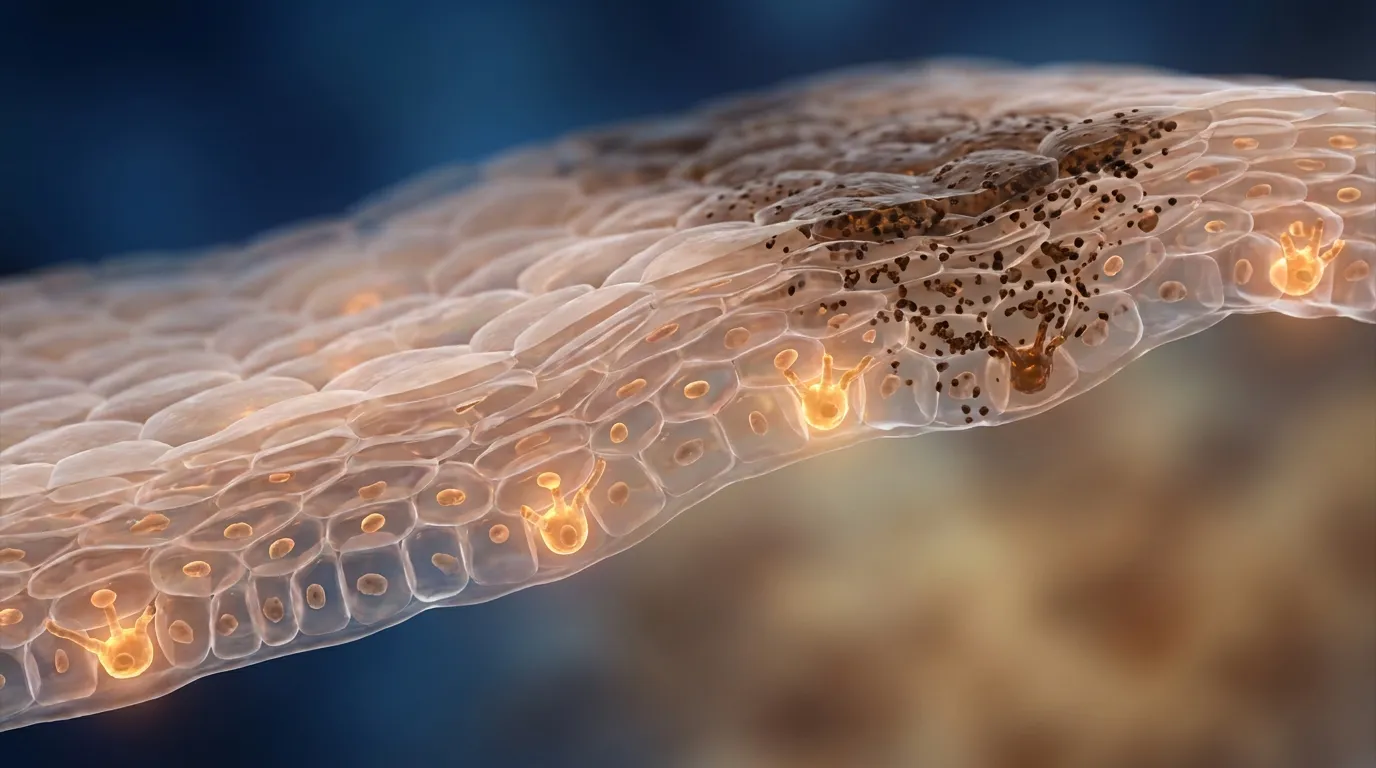
Melanotan 1 works by switching on the MC1 receptor, the same "tanning switch" your skin uses, telling pigment cells to make more of the brown-black pigment eumelanin, which both darkens skin and shields it from light. It is more selective for that receptor than Melanotan 2, which is why its effects stay closer to the skin and it does not trigger the same whole-body side effects. In the approved EPP setting, that extra eumelanin lets patients tolerate more light without pain.
In plain terms, your skin already has this switch. Ultraviolet light normally prompts your body to release alpha-MSH, which binds the MC1 receptor (MC1R) on pigment cells called melanocytes and tells them to build eumelanin, the pigment that darkens skin and absorbs light. Afamelanotide is a stable, longer-lasting copy of that hormone, so it presses the MC1R button directly and steadily. A 2024 review describes it as a melanocortin agonist "binding predominantly to the melanocortin-1 receptor (MC1R)," driving eumelanin production and photoprotection (Afamelanotide review, PMC, 2024, retrieved 2026-06-15). The FDA explains the practical result simply: it "increases the production of eumelanin... independent of exposure to sunlight or artificial light sources" (U.S. FDA press release, 2019, retrieved 2026-06-15).
The selectivity is the whole story here. There are several melanocortin receptors, and what a melanotan molecule does depends on which ones it hits:
- MC1R (skin): the tanning and photoprotection receptor. Afamelanotide targets this one predominantly, which is its intended action.
- MC3R / MC4R / MC5R (brain, nervous system, glands): linked to appetite, sexual arousal, and other whole-body effects. Melanotan 2 activates these strongly; afamelanotide's predominant MC1R binding means it largely stays out of this territory, so it lacks the prominent libido/erection effect.
The receptor-pharmacology deep dive (selectivity, alpha-MSH biology, why MC1R focus matters) is its own topic. We keep it at overview level here and link out to how peptides work for the foundations.
What is Melanotan 1 (SCENESSE) approved for?
Melanotan 1 is FDA-approved, as afamelanotide / SCENESSE, for exactly one thing: increasing pain-free light exposure in adults with erythropoietic protoporphyria (EPP), a rare inherited disease that makes sunlight intensely painful. It is not approved for cosmetic tanning, for general "skin health," or for anything sold as an online research peptide. That one narrow approval is the legitimate medical use.
EPP is a rare inherited porphyria, a disorder of how the body builds heme, in which a protein called protoporphyrin IX accumulates and reacts with light, causing severe burning pain in the skin within minutes of light exposure. Most cases come from mutations in the FECH gene, and the condition is estimated to affect somewhere between roughly 1 in 75,000 and 1 in 180,000 people in Europe (Afamelanotide review, PMC, 2024, retrieved 2026-06-15). For people with EPP, normal daylight is not a comfort but a threat, and before afamelanotide there was no approved treatment.
In 2019 the FDA approved SCENESSE as the first treatment for EPP, with the specific purpose "to increase pain-free light exposure in adult patients with a history of phototoxic reactions from erythropoietic protoporphyria" (U.S. FDA press release, 2019, retrieved 2026-06-15). The approval rested in part on randomized clinical-trial evidence, including a 168-patient trial published in the New England Journal of Medicine in 2015, which found patients on afamelanotide could tolerate significantly more pain-free time in sunlight than those on placebo (Langendonk et al., New England Journal of Medicine, 2015, via PMC review, 2024, retrieved 2026-06-15). Europe got there first: the European Medicines Agency approved SCENESSE for EPP back in 2014 (Afamelanotide review, PMC, 2024, retrieved 2026-06-15).
Our take: This is the detail people miss most. "Melanotan 1 is FDA-approved" is technically true, but the approval is for a rare disease, under a doctor's supervision, as an implant, not as a tanning shortcut you can buy online. Borrowing the credibility of the EPP approval to vouch for an unapproved tanning injectable is exactly the leap this article exists to stop.
How is the approved version (SCENESSE) actually given?
The approved form of Melanotan 1 is not an injection you do at home; it is a small bioresorbable implant that a trained healthcare professional inserts under the skin, about every two months. That clinician-controlled delivery is one of the biggest differences between the real drug and the online product, and it is part of why the approved version is considered manageable.
SCENESSE comes as a single 16 mg implant, roughly the size of a grain of rice, which a healthcare professional places subcutaneously, typically above the hip bone (the anterior supra-iliac crest), after appropriate training; it is given about every two months during the months of highest light exposure (U.S. FDA press release, 2019; Clinuvel, "SCENESSE", 2026, retrieved 2026-06-15). The implant slowly releases afamelanotide and is bioresorbable, so it dissolves over time rather than needing removal. Because a clinician handles dosing, sterility, and timing, the approved route sidesteps the do-it-yourself reconstitution and self-injection risks that come with research vials.
Here is the high-level contrast between the two "Melanotan 1" worlds:
| Feature | SCENESSE (approved afamelanotide) | "Melanotan 1" research/tanning vial |
|---|---|---|
| Approval | FDA-approved 2019 for EPP; EMA 2014 | Not approved anywhere for any use |
| Form | 16 mg bioresorbable implant | Lyophilized powder you reconstitute and inject |
| Who administers it | Trained healthcare professional, in-office | Self-administered, unsupervised |
| Quality control | Pharmaceutical-grade, regulated | Unregulated; potency and purity unverified |
| Intended use | Photoprotection in EPP | Cosmetic tanning (off-label, unapproved) |
The deeper procedural detail (the implant insertion technique, the EPP treatment schedule, monitoring during therapy) belongs to a clinical setting and is not something this hub instructs on. For general background on handling research peptides, see the are peptides legal guide.
What doses of the research version do people report using?
There is no validated or approved dose for the injectable "Melanotan 1" sold online, but reported community protocols cluster around 0.5 to 1 mg per dose by subcutaneous injection, far less often and at lower frequency than Melanotan 2. These are figures people report, not an established or safe dose, and they have nothing to do with the controlled 16 mg implant the approved drug uses.
Because the approved product is an implant and the online powder is a separate, unregulated item, there is no label dose to anchor a self-injected regimen. Community write-ups for the research version generally describe small subcutaneous doses, commonly in the 0.5 to 1 mg range, used to build pigment, with the milder side-effect profile meaning users tend to report fewer of the nausea-and-flushing problems associated with Melanotan 2. We label all of this as a community convention because no regulator has reviewed a self-injected dose of afamelanotide, and the human pharmacokinetics behind these numbers, for this route, are thin. ProtocolPlus tracking of Melanotan 1 reflects this lighter, lower-frequency pattern (see the app-data section below).
The detailed titration approach, reconstitution math, and injection-site choices are not something this hub instructs on, both because the approved product is an implant and because self-injecting an unapproved peptide carries real, unmeasured risk. For general handling background, see the are peptides legal and how peptides work guides.
Our take: Numbers like "1 mg of MT-1" get traded online as if they were equivalent to the approved drug. They are not. The approved drug is a 16 mg implant placed and timed by a clinician; a self-injected research vial is a different product at a different dose by a different route, with none of the same oversight. Treating one as a stand-in for the other is the core mistake.
What are the side effects of Melanotan 1?
For the approved drug, the most common side effects are mild and local, implant-site reactions, nausea, headache, fatigue, and skin darkening, and afamelanotide notably lacks the strong libido and appetite effects of Melanotan 2; for the unapproved injectable, the bigger unknowns are quality and self-injection risk. Because afamelanotide is more selective, its side-effect list is shorter and gentler than its non-selective cousin's, but "milder than Melanotan 2" is not the same as "risk-free."
In the SCENESSE clinical setting, the FDA lists the most common adverse reactions as implant-site reactions, nausea, throat pain, cough, fatigue, and skin darkening (U.S. FDA press release, 2019, retrieved 2026-06-15). Dermatology references add hyperpigmentation at the implant site, darkening of existing moles and freckles, and mild, short-lived headache, dizziness, or nausea, and they recommend a full-body skin examination before treatment and roughly every six months during it (DermNet, "Afamelanotide", 2026, retrieved 2026-06-15). Crucially, the prominent sexual side effects that make Melanotan 2 infamous, spontaneous erections in men, strong arousal, are not part of afamelanotide's approved-label profile, a direct consequence of its MC1R selectivity.
A hub-level overview of what is reported:
- Common, mild (approved drug): implant-site reaction, nausea, headache, fatigue, dizziness, cough or throat pain.
- Pigment-related: general skin darkening, and darkening of existing moles and freckles, which is why dermatologists monitor the skin.
- Notably absent vs Melanotan 2: the prominent libido/erection and strong appetite-suppression effects, thanks to MC1R selectivity.
- Specific to the unapproved injectable: contamination, wrong potency, and non-sterile product from an unregulated market, plus the risks of unsupervised self-injection, none of which apply to the clinician-placed implant.
Because afamelanotide darkens moles, the dermatology caution that applies to any pigment-altering compound applies here too: have a baseline skin check and ongoing monitoring. The fuller comparison of the two molecules' safety profiles lives in the next section and in our Melanotan 2 guide.
How does Melanotan 1 compare to Melanotan 2?
Melanotan 1 (afamelanotide) and Melanotan 2 are constantly confused, but they are different molecules with opposite regulatory fates: Melanotan 1 is a more selective MC1R agonist that became an approved drug with a milder side-effect profile, while Melanotan 2 is non-selective, unapproved, and carries stronger tanning convenience alongside prominent sexual and appetite side effects. They are not interchangeable, and only one of them is a legitimate medicine.
The core difference is receptor selectivity. Afamelanotide binds predominantly to MC1R, the tanning and photoprotection receptor, so its effects stay close to the skin (Afamelanotide review, PMC, 2024, retrieved 2026-06-15). Melanotan 2 is non-selective, hitting MC1, MC3, MC4, and MC5, which is why it also drives the famous spontaneous-erection and appetite-suppression effects through MC4R, and why a related molecule, bremelanotide (PT-141), was developed from that program into a sexual-dysfunction drug (Wikipedia, "Afamelanotide", 2026, retrieved 2026-06-15). The practical headline: "Melanotan 1" is sometimes a real, supervised medicine for a rare disease, while "Melanotan 2" is the broader, unapproved grey-market tanning peptide. That said, the injectable "Melanotan 1" sold online shares Melanotan 2's unapproved, unregulated status, even though the molecule itself is the milder one.
This is the hub-level contrast, kept deliberately brief. Our side-by-side Melanotan 1 vs Melanotan 2 breakdown weighs the two on safety and what people actually use. The full guide to the more common tanning peptide, its dosing, its mole-and-melanoma concerns, and the bremelanotide connection, is its own page: see our complete Melanotan 2 guide and the melanocortin libido peptide PT-141 (bremelanotide) guide.
Is Melanotan 1 safe and legal?
It depends entirely on which "Melanotan 1" you mean: afamelanotide as SCENESSE is an FDA-approved prescription drug given safely under medical supervision for EPP, while the "Melanotan 1" sold online as a research or tanning injectable is unapproved, unregulated, and not legal to sell for human use in most countries. The same molecule sits on both sides of the line, and that is the crux of this entire article.
On the approved side, SCENESSE has been reviewed by the FDA (2019) and the European Medicines Agency (2014), is manufactured to pharmaceutical standards by Clinuvel, and is administered by trained clinicians, so for its EPP indication it has an actual safety determination behind it (U.S. FDA press release, 2019; Clinuvel, "SCENESSE", 2026, retrieved 2026-06-15). On the unapproved side, the picture matches the rest of the melanotan grey market: Clinuvel itself warns that the melanotan products sold online are "unlicensed, unregulated chemicals" and that selling them for human use is illegal in most countries, and Cancer Research UK states that melanotan is "illegal to sell and supply" and has "not been tested for safety, quality or effectiveness" (Clinuvel, "SCENESSE", 2026; Cancer Research UK, "Tanning, fake tan and Melanotan", 2025, retrieved 2026-06-15). And no regulator anywhere has approved Melanotan 1 for cosmetic tanning. For the full legal picture and how to evaluate a vendor, see are peptides legal.
Our take: The most common misunderstanding is treating the FDA approval of SCENESSE as a green light for the online product. It is not. The approval covers a specific implant, for a specific rare disease, given by a clinician. Buying a research vial labeled "Melanotan 1" and injecting it for a tan is using an unapproved, untested product, and the approval next to its name does nothing to make that safer or legal.

The bottom line
Melanotan 1 is the most misunderstood molecule in the melanotan family, precisely because the honest answer to "is it approved?" is "yes, but." As afamelanotide, it is a genuine FDA-approved drug, SCENESSE, that gives people with a painful rare disease something they never had before: more time in daylight without agony. That approval is real, it rests on clinical-trial evidence, and the molecule's MC1R selectivity is exactly why it is milder than Melanotan 2.
The other half of the story is the gap between that approved implant and the "Melanotan 1" sold online. The approved product is a clinician-placed 16 mg implant for EPP; the online version is an unapproved, unregulated research injectable used off-label for tanning, with no quality control and no safety determination behind it. They are the same molecule and not the same product. If you take one thing from this hub, let it be that the FDA approval belongs to SCENESSE and EPP, not to a vial you buy for a tan, and that a dermatologist and a qualified clinician belong in any decision involving a pigment-altering compound. From here, the natural next reads are the Melanotan 2 guide, are peptides legal, and how peptides work.
Frequently Asked Questions
Sources
- Wikipedia. "Afamelanotide." 2026. Retrieved 2026-06-15. https://en.wikipedia.org/wiki/Afamelanotide
- Wikipedia. "Melanotan." 2026. Retrieved 2026-06-15. https://en.wikipedia.org/wiki/Melanotan
- U.S. Food and Drug Administration. "FDA approves first treatment to increase pain-free light exposure in patients with a rare disorder." 2019. Retrieved 2026-06-15. https://www.prnewswire.com/news-releases/fda-approves-first-treatment-to-increase-pain-free-light-exposure-in-patients-with-a-rare-disorder-300934079.html
- U.S. Food and Drug Administration. "SCENESSE (afamelanotide) implant — prescribing information." 2019. Retrieved 2026-06-15. https://www.accessdata.fda.gov/drugsatfda_docs/label/2019/210797s000lbl.pdf
- Clinuvel Pharmaceuticals. "SCENESSE (afamelanotide 16 mg)." 2026. Retrieved 2026-06-15. https://www.clinuvel.com/scenesse/
- "Afamelanotide in protoporphyria and other skin diseases." PMC / peer-reviewed review, 2024. Retrieved 2026-06-15. https://pmc.ncbi.nlm.nih.gov/articles/PMC11110213/
- DermNet. "Afamelanotide." 2026. Retrieved 2026-06-15. https://dermnetnz.org/topics/afamelanotide
- Cleveland Clinic. "Afamelanotide implant." 2026. Retrieved 2026-06-15. https://my.clevelandclinic.org/health/drugs/21426-afamelanotide-implant
- Cancer Research UK. "Tanning, fake tan and Melanotan." 2025. Retrieved 2026-06-15. https://www.cancerresearchuk.org/about-cancer/causes-of-cancer/sun-uv-and-cancer/fake-tan-and-melanotan-injections
- DrugBank. "Afamelanotide (DB04931)." Retrieved 2026-06-15. https://go.drugbank.com/drugs/DB04931
- PubChem. "Afamelanotide." Retrieved 2026-06-15. https://pubchem.ncbi.nlm.nih.gov/compound/Afamelanotide