TRT With HCG or Gonadorelin: Protocol and Rationale (2026)
If you have read anything about testosterone replacement therapy, you have probably seen HCG or gonadorelin mentioned as a companion shot, and wondered whether you actually need it. The short version: testosterone you inject works, but it also tells your body to stop making its own, which quiets the testicles. HCG and gonadorelin are the two tools clinicians use to keep that testicular machinery switched on. This guide explains why men add them, how each one works in the hormonal loop, how clinicians choose between them, and what the bloodwork looks like, with the depth most clinic pages skip and the sales pitch they do not.
A quick honesty note. HCG and gonadorelin are prescription medications used off-label here, not supplements, and adding either one is a decision you make with a clinician against your own labs, not because a forum recommended it. Where a topic gets deep, such as fertility restart, estradiol management, or the full bloodwork panel, we summarize and link to a dedicated guide so this page stays a clear map rather than a wall.
Key Takeaways
- TRT shuts down the natural signal to the testicles. Injected testosterone suppresses LH and FSH, which lowers intratesticular testosterone, slows sperm production, and can shrink the testicles. HCG and gonadorelin exist to counter that.
- HCG and gonadorelin act at different points in the loop. HCG mimics LH and acts downstream, directly on the testicle. Gonadorelin mimics GnRH and acts upstream, on the pituitary, which can stimulate both LH and FSH.
- The two main reasons to add one are fertility preservation and testicular function (size and the subjective sense of feeling normal). You can want one, the other, or both.
- There is real evidence for HCG. A controlled 2005 trial showed low-dose HCG maintained intratesticular testosterone in men whose own production had been suppressed, with a clear dose response.
- Both add a monitoring layer. Estradiol can rise (especially on HCG), so the panel and the retest cadence matter. All dose figures here are studied or typical clinic ranges, never a recommendation.
Why add HCG or gonadorelin to TRT?
You add HCG or gonadorelin to keep your testicles working, because the testosterone you inject tells your body to stop sending them the signal they need. It is a side effect of how TRT works, not a flaw in your therapy. Left unaddressed, the testicles get less stimulation, make less of their own testosterone, slow sperm production, and often shrink. HCG and gonadorelin restore part of that signal so the testes stay active while you remain on TRT.
The mechanism is worth understanding because it explains everything else on this page. Your brain normally runs the testicles through a feedback loop. The hypothalamus releases GnRH, which prompts the pituitary to release LH and FSH, which travel to the testicles: LH tells them to make testosterone, FSH supports sperm production. When you inject testosterone, your brain senses plenty of hormone and dials the whole loop down, so LH and FSH fall. The testicles, no longer told to do much, reduce their internal (intratesticular) testosterone, which is far higher than blood levels and is what sperm production depends on. That is why fertility and testicular size are the casualties of otherwise well-run TRT, and why a tool that re-supplies the missing signal is useful. The pillar covers this suppression at a high level in our TRT beginner's guide; here we go deeper on the fix.
One detail catches most people by surprise: intratesticular testosterone runs at concentrations many times higher than what circulates in your blood, and sperm production needs that local concentration, not the blood level your TRT bloodwork shows. This is the crux of why a man can have a perfectly optimized blood testosterone on TRT and still go infertile. Your serum number looks great, but inside the testicle the level has collapsed because LH is gone. An add-on does not raise your blood testosterone in any meaningful way; its whole job is to restore that local, intratesticular signal so the testicle keeps doing its other work. Keeping that distinction in mind, blood testosterone is what TRT manages, intratesticular testosterone is what the add-on protects, makes the rest of this page much clearer.
The HPTA in one diagram: where each drug acts
Exogenous testosterone breaks the loop at the top, HCG re-enters at the bottom (the testicle), and gonadorelin re-enters in the middle (the pituitary). That single difference, where in the chain each drug plugs in, drives the entire HCG-versus-gonadorelin discussion. Picture the axis as a vertical chain and it becomes intuitive.
The chart below maps the hypothalamic-pituitary-testicular axis (the HPTA) and marks the three intervention points.
The practical upshot: HCG reaches around the suppression and pokes the testicle directly, so it works regardless of how shut down your pituitary is. Gonadorelin instead nudges the pituitary to make its own LH and FSH, which is more "natural" in design but depends on the pituitary still being responsive. We unpack what that trade-off means a little further down.
What HCG is and how it works
HCG (human chorionic gonadotropin) is a hormone that closely mimics LH, so it binds the same receptors on the testicle and tells it to keep making testosterone and supporting sperm production, even while TRT has silenced your own LH. It is the older, better-studied of the two options. It is given by injection a few times a week, and it acts downstream, at the testicle itself, which is why it works even when the pituitary is fully suppressed.
The evidence here is unusually concrete for this corner of TRT. In a controlled 2005 study, researchers suppressed the natural testosterone production of healthy men and then gave low doses of HCG; the HCG maintained intratesticular testosterone in a clear dose-dependent way, with doses of roughly 125 to 500 IU every other day preserving the internal testosterone that sperm production relies on (Coviello et al., 2005, Journal of Clinical Endocrinology & Metabolism, "Low-Dose Human Chorionic Gonadotropin Maintains Intratesticular Testosterone in Normal Men With Testosterone-Induced Gonadotropin Suppression", retrieved 2026-06-17). That study is the reason low-dose HCG, rather than the much larger doses once used, is the typical approach: it preserves testicular function without driving levels sky-high. Because HCG also stimulates the testicle to make more estrogen precursor, estradiol can rise, which is the main monitoring catch, covered below.
What gonadorelin is and how it works
Gonadorelin is a synthetic version of GnRH, the brain's own upstream signal, so instead of mimicking LH at the testicle it prompts the pituitary to release its own LH and FSH. It acts one step higher in the chain than HCG. Because it restarts the body's natural messengers rather than substituting for them, it can in theory support both the LH side (testosterone) and the FSH side (sperm) of testicular function. It is given as small, frequent subcutaneous doses.
There is an important nuance that keeps gonadorelin from being a clear upgrade. The natural GnRH signal is pulsatile, released in rhythmic bursts; the pituitary is tuned to respond to that rhythm. Continuous or poorly timed GnRH stimulation can actually desensitize the pituitary over time, the same principle that makes long-acting GnRH agonists suppress hormones in other medical settings such as prostate cancer treatment. In practice, the frequent small-dose schedule clinics use is meant to imitate pulses and avoid that desensitization, but gonadorelin has a much thinner evidence base than HCG for testicular support on TRT, and it depends on a pituitary that can still respond. That last point matters in secondary hypogonadism, where the pituitary is the weak link to begin with; in those men gonadorelin may underperform precisely because the part of the loop it relies on is the part that is impaired, whereas HCG sidesteps the issue entirely. Its theoretical FSH advantage is genuine but not well quantified in this specific use, which is why clinicians who prioritize sperm production sometimes still reach for HCG (occasionally with added FSH) where the evidence is firmer. A current review of options for preserving spermatogenesis during testosterone deficiency treatment places gonadotropin-style stimulation, including HCG and HCG-plus-FSH approaches, in the broader fertility-preservation toolkit (Hochu et al., 2025, Translational Andrology and Urology, "Preserving spermatogenesis in testosterone deficiency", retrieved 2026-06-17).
HCG versus gonadorelin: how clinicians choose
The choice comes down to track record versus design: HCG has decades of data and acts directly on the testicle, while gonadorelin is the more physiologic, pituitary-level approach with a thinner evidence base and a theoretical FSH advantage. Neither is universally "better"; the right one depends on your goal, your pituitary, your provider's experience, and availability. The comparison below is deliberately short, because this is a protocol spoke, not a full head-to-head buying guide.
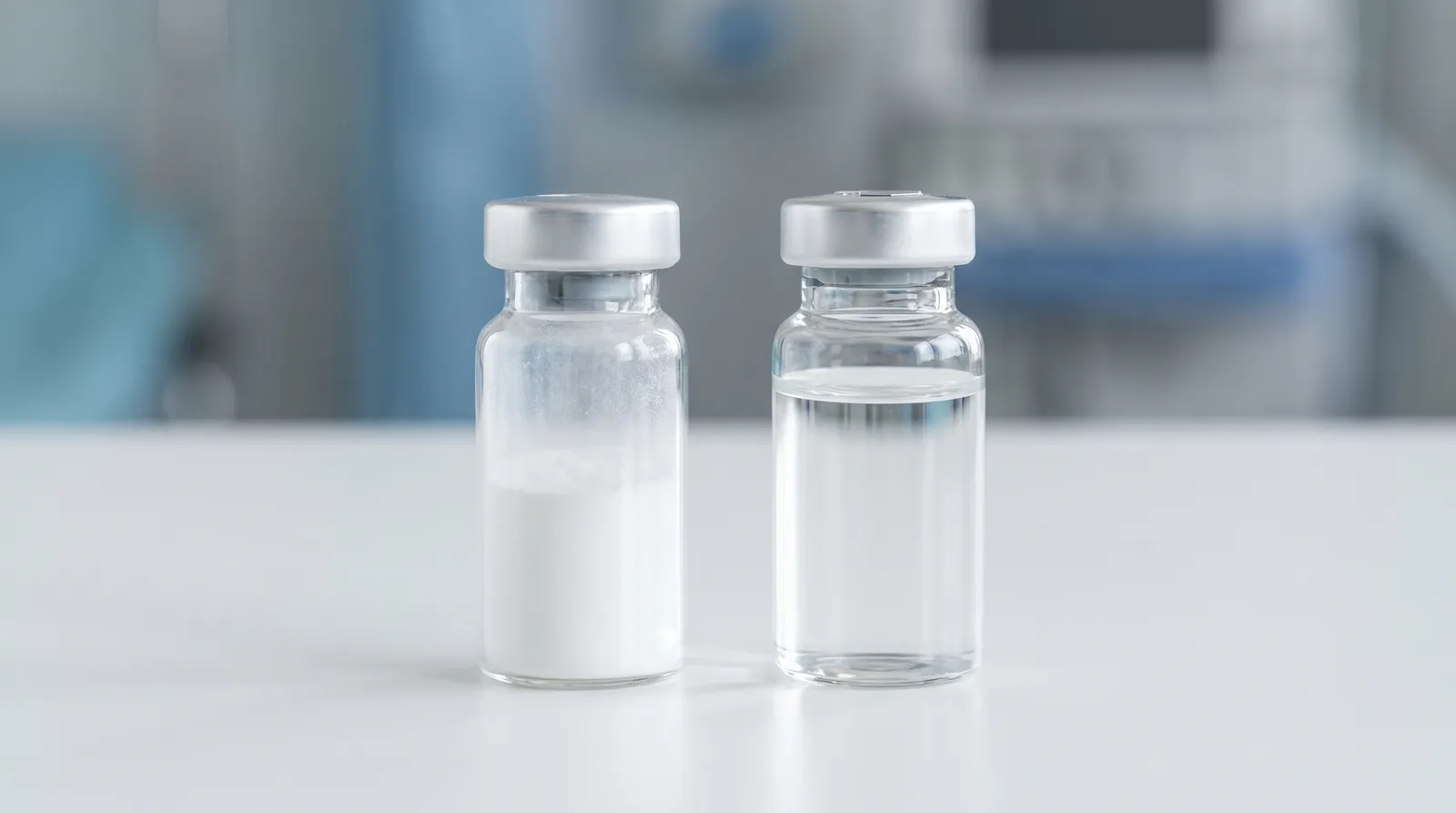
A few dimensions tend to decide it:
- Mechanism and reliability. HCG works downstream, so it does not care whether your pituitary is responsive; that makes it the dependable workhorse. Gonadorelin needs a functioning pituitary to do anything.
- FSH coverage. Gonadorelin can in principle trigger both LH and FSH, which is the part of the loop most tied to sperm production. HCG mimics LH only, though it still preserves the high intratesticular testosterone that spermatogenesis needs, and stubborn fertility cases sometimes add FSH to HCG.
- Evidence and track record. HCG has been used and studied for this purpose for decades, including the Coviello dose-response work. Gonadorelin's evidence for testicular support specifically on TRT is much thinner.
- Availability and cost. Both are prescription, off-label for this use, and availability shifts with supply and compounding-pharmacy access; gonadorelin became more common in some clinics partly due to HCG supply gaps. Treat cost and access as practical, provider-specific factors, not a reason to self-source.
The chart below illustrates the conceptual trade-off in testicular support, anchored to the dose-response idea from the HCG evidence. The values are illustrative, not measured outcomes.
Typical clinic protocol ranges
In clinic practice and trials, HCG for testicular support is dosed low and a few times per week, while gonadorelin is given as smaller, more frequent doses to imitate the body's natural pulses, but the exact dose, frequency, and whether you need either are set by a clinician against your labs. These figures are context, not instructions, and this page contains no reconstitution or self-injection steps.
For HCG, the studied and commonly cited range for maintaining testicular function alongside TRT is on the order of 250 to 500 IU roughly two to three times per week, a deliberately low range that traces back to the Coviello dose-response finding that even small doses preserve intratesticular testosterone. The older approach of large HCG doses (thousands of IU) is mostly a relic of fertility recovery protocols, not maintenance; for keeping the testicles active on TRT, low and frequent beats high and sparse, because steady low-level stimulation mirrors what the testicle would normally receive. Gonadorelin, because of its very short action and the pulsatile-signaling issue, is typically used as small doses given more often, sometimes around the time of, or more frequently than, the testosterone injection schedule, precisely so that the stimulation arrives in pulse-like bursts rather than a flat continuous signal that would risk desensitizing the pituitary.
There are two broad timing philosophies. The first is starting the add-on concurrently with TRT, so the testicles never go fully quiet; this is the easier path and the one most men who care about fertility or size choose, because preventing atrophy is simpler than reversing it. The second is retroactive, adding the support later only if testicular size shrinks or fertility becomes a goal, accepting that recovery from long suppression can take months and is less certain. How long someone stays on an add-on also varies widely, from indefinitely (to maintain size and the subjective sense of normal) to a defined window around trying to conceive, after which some men taper it. None of these timings is a rule; they are clinic practice patterns, and the actual decision is a provider's. The deep dosing-cadence mechanics for TRT itself live in our TRT dosing protocols guide.
Fertility preservation: the main reason men add HCG
The strongest reason to add HCG or gonadorelin is to protect fertility, because TRT suppresses the intratesticular testosterone and FSH signaling that sperm production depends on, and keeping the testicle stimulated throughout therapy is far easier than restarting it later. If you may want children, this is the conversation to have before you start TRT, not after. Concurrent testicular support keeps the machinery running so that sperm production is less likely to fully shut down.
Major guidelines are explicit that testosterone therapy suppresses spermatogenesis and that fertility should be discussed before starting, with gonadotropin therapy available for men who want to preserve or restore it (Bhasin et al., 2018, Endocrine Society, JCEM, "Testosterone Therapy in Men With Hypogonadism", retrieved 2026-06-17). In stubborn cases where HCG alone does not restore adequate sperm parameters, clinicians sometimes add FSH, an approach noted in current fertility-preservation reviews. Fertility on TRT is monitored with semen analysis over months, not by guesswork, since the response varies by man and by how long suppression has gone on. The deeper questions, how to actively restart production, coming off TRT to conceive, and PCT-style protocols, belong to a dedicated guide; see our guide to TRT and fertility. For the SERM-based alternative that raises your own testosterone without exogenous T, see enclomiphene versus TRT.
If fertility is not a concern: testicular function and feeling normal
Even if you never want children, there is a real reason men add HCG or gonadorelin: it preserves testicular size and, for many, the subjective sense of feeling normal that pure TRT can blunt. Testicular atrophy is one of the most visible and bothersome effects of TRT for some men, and keeping the testes stimulated prevents much of it. Beyond appearance, some men report that the testicular signaling contributes to libido and well-being in a way that testosterone levels alone do not fully capture.
This is a genuinely individual call. Many men on well-dosed TRT feel completely normal without any add-on and never miss it; others notice shrinkage or a flatter sense of drive and find that low-dose HCG restores it. The reason testicular signaling can affect well-being beyond the blood testosterone number is that the testes produce other hormones and signaling molecules besides testosterone, and keeping them active maintains that fuller hormonal picture rather than just the single marker TRT optimizes. Because the add-on raises estradiol and adds cost and another injection, it is not a default, just an option for men who value testicular size or that subjective edge. There is no fertility number to track here, so the "is it working" signal is largely how you feel and how the testicles respond, alongside the usual safety bloodwork. A practical middle path some men take is to start TRT alone, see how they feel, and add HCG later only if size or well-being becomes a concern, since the option remains open at any point.
Monitoring: what changes when you add an add-on
Adding HCG or gonadorelin layers one main thing onto your monitoring: estradiol can rise, especially on HCG, so the standard TRT panel plus an eye on estradiol and how you feel is the watch list, typically rechecked around 8 to 12 weeks after a change. It does not overturn your monitoring; it sharpens the focus on a couple of markers. The point is to confirm the add-on is helping without pushing estradiol or other markers out of range.
HCG stimulates the testicle, which increases the substrate that aromatizes to estradiol, so a meaningful number of men see estradiol drift up after starting it. The fix is not automatic suppression; it is to treat the number together with symptoms, sometimes with a low-dose aromatase inhibitor, sometimes by adjusting the HCG dose. We keep the full estradiol playbook in our managing estradiol on TRT guide, and an aromatase inhibitor is not automatically required just because an add-on is started. Beyond estradiol, the usual panel still applies: total and free testosterone, hematocrit, SHBG, PSA, and lipids; the marker-by-marker detail lives in our TRT bloodwork panel guide, and the LH/FSH and free-versus-total nuance is covered in free versus total testosterone and SHBG. If fertility is the goal, semen analysis is the marker that actually answers the question, not blood testosterone. Hematocrit and injection cadence have their own considerations in managing hematocrit on TRT.
A couple of common questions fit here. Can HCG or gonadorelin restart natural production after you stop TRT? They can play a role in a recovery protocol, but that is a different goal from maintenance and is its own topic. And growth-hormone peptides like sermorelin are sometimes bundled by clinics in the same package, but they act on an entirely different axis and are not testicular support; see sermorelin and GH peptides versus TRT.
Side effects of HCG and gonadorelin
The most common downsides are a rise in estradiol, some water retention or breast tenderness if estradiol runs high, injection-site reactions, and, for gonadorelin specifically, the theoretical risk of pituitary desensitization with poor timing. Most are manageable and are exactly what the monitoring above is designed to catch. None of this makes the add-ons inherently dangerous; it makes them, like TRT itself, something to run under supervision.
The estradiol-linked effects are the most frequent, which is why estradiol is the marker that gets the most attention after starting. Injection-site irritation is minor and common to any subcutaneous medication. The desensitization concern with gonadorelin is the reason it is dosed in small, frequent, pulse-imitating amounts rather than continuously, and it is part of why HCG remains the more predictable choice. As always, these are reasons to monitor and adjust, not automatic reasons to avoid an add-on if you and your clinician decide it serves a goal.
What real TRT trackers log
Aggregated tracking data shows that a sizable minority of TRT users run a testicular-support add-on, that HCG dominates over gonadorelin among them, and that the reasons split roughly evenly between fertility and testicular function. These are the real-world patterns behind the guidance above. The figures are drawn from the OCR-scanned bloodwork and protocol logs our users keep.
In our data, of roughly 6,400 TRT trackers, about 38% log a testicular-support add-on rather than running testosterone alone. Among those add-on users, the split is heavily toward HCG: roughly 71% use HCG, about 22% use gonadorelin, and around 7% use something else or add FSH. Their stated primary reason divides almost in half, about 41% for fertility preservation, 39% for testicular size or feeling normal, and 20% for both. Add-on users also show a modestly higher estradiol skew than testosterone-only trackers, kept within range, which lines up with HCG's known estradiol effect and reinforces why the monitoring section flags it. None of these figures is a target to copy; they are a snapshot of how the choice plays out in practice.
Frequently asked questions
Sources
Factual and clinical claims are sourced below. Dosing figures are described as studied in trials or typical of clinic practice, not recommendations.
- Coviello AD, Matsumoto AM, Bremner WJ, et al. (2005), JCEM - Low-Dose Human Chorionic Gonadotropin Maintains Intratesticular Testosterone in Normal Men With Testosterone-Induced Gonadotropin Suppression. https://academic.oup.com/jcem/article-abstract/90/5/2595/2836735 - retrieved 2026-06-17.
- Hochu G, Geyer-Kim G, Kim ED (2025), Translational Andrology and Urology - Preserving spermatogenesis in testosterone deficiency: innovations in replacement and stimulatory therapies. https://tau.amegroups.org/article/view/146924/html - retrieved 2026-06-17.
- Endocrine Society (2018), JCEM - Bhasin S, et al., Testosterone Therapy in Men With Hypogonadism: An Endocrine Society Clinical Practice Guideline. https://academic.oup.com/jcem/article/103/5/1715/4939465 - retrieved 2026-06-17.
- American Urological Association (2018, amended 2023) - Evaluation and Management of Testosterone Deficiency: AUA Guideline. https://www.auanet.org/guidelines-and-quality/guidelines/testosterone-deficiency-guideline - retrieved 2026-06-17.
- U.S. Food & Drug Administration - Testosterone products: drug safety communication and labeling. https://www.fda.gov/drugs/drug-safety-and-availability/fda-drug-safety-communication-fda-cautions-about-using-testosterone-products-low-testosterone-due - retrieved 2026-06-17.
About this guide. Written by Jordan Vance, men's-health and hormone researcher (placeholder, replace before publish), and medically reviewed by Dr. Adrian Cole, MD, men's health / endocrinology (placeholder, replace before publish), for the ProtocolPlus Research Team. This guide is educational and not medical advice.