
TRT Bloodwork Panel: What to Track and When (2026)

If TRT had a single rule, it would be this: the bloodwork is not paperwork, it is half the therapy. The injection gets the attention, but the labs are what tell you whether the dose is right, whether your blood is getting too thick, and whether a symptom is coming from the testosterone or from something else entirely. A man who injects on schedule but never draws blood is not really doing TRT, he is guessing with a controlled substance.
This guide is the full panel, marker by marker. For each one we cover what question it actually answers, the target zone clinics typically aim for (framed as context, never a number to chase), what tends to happen when it drifts, and where our trackers actually land once you scan real lab reports. We also dig into the part most pages skip: when to draw the blood, because the same vial drawn on the wrong day can make a perfectly good protocol look broken. Where a marker has a whole guide of its own, we keep it short here and point you to it, so this stays a clean map of the panel rather than a wall.
Key Takeaways
- A standard TRT panel tracks total and free testosterone, estradiol (sensitive assay), a complete blood count for hematocrit and hemoglobin, SHBG, PSA, and a lipid panel, with LH and FSH and a metabolic panel often added at baseline.
- Timing changes the number. Most clinics draw at the trough (just before the next injection) and in the morning, so results reflect your lowest, most representative level rather than a post-shot peak.
- The schedule is staged, not constant: a full baseline panel, a recheck around 6 to 12 weeks, again at roughly 3 to 6 months, then every 6 to 12 months once stable, plus a recheck after any protocol change.
- Hematocrit is the safety marker. Testosterone raises red cell mass, and crossing about 54% is the level that typically prompts action; in our tracking data about 9% of trackers cross it.
- A "normal" total testosterone with low free testosterone usually points to high SHBG binding up the hormone, which is why free testosterone belongs on the panel.
- Ranges shift with age and lab, so the trend in your own numbers over time matters more than a single reading against a generic reference interval.
What is a TRT bloodwork panel?
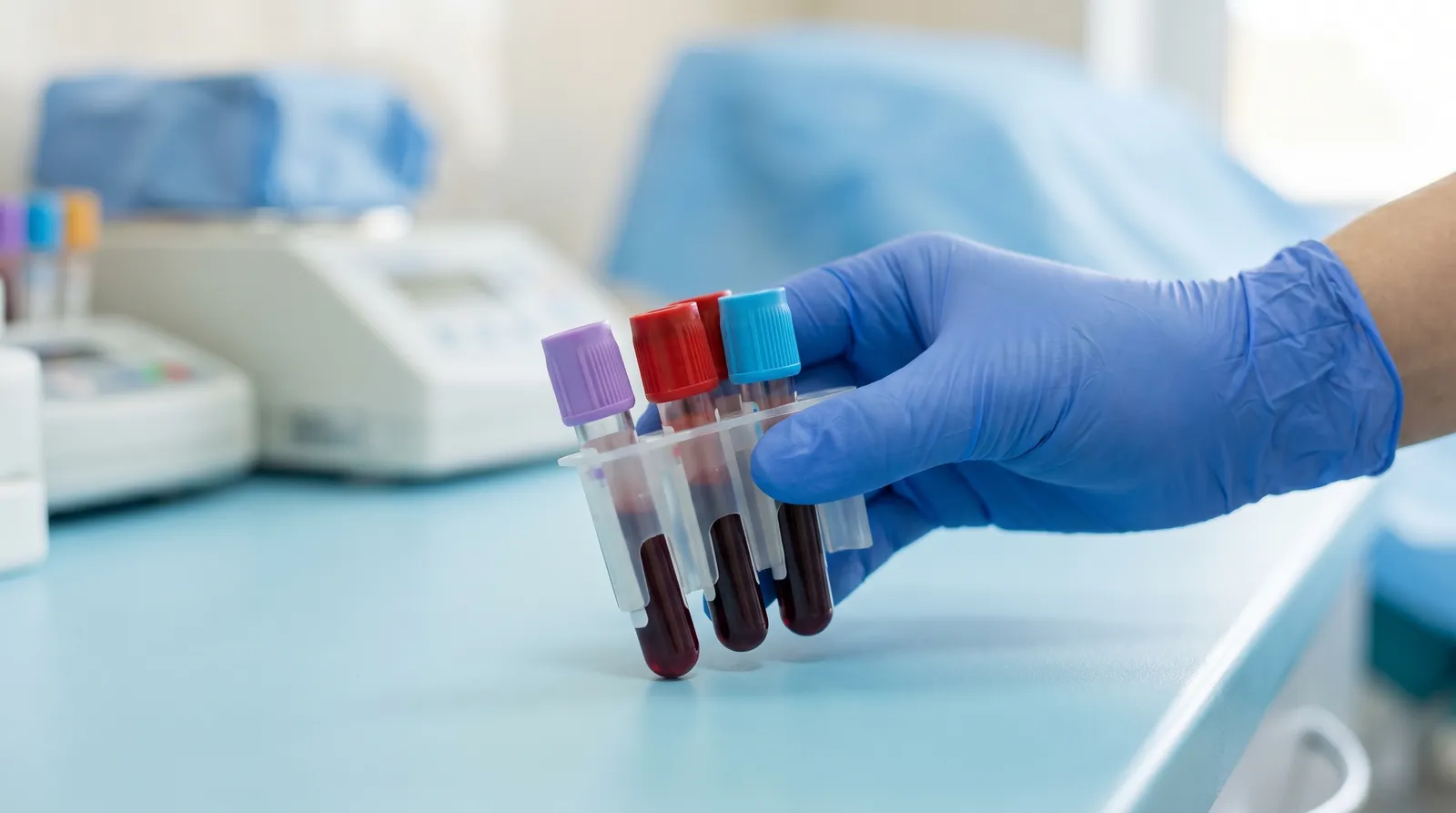
A TRT bloodwork panel is the standard set of blood markers a clinician tracks before and during testosterone therapy to confirm the dose is working and to catch the predictable side effects early. It is not a single test but a small collection of them, drawn together so they can be read against each other. The core panel covers the hormone itself plus the few things testosterone reliably moves; an extended panel adds context markers and is used more at baseline. Guidelines from the major bodies all describe the same backbone: testosterone, a blood count for hematocrit, and prostate surveillance, repeated on a schedule.
Think of the panel in two layers. The core monitoring panel is what you repeat at every checkpoint: total and free testosterone, a complete blood count (CBC) for hematocrit and hemoglobin, estradiol, and PSA once you are in the relevant age band. The extended baseline panel adds the markers you mostly need once, to set the scene and find the cause of the deficiency: LH and FSH (to separate primary from secondary hypogonadism), SHBG, a lipid panel, a metabolic panel with fasting glucose or HbA1c, and sometimes prolactin and a thyroid check. Diagnosis itself, which happens before any of this, rests on two early-morning total testosterone readings below range plus symptoms, with the American Urological Association using a total testosterone below 300 ng/dL as its cutoff (AUA, 2018, validity confirmed 2024, "Evaluation and Management of Testosterone Deficiency", retrieved 2026-06-17). The how-you-get-diagnosed sequence lives in the pillar guide; this page is about the panel that follows.
The reason the panel exists is simple. Without baseline labs you have nothing to compare against, and without follow-up labs you cannot see a hematocrit climbing toward a dangerous level, an estradiol running high, or a testosterone that never actually reached the target. The risks of running TRT unmonitored are not abstract: undetected erythrocytosis raises clotting risk, an unseen high estradiol drives symptoms that get blamed on the wrong thing, and a dose that is too low quietly fails while the man assumes the therapy "did not work." Each of these is invisible without the blood and obvious with it. That asymmetry, cheap and routine to measure, expensive and dangerous to miss, is the whole argument for the panel. The monitoring is what makes TRT a treatment rather than a gamble, and it is the reason every legitimate protocol is built around a lab schedule rather than just an injection schedule.
The full TRT marker panel at a glance
The lead chart below is the whole panel in one view: each marker, the typical target zone clinics aim for, where our trackers tend to land once their lab reports are scanned, and how often it is rechecked. Read it as a map of the rest of this article, then dig into any marker in the per-marker section. Every band is illustrative and framed as typical clinic practice, not a recommendation, and reference ranges vary by laboratory and assay.
The same panel as a quick reference table, with the question each marker answers and how often it is typically rechecked:
| Marker | What it answers | Typical target framing (clinic context) | Typical retest cadence |
|---|---|---|---|
| Total testosterone | Is the dose getting you into range at trough? | Mid-to-upper of the normal reference interval | Baseline, 6-12 wk, then every 6-12 mo |
| Free testosterone | How much hormone is actually available? | Upper part of normal, read with SHBG | With total T, especially if SHBG is off |
| Estradiol (sensitive) | Is estrogen moderate, not high or crashed? | Moderate, not suppressed | With each testosterone draw |
| Hematocrit / Hgb (CBC) | Is the blood getting too thick? | Below the ~54% action threshold | Baseline, early, then every 6-12 mo |
| SHBG | Why do free and total disagree? | Interpreted, not targeted | Baseline and when free vs total puzzles |
| PSA | Any prostate change to investigate? | Stable, watch velocity, not a fixed number | Baseline, then yearly in men 40+ |
| Lipids | Cardiovascular marker shifts? | Within standard cardiac targets | Baseline, then every 6-12 mo |
| LH / FSH | Primary vs secondary cause? | Diagnostic, suppressed once on TRT | Baseline (rarely repeated on therapy) |
Per-marker deep dive: what each test answers
Each marker on the panel answers one specific question, and reading them together is what turns a sheet of numbers into a protocol decision. Below is the core set, with the truly deep markers kept short and pointed to their own guides so this page does not turn into five articles. The throughline across all of them: treat the number alongside the symptom and the trend, never the number alone.
Total and free testosterone
Total testosterone tells you whether the dose is landing you in range, and free testosterone tells you how much of that hormone is actually usable, which is why both belong on the panel. Total testosterone is the headline, and at trough most clinics aim for the mid-to-upper part of the normal reference interval rather than the top, because chasing a high peak number adds side effects without added benefit. Free testosterone is the fraction not bound to SHBG or albumin, the part that can actually act on tissue. When the two disagree, the explanation is almost always SHBG.
A couple of measurement details matter here. Total testosterone is usually drawn directly, while free testosterone can be either measured (equilibrium dialysis is the reference method) or calculated from total testosterone, SHBG, and albumin; the calculated value is cheaper and common, but the two methods do not always agree, so consistency between draws matters more than the absolute figure. Because total testosterone swings most between a peak and a trough on injectable esters, this is also the marker most sensitive to draw timing, which is why the trough rule below exists. The deep mechanics of how free and total diverge, and why a "normal" total can hide a low free, are covered in our free vs total testosterone and SHBG guide. The practical point on the panel: do not judge a protocol on total testosterone alone if SHBG is unusual, and do not compare a peak draw to a trough draw and call it a change.
SHBG: why free and total disagree
SHBG (sex hormone binding globulin) is the protein that grabs onto testosterone in the blood, so it sets how much of your total is actually free. High SHBG binds more hormone, dropping free testosterone even when total looks fine; low SHBG does the opposite. It drifts with age, body fat, thyroid status, and liver health, which is why it earns a baseline measurement and a repeat whenever free and total tell different stories. It is interpreted, not targeted: there is no SHBG you are trying to hit, only a value that explains the other two. The full interpretation framework lives in the free vs total and SHBG guide.
Estradiol
Estradiol is the estrogen men make from testosterone, and the goal on TRT is moderate, not high and not crashed, because men need some for libido, mood, joints, and bone. Because testosterone partly converts to estradiol, levels usually rise somewhat on therapy, and the common mistake is over-suppressing it with an aromatase inhibitor and feeling worse. One technical detail matters on the panel: ask for the sensitive (LC-MS/MS) estradiol assay rather than the standard immunoassay, which was designed for the much higher levels seen in women and can read unreliably in men. The full management picture, including when an aromatase inhibitor is and is not appropriate, is in our managing estradiol on TRT guide; here, just measure it sensitively and read it alongside symptoms like water retention or nipple tenderness.
Hematocrit and hemoglobin

Hematocrit, the percentage of your blood made up of red cells, is the single most important safety marker on TRT, because testosterone reliably stimulates red cell production and thick blood raises clotting risk. It comes from the complete blood count along with hemoglobin, and it is the marker that most often forces a protocol change. The widely used watch line is around 54%, the point at which clinicians typically consider a dose reduction, a switch in cadence or form, or a therapeutic blood donation; a 2024 review walks through that threshold and the debate around phlebotomy (Endocrine Connections, 2024, "Testosterone therapy-induced erythrocytosis: can phlebotomy be justified?", retrieved 2026-06-17). Higher doses, once-weekly dosing with bigger peaks, smoking, and sleep apnea all push it up.
Two interpretation traps are worth knowing. First, hydration affects the reading: hematocrit is a concentration, so a dehydrated draw can read artificially high, which is one reason a consistent, well-hydrated draw matters and a single borderline value is usually rechecked before anyone acts. Second, endurance athletes and people living at altitude naturally run higher red cell counts, so the same number means something different in them, and the trend over time is more telling than a one-off. The full management playbook, including donation timing and how a recent blood donation can itself shift the next draw, is in our managing hematocrit on TRT guide. On the panel, the job is simply to catch the climb early, before it becomes a problem.
PSA and prostate surveillance
PSA (prostate-specific antigen) is on the panel as a prostate safety check, watched mainly in men 40 and older and judged more by its rate of change than by a single value. Testosterone is no longer thought to cause prostate cancer in the way once feared, which is precisely why the approach is to monitor rather than withhold. A baseline PSA before starting gives a reference point, and a meaningful jump (a velocity flag) prompts a conversation with the clinician and possibly a urology referral, not a panic. The AUA guidance includes PSA monitoring in men over 40 as part of standard testosterone follow-up (AUA, 2018, validity confirmed 2024, retrieved 2026-06-17).
A practical note on the early phase: starting testosterone in a previously deficient man can cause a small, expected rise in PSA over the first months as the prostate responds to a normal hormone level, which is why a single low-to-high jump early on is interpreted in context rather than treated as alarming on its own. What matters is the trend in your own numbers and the velocity, not how you compare to a generic cutoff. Recent ejaculation, a urinary infection, or a recent prostate exam can also nudge a PSA, so an unexpected spike is typically repeated before it drives any decision.
Lipids and metabolic markers
A lipid panel and a metabolic check sit on the panel because testosterone and the conditions it overlaps with both touch cardiovascular and metabolic health. Testosterone can nudge lipids, and many men starting TRT also carry metabolic risk worth a baseline read, so HDL, LDL, triglycerides, fasting glucose, and often HbA1c get measured at the start and periodically after. These are not testosterone targets, they are general cardiometabolic context, drawn fasting when included. The large 2023 TRAVERSE trial reshaped the cardiovascular conversation by finding no increase in major adverse cardiac events in men with hypogonadism and high CV risk, though it flagged some other signals, and the FDA updated testosterone labeling on that basis (U.S. Food & Drug Administration, "Testosterone products: drug safety communication and labeling", retrieved 2026-06-17). The broader cardiovascular detail belongs to the pillar guide; on the panel, lipids are a watch-and-trend item.
LH, FSH, and the rest of the supporting cast
LH and FSH are baseline markers that tell your clinician whether the deficiency is primary (in the testicles) or secondary (in the brain's signaling), and they go quiet once you are on TRT. That makes them mostly a one-time, pre-therapy test rather than something you repeat, because exogenous testosterone suppresses the body's own signal by design. They matter because the primary-versus-secondary answer shapes whether alternatives that preserve fertility are even an option; we cover those in the enclomiphene vs TRT guide and the fertility angle in TRT and fertility guide. Prolactin is added when symptoms or a very low testosterone suggest a pituitary cause, and a thyroid check can be useful because thyroid status moves SHBG. None of these are routine repeats; they are the baseline context that explains the rest.
When to draw your blood: the timing science

On TRT, when you draw the blood matters almost as much as what you draw, because the same protocol can look very different at the trough versus the peak, so most clinics standardize on a morning, trough draw. This is the part most pages gloss over, and it is where a lot of avoidable confusion comes from. Get the timing right and your numbers are comparable from draw to draw; get it wrong and you cannot tell whether a change in the result is real or just an artifact of the clock.
The single most important concept is trough versus peak. With injectable esters, your level rises after a shot and falls before the next one, so a draw taken the day after injecting catches an inflated peak, while a draw just before your next injection catches the trough, your lowest and most representative level. Most clinics dose to a trough target precisely so the number reflects the floor you live at, not a transient high. In practice that means: if you inject, for example, on a Monday on a once-weekly schedule, the trough draw is the following Monday morning right before the next shot. On a twice-weekly schedule the swing is smaller, but the same principle holds, draw right before a scheduled injection. Some clinicians occasionally also order a peak draw (a couple of days after the shot) to see the full swing when symptoms come and go with the cadence, but the trough is the standard reference point. The full cadence-and-stability picture sits in the TRT dosing protocols and injection frequency guide; for bloodwork, the rule is: be consistent, draw at the same point in your cycle each time, and tell the lab and your clinician exactly when you last injected.
The size of the timing effect depends on the ester and the cadence. A long ester taken once weekly produces the widest peak-to-trough gap, so a mistimed draw there can swing the number dramatically; a shorter cadence like twice weekly or every other day flattens the curve, so the timing is more forgiving but still worth getting right. This is also why the once-weekly group in our tracking data has the most timing-sensitive labs: the same protocol can read very differently depending on which day the vial was filled.
A few more timing rules round it out. Draw in the morning, ideally before about 10 a.m., because testosterone follows a daily rhythm and the reference ranges were built on morning samples, and the baseline diagnostic draws are specifically early-morning by guideline. Fast only if the panel includes lipids or glucose, since those are the markers that fasting affects; testosterone, estradiol, and hematocrit do not require fasting, so a panel without metabolic markers can be drawn fed. Do not stop your TRT before the test unless your clinician tells you to, because the whole point is to measure your therapy as you actually run it; stopping skews the result and tells you nothing useful. As for supplements, ordinary vitamins do not need to be paused, with one notable exception worth flagging to your clinician: high-dose biotin can interfere with some hormone immunoassays, so it is commonly held for a day or two before a draw. The form you are on also shifts timing, gels are drawn a set number of hours after application and pellets are drawn at a defined point in the cycle rather than at a trough, so confirm the protocol for your specific delivery method.
How often to retest: the monitoring schedule
TRT monitoring follows a staged schedule, not a constant one: a full baseline before the first dose, an early recheck around 6 to 12 weeks, another at roughly 3 to 6 months, then settling into every 6 to 12 months once stable, with an extra recheck after any change. The early phase is dense because that is the calibration period; the long-term phase is lighter because a stable protocol mostly needs maintenance surveillance. The major guidelines describe this same arc of an early recheck in the first months followed by periodic monitoring thereafter (Endocrine Society, 2018, "Testosterone Therapy in Men With Hypogonadism", retrieved 2026-06-17).
The timeline below shows which markers come into focus at each gate:
A practical note on changes: after a dose, frequency, or formulation change, levels take several weeks to reach a new steady state, so retesting too early measures a moving target. The common practice is to wait roughly 6 to 8 weeks after a change before drawing, the same window used for the early recheck after starting. Switching delivery method, say from injection to gel or pellet, resets the clock the same way, with the added wrinkle that the new form has its own draw-timing rule (see the timing section above). One real-world constraint worth naming: some insurance plans only cover labs at fixed intervals, which can push men toward direct-pay testing to retest after a change; that is a cost-planning issue, not a reason to skip the recheck.
How to read your results: common scenarios
Most TRT lab puzzles fall into a handful of recurring patterns, and recognizing the pattern is more useful than memorizing a reference range, though every actual change to your protocol belongs to your clinician. The point of this section is literacy, not self-management: it helps you walk into the appointment understanding what your sheet is probably saying, so the conversation is sharper. Actions here are deliberately general, and the dose, aromatase-inhibitor, and phlebotomy decisions are pointed back to a clinician and to the sibling guides.
- Total testosterone is in range but you still feel low. The usual suspects are timing (a peak draw flattered the number, or a trough draw is genuinely low), a low free testosterone hidden by high SHBG, an estradiol that is too high or too crashed, or a symptom that is not actually testosterone-driven. The fix starts with checking the free testosterone and the timing, not with assuming the dose is wrong. The free-versus-total mechanics are in the free vs total and SHBG guide.
- Free testosterone is low while total is normal. This is the classic high-SHBG picture: plenty of hormone, too much of it bound. It is a key reason free testosterone is on the panel, and the interpretation (and what clinicians do about it) is covered in the free vs total and SHBG guide.
- Estradiol is high and you have water retention or nipple tenderness. First confirm it was the sensitive assay, then read it with symptoms rather than chasing a number, because over-suppression causes its own problems. Management belongs to the managing estradiol on TRT guide.
- Hematocrit is creeping toward the mid-50s. This is the safety pattern to take seriously. The general levers are dose, cadence, hydration at the draw, and a possible blood donation, all clinician-directed; the full playbook is in the managing hematocrit on TRT guide.
- PSA jumped between draws. A single value matters less than the velocity; a real rise prompts a clinical conversation and possibly urology, not a self-adjustment.
If a result suggests the dose or frequency itself needs to move, that decision and the retest that follows it belong to the dosing protocol, and the recovery-panel question for men considering coming off therapy belongs nearer the TRT and fertility guide. Keep this page's role to reading the panel, not changing the protocol.
Reference ranges by age
Testosterone reference ranges are not one-size-fits-all, because natural testosterone declines gradually with age, so what counts as a low number for a 30-year-old can sit comfortably in range for a 70-year-old. This is one reason guidelines anchor diagnosis to symptoms plus repeated low readings rather than a single number against a generic interval, and it is why the trend in your own labs over time tells you more than any one comparison. On therapy the goal is the same across ages, restore to a healthy mid-to-upper range, but the baseline you started from and the way you feel at a given level vary with age.
The chart below shows the broad pattern of declining baseline total testosterone by decade alongside the on-therapy target, using illustrative ranges; your lab's intervals are what your clinician reads against.
The takeaway is not the exact figures, which are illustrative, but the shape: baseline falls with age, the therapy target stays roughly constant, and so the gap a man is closing is larger the older he starts. Because of that decline, a value that triggers a workup in one decade may be ordinary in another, which is exactly why diagnosis pairs the number with symptoms and a repeat draw rather than reading a single result in isolation.
What real TRT trackers log
Because the ProtocolPlus app reads users' lab reports directly through bloodwork OCR, we can put textbook reference ranges next to where men on TRT actually land, something no clinic blog or lab-store page does. Aggregated across our tracker base, the patterns line up with the guidance above: most markers sit comfortably in range, with the expected TRT tendencies showing up at the edges. These figures are a snapshot of real-world practice, not a target to chase.
In that data, drawn from roughly 6,400 TRT trackers, the median total testosterone moves from about 310 ng/dL at baseline to around 720 ng/dL on therapy, squarely in the mid-to-upper target zone rather than anywhere supraphysiologic. The cautionary marker is hematocrit: the median sits near 48%, comfortably normal, the upper quartile around 52%, and about 9% of trackers cross the ~54% threshold where clinicians typically step in, the long tail that monitoring exists to catch. Estradiol trends slightly higher than at baseline, as expected when more testosterone is available to convert, and SHBG trends slightly lower, both consistent with known TRT physiology and both mostly in range. On cadence, the split is once-weekly about 32%, twice-weekly or every-3.5-days about 46%, and every-other-day or daily about 22%, which matters for bloodwork because the once-weekly group sees the biggest peak-to-trough swing and so the most timing-sensitive draws.
What the distribution shows is the whole rationale for the panel in one picture: the bulk of trackers sit safely in range, but a real minority drift into the zone where a clinician would act, and you cannot tell which group you are in without drawing the blood. That is the case for monitoring, made with data instead of assertion. For the biometric side of the moat, resting heart rate, HRV, and sleep alongside the labs, see our TRT and HRV, sleep, and resting heart rate guide.
Frequently asked questions
Sources
Factual and clinical claims are sourced below. Testosterone target ranges are described as typical of clinic practice or as studied in trials, not recommendations. ProtocolPlus tracking figures are first-party OCR-scanned app data.
- Endocrine Society (2018), JCEM — Bhasin S, et al., Testosterone Therapy in Men With Hypogonadism: An Endocrine Society Clinical Practice Guideline. Monitoring guidance: recheck testosterone, hematocrit, and prostate-cancer-risk evaluation in the first year of therapy. https://academic.oup.com/jcem/article/103/5/1715/4939465 — retrieved 2026-06-17.
- American Urological Association (2018, validity confirmed 2024) — Evaluation and Management of Testosterone Deficiency: AUA Guideline. Total testosterone below 300 ng/dL on two morning draws plus symptoms; follow-up testosterone every 6-12 months; hemoglobin/hematocrit and PSA monitoring (men 40+). https://www.auanet.org/guidelines-and-quality/guidelines/testosterone-deficiency-guideline — retrieved 2026-06-17.
- Endocrine Connections (2024) — Testosterone therapy-induced erythrocytosis: can phlebotomy be justified? Hematocrit ~54% action thresholds and the phlebotomy debate. https://www.ncbi.nlm.nih.gov/pmc/articles/PMC11466264/ — retrieved 2026-06-17.
- U.S. Food & Drug Administration — Testosterone products: drug safety communication and labeling (2015; 2025 TRAVERSE-driven label change). Supports PSA, blood-pressure, and cardiovascular-marker monitoring framing. https://www.fda.gov/drugs/drug-safety-and-availability/fda-drug-safety-communication-fda-cautions-about-using-testosterone-products-low-testosterone-due — retrieved 2026-06-17.
- NEJM (2023) — Lincoff AM, et al. (TRAVERSE), Cardiovascular Safety of Testosterone-Replacement Therapy. Context for lipid and cardiovascular monitoring on the panel. https://pubmed.ncbi.nlm.nih.gov/37326322/ — retrieved 2026-06-17.
About this guide. Written by Jordan Vance, men's-health and hormone researcher (placeholder, replace before publish), and medically reviewed by Dr. Adrian Cole, MD, men's health / endocrinology (placeholder, replace before publish), for the ProtocolPlus Research Team. This guide is educational and not medical advice.