TRT and HRV, Sleep, and Resting Heart Rate: What Your Wearable Shows (2026)
If you wear an Apple Watch, Whoop, Oura ring, or Garmin, starting testosterone replacement therapy (TRT) turns your wrist into a front-row seat. Within weeks you may notice your heart rate variability (HRV) drifting, your resting heart rate nudging up or down, and your sleep score doing something strange before it settles. These three numbers, HRV, resting heart rate, and sleep, are the everyday window most people have into how their nervous system is responding to therapy, and they are exactly the metrics this guide covers.
Here is the honest headline before we go deep: the research linking TRT to HRV, resting heart rate, and sleep is real but small and mixed. It is not a settled science with clean before-and-after charts. What we can say is that in men who are genuinely deficient, restoring testosterone toward a normal range tends to nudge autonomic balance in a favorable direction, while overshooting or letting estradiol run high can blunt that. The rest is individual, which is why your own trend, watched over weeks, matters more than any single study or any single night.
Key Takeaways
- HRV often improves modestly in deficient men on TRT, but the evidence is small and mixed. A 9-week study raised several HRV measures without returning them fully to healthy-control values; other reports show no change. Baseline matters: the more deficient you start, the more room there is to gain.
- Resting heart rate usually shifts little. Some studies show a small decrease, some no change. A sustained rise of several beats per minute is the signal worth investigating, often pointing to rising hematocrit, high estradiol, or anxiety, not the testosterone itself.
- Sleep often gets worse before it gets better. Many men report disrupted sleep in the first few weeks (the adjustment phase), which commonly improves and can settle above baseline by around month three.
- Obstructive sleep apnea is a real caveat, not a deal-breaker. Studies show a time-limited worsening of apnea measures around 7 weeks that is no longer significant by about 18 weeks; screen and monitor rather than assume.
- Trends beat single nights. Alcohol, illness, travel, training load, and room temperature move these numbers far more than a milligram of testosterone does. Read the weekly median, not the daily noise.
Does TRT change your HRV, resting heart rate, and sleep?
For most men with diagnosed low testosterone, TRT tends to nudge HRV upward modestly and resting heart rate slightly down over the first few months, while sleep often dips during an early adjustment phase before improving, but the evidence is small, mixed, and highly individual. None of these are guaranteed effects, and none should be treated as a reason to start or change therapy on their own. The direction of the effect depends heavily on where you began: a man restoring testosterone from a genuinely deficient level has the most room to see autonomic improvement, while a man already in range has little to gain and some risk if he overshoots.
The realistic timeline looks like this. Sleep is usually the first metric to move, sometimes worsening within days to weeks as the body adjusts, then recovering over the following weeks. HRV and resting heart rate change more slowly, tracking the gradual normalization of your hormones and, often, secondary improvements in sleep, body composition, and mood that themselves influence the autonomic nervous system. Because these metrics feed off each other, it is rarely possible to attribute a single number to testosterone alone. That is the central honesty of this whole topic, and the reason a sales-driven clinic page promising "TRT fixes your HRV" is overselling a thin literature.
It is worth being explicit about what "mixed evidence" means here, because it is the honest core of the page. The studies that exist are small, mostly short, and concentrated in deficient men with metabolic problems, so they tell us about a specific population over a few weeks, not about every man over years. Some show improvement, some show no change, and almost none are large randomized trials designed specifically to answer the HRV, sleep, or resting-heart-rate question; those metrics are usually secondary observations in trials built to study something else. That does not make the signal worthless, it makes it provisional. The right mental model is that TRT, when it corrects a genuine deficiency, tends to move autonomic and sleep metrics in a favorable direction for many men, with real individual variation and a meaningful minority who see little change or a temporary worsening. Anyone who tells you the effect is large, guaranteed, or a reason in itself to start therapy is going beyond the data.
What is HRV, and why do TRT trackers watch it?
Heart rate variability (HRV) is the tiny, beat-to-beat variation in the time between your heartbeats, and it is widely used as a non-invasive proxy for the balance between your "rest and digest" parasympathetic nervous system and your "fight or flight" sympathetic system. Higher HRV generally reflects stronger parasympathetic (vagal) tone and better recovery; lower HRV often reflects stress, poor sleep, illness, or overtraining. Wearables estimate it overnight, usually reporting a number in milliseconds (commonly an RMSSD-style index) that you compare against your own baseline, not against other people.
The reason TRT trackers fixate on HRV is that it is the most sensitive everyday readout of autonomic state they have, and testosterone is one of many inputs that touch that state. A consistent upward drift in your overnight HRV over weeks is a reasonable, if imperfect, sign that recovery is trending in the right direction. A persistent drop, by contrast, is a prompt to look for a cause: poor sleep, alcohol, a climbing hematocrit, high estradiol, or simply life stress. The key word is your own baseline. HRV varies enormously between individuals based on age, genetics, and fitness, so an absolute number means little; the change in your personal trend is what carries information.
We keep this primer tight because HRV interpretation is its own large topic. What matters for TRT is that you treat the wearable number as a directional, trend-based wellness signal rather than a precise medical measurement.
TRT and HRV: what the research actually shows
The strongest evidence comes from small studies in men who were both testosterone-deficient and metabolically unwell, where short-term TRT raised several HRV measures without fully normalizing them, while other reports show little or no effect, so the honest summary is "promising in deficient men, but limited and inconsistent." This is a thin literature, and anyone claiming TRT reliably boosts HRV is going beyond what the data support.
The most cited work is a Polish study from 2013 in men with hypoandrogen-metabolic syndrome. After nine weeks of testosterone therapy, several time-domain and frequency-domain HRV measures (including SDNN, SDANN, total power, low-frequency power, and the very-low and ultra-low frequency bands) rose significantly, suggesting improved autonomic regulation, though they did not reach the values of healthy controls (Polish Archives of Internal Medicine, 2013, Poliwczak et al., "Effect of short-term testosterone replacement therapy on heart rate variability in men with hypoandrogen-metabolic syndrome", retrieved 2026-06-17). The same research group reported in 2014 that testosterone therapy improved heart-rate turbulence, another autonomic marker tied to vagal function, in men with metabolic syndrome (Hormone and Metabolic Research, 2014, Poliwczak et al., "Testosterone therapy improves the heart rate turbulence without effect on NT-proBNP level in men with metabolic syndrome", retrieved 2026-06-17).
It helps to know what those HRV measures actually capture, because wearables collapse them into a single score. SDNN and SDANN are time-domain measures of overall variability across a recording; total power is the frequency-domain equivalent. Within the frequency bands, the high-frequency component is driven mainly by parasympathetic (vagal) activity, the low-frequency component reflects a mix of sympathetic and parasympathetic input, and the very-low and ultra-low frequency bands track slower regulatory processes. When several of these rise together, as they did in the 2013 study, the most defensible interpretation is a broad improvement in autonomic regulation rather than a single switch being flipped. Heart-rate turbulence, the marker that improved in the 2014 follow-up, measures how your heart rate briefly speeds up and then settles after a premature beat, and a stronger turbulence response is generally read as healthier vagal function. The detail matters because the consumer HRV number on your wrist is a simplification of exactly this machinery.
A few important caveats keep this in proportion. These were small studies in a specific population (deficient men with metabolic syndrome), the follow-up was short, and the improvements were partial, with values that rose but did not reach those of healthy controls. The findings do not establish that TRT raises HRV in men who start with normal autonomic function, and they do not tell you what your number will do. They also cannot fully separate the testosterone effect from the parallel improvements in weight, insulin sensitivity, and sleep that often accompany successful therapy in this population, all of which independently lift HRV. The most reasonable reading is baseline-dependent: the men with the most disordered autonomic state at the start had the most to gain, which fits the broader pattern that TRT helps deficiency and does little for men who are not deficient. Treat the published improvement as a plausible direction for a deficient man, not a promise, and certainly not a justification for therapy in someone whose levels are already normal.
The autonomic mechanism: how testosterone touches your nervous system
Testosterone influences the autonomic nervous system through several plausible routes, shifting the balance between sympathetic and parasympathetic activity, which is why deficiency tends to associate with lower HRV and why restoring normal levels may improve it, while overshooting or high estradiol can work against it. This is the mechanistic depth that thin clinic pages skip, and it explains why the effect is direction-dependent rather than "more testosterone equals better."
The core idea is sympathovagal balance. HRV is high when vagal (parasympathetic) tone dominates at rest and low when sympathetic (stress) drive takes over. Low testosterone is associated, in observational data, with a more sympathetically dominant, lower-HRV state, often bundled with the metabolic problems (visceral fat, insulin resistance, poor sleep) that themselves suppress HRV. Several mechanisms are proposed for how restoring testosterone could nudge this balance back: direct effects on the central and peripheral nervous system and on baroreflex sensitivity, improvements in the metabolic syndrome features that drag HRV down, better sleep, and improvements in mood and stress reactivity. Because so many of these are indirect, the autonomic benefit of TRT is best understood as part of a broader normalization rather than a single dedicated pathway.
A little more detail on the candidate routes. Androgen receptors are present in regions of the brainstem and hypothalamus that help set autonomic outflow, so there is a plausible central route by which testosterone status influences the resting balance between sympathetic and parasympathetic drive. The baroreflex, the fast feedback loop that adjusts heart rate to keep blood pressure stable, is a major contributor to beat-to-beat variability, and conditions that blunt it (obesity, insulin resistance, poor sleep) also flatten HRV, so anything that improves those conditions tends to restore some variability. There is also a vascular angle: testosterone influences endothelial function and nitric-oxide signaling, which feed into vascular tone and, indirectly, into the regulatory loops HRV reflects. None of these is proven to be the mechanism in humans on TRT, and the honest position is that the autonomic effect is multifactorial and partly secondary to feeling and sleeping better, not a clean pharmacological lever.
This framing also clarifies why high estradiol or crashed estradiol both tend to show up as worse HRV. Estradiol is not a bystander in autonomic regulation; it interacts with the same vascular and central systems, so when aromatization runs high (fluid retention, palpitations, irritability, fragmented sleep) or when an aromatase inhibitor drives it too low (joint discomfort, low libido, poor sleep), the downstream HRV cost is similar even though the cause is opposite. That is one more reason the wearable number is a whole-system readout rather than a testosterone gauge.
This framing also explains the failure modes. If you push testosterone above the target range, you do not get extra autonomic benefit; you add the side effects (rising hematocrit, fluid shifts, anxiety in some men) that can lower HRV. If aromatization drives estradiol high, or an aromatase inhibitor crushes it too low, mood and sleep suffer, and HRV often follows. The autonomic upside lives in the same place the rest of TRT's benefit does: restoring a deficient system toward normal and keeping it steady, not maximizing a number. The deeper estradiol piece is covered in our guide to managing estradiol and aromatase-inhibitor use on TRT.
Does TRT raise or lower your resting heart rate?
The honest answer is that resting heart rate usually changes very little on TRT: some studies show a small decrease, some show no meaningful change, and a few people see a small rise, so a modest shift in either direction is generally not alarming, while a sustained, several-beat increase is the signal worth investigating. Resting heart rate is a noisy metric heavily driven by sleep, stress, hydration, alcohol, and fitness, so the testosterone-specific contribution is small and easily masked.
For most men, restoring testosterone toward normal, improving sleep, and gradually improving body composition would, if anything, tend to lower resting heart rate slightly over months, the same direction better fitness moves it. On a wearable, a drop of a couple of beats per minute over a few months is plausible and unremarkable. The reading that matters is not any single morning but the multi-week trend.
The case that deserves attention is a sustained upward drift of roughly five or more beats per minute that does not track an obvious cause like a cold, a stressful stretch, or poor sleep. On TRT, the classic mechanical driver of a higher resting heart rate is rising hematocrit: as testosterone increases red blood cell production, blood becomes thicker, and the heart can work harder to move it. That is one of the central reasons hematocrit is monitored, and why a persistent resting-heart-rate rise on your watch is a reason to check your bloodwork rather than to ignore it. We cover the thresholds and management in our guide to managing hematocrit and erythrocytosis on TRT. Two other common contributors are high estradiol (fluid retention, palpitations in some men) and anxiety or stimulant use. The practical rule: a small shift is noise, a sustained rise is a conversation with your clinician, never a cue to self-adjust your dose.
There is also an injection-cadence wrinkle worth knowing. On a less frequent schedule, your testosterone (and the estradiol it converts into) swings between a post-injection peak and a pre-injection trough, and some men feel that swing in their resting heart rate, slightly elevated in the day or two after a shot, calmer later in the week. If your wearable shows a rhythmic, predictable bump that lines up with your injection days rather than a steady climb, that pattern is more about level stability than about the dose being wrong, and a steadier cadence sometimes smooths it; the trade-offs are covered in our guide to TRT dosing protocols and injection frequency. Distinguishing a rhythmic fluctuation (cadence) from a sustained climb (often hematocrit or estradiol) is exactly the kind of pattern reading a trend-based approach makes possible, and it is one of the practical payoffs of keeping a clean baseline. When in doubt, the next step is bloodwork, not a guess.
TRT and sleep: the adjustment phase, architecture, and apnea
Many men sleep worse in the first few weeks of TRT (an adjustment phase) and then often sleep better than before, with improvements in how rested they feel and, for some, in deep and REM sleep, but obstructive sleep apnea is a genuine caveat that should be screened for rather than assumed away. Sleep is usually the first of these three metrics to move, and the early dip is the single most common complaint new TRT users post about.
The adjustment phase is real and time-limited. As hormone levels shift, especially in the first weeks while a clinician is calibrating the dose and cadence, sleep can become lighter, more fragmented, or harder to initiate. Some of this tracks the early surge-and-trough pattern of less frequent injections (a once-weekly shot produces a bigger peak than a split dose), which is one reason injection frequency is sometimes adjusted; the cadence-versus-stability question is covered in our guide to TRT dosing protocols and injection frequency. For most people the disruption settles over the following weeks, and many report that once levels stabilize, sleep quality and daytime energy land above where they started. On a wearable, that pattern shows up as a dip in sleep efficiency around weeks two to four followed by a recovery, often with a modest rise in the deep-plus-REM share as overall sleep consolidates.
On sleep architecture, the stages your wearable labels as deep (slow-wave) and REM, the picture is less studied but consistent with the felt experience: as fragmented sleep consolidates, the proportion spent in restorative stages tends to edge up. There is a physiological reason to care about this beyond the score. A meaningful share of a man's daily testosterone is released during sleep, and that release is tied to sleep continuity and to slow-wave and REM stages, which is part of why chronically poor or short sleep can itself lower testosterone. That creates a two-way street on TRT: replacing testosterone can help stabilize sleep, and more consolidated sleep supports the endocrine system more broadly. The flip side is that fragmenting your sleep, whether from the early adjustment phase, alcohol, or untreated apnea, undercuts one of the things you are trying to improve. Wearable stage estimates are approximate (they infer stages from heart rate, movement, and breathing rather than measuring brain waves), so treat any single night's breakdown with skepticism and watch the weekly pattern instead. The trustworthy signal is a gradual rise in your deep-plus-REM share alongside higher sleep efficiency over weeks, not a flattering number on one good night.
The one part of the sleep story that needs real caution is obstructive sleep apnea (OSA). Older case reports raised concern that testosterone could worsen apnea, and the modern evidence points to a time-limited effect: in controlled studies, apnea measures were elevated around seven weeks of therapy but were no longer significantly different from baseline by roughly eighteen weeks (Androgens: Clinical Research and Therapeutics, 2020, La Vignera et al., "Obstructive Sleep Apnea and Testosterone Replacement Therapy", retrieved 2026-06-17). Major guidelines treat untreated, severe OSA as a relative caution and advise screening before starting and monitoring after (Endocrine Society, 2018, Bhasin et al., "Testosterone Therapy in Men With Hypogonadism", retrieved 2026-06-17). The practical takeaway: if you snore heavily, wake unrefreshed, or have witnessed pauses in breathing, raise it with your clinician before starting, and flag any new loud snoring or daytime sleepiness after. This is a screen-and-monitor item, not a full apnea-treatment topic, and not a reason to fear TRT if your airway is healthy.
Estradiol, cortisol, and why your numbers wobble
Even when testosterone is dialed in, your HRV, sleep, and resting heart rate can wobble because estradiol and your cortisol rhythm also drive autonomic tone, so a metric that worsens despite "good" testosterone often points to one of these rather than to the testosterone dose itself. This is why chasing a single hormone number rarely fixes a stubborn wearable trend.
Estradiol is the usual suspect. Some testosterone converts to estradiol, and men need it in moderation for mood, libido, and sleep. If it runs high, common complaints are fluid retention, palpitations, irritability, and poor sleep, any of which can drag HRV down and push resting heart rate up; if an aromatase inhibitor crushes it too low, joint discomfort, low libido, and disrupted sleep can do the same. The fix is balance, not suppression, and it is covered in our guide to managing estradiol on TRT. Cortisol, your stress hormone, has its own daily rhythm; a flattened or elevated curve from chronic stress, poor sleep, or overtraining will suppress HRV regardless of where your testosterone sits. The lesson for a tracker is to read these metrics in context: a worsening trend is information about your whole system, and the right next step is your bloodwork and your clinician, covered in our full TRT bloodwork panel guide.
How to read your own HRV, resting heart rate, and sleep data on TRT
The single most useful skill is to read the trend, not the night: compare your weekly median against your own pre-TRT baseline, account for confounders before blaming testosterone, and treat a sustained multi-week change as the signal and daily swings as noise. Wearable metrics are directional wellness signals, and using them well is mostly about discipline and context, not buying a better device.
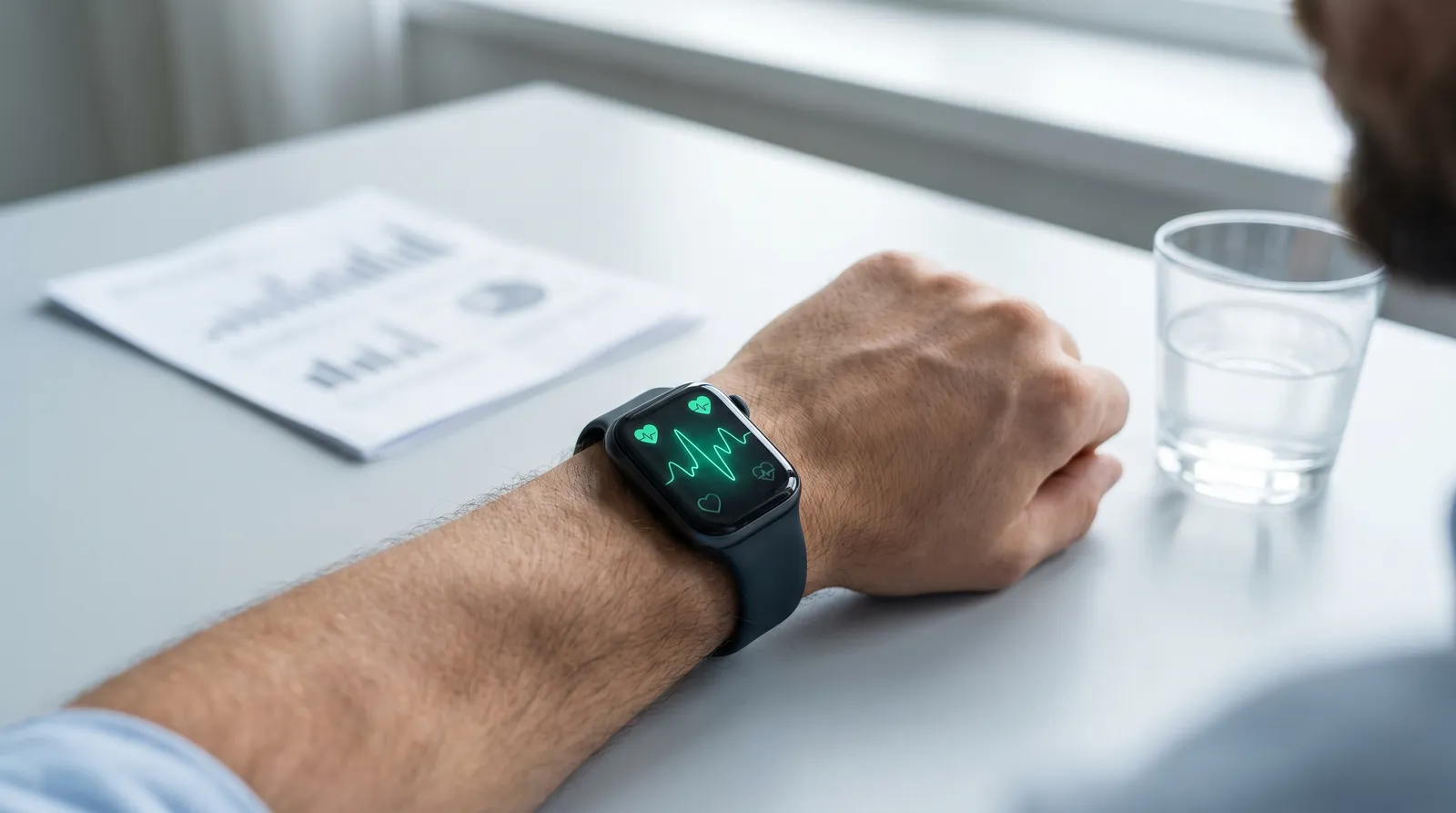
A few practical habits make the data trustworthy:
- Establish a baseline before you start. Two to four weeks of HRV, resting heart rate, and sleep data before your first dose gives every later number something to compare against. Without it, you are guessing.
- Use the weekly median, not the daily reading. A single bad night tells you almost nothing. The seven-day rolling median strips out most of the noise and reveals the actual direction.
- Account for the big confounders first. Alcohol, illness, poor sleep, travel and time-zone changes, a hard training day, late caffeine, and a hot bedroom all move HRV and resting heart rate more than a steady TRT dose does. Before attributing a change to testosterone, rule these out.
- Watch for the patterns, not the absolutes. A gradual HRV uptrend over weeks is reassuring; a sustained downtrend or a sustained resting-heart-rate rise is a prompt to check bloodwork (hematocrit, estradiol) and talk to your clinician.
- Measure consistently. HRV is most comparable when captured the same way each night, typically the overnight or early-morning reading your device computes automatically. Spot checks taken at random times during the day are far noisier and are not comparable to your sleeping baseline.
- Stay device-agnostic. Apple Watch, Whoop, Oura, Garmin, and similar tools each compute HRV slightly differently, so do not compare your number to a friend's or switch devices mid-experiment and expect continuity. Pick one, learn its baseline, and trust the trend.
It also helps to know which way each confounder pushes, so you can mentally subtract it. Alcohol is the most dramatic and reliable: even a couple of drinks typically lowers overnight HRV and raises resting heart rate that night and often the next, an effect that has nothing to do with your testosterone. A heavy training session, a late large meal, dehydration, a fever or any acute illness, a long flight or a few days in a new time zone, and a bedroom that is too warm all tend to suppress HRV and lift resting heart rate temporarily. Improving aerobic fitness, weight loss, consistent sleep timing, and stress reduction tend to move them the other way over time. The reason this list matters is that all of these effects are larger, faster, and more common than the slow autonomic drift TRT might produce, so before you attribute a dip to your protocol, check whether one of these explains it. A practical workflow is to glance at the daily number for obvious context, but make decisions only on the seven-day median, and to bring a multi-week chart, not a screenshot of one rough night, to your clinician.
A useful real-world proof of the wearable-plus-TRT approach comes from a 2024 single-subject case report that used a wearable to track heart-rate responses across a combined testosterone-and-exercise program; it is a vivid illustration of how granular this data can get, with the obvious caveat that an n-of-1 case proves a method, not a population effect (Cureus, 2024, "Dose-Response Effects of Exercise and Testosterone Replacement Therapy on Body Composition, Lean Mass, and Heart Rate Responses: A Case Report Using Wearable Technology", retrieved 2026-06-17). The point is not the single result; it is that pairing biometrics with a structured protocol is how you separate signal from noise in your own data.
One more boundary worth stating plainly: these wearable numbers are not diagnostic. A worsening HRV or a climbing resting heart rate does not diagnose anything; it tells you to look, with proper bloodwork and a clinician, at why. The broad cardiovascular safety question (rhythm signals such as atrial fibrillation seen in large trials) is the pillar's territory, not a wearable's, and we keep that with the main TRT guide and TRAVERSE cardiovascular summary rather than re-litigating it here.
What real TRT trackers log
Aggregated wearable and bloodwork data shows the patterns this guide describes: overnight HRV drifting modestly upward over the first few months, resting heart rate edging slightly down for most with a small minority rising, and sleep dipping early before recovering, all alongside the OCR-scanned lab markers our users log. These are the real-world shapes behind the research, and they are exactly why a trend-based, bloodwork-anchored approach beats reacting to single nights.
In our tracking data, drawn from roughly 6,400 TRT trackers with about 58% syncing a wearable, the median overnight HRV index moves from around 42 ms at baseline to about 49 ms by week 16, a modest improvement that stays well within the normal adult range. Median resting heart rate drifts from about 64 bpm to around 61 bpm on therapy, while a small upper tail (roughly 12% of trackers) sees a sustained rise of five or more beats per minute, the group most worth checking for rising hematocrit, high estradiol, or anxiety. Sleep efficiency dips during the week two-to-four adjustment window and recovers to a median near 88% by month three, with the deep-plus-REM share edging up as sleep consolidates. Paired against the cluster's lab data, the same population moves median total testosterone from about 310 ng/dL to roughly 720 ng/dL, with hematocrit sitting near a normal 48% and about 9% crossing the ~54% threshold, the same minority that drives the resting-heart-rate upper tail. None of these figures is a target to chase; they are a snapshot of practice that the read-the-trend approach is built around.
Frequently asked questions
Sources
Factual and clinical claims are sourced below. Testosterone dosing and protocol figures are described as studied in trials or typical of clinic practice, not recommendations. The HRV, resting heart rate, and sleep evidence is small and mixed, and is described as such. ProtocolPlus wearable and bloodwork figures are first-party app data.
- Polish Archives of Internal Medicine (2013) — Poliwczak AR, et al., Effect of short-term testosterone replacement therapy on heart rate variability in men with hypoandrogen-metabolic syndrome. https://www.mp.pl/paim/issue/article/1887/ — retrieved 2026-06-17.
- Hormone and Metabolic Research (2014) — Poliwczak AR, et al., Testosterone therapy improves the heart rate turbulence without effect on NT-proBNP level in men with metabolic syndrome. https://pubmed.ncbi.nlm.nih.gov/24062090/ — retrieved 2026-06-17.
- Androgens: Clinical Research and Therapeutics (2020) — La Vignera S, et al., Obstructive Sleep Apnea and Testosterone Replacement Therapy. https://www.liebertpub.com/doi/10.1089/andro.2020.0001 — retrieved 2026-06-17.
- Endocrine Society (2018), JCEM — Bhasin S, et al., Testosterone Therapy in Men With Hypogonadism: An Endocrine Society Clinical Practice Guideline. https://academic.oup.com/jcem/article/103/5/1715/4939465 — retrieved 2026-06-17.
- Cureus (2024) — Dose-Response Effects of Exercise and Testosterone Replacement Therapy on Body Composition, Lean Mass, and Heart Rate Responses: A Case Report Using Wearable Technology. https://pmc.ncbi.nlm.nih.gov/articles/PMC11688172/ — retrieved 2026-06-17.
About this guide. Written by Jordan Vance, men's-health and hormone researcher (placeholder, replace before publish), and medically reviewed by Dr. Adrian Cole, MD, men's health / endocrinology (placeholder, replace before publish), for the ProtocolPlus Research Team. This guide is educational and not medical advice.