
GLP-3 & Triple Agonists Explained: The Next Generation After GLP-1
If you have searched for "GLP-3," you were probably looking for the next big thing after Ozempic and Mounjaro, the drug that loses even more weight than a GLP-1. Here is the honest answer up front: there is no hormone or drug class officially called "GLP-3." The term is an informal, marketing-flavored nickname people use for the next generation of weight-loss medicines, the multi-receptor agonists that now top the peptides people use for weight loss, and especially the triple agonist retatrutide, which hits three hormone receptors at once.
This is the concept hub for that whole next generation. Instead of re-profiling any single molecule, it explains the idea behind the search: how these drugs evolved from hitting one receptor (GLP-1), to two (GLP-1 plus GIP), to three (GLP-1 plus GIP plus glucagon), what each added receptor actually does, and roughly how much more weight loss each generation delivered in trials. For the full profile of any one molecule, we keep things short here and link out to its dedicated guide. Think of this as the map of the family, not the file on one member.
Key Takeaways
- "GLP-3" is not a real hormone or drug class. The body's proglucagon hormone makes GLP-1 and GLP-2 (both real gut peptides); there is no natural "GLP-3." The term is informal shorthand for next-generation multi-receptor agonists, usually the triple agonist retatrutide (Wikipedia, "Proglucagon," 2026).
- The drugs are sorted by how many receptors they activate. Single (GLP-1: semaglutide), dual (GLP-1 + GIP: tirzepatide), and triple (GLP-1 + GIP + glucagon: retatrutide). Each added receptor is meant to add a different fat-loss lever.
- Trial weight loss has climbed with each generation. Semaglutide reached about 14.9% in STEP 1 (NEJM, 2021), tirzepatide about 20.9% in SURMOUNT-1 (NEJM, 2022), and retatrutide about 24.2% in its Phase 2 trial (NEJM, 2023).
- The "GLP-3" drug is still experimental. Retatrutide (Eli Lilly, code LY3437943) is investigational and in Phase 3 (the TRIUMPH program); it is not FDA-approved (Eli Lilly, 2025).
- GIP and glucagon do different jobs. Adding GIP can improve appetite effect and reduce GLP-1 nausea; adding glucagon raises energy expenditure and burns fat, including liver fat (PMC review, 2025).
- The family is bigger than three drugs. It also includes the oral GLP-1 orforglipron and the amylin combo cagrilintide (CagriSema). Each is covered in its own guide.
Is GLP-3 a real thing?
No. There is no official hormone or drug class called "GLP-3"; it is an informal nickname people use for the newest multi-receptor weight-loss drugs, most often the triple agonist retatrutide. The "GLP" part is borrowed from GLP-1, and the "3" is a colloquial way of saying "third generation" or "three receptors." It is not a term you will find in a drug label or a textbook.
Here is where the confusion comes from. The body really does make a hormone family from a precursor protein called proglucagon, and that family includes GLP-1 (glucagon-like peptide-1) and GLP-2 (glucagon-like peptide-2). Both are genuine gut hormones; GLP-2 is involved in the gut lining rather than blood sugar or appetite (Wikipedia, "Proglucagon," 2026, retrieved 2026-06-16). So GLP-1 and GLP-2 are real. "GLP-3," by contrast, was never a hormone the body produces. When people search it, they are almost always reaching for "the thing that comes after GLP-1 drugs."
The useful way to read the search is by intent, not by the literal name. People typing "GLP-3" want to know what is stronger than Ozempic and how it works. The accurate answer is that the next step was not a new natural hormone at all; it was engineering one drug molecule to switch on more than one receptor. That is what a multi-receptor agonist is, and it is the real story behind the "GLP-3" label.
It is worth being precise about why the nickname stuck, because the logic is intuitive even though the term is wrong. The first blockbuster of this class was a GLP-1 drug, so "GLP-1" became the household name for the entire category, the way people say a brand when they mean the product. When a noticeably stronger drug arrived, the natural shorthand was to bump the number: if Ozempic is the GLP-1, the bigger one must be the GLP-2 or GLP-3. GLP-2 was already taken by a real hormone, so "GLP-3" became the informal label for "the strongest one." The number is doing the work of "next generation," not naming a fourth hormone. Knowing that lets you cut through a lot of online noise, because some vendors lean on the GLP-3 name to make a research-chemical vial sound like an officially recognized new class. It is not one.
Citation capsule. There is no hormone or drug class officially named "GLP-3." Human proglucagon is cleaved into the real peptides GLP-1 and GLP-2; GLP-2 is an intestinotrophic gut hormone, not an appetite drug. "GLP-3" is an informal, consumer-coined nickname for next-generation multi-receptor agonists, most commonly the investigational triple agonist retatrutide. Source: Wikipedia, "Proglucagon," 2026; Eli Lilly investor release, 2025.

What is a triple agonist?
A triple agonist is a single drug molecule engineered to switch on three different hormone receptors at the same time, GLP-1, GIP, and glucagon, so it can attack weight from three angles at once. An agonist is simply something that activates a receptor, the way a key turns a lock. A triple agonist carries three "keys" in one molecule.
This matters because each receptor does a different job. GLP-1 mainly curbs appetite and slows the stomach. GIP adds to the appetite and metabolic effect and appears to soften GLP-1's nausea. Glucagon, surprisingly, helps the body burn more energy and break down fat. Hitting all three together is the idea behind the strongest experimental weight-loss drug, retatrutide, the molecule most people mean when they say "GLP-3."
The term is part of a tidy naming ladder that describes how many receptors a drug activates. A single agonist hits one receptor, a dual agonist hits two, and a triple agonist hits three. The drugs got progressively more ambitious as researchers learned that combining receptor targets in one molecule produced more weight loss than a GLP-1 alone. We unpack what each rung adds in the next section, and link to the molecule guides for the deep mechanism: how peptides work in the body and the pharmacokinetics of GLP-1 drugs.
Single vs dual vs triple agonist: the generations explained
The generations of these drugs are defined by how many receptors a single molecule activates, and with each added receptor, trial weight loss has tended to go up. Single hits GLP-1, dual adds GIP, triple adds glucagon. That is the whole framework behind the "next generation" idea.
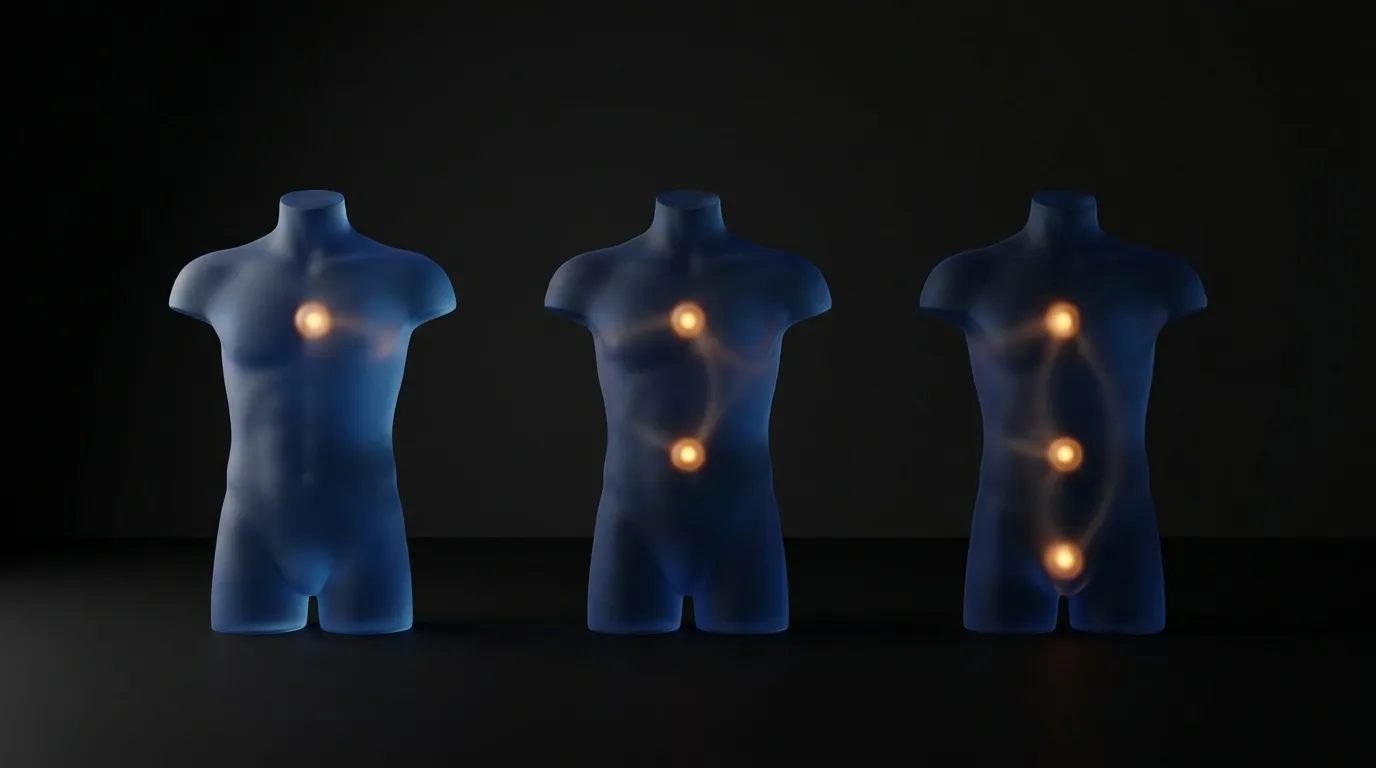
In plain terms, think of weight regulation as a control panel with several switches. The first-generation drugs flipped one switch (appetite, via GLP-1). The second generation flipped two. The third flips three, adding a fat-burning, energy-expenditure switch on top. More switches has, so far, meant more weight loss in trials, though it also means a stronger and less-studied drug. The table below maps each generation to its example drug, its approval status, and the average weight loss reported in its landmark trial.
| Generation | Receptors activated | Example drug | Status (2026) | Trial weight loss |
|---|---|---|---|---|
| Single agonist | GLP-1 | Semaglutide (Ozempic / Wegovy) | FDA-approved | ~14.9% at 68 weeks (STEP 1) |
| Dual agonist | GLP-1 + GIP | Tirzepatide (Mounjaro / Zepbound) | FDA-approved | ~20.9% at 72 weeks (SURMOUNT-1) |
| Triple agonist ("GLP-3") | GLP-1 + GIP + glucagon | Retatrutide (LY3437943) | Investigational, Phase 3 | ~24.2% at 48 weeks (Phase 2) |
The figures come from each drug's landmark trial: semaglutide lost about 14.9% of body weight at 68 weeks in STEP 1 (NEJM, "Once-Weekly Semaglutide in Adults with Overweight or Obesity," 2021, retrieved 2026-06-16); tirzepatide lost about 20.9% at its highest dose at 72 weeks in SURMOUNT-1 (NEJM, "Tirzepatide Once Weekly for the Treatment of Obesity," 2022, retrieved 2026-06-16); and retatrutide lost about 24.2% at the 12 mg dose at 48 weeks in its Phase 2 obesity trial (NEJM, "Triple-Hormone-Receptor Agonist Retatrutide for Obesity," 2023, retrieved 2026-06-16). One honest caveat before reading too much into the climb: these are different trials with different lengths and designs, so the numbers are directional, not a head-to-head race. No trial has pitted all three against each other.
How much more weight does each generation lose?
Across their landmark trials, average weight loss rose from roughly 15% with a single agonist, to about 21% with a dual agonist, to about 24% with the triple agonist, though these are separate trials, not a direct contest. More receptors has, so far, tracked with more weight loss.

The simple version: a single-receptor GLP-1 drug like semaglutide reliably puts people in the mid-teens percent range. Adding the GIP receptor (tirzepatide) pushed averages into the low twenties. Adding the glucagon receptor on top (retatrutide) pushed Phase 2 averages higher still, with the strongest experimental signal of the three. That is the real engine behind the "GLP-3 is stronger" expectation, and it is broadly true in the data we have. The deeper-funnel topline from retatrutide's Phase 3 program suggests even larger numbers, but that is a press-release figure from an ongoing investigational trial, so we treat the peer-reviewed Phase 2 result (about 24.2%) as the citable anchor and keep the "investigational" label firmly attached (Eli Lilly, 2025, retrieved 2026-06-16).
Our take: It is tempting to read 15 to 21 to 24 as a clean ladder where "more receptors equals more loss, guaranteed." Be careful. These came from different trials with different durations and patient mixes, and the strongest number belongs to a drug that is not approved and not finished testing. The trend is real and encouraging; the precision is not.
What does the GIP receptor add (the second receptor)?
Adding the GIP receptor, the step from a single to a dual agonist, is thought to boost the appetite and metabolic effect of GLP-1 and, importantly, to reduce the nausea that GLP-1 drugs can cause. GIP stands for glucose-dependent insulinotropic polypeptide, another gut hormone involved in how the body handles food and fat.
In everyday terms, GIP is the receptor that lets a dual agonist like tirzepatide hit harder on weight while often feeling more tolerable than a pure GLP-1 at an equivalent appetite effect. A 2025 review of these therapies notes that GIP receptor activity "may enhance appetite suppression and weight loss" and that it "reduces emesis caused by a GLP-1 RA," meaning less vomiting and nausea (PMC, "Triple Agonism Based Therapies for Obesity," 2025, retrieved 2026-06-16). That combination, more effect with better tolerability, is a big part of why the dual agonist out-lost the single agonist in trials.
The full mechanism of how GIP and GLP-1 cooperate inside fat and brain tissue is a deeper topic than this hub needs. We keep it at the overview level and point to the molecule guide for depth: the tirzepatide guide.
What does the glucagon receptor add (the third receptor)?
The third receptor, glucagon, is what makes a triple agonist different, and it works less by cutting appetite and more by raising how much energy and fat your body burns. That is a genuinely different lever from GLP-1 and GIP, which both lean on eating less.
Glucagon has an old reputation as the hormone that raises blood sugar, so using it in a weight-loss drug sounds backwards. The trick is balance: paired with GLP-1 and GIP, glucagon receptor activation contributes fat-burning without the blood-sugar downside. The same 2025 review describes glucagon receptor agonism as something that "reduces appetite and increases energy expenditure," "enhances lipid oxidation and reduces hepatic lipid synthesis," and lowers fat in the liver (PMC, "Triple Agonism Based Therapies for Obesity," 2025, retrieved 2026-06-16). In plain language: it helps the body spend more energy and break down stored fat, including in the liver, which is why the triple agonist drew so much interest beyond just the weight number.
This added energy-expenditure mechanism is the single most important thing to understand about the "GLP-3" concept. It is the reason a triple agonist is not simply "a stronger Ozempic," but a drug with an extra, metabolically distinct mode of action. A GLP-1 drug, and to a large extent a dual agonist, works mostly on the "calories in" side by making you eat less. The glucagon receptor opens a lever on the "calories out" side, nudging the body to spend more energy and to actively mobilize and oxidize fat rather than just storing less of it. That difference is also why the triple agonist attracted interest for fatty-liver disease, where reducing fat inside the liver matters as much as the number on the scale.
The trade-off worth naming, honestly, is that a third lever is also a third way for a drug to cause unintended effects, and glucagon's effects on blood sugar and the heart are exactly why a triple agonist needs full Phase 3 testing before anyone can call it safe. More mechanism is more power and more unknowns at the same time. The molecule-level detail, including dosing studied in trials and the side-effect picture, lives in the dedicated guide: the retatrutide guide.
Retatrutide vs tirzepatide vs semaglutide: which is which?
Semaglutide is the approved single agonist, tirzepatide is the approved dual agonist, and retatrutide is the investigational triple agonist, the one people call "GLP-3." They are best understood as three rungs on the same ladder rather than three rival products you choose between today.
Here is the brand and status picture in one view. Semaglutide is sold as Ozempic (for type 2 diabetes) and Wegovy (for weight management), made by Novo Nordisk and FDA-approved. Tirzepatide is sold as Mounjaro (diabetes) and Zepbound (weight and sleep apnea), made by Eli Lilly and FDA-approved. Retatrutide has no brand name yet because it is not approved; it is Eli Lilly's investigational triple agonist (development code LY3437943), still in Phase 3 testing (Eli Lilly, 2025, retrieved 2026-06-16). So a meaningful difference is not just receptors and weight loss, but availability: two of the three are real prescriptions you can get, and the strongest one is not yet a medicine you can be prescribed.
| Drug | Class | Receptors | Maker | Brands | Status |
|---|---|---|---|---|---|
| Semaglutide | Single agonist | GLP-1 | Novo Nordisk | Ozempic, Wegovy | FDA-approved |
| Tirzepatide | Dual agonist | GLP-1 + GIP | Eli Lilly | Mounjaro, Zepbound | FDA-approved |
| Retatrutide | Triple agonist | GLP-1 + GIP + glucagon | Eli Lilly | None yet | Investigational (Phase 3) |
This is the hub-level contrast, kept deliberately short. The full head-to-head, with side-effect differences, dosing schedules, and who tends to reach for which, is its own comparison and molecule pages: the semaglutide guide, the tirzepatide guide, and the retatrutide guide.
Is retatrutide ("GLP-3") FDA-approved?
No. Retatrutide, the triple agonist most people mean by "GLP-3," is investigational and in Phase 3 trials; it is not approved by the FDA or any other regulator, and there is no legal way to be prescribed it as an approved medicine. Its strong trial results are exactly that, trial results, not a green light.
Retatrutide is being developed by Eli Lilly and is running through the Phase 3 TRIUMPH clinical-trial program; until those trials finish and a regulator reviews them, it remains experimental (Eli Lilly, 2025, retrieved 2026-06-16). That status has two practical consequences. First, the only legitimate way to receive retatrutide is by enrolling in a clinical trial. Second, vials sold online as "retatrutide" or "GLP-3" labeled "for research use only" are unapproved research chemicals: not quality-verified, not legal to use as medicine, and not something a clinician can responsibly prescribe. For how that gray market works and how to think about it, see are peptides legal and how to vet peptide quality.
Our take: The biggest trap in the "GLP-3" search is assuming the strongest drug is also an available one. It is the opposite. Semaglutide and tirzepatide are approved and prescribable; retatrutide is the headline-grabber precisely because it is new, and new here means unfinished and unapproved.
What else counts as "next generation" beyond the triple agonist?
The next generation is bigger than just the triple agonist; it also includes oral GLP-1 pills and amylin-based combinations, each adding a different twist to the same goal. "GLP-3" gets the attention, but the pipeline is a small family, not one drug.
Two stand out. The first is orforglipron, an oral small-molecule GLP-1 from Eli Lilly: notable because it is a once-daily pill rather than an injection, which could make GLP-1 therapy far easier to start (AJMC, "FDA Approves Lilly's Oral GLP-1 Orforglipron," 2026, retrieved 2026-06-16). The second is cagrilintide, a long-acting amylin analog that Novo Nordisk is combining with semaglutide as CagriSema; amylin is yet another appetite hormone, a different mechanism from the GLP/GIP/glucagon trio, and the combination is under FDA review rather than approved (BioSpace, "Novo Nordisk files for FDA approval of CagriSema," 2025, retrieved 2026-06-16).
The point of the hub is to place these on the map without re-profiling each one. Orforglipron is the "make it a pill" branch; cagrilintide is the "add a different hormone" branch; retatrutide is the "add a third receptor" branch. Each has its own dedicated guide: the orforglipron guide and the cagrilintide guide.
What does our community usage data show?
Because there is no single "GLP-3" compound, we anchor our tracking data to retatrutide, the triple agonist most actively tracked in the ProtocolPlus community, where it accounts for a meaningful and fast-growing share of logged doses. These are usage-pattern figures from our app, labeled as community signal, not a clinical or stability claim, and certainly not an endorsement of using an investigational drug.
In our anonymized data, retatrutide shows up as one of the most-tracked next-generation compounds: 14,368 logged doses from 2,310 tracking users, drawn from a global window of 27,272 unique trackers and 233,668 logged doses (data window September 2024 to June 2026). That puts retatrutide at roughly 6% of all logged doses on its own, a striking number for a drug that is not even approved. A typical reconstituted vial runs about 24.7 days from first to last logged dose, clustering near a once-weekly cadence. As with all our app data, these describe how a community tracks the compound, not how well or how safely it works.
Frequently Asked Questions
The bottom line
"GLP-3" is the clearest example of a search where the term is wrong but the question is exactly right. There is no hormone or drug class called GLP-3; the body makes GLP-1 and GLP-2, and that is the end of the natural list. What people are actually reaching for is the next generation of weight-loss medicine, and that story is real: the field went from single-receptor GLP-1 drugs, to dual GLP-1 plus GIP agonists, to the triple GLP-1 plus GIP plus glucagon agonist, retatrutide, with each step adding a different fat-loss lever and, so far, more weight loss in trials.
If you take away one idea, make it the gap between strength and availability. The most powerful drug in the family, the triple agonist, is also the one you cannot get: it is investigational, in Phase 3, and not approved. The approved options are the single and dual agonists. From here, the natural next reads are the molecule guides for retatrutide, tirzepatide, and semaglutide, plus the foundations in how peptides work. And for any of this, talk to a qualified clinician first.
Sources
- Wikipedia. "Proglucagon." Retrieved 2026-06-16. https://en.wikipedia.org/wiki/Proglucagon
- Wilding JPH, et al. "Once-Weekly Semaglutide in Adults with Overweight or Obesity" (STEP 1). New England Journal of Medicine, 2021. Retrieved 2026-06-16. https://www.nejm.org/doi/full/10.1056/NEJMoa2032183
- Jastreboff AM, et al. "Tirzepatide Once Weekly for the Treatment of Obesity" (SURMOUNT-1). New England Journal of Medicine, 2022. Retrieved 2026-06-16. https://www.nejm.org/doi/full/10.1056/NEJMoa2206038
- Jastreboff AM, et al. "Triple-Hormone-Receptor Agonist Retatrutide for Obesity, A Phase 2 Trial." New England Journal of Medicine, 2023. Retrieved 2026-06-16. https://www.nejm.org/doi/full/10.1056/NEJMoa2301972
- Eli Lilly and Company. "Lilly's triple agonist, retatrutide, delivered powerful weight loss in pivotal Phase 3 obesity trial" (investor release; TRIUMPH program; LY3437943; investigational). 2025. Retrieved 2026-06-16. https://investor.lilly.com/news-releases/news-release-details/lillys-triple-agonist-retatrutide-delivered-powerful-weight-loss
- ClinicalTrials.gov. "A Study of Retatrutide (LY3437943) in Participants With Obesity" (TRIUMPH; NCT05931367). Retrieved 2026-06-16. https://clinicaltrials.gov/study/NCT05931367
- "Triple Agonism Based Therapies for Obesity" (mechanisms of GIP and glucagon receptor agonism). PMC review, 2025. Retrieved 2026-06-16. https://pmc.ncbi.nlm.nih.gov/articles/PMC12304053/
- U.S. Food and Drug Administration. "FDA Approves New Medication for Chronic Weight Management." Retrieved 2026-06-16. https://www.fda.gov/news-events/press-announcements/fda-approves-new-medication-chronic-weight-management
- AJMC. "FDA Approves Lilly's Oral GLP-1 Orforglipron for Obesity." 2026. Retrieved 2026-06-16. https://www.ajmc.com/view/fda-approves-lilly-s-oral-glp-1-orforglipron-for-obesity
- BioSpace. "Novo Nordisk files for FDA approval of CagriSema, the first once-weekly combination of GLP-1 and amylin analogues for weight management." 2025. Retrieved 2026-06-16. https://www.biospace.com/press-releases/novo-nordisk-files-for-fda-approval-of-cagrisema-the-first-once-weekly-combination-of-glp-1-and-amylin-analogues-for-weight-management