Ozempic: The Complete Guide (Brand, Cost, Coverage & How to Get It)
Ozempic is the brand name for a once-weekly type 2 diabetes injection made by Novo Nordisk. The drug inside the pen is semaglutide, the same molecule sold as Wegovy (for weight management) and Rybelsus (an oral diabetes tablet). Ozempic became a household word because so many people lost weight on it, and it sits among the most-discussed options in our guide to the best peptides for weight loss, but the brand itself is approved to manage blood sugar and lower cardiovascular and kidney risk in adults with type 2 diabetes, not for weight loss.
This is the brand and market hub. It answers the practical questions people actually search for: what Ozempic is as a product, who makes it and what it is approved to treat, how much it costs in 2026, whether insurance or Medicare covers it, whether the shortage is over, the generic and compounded situation, the off-label weight-loss story, and how people get a prescription. For the underlying science of the molecule, such as how semaglutide signals in the body, full dosing schedules, and the side-effect playbook, we keep things short here and point you to the semaglutide molecule guide. The goal is one clear map of the Ozempic brand.
Key Takeaways
- Ozempic is a brand of semaglutide, a GLP-1 receptor agonist made by Novo Nordisk, given as a once-weekly subcutaneous injection in 0.25, 0.5, 1, and 2 mg doses (Novo Nordisk, NovoCare, 2026).
- It is approved for type 2 diabetes, not weight loss. Ozempic was first FDA-approved in 2017, gained a cardiovascular-risk indication in 2020, and in January 2025 added a chronic-kidney-disease indication (Novo Nordisk, 2025).
- The list price is about $1,027.51 per month before insurance, but most people pay far less through coverage, savings cards, or Novo Nordisk's cash-pay program (Novo Nordisk, NovoCare, 2026).
- The shortage is over. The FDA declared the semaglutide injection shortage resolved on February 21, 2025, which also ended the legal basis for mass-compounded copies (Alston & Bird, 2025).
- Medicare can cover Ozempic for diabetes but is barred by law from covering any drug for weight loss alone; a Medicare-negotiated price takes effect January 1, 2027 (KFF, 2025).
- Ozempic, Wegovy, and Rybelsus are the same drug in different forms and doses. The brand-versus-brand breakdown lives below; the deep pharmacology is in the semaglutide guide.
What is Ozempic?
Ozempic is Novo Nordisk's brand name for once-weekly injectable semaglutide, a GLP-1 receptor agonist prescribed to lower blood sugar in adults with type 2 diabetes. It is a pre-filled, multi-dose pen you inject under the skin once a week.
The drug inside is the important part. Semaglutide is a peptide engineered to mimic GLP-1, a gut hormone that prompts insulin release, slows stomach emptying, and reduces appetite. Because it resists breakdown and binds to blood proteins, it lasts about a week in the body, which is why one injection covers seven days. Ozempic itself is simply the diabetes-branded, diabetes-dosed package of that molecule.
Novo Nordisk, the Danish pharmaceutical company, is the only manufacturer of FDA-approved semaglutide. The same company sells the molecule as Wegovy and Rybelsus, so all three are products from one maker rather than competitors. For what GLP-1 peptides are and how they work at the receptor level, see what peptides are and how peptides work in the body. The full molecule profile lives in the semaglutide guide.
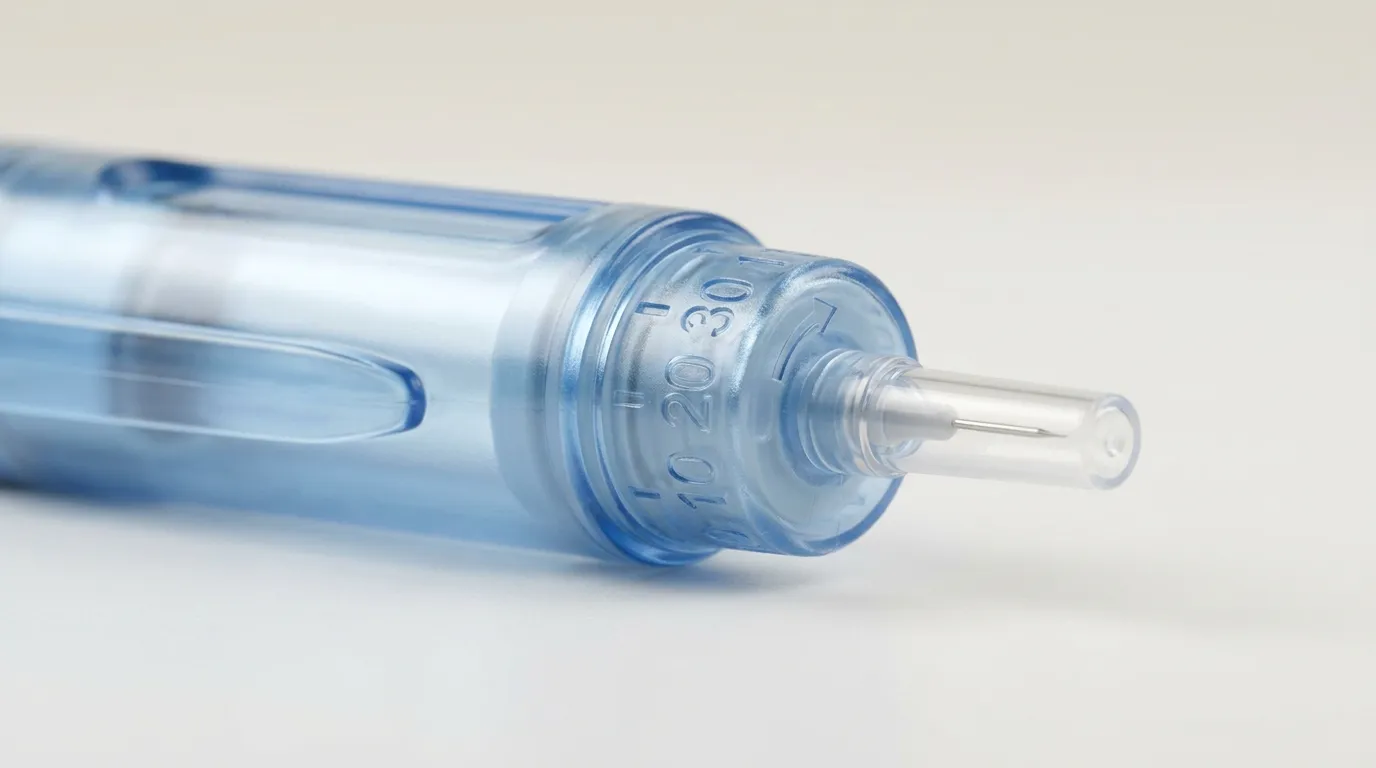
Citation capsule. Ozempic is a brand of injectable semaglutide manufactured by Novo Nordisk, supplied as a once-weekly subcutaneous pen in 0.25, 0.5, 1, and 2 mg strengths, and FDA-approved to improve blood sugar in adults with type 2 diabetes. Source: Novo Nordisk, NovoCare "Explaining the list price of Ozempic," 2026.
What is Ozempic approved to treat?
Ozempic is FDA-approved for adults with type 2 diabetes to improve blood sugar control, to reduce the risk of major cardiovascular events in those with known heart disease, and, since 2025, to slow chronic kidney disease. Weight loss is not an approved use of Ozempic.
The brand's approvals have widened in three steps. It was first approved in 2017 to improve glycemic control alongside diet and exercise. In 2020, the label added a reduction in the risk of major cardiovascular events (heart attack, stroke, and cardiovascular death) in adults with type 2 diabetes and established heart disease. On January 28, 2025, the FDA approved a third indication: reducing the risk of worsening kidney disease, kidney failure, and cardiovascular death in adults with type 2 diabetes and chronic kidney disease, based on the FLOW trial, which reported a roughly 24% reduction in the risk of those kidney and cardiovascular outcomes (Novo Nordisk, 2025).
This is the key brand distinction people miss: Ozempic treats diabetes and protects the heart and kidneys, while its sibling Wegovy is the brand approved for weight management. The weight loss people associate with "Ozempic" is real but is technically an off-label effect of the same molecule. The timeline below shows how the brand's role expanded.
Ozempic vs Wegovy vs Rybelsus: which brand is which?
Ozempic, Wegovy, and Rybelsus all contain semaglutide, but they are three separate Novo Nordisk brands aimed at different jobs: Ozempic and Rybelsus for type 2 diabetes, and Wegovy for weight management. Choosing between them is really about indication, form, and dose, not the molecule.
Here is the brand-level difference in one view. Ozempic is a weekly injection for diabetes (0.25 to 2 mg). Wegovy is a weekly injection approved for chronic weight management at a higher top dose (2.4 mg) and also for cardiovascular risk reduction. Rybelsus is a once-daily tablet for diabetes (3, 7, and 14 mg) that must be taken fasting. Because the active drug is identical, prescribers sometimes use one brand off-label for another's purpose, which is exactly why "Ozempic for weight loss" became common.
| Brand | Form | Frequency | FDA-approved use | Dose range |
|---|---|---|---|---|
| Ozempic | Injection | Weekly | Type 2 diabetes; CV and kidney risk | 0.25 to 2 mg |
| Wegovy | Injection (also a new oral form) | Weekly | Chronic weight management; CV risk | up to 2.4 mg |
| Rybelsus | Oral tablet | Daily | Type 2 diabetes | 3, 7, 14 mg |
Novo Nordisk has also begun moving semaglutide into pill form beyond Rybelsus: the company reported FDA approval of an oral semaglutide under the Ozempic brand for type 2 diabetes, with US availability expected in 2026, and a higher-dose oral Wegovy was approved for weight management in late 2025 (Novo Nordisk, 2026). The deeper head-to-head on results and mechanism belongs in the Ozempic vs Wegovy comparison and the semaglutide guide, so we keep it brand-level here.
What dose strengths and pens does Ozempic come in?
Ozempic comes as a pre-filled, multi-dose pen in four strengths, 0.25, 0.5, 1, and 2 mg, with the 0.25 mg dose used only as a starter to limit side effects, not as a maintenance dose. Knowing which pen you have matters, because they hold different amounts.
The pens are packaged by how much drug they deliver. The lower-strength pen (used for the 0.25 mg starting dose and the 0.5 mg dose) is a smaller 1.5 mL pen, while the 1 mg and 2 mg doses come in a larger 3 mL pen (Novo Nordisk, NovoCare, 2026). Each pen lasts about a month at a steady dose and pairs with disposable needles you attach for each injection.
A clinician almost always starts at 0.25 mg once weekly for four weeks, then steps up to 0.5 mg, and only increases further if more blood-sugar control is needed. That slow climb, called titration, is what keeps the mostly digestive side effects manageable. The starter dose is deliberately too low to do much for blood sugar; its only job is to let your body adjust. The full week-by-week schedule and how to handle a missed dose live in the semaglutide dosing chart, and the side-effect playbook in the semaglutide side-effects guide.
Storage is a brand-practical detail people get wrong: unused pens are kept refrigerated, and once a pen is in use it can typically be stored at room temperature or refrigerated for a set number of days per the label before it must be discarded. For general handling of injectable peptides, see the peptide injection guide.
How much does Ozempic cost in 2026?
Ozempic's list price is about $1,027.51 per month, but very few people pay that; with commercial insurance plus a savings card the cost can drop to as little as roughly $25 a month, and Novo Nordisk's cash-pay program prices it between about $199 and $499 a month. What you actually pay depends on your insurance, your pharmacy, and which program you use.
There are four prices worth separating, because they get confused constantly:
- List price (WAC): about $1,027.51 per month for any strength, set by Novo Nordisk (Novo Nordisk, NovoCare, 2026). This is the sticker price, not what most people pay.
- With commercial insurance + savings card: eligible, commercially insured patients may pay as little as about $25 a month through Novo Nordisk's savings offer (confirm current eligibility and term limits on the official savings-card page).
- Cash-pay (NovoCare direct): roughly $199 a month for the first months at starter doses, then around $349 to $499 a month depending on dose, for people paying without insurance (GoodRx, 2025).
- Discount-card retail (GoodRx-style): cash coupons commonly land in the high-hundreds to about $950 to $1,200 a month, varying widely by pharmacy (GoodRx, 2025).
Because these prices move and depend on eligibility, treat them as a 2026 snapshot rather than a quote, and confirm the current figure with the pharmacy or NovoCare. The semaglutide molecule guide tracks the full pricing and access breakdown.
Is Ozempic covered by insurance or Medicare?
Many commercial insurance plans cover Ozempic for type 2 diabetes, often with a prior authorization, and Medicare Part D can cover it for diabetes; by federal law, neither Medicare nor most plans will cover it purely for weight loss. Coverage hinges on the diagnosis on the prescription.
For people with type 2 diabetes, Ozempic is widely included on formularies, though plans frequently require a prior authorization or step therapy first. Where it gets restrictive is weight loss: because Ozempic is not FDA-approved for weight management, plans generally will not cover it for that use, and Medicare is barred by statute from covering any drug used only for weight loss (KFF, 2025). That is the single biggest reason people end up paying cash.
The policy landscape is shifting, though. Semaglutide was selected for Medicare drug-price negotiation, and a negotiated price takes effect on January 1, 2027 (KFF, 2025). Separately, federal officials have floated a model to expand GLP-1 coverage for obesity through Medicare and Medicaid beginning in 2027 (KFF, 2025). Until those land, the practical rule stands: covered for diabetes, rarely for weight alone.
Is the Ozempic shortage over?
Yes. The FDA declared the semaglutide injection shortage resolved on February 21, 2025, after roughly three years of supply problems, so Ozempic is generally available again through normal pharmacy channels. The end of the shortage also changed the rules for compounded copies.
From early 2022 through early 2025, surging demand, much of it off-label for weight loss, outstripped supply, and Ozempic and Wegovy spent long stretches on the FDA's drug-shortage list. With manufacturing capacity expanded, the FDA confirmed the shortage was resolved in February 2025 (Burr & Forman, 2025). Pharmacies can again order standard doses, though individual stores can still have temporary gaps.
The resolution had a second, less obvious effect. During a shortage, pharmacies are allowed to compound copies of a scarce drug. Once the shortage ended, that legal basis disappeared, with wind-down deadlines of April 22, 2025 for smaller (503A) pharmacies and May 22, 2025 for larger (503B) outsourcing facilities (Alston & Bird, 2025). That is why mass-marketed "compounded semaglutide" largely vanished in 2025.
Is there a generic or compounded Ozempic?
No FDA-approved generic Ozempic exists, and compounded semaglutide is no longer broadly legal now that the shortage is over, so the branded product from a licensed pharmacy is the verified option. Anything sold as "research" or "generic Ozempic" online sits in a risky gray zone.
Semaglutide is still under patent protection in the United States, so there is no authorized generic version of Ozempic. The compounded products that flooded the market during the shortage, including telehealth offerings, lost their legal footing once the FDA resolved the shortage in 2025 and the compounding deadlines passed. Products still marketed as compounded or "research-use-only" semaglutide are not FDA-verified for identity, dose accuracy, or sterility, and the agency previously warned that some compounders used salt forms that are not the approved active ingredient.
The takeaway for safety is simple: if you cannot confirm what is in the vial and who made it, you cannot confirm it is safe. For how to evaluate any peptide's quality and paperwork, see how to vet peptide quality, and for the broader rules, are peptides legal.
Our take: The end of the shortage was good news for legitimate supply but bad news for the cheap compounded market many people relied on. If your budget depended on a $150 compounded vial, the realistic 2026 options are insurance plus a savings card, Novo Nordisk's cash-pay program, or a clinician's help finding coverage, not a sketchy "generic."
Ozempic for weight loss: the off-label story
People lose weight on Ozempic because semaglutide reduces appetite, but Ozempic is not FDA-approved for weight loss; the approved weight brand is Wegovy. Using Ozempic to lose weight is an off-label decision a clinician makes case by case.
The weight effect is genuine and is why prescriptions exploded. Across the US, monthly fills of semaglutide products rose from 471,876 in 2021 to 2,555,308 in 2023, a 442% increase, with Ozempic-specific fills up about 392% and peaking at 1,968,892 fills in August 2023 (JAMA Health Forum, 2024). That surge, plus celebrity attention, turned "Ozempic" into shorthand for weight-loss drugs in general, even as the rival diabetes brand tirzepatide drew its own comparisons, covered in our Mounjaro vs Ozempic breakdown.
It also spawned terms like "Ozempic face" for the facial thinning that can accompany rapid weight loss. Clinicians at Mayo Clinic have pushed back on that framing, noting it stigmatizes a normal consequence of losing weight quickly rather than a drug-specific effect (Mayo Clinic Press, 2024). If weight management is the actual goal, the on-label path is usually Wegovy, discussed in the Wegovy guide.
How do you get Ozempic?
You get Ozempic with a prescription from a licensed clinician, filled at a pharmacy; you can start either in person or through a reputable telehealth service, but the legitimate route always ends with genuine, pharmacy-dispensed product. There is a clear path and a risky shortcut.
The legitimate path looks like this:
- See a clinician (primary care, an endocrinologist, or a vetted telehealth provider) who confirms you are an appropriate candidate, typically for type 2 diabetes.
- Get a prescription for branded Ozempic at the starting 0.25 mg dose.
- Fill it at a licensed pharmacy, retail or through Novo Nordisk's NovoCare, which dispenses genuine, quality-controlled pens.
- Sort out cost using insurance, a savings card, or the cash-pay program before you commit to a long course.
- Follow the titration plan your clinician sets, stepping the dose up slowly to limit side effects.
The shortcut to avoid is buying vials labeled "research use only," "compounded," or shipped from overseas sellers. With the shortage resolved, those are no longer a legal or quality-verified option, and you cannot confirm what is inside. The injection technique itself is covered in our peptide injection guide, and the full dosing schedule in the semaglutide dosing chart.
What does our community usage data show?
Within the ProtocolPlus community, semaglutide (the drug in Ozempic) is one of the most-tracked compounds, and members typically finish a multi-dose vial in about three to four weeks, consistent with once-weekly use. These are usage-pattern figures from our app, labeled as community signal, not a clinical or stability claim.
In our anonymized tracking data, semaglutide accounts for a large share of activity: 38,900 logged doses from 6,224 tracking users, drawn from a global window of 27,272 unique trackers and 233,668 logged doses (data window September 2024 to June 2026). The median vial in our community runs about 26 days from first to last logged dose, clustering right around a three-to-four-week window that mirrors weekly dosing. These numbers describe how people use the compound, not how long it is chemically stable.
Frequently Asked Questions
The bottom line
Ozempic is the diabetes-branded face of semaglutide, a once-weekly Novo Nordisk injection approved to control blood sugar and protect the heart and kidneys, not to treat weight loss. The weight loss people associate with it is a real but off-label effect of the same molecule that, as Wegovy, has its own approval. The brand's story in 2025 and 2026 is mostly about access: the shortage is over, compounded copies have largely disappeared, the list price is high but rarely what people pay, and a Medicare-negotiated price arrives in 2027.
If you take away one idea, make it this: with Ozempic, the molecule is settled science, so the real decisions are about brand, indication, and cost. Match the brand to the approved use, confirm coverage before you start, and get the genuine product through a licensed pharmacy. From here, the natural next steps are the semaglutide molecule guide and the Ozempic vs Wegovy comparison. And for anything you might consider, talk to a qualified clinician first.
Sources
- Novo Nordisk. "Explaining the List Price of Ozempic (semaglutide) injection." NovoCare, 2026. Retrieved 2026-06-15. https://www.novocare.com/diabetes/products/ozempic/explaining-list-price.html
- Novo Nordisk / PR Newswire. "FDA approves Ozempic (semaglutide) to reduce the risk of worsening kidney disease and cardiovascular death in adults with type 2 diabetes and chronic kidney disease." 2025. Retrieved 2026-06-15. https://www.prnewswire.com/news-releases/fda-approves-ozempic-semaglutide-as-the-only-glp-1-ra-to-reduce-the-risk-of-worsening-kidney-disease-and-cardiovascular-death-in-adults-with-type-2-diabetes-and-chronic-kidney-disease-302362466.html
- Novo Nordisk / PR Newswire. "Novo Nordisk's Ozempic pill, the only FDA-approved oral peptide GLP-1 medication for adults with type 2 diabetes, soon to be available in the US." 2026. Retrieved 2026-06-15. https://www.prnewswire.com/news-releases/novo-nordisks-ozempic-pill-the-only-fda-approved-oral-peptide-glp-1-medication-for-adults-with-type-2-diabetes-soon-to-be-available-in-the-us-302760106.html
- Alston & Bird. "FDA Resolves Semaglutide Shortage" (compounding wind-down deadlines). 2025. Retrieved 2026-06-15. https://www.alston.com/en/insights/publications/2025/03/fda-resolves-semaglutide-shortage
- Burr & Forman. "The FDA Removes Semaglutide From the Drug Shortage List." 2025. Retrieved 2026-06-15. https://www.burr.com/newsroom/articles/the-fda-removes-semaglutide-from-the-drug-shortage-list
- Healio (reporting JAMA Health Forum, 2024). "Prescription fills for semaglutide dramatically increase from 2021 to 2023." 2024. Retrieved 2026-06-15. https://www.healio.com/news/endocrinology/20240802/prescription-fills-for-semaglutide-dramatically-increase-from-2021-to-2023
- KFF. "Key Facts About Medicare Drug Price Negotiation." 2025. Retrieved 2026-06-15. https://www.kff.org/medicare/key-facts-about-medicare-drug-price-negotiation/
- KFF. "What to Know About the BALANCE Model for GLP-1s in Medicare and Medicaid." 2025. Retrieved 2026-06-15. https://www.kff.org/medicare/what-to-know-about-the-balance-model-for-glp-1s-in-medicare-and-medicaid/
- GoodRx. "Ozempic Prices, Coupons & Savings Tips." 2025. Retrieved 2026-06-15. https://www.goodrx.com/ozempic
- Mayo Clinic Press. "Let's stop using the term 'Ozempic face.'" 2024. Retrieved 2026-06-15. https://mcpress.mayoclinic.org/women-health/lets-stop-using-the-term-ozempic-face/