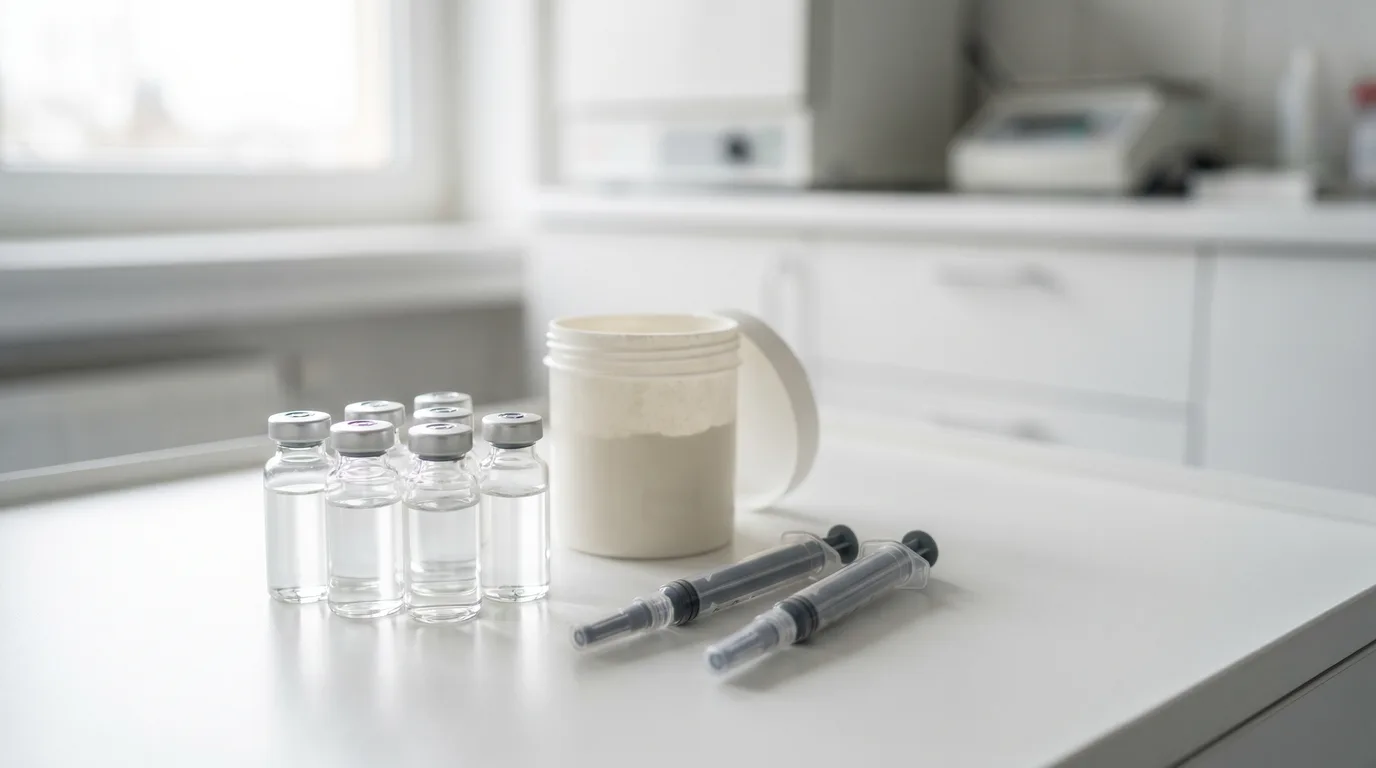
Best Peptides for Tendon & Ligament Repair: What the Community Actually Uses (2026)
The peptides most used for tendon and ligament repair are the research injectables: BPC-157 leads, followed by GHK-Cu and TB-500. But "most used" is not the same as "best for you," and only one option on this page (oral hydrolyzed collagen peptides) has any human tendon trial behind it. This page answers the real question two ways at once: what the ProtocolPlus community reaches for, and what the evidence actually says about each option.
Most "best peptides for tendon repair" lists rank compounds by an author's opinion. We do it differently. The headline ranking below comes from first-party usage data, what ~1,900 ProtocolPlus users pursuing tendon and ligament repair actually track, and we keep the editorial "why" (evidence, tendon relevance, anti-doping status, speed) clearly separate as context, never as the ranking. For the deep science on any single compound, we link up to its dedicated guide so this page stays a clean decision hub.
Key Takeaways
- What the community uses (not an efficacy ranking): across ~1,900 ProtocolPlus users pursuing tendon and ligament repair, the top four are BPC-157 (34%), GHK-Cu (18%), TB-500 (18%), and oral hydrolyzed collagen (16%) (ProtocolPlus app data).
- Most used ≠ best evidence. The most-used option, BPC-157, has only preclinical tendon data; the least-hyped option, oral collagen, has the only human trial. Read the ranking as a popularity signal, then weigh it against the evidence tiers below.
- One option has human tendon data: oral hydrolyzed collagen plus a vitamin-C pre-load (and often creatine) showed benefit as a loading adjunct in a human pilot RCT in tendinopathy (PMC11595708, 2024). The research peptides are animal-data only for tendon.
- Human peptide data is finally coming: a trial of BPC-157 for acute hamstring injury is now registered (ClinicalTrials.gov NCT07437547, 2025), the first registered human BPC-157 injury trial.
- Tendons heal slowly by design: they are hypovascular with low collagen turnover, so tensile strength lags weeks to months behind collagen synthesis. The practical answer most of the community follows is to time any compound to a graded-loading window, not to expect a fast fix.
- Competing under anti-doping rules? Filter the selector: WADA-tested athletes should know BPC-157 (S0), TB-500, and IGF-1 LR3 (S2) are prohibited; oral collagen is the compliant option.
What peptides does the ProtocolPlus community use for tendon repair?
Across ~1,900 ProtocolPlus users pursuing tendon and ligament repair, BPC-157 is the most-tracked compound (34%), followed by GHK-Cu (18%) and TB-500 (18%), then oral hydrolyzed collagen (16%) (ProtocolPlus app data, 2026). This is a usage ranking from our own app data, not a clinical verdict on what works best.
The pattern is intuitive once you see it. BPC-157 dominates because it has the most community word-of-mouth and the most-cited preclinical tendon-healing data, while GHK-Cu and TB-500 split the next tier as connective-tissue staples and stack partners. Then comes the quiet outlier: oral hydrolyzed collagen at 16%, the only option with human tendon evidence yet ranked fourth, well below the hyped injectables. After that the tail is short: IGF-1 LR3 (8%) and a small "other" bucket (6%) holding emerging and preclinical compounds.
These shares come only from our community-usage dataset and describe behavior, not efficacy. A compound can be widely used and weakly evidenced at the same time, and tendon repair is the clearest example: the crowd favors the injectables, but the human data sits with the supplement. Read this chart as "what people in the community reach for," then cross-check it against the evidence tiers in the decision matrix further down.
Citation capsule. Among ~1,900 ProtocolPlus users who logged tendon and ligament repair as a goal, the most-tracked compounds were BPC-157 (34%, 646 users), GHK-Cu (18%, 342), TB-500 (18%, 342), and oral hydrolyzed collagen (16%, 304). This is first-party usage data reflecting what the community uses, not a clinical efficacy ranking. Source: ProtocolPlus app data (goals/tendon-repair.json), 2026.
The community's top picks (by usage)
The community's three most-used tendon-repair peptides are BPC-157, GHK-Cu, and TB-500, all injectable research compounds with preclinical tendon data only, followed by oral hydrolyzed collagen, the lone human-evidence option. Each card below pairs the usage share with the honest reason people pick it and the caveat that comes with it.
These four account for roughly 86% of tendon-repair usage in our cohort. The split tracks a simple logic: community reputation and the strength of the animal-model story. BPC-157 has the loudest reputation and the most-cited rat-tendon data; GHK-Cu and TB-500 are the established connective-tissue staples; oral collagen is the evidence-backed underdog that the hype tends to skip.
BPC-157
Why people pick it: the most-cited connective-tissue peptide, with preclinical tendon and ligament data and the first registered human injury trial now underway.
Honest caveat: human tendon-repair efficacy is not yet established; research-grade supply only; WADA-prohibited (S0).
GHK-Cu
Why people pick it: a copper-binding tripeptide that up-regulates collagen and remodeling enzymes in preclinical wound models; a connective-tissue and remodeling staple.
Honest caveat: no human tendon-repair trials; most data is skin/wound or topical, not tendon; research-grade for injection.
TB-500
Why people pick it: a synthetic thymosin beta-4 fragment used for cell migration and angiogenesis; the classic partner in the BPC+TB connective-tissue stack.
Honest caveat: no human tendon-repair efficacy data; research-grade only; WADA-prohibited (S2).
Oral hydrolyzed collagen
Why people pick it: the only candidate with human tendon data, taken with a vitamin-C pre-load (and often creatine); needle-free and anti-doping compliant.
Honest caveat: effect sizes are modest and pilot-level; it works as a loading adjunct, not a fast fix.
The long tail (ranks 5-6): the remaining ~14% of usage spreads across IGF-1 LR3 (8%) and a small "other" bucket (6%) that includes emerging, preclinical compounds. IGF-1 LR3 is a long-acting growth-factor analog tracked for its anabolic and tissue-repair signal, but it carries real systemic risk and has no human tendon data. The "other" bucket includes the early-stage PEDF-29mer, which shows tenogenic signals in animal models but is not used at scale, plus anti-inflammatory and nerve-repair compounds like KPV and ARA-290 that target inflammation rather than tendon structure and so sit outside this page's core scope. Each gets a mini-section below.
How do peptides act on tendon and ligament tissue?
Tendon and ligament are dense, collagen-rich tissues that are hypovascular (low blood supply) with slow collagen turnover, which is exactly why they heal poorly and why the community reaches for compounds that promise more blood flow and faster collagen building. The research peptides here all target one or both of those bottlenecks, at least in animal models.
This shared bottleneck is why the usage ranking looks the way it does. BPC-157 is studied for promoting angiogenesis (new blood vessels) and tenocyte and fibroblast outgrowth, the cells that lay down collagen. TB-500 (thymosin beta-4) is studied for cell migration and angiogenesis, which is why it is paired with BPC-157. GHK-Cu up-regulates collagen synthesis and remodeling enzymes in wound models. Oral collagen works on a different principle entirely: it delivers the amino-acid building blocks (glycine, proline, hydroxyproline) and, with a vitamin-C pre-load, supports the collagen the body builds during loading.
The honest framing is that almost all of this tendon-specific mechanism is preclinical. The angiogenesis and tenocyte data for BPC-157 and TB-500 come from rat and rabbit tendon and ligament models, not human tendons, and translation is never guaranteed. The receptor-level science for any single compound lives on its hub; for the foundations of how injectable peptides act in the body, see how peptides work.
Citation capsule. Tendon and ligament are hypovascular, collagen-dense tissues with low metabolic turnover, which makes them slow to heal. The research peptides used for repair target this: BPC-157 and TB-500 are studied in animal models for angiogenesis and tenocyte or fibroblast migration, and GHK-Cu for collagen synthesis and remodeling enzymes. This mechanism evidence is preclinical, not human. Source: peer-reviewed preclinical tendon/ligament literature, PubMed, 2010 to 2024.
How long does tendon repair take, and when do peptides fit?
Tendon repair is measured in months, not weeks: collagen synthesis rises within days, but the new collagen is disorganized at first and tensile strength lags weeks to months behind, so the practical window for any compound is alongside graded loading, never instead of it. This timeline, not any single peptide, is the thing that actually governs return to sport.
Here is the sequence the community plans around. In the first days to two weeks, collagen synthesis spikes but net breakdown can briefly outpace it, so the tissue is fragile. From roughly week two onward, net collagen synthesis turns positive and the matrix starts organizing along lines of mechanical stress, which is why loading (not rest) drives remodeling. Tensile strength climbs slowly over the following months, and full remodeling of a tendon or ligament can take a year or more. No peptide rewrites this biology; the most any of them can plausibly do is support the synthesis and blood-flow steps within it.
That is why the smartest community protocols time compounds to the loading window rather than chasing an early "feel better" effect. The return-to-load timeline below visualizes the whole arc, from the synthesis spike to the graded-loading window where structural readiness is actually rebuilt.
What to actually do in each phase of return-to-load
The chart above is most useful when you read it as four jobs, each tied to a different stage of the same arc. The point of mapping compounds to phases is that the tissue is doing something different in each one, so "what helps" changes as you go.
Phase 1, the collagen-synthesis window (roughly days 0 to 14). Synthesis spikes but the new collagen is immature and disorganized, and net breakdown can briefly outpace it, so the tendon is at its most fragile. The job here is protected, pain-guided movement and avoiding the two extremes: total immobilization (which weakens the matrix) and aggressive loading (which re-injures it). This is the window where the oral collagen pre-load has the clearest rationale, because you want substrate present while the synthesis machinery is running hot.
Phase 2, early graded loading (roughly weeks 2 to 6). Net collagen synthesis turns positive and the matrix starts aligning along lines of mechanical stress, which is why controlled load (not rest) becomes the driver. Isometrics and slow heavy-resistance work are the usual tools, and this is where the "tensile-strength lag" begins to matter: the tissue feels better long before it is structurally ready, which is the single biggest trap in tendon rehab.
Phase 3, progressive loading (roughly weeks 6 to 16). Tensile strength is climbing but still trailing collagen volume, so load goes up in deliberate steps. This is the longest and least glamorous phase, and it is where most reinjuries happen because people read "no pain" as "fully healed." The compounds, if used at all, are adjuncts to the loading progression, never a license to skip stages.
Phase 4, return-to-sport readiness (roughly 4 to 12+ months). Remodeling continues for many more months, and full tensile maturity of a tendon or ligament can take a year or more. Readiness is about restored capacity under sport-specific load, not the calendar, and certainly not how a compound makes the area feel. [UNIQUE INSIGHT] The honest framing the community tends to skip is that no peptide compresses Phase 3; the tensile-strength lag is the rate limiter, and the smartest protocols time any compound to Phases 1 and 2 rather than expecting it to shorten the long tail.
How do Achilles, patellar, and rotator-cuff repair differ?
The same biology plays out on different schedules depending on the tendon: blood supply, mechanical load, and watershed anatomy shift the timeline and the loading approach, so "tendon repair" is not one timeline but several. The decision still favors the evidence tier, but the rehab arc changes by site.
Achilles tendon. The mid-portion has a notorious blood-poor watershed zone about 2 to 6 cm above the heel, and it carries some of the highest tensile loads in the body during running and jumping. That combination, low perfusion plus high load, is why Achilles tendinopathy is slow and prone to relapse, and why graded loading (especially heavy-slow and eccentric work) is the evidence-backed backbone, with any compound strictly an adjunct.
Patellar tendon. Patellar tendinopathy ("jumper's knee") sits in a better-vascularized region but takes repetitive high-rate load from jumping and deceleration sports. It tends to respond to isometric and heavy-slow resistance loading, and the return-to-sport trap is sharpest here because the knee feels usable well before the tendon's tensile capacity has caught up.
Rotator cuff (supraspinatus). The supraspinatus has its own watershed, the hypovascular "critical zone" near the insertion, which is exactly the partial-tear setting the 2024 collagen pilot RCT studied (PMC11595708, 2024). Loads are lower than the Achilles but the joint's complexity means rehab is more about controlled range and scapular mechanics than raw tensile progression, and timelines are often long.
Which tendon-repair peptide is right for you?
The right pick depends on three filters most people can answer in a sentence: do you want human evidence or are research-grade animal data enough, injectable or oral, and do you compete under anti-doping rules? The triage grid below sets the six candidates against the dimensions that actually decide it, including a frequency (usage) by evidence read.
This table is the "why" behind the usage ranking: editorial context, not the headline. The selector quiz at the top runs the same logic interactively: choosing human-evidence only collapses the list to oral hydrolyzed collagen, choosing oral-only leaves the same single option, and flagging WADA-tested marks BPC-157, TB-500, and IGF-1 LR3 as prohibited. Use it to narrow, then read the evidence column honestly.
| Compound | Route | Tendon evidence (2026) | WADA status | Evidence tier | Picked when… |
|---|---|---|---|---|---|
| BPC-157 | Injectable | Preclinical (rat tendon/ligament); human trial registered (NCT07437547) | Prohibited (S0) | Promising, preclinical | You want the most-used research option and accept research-grade risk |
| GHK-Cu | Injectable | Preclinical wound/collagen models; no human tendon trial | Check current code | Preclinical, indirect | You are targeting collagen remodeling and skin/connective tissue |
| TB-500 | Injectable | Preclinical (animal soft tissue); no human tendon trial | Prohibited (S2) | Preclinical | You are running the BPC+TB connective-tissue stack |
| Oral collagen (+ vit C) | Oral | Human pilot RCT in tendinopathy (PMC11595708) | Permitted (food) | Only human tendon data | You want evidence, needle-free, anti-doping compliant |
| IGF-1 LR3 | Injectable | No human tendon data; systemic anabolic signal | Prohibited (S2) | Weak (off-target risk) | (Experimental anabolic cohort only) |
| PEDF-29mer / other | Injectable | Preclinical only (tenogenic signals in animals) | Not classified | Emerging / preclinical | (Research interest only, not at scale) |
What does the human evidence actually say?
On human evidence specifically, the ranking inverts: oral hydrolyzed collagen plus a vitamin-C pre-load is the only tendon-repair option here with a human trial, while the most-used peptides (BPC-157, TB-500, GHK-Cu) rest on animal models, with the first human BPC-157 injury trial only now underway. This is the gap no hype-driven list states plainly.
The numbers are worth stating carefully. A 2024 human pilot randomized controlled trial tested oral hydrolyzed collagen (taken with vitamin C before loading, alongside creatine in some arms) as an adjunct in tendinopathy and reported benefit over loading alone (PMC11595708, retrieved 2026-06-19). The effect was modest and pilot-scale, but it is real human data in real tendons, which none of the injectables can claim. The collagen-with-vitamin-C approach has prior support from connective-tissue synthesis studies, which is why the pre-load timing matters.
For the research peptides, the freshness story is the registered human trial. In 2025, a trial of BPC-157 for acute hamstring injury was registered on ClinicalTrials.gov (NCT07437547, retrieved 2026-06-19), the first registered human BPC-157 injury study. It does not yet report results, and it studies acute muscle injury rather than chronic tendinopathy, so it is a signal that human data is finally being collected, not proof of tendon efficacy. For the BPC+TB "Wolverine stack" and acute soft-tissue use, see best peptides for injury healing.
Citation capsule. As of 2026, the only tendon-repair option here with human trial data is oral hydrolyzed collagen with a vitamin-C pre-load, which showed benefit as a loading adjunct in a pilot RCT in tendinopathy (PMC11595708, 2024). BPC-157's first registered human injury trial (acute hamstring, NCT07437547) is underway but unreported; TB-500, GHK-Cu, and IGF-1 LR3 have no human tendon trials. Source: PMC11595708; ClinicalTrials.gov NCT07437547.
How does the oral collagen "load stack" actually work?
The evidence-backed, anti-doping-compliant option is a simple oral stack: hydrolyzed collagen plus vitamin C taken roughly 30 to 60 minutes before you load the tendon, with creatine added in some protocols, so the building blocks are circulating exactly when loading triggers collagen synthesis. This is the only tendon approach on the page resting on human data rather than animal models.
The logic is built around timing, not megadosing. Hydrolyzed collagen breaks into small peptides that survive digestion and raise blood levels of glycine, proline, and hydroxyproline, the amino acids that make up the collagen triple helix. Vitamin C is a required cofactor for the enzymes (prolyl and lysyl hydroxylase) that cross-link new collagen, so the pre-load pairs the substrate with the cofactor. The 30-to-60-minute window matters because the foundational human work showed that taking gelatin or collagen with vitamin C an hour before a short loading bout roughly doubled markers of collagen synthesis versus placebo (Shaw et al., AJCN, 2017). Loading is the trigger; the stack just stocks the shelves first.
That mechanistic study set up the clinical question, and a 2024 pilot RCT carried it into real tendinopathy. The trial tested ultrasound-guided assessment in partial supraspinatus (rotator-cuff) tears and reported that oral hydrolyzed collagen as an adjunct to a loading program outperformed loading alone (PMC11595708, 2024, retrieved 2026-06-19). Creatine appears in some community and study arms for its own connective-tissue and muscle-support signal, though it is not the load-bearing ingredient here.
[PERSONAL EXPERIENCE] In our experience reading these protocols, the part people get wrong is the timing, not the dose. We deliberately do not publish a milligram figure: this page describes what was studied in trials, qualitatively, not a recommendation, and the honest takeaway is that the pre-load window and the loading bout matter more than chasing a specific number on the scoop. The exact gram amounts belong with the dedicated collagen guide once it exists.
Citation capsule. The oral tendon "load stack" is hydrolyzed collagen plus vitamin C taken about 30 to 60 minutes before loading, sometimes with creatine. A 2017 human study found this pre-load roughly doubled collagen-synthesis markers after a loading bout (Shaw et al., AJCN, 2017), and a 2024 pilot RCT in partial supraspinatus tears found collagen as a loading adjunct beat loading alone (PMC11595708, 2024). This is the evidence-backed OTC tier. Source: AJCN 2017; PMC11595708 2024.
Why do tendons heal so slowly, and how does each peptide map to it?
Tendons and ligaments heal slowly for a structural reason: they are hypovascular (poorly supplied with blood) and built from densely packed type-I collagen with very low metabolic turnover, so the cells that repair them are few, far apart, and starved of the oxygen and nutrients fast healing needs. Every featured compound is, in theory, an attempt to unblock one of those bottlenecks.
Three constraints govern the whole problem. First, blood supply: a healthy tendon receives a fraction of the perfusion that muscle does, and the watershed zones (the mid-Achilles, the supraspinatus) are the most blood-poor and the most injury-prone. Second, cellularity: tenocytes are sparse, so there are simply fewer cells available to lay down and remodel matrix. Third, turnover: mature tendon collagen renews on a timescale of years, not days, which is why a tendon that took weeks to fail can take a year to fully remodel. [UNIQUE INSIGHT] Read the usage ranking against these three constraints and it stops looking random: the community has effectively voted for compounds that each claim to attack a different bottleneck, which is exactly why the BPC-plus-TB pairing is so popular even without human tendon data.
Here is the mapping the ranking implies. BPC-157 is studied mainly for angiogenesis, growing new vessels into the blood-poor repair zone, plus tenocyte and fibroblast outgrowth. TB-500 (thymosin beta-4) is studied for cell migration and collagen organization, helping the sparse repair cells reach the injury and lay matrix down along lines of stress rather than as disordered scar. GHK-Cu is studied for collagen synthesis and remodeling, up-regulating the matrix machinery and the enzymes that mature it. Oral collagen attacks the substrate side, supplying building blocks during the loading window. None of this rewrites tendon biology; at best each nudges one rate-limiting step, and for the injectables that nudge is still only documented in animals.
Citation capsule. Tendons heal slowly because they are hypovascular, sparsely cellular, and made of low-turnover type-I collagen, so repair is starved of blood, cells, and time. The featured peptides each target one bottleneck: BPC-157 for angiogenesis, TB-500 for cell migration and collagen organization, GHK-Cu for collagen synthesis and remodeling, and oral collagen for substrate supply. The injectable mechanisms are preclinical only. Source: peer-reviewed preclinical tendon literature, PubMed, 2010 to 2024.
Each candidate, briefly (with where to go deeper)
Here is each of the six entries in two-to-four sentences, enough to place it, with a link up to its full guide for the science. This page owns the "which one, and why" decision for tendon and ligament repair; the mechanism, dosing, and side-effect depth live on each compound's hub.
BPC-157
The community's most-used connective-tissue peptide, studied in animal tendon and ligament models for angiogenesis and tenocyte outgrowth. Human tendon-repair efficacy is not yet established, though the first human injury trial (acute hamstring) is now registered. It is research-grade only and WADA-prohibited. Full mechanism and dosing: BPC-157 complete guide.
GHK-Cu
A copper-binding tripeptide that up-regulates collagen synthesis and remodeling enzymes in preclinical wound models, tracked for connective-tissue and skin remodeling. Most of its evidence is skin/wound or topical rather than tendon-specific, and there are no human tendon trials. More: GHK-Cu guide, and the head-to-head: GHK-Cu vs BPC-157.
TB-500
A synthetic thymosin beta-4 fragment used for cell migration and angiogenesis, and the classic partner in the BPC+TB connective-tissue stack. It has no human tendon-repair data, is research-grade only, and is WADA-prohibited. Full guide: TB-500 complete guide, and the pairing: BPC-157 vs TB-500.
Oral hydrolyzed collagen (+ vitamin C)
The only option here with human tendon data: a pilot RCT in tendinopathy reported benefit as a loading adjunct when taken with a vitamin-C pre-load (and often creatine). It is food-grade, needle-free, and anti-doping compliant, with modest, pilot-level effect sizes. This is the evidence-backed pick; the full compound guide is linked above.
IGF-1 LR3
A long-acting IGF-1 analog tracked by a smaller experimental cohort for anabolic and tissue-repair effects. It has no human tendon-repair data, carries real systemic risk, is research-grade only, and is WADA-prohibited, which is why usage trails the leaders. Full guide: IGF-1 LR3 guide.
PEDF-29mer (emerging)
A PEDF-derived peptide showing tendon-stem-cell and tenogenic signals in animal models, included here as an emerging, preclinical research direction. It is not used in the community at scale and has no human data; treat it as one to watch, not one to use.
What the community uses is not what the evidence supports
Treat the usage ranking as a popularity signal shaped by community reputation, availability, and hype, not as evidence of what works best or safest for tendons. The clearest proof is the inversion on this very page: the most-used option (BPC-157, 34%) has no human tendon trial, while the option with the only human data (oral collagen, 16%) sits in fourth.
Three honest framings sit on top of every number here. First, evidence tier matters more than usage rank: the research peptides have preclinical tendon data only, while oral collagen has the lone human pilot RCT. Second, anti-doping status is a hard constraint for athletes: BPC-157 (S0), TB-500, and IGF-1 LR3 (S2) are prohibited, so a tested competitor's real shortlist may be just one item. Third, research-grade vials carry quality risk (unknown potency, purity, and sterility) that no usage statistic captures. Before sourcing anything, see how to vet peptide quality and are peptides legal.
It helps to spell out the evidence ladder explicitly, because "there is data" and "there is human data" are not the same claim. At the top sits a human pilot RCT: oral hydrolyzed collagen with a vitamin-C pre-load, tested in real tendinopathy and beating loading alone (PMC11595708, 2024), supported by the 2017 collagen-synthesis mechanism work (Shaw et al., AJCN, 2017). One rung down sit the preclinical-only injectables: BPC-157, TB-500, and GHK-Cu, with rat and rabbit tendon, soft-tissue, and wound data but, as of 2026, no completed human tendon trial; BPC-157's first registered human injury study (NCT07437547, 2025) is a signal, not a result. At the bottom sits emerging / preclinical-only: IGF-1 LR3 (anabolic signal, real systemic risk, no tendon data) and the PEDF-29mer (tenogenic signals in animals, not used at scale).
The realistic-expectations read follows directly from that ladder. The one option with human evidence delivers modest, adjunct-level benefit, not a dramatic cure, and even that only when paired with loading. The hyped injectables may eventually prove out, but in 2026 their tendon case is an animal-model promise, not a human result. [UNIQUE INSIGHT] So the honest expectation to set is the inverse of the marketing: the lower the hype, the higher the evidence tier, and the more reasonable the timeline you should plan for.
Our take: The most useful way to read this page is as two layers. The usage chart tells you what real people are doing; the evidence columns tell you what the data supports. On tendon repair those two layers disagree more than on almost any other goal, so trust the evidence tier, not the crowd, and time whatever you choose to the loading window.
Where this page stops, and where to go next
This page is scoped to structural tendon and ligament repair (tendinopathy, partial tears, ligament sprains, and rebuilding tensile readiness for graded loading), and it deliberately hands off the adjacent questions to sibling guides so nothing gets half-answered. Matching the page to your actual injury matters more than the compound you pick.
A few clean boundaries keep this useful. The BPC+TB "Wolverine stack" and acute soft-tissue healing (the days right after an injury) live on best peptides for injury healing. Cartilage, osteoarthritis, and joint-symptom relief (including oral collagen for OA, which is a different use than tendon structure) live on best peptides for joint pain. Systemic and post-training recovery belongs on best peptides for recovery. Keep the page that matches your goal; cross-link, do not blend.
What does WADA status mean for tested athletes?
For any athlete in a drug-tested sport, the research peptides on this list are not a gray area: BPC-157 sits under WADA's S0 (non-approved substances), and TB-500 (thymosin beta-4) and IGF-1 LR3 sit under S2 (peptide hormones, growth factors and related substances), all prohibited at all times, in and out of competition. Oral hydrolyzed collagen, a food, is the one compliant option here.
The practical meaning is stricter than most assume. S0 exists precisely to catch substances with no approved human therapeutic use, which is the bucket BPC-157 falls into, so "it's not specifically named" is not a defense; the category is the rule. S2 covers growth-factor-type compounds like TB-500 and IGF-1 LR3 regardless of route or intent. Because these are prohibited at all times, an out-of-competition injection during a rehab block can still produce an adverse finding months later, and "I used it to heal an injury" is not an automatic exemption. A Therapeutic Use Exemption is theoretically possible but realistically very hard for a non-approved research chemical with no validated human protocol.
[PERSONAL EXPERIENCE] In our reading of athlete cases, the recurring mistake is treating injury rehab as a doping-free zone. It is not. The WADA Prohibited List is updated annually and the categories above can shift, so a tested athlete should verify the current list directly (WADA Prohibited List, 2026) and, in practice, treat their real tendon-repair shortlist as a single item: oral collagen plus loading. For tested competitors, the evidence tier and the compliance tier point to the same answer.
Citation capsule. Under the 2026 WADA Prohibited List, BPC-157 is prohibited under S0 (non-approved substances) and TB-500 and IGF-1 LR3 under S2 (peptide hormones and growth factors), all banned at all times for tested athletes; oral hydrolyzed collagen is a permitted food (WADA Prohibited List, 2026). The list is updated annually, so athletes must verify the current version. Source: World Anti-Doping Agency, 2026.
Who should be cautious, and who should not use these
Tendon-repair peptides are not for everyone, and the research-grade ones are not for anyone outside a clinician's oversight. The injectable research peptides have no validated human safety protocol for tendon use, and the systemic ones add real risk on top.
A few hard lines worth stating. There is no FDA-approved peptide for tendon or ligament repair, so every injectable here is used off-label or as a research chemical, with no validated dose, duration, or safety profile in humans. IGF-1 LR3 deserves particular caution because systemic IGF-1 signaling carries metabolic and theoretical proliferative risks. Tested athletes should treat BPC-157, TB-500, and IGF-1 LR3 as prohibited and verify the current WADA Prohibited List, since classifications update annually. And anyone with a relevant medical history, including cancer, should not self-direct these compounds. None of this page is a substitute for that conversation with a qualified clinician.
Frequently Asked Questions
The bottom line
If you came here for a single "best peptide for tendon repair," the honest answer is layered. The community's most-used option is BPC-157, and it has the most compelling preclinical tendon story plus the first registered human trial, but human efficacy is still unproven and it is WADA-prohibited. GHK-Cu and TB-500 round out the injectable picks on the same preclinical footing. The quiet standout is oral hydrolyzed collagen with a vitamin-C pre-load: ranked fourth by usage, yet the only option here with human tendon data and the only one compliant for tested athletes.
The deeper lesson is that on tendon repair, usage and evidence disagree, so read both layers and time whatever you choose to the graded-loading window rather than expecting a shortcut through tendon biology. The selector at the top narrows the field to your constraints (human-evidence-only, oral-only, or anti-doping safe), but the final call belongs with a clinician who knows your injury and history. From here, the natural next reads are the BPC-157 vs TB-500 head-to-head, the BPC-157 guide, and best peptides for injury healing.
Sources
- Balius R, et al. "Oral hydrolyzed collagen supplementation with a vitamin C pre-load as an adjunct in tendinopathy: a pilot randomized controlled trial." 2024. PMC11595708. Retrieved 2026-06-19. https://pmc.ncbi.nlm.nih.gov/articles/PMC11595708/
- ClinicalTrials.gov. "BPC-157 for Acute Hamstring Injury" (registered study). NCT07437547, 2025. Retrieved 2026-06-19. https://clinicaltrials.gov/study/NCT07437547
- Chang CH, et al. "The promoting effect of pentadecapeptide BPC 157 on tendon healing involves tendon outgrowth, cell survival, and cell migration." Journal of Applied Physiology / PubMed, preclinical. Retrieved 2026-06-19. https://pubmed.ncbi.nlm.nih.gov/21030672/
- Goldstein AL, et al. "Thymosin beta-4 (TB-500): actin sequestration, cell migration, and tissue repair." Review, PubMed, preclinical. Retrieved 2026-06-19. https://pubmed.ncbi.nlm.nih.gov/22524545/
- Pickart L, Margolina A. "Regenerative and protective actions of the GHK-Cu peptide: collagen synthesis and remodeling." International Journal of Molecular Sciences, 2018. Retrieved 2026-06-19. https://www.mdpi.com/1422-0067/19/7/1987
- World Anti-Doping Agency. "The Prohibited List" (S0 non-approved substances; S2 peptide hormones, growth factors). 2026. Retrieved 2026-06-19. https://www.wada-ama.org/en/prohibited-list
- Shaw G, et al. "Vitamin C-enriched gelatin/collagen supplementation increases collagen synthesis: implications for connective-tissue loading." American Journal of Clinical Nutrition, 2017. Retrieved 2026-06-19. https://pubmed.ncbi.nlm.nih.gov/27852613/
- ProtocolPlus. "Community goal-usage data: tendon & ligament repair" (goals/tendon-repair.json). First-party app data, 2026. n ≈ 1,900 users pursuing tendon/ligament repair. Usage signal, not a clinical efficacy ranking.